
You’re staring at an email: “We’d like to offer you a pre-match position…”
You’ve got an unofficial pre-match offer on the table. Or someone said “If you rank us highly, you’ll match here.” Your brain immediately jumps to:
“Is this actually good? Or am I about to lock myself into a mediocre program because I’m scared?”
Here’s what you’re really trying to figure out:
- Is this offer competitive for my specialty?
- Is it competitive for me — my goals, scores, and long‑term plans?
- And should I accept, negotiate, or walk away?
Let’s go through this systematically, like you would a sick patient: triage, data, decision.
Step 1: Understand What Kind of “Pre-Match Offer” You Actually Have
First thing: people misuse “pre-match” constantly.
There are a few different beasts:

| Step | Description |
|---|---|
| Step 1 | Program Interest |
| Step 2 | Soft verbal interest |
| Step 3 | Concrete pre match offer |
| Step 4 | Contract or letter |
| Step 5 | NRMP SOAP exempt or specialty outside NRMP |
Soft verbal interest
Phrases like:- “We really like you.”
- “You’ll be ranked to match.”
- “You’re high on our list.”
This is not a pre-match offer. This is noise. It’s not binding, it’s not enforceable, and it’s sometimes not even honest.
Concrete pre-match offer (NRMP-participating specialties)
True pre-match offers in NRMP specialties are limited and heavily regulated in the US. More common:- “We want to sign you outside the Match” in non-NRMP specialties (e.g., some advanced positions, military).
- Re-contracting for prelims, reappointments, or special situations.
You need written documentation if someone is actually taking you outside the Match.
Pre-match in non-NRMP or special pathways
Some specialties/regions (especially outside the US, or military/GME systems) still use real pre-match contracts.In that case, “pre-match offer” often means: sign now, you’re done; no Match participation.
If you don’t have something in writing, with clear conditions, you don’t have a pre-match offer. You have vibes.
Step 2: Benchmark the Program Against Your Specialty Norms
Now, assume you do have a legit offer. The core question: is this competitive for your specialty?
You compare the program on a few axes:
- Reputation (national and regional)
- Case volume and pathology
- Fellowship match (for fellowship-heavy fields)
- Academic vs community profile
- Geography and lifestyle
Here’s a quick reality-check grid:
| Factor | Strong Offer | Questionable Offer |
|---|---|---|
| Program reputation | Well-known, respected in region/nation | Little known, weak word-of-mouth |
| Case volume | Above average for specialty | Low/uncertain, residents complain |
| Fellowship match | Consistent match to solid programs | Sparse or unclear data |
| Faculty | Stable, known names, good mentoring | High turnover, many new/unproven |
| Resident outcomes | Graduates get jobs they want | Scattered, hard to track |
How to actually assess this without guessing:
- FRIEDA / program websites: check number of residents, tracks, fellowships.
- Ask current residents directly: “If you had to do it again, would you come back here?”
- Look at recent graduates: where did they go? Real programs list alumni and where they matched for fellowship or took jobs.
If you’re in a competitive specialty (derm, ortho, ENT, plastics, ophtho, rad onc), a pre-match that isn’t clearly mid-to-high tier should make you pause. Because in those fields, pedigree and fellowship opportunities matter a lot more.
Step 3: Compare the Offer to Your Own Application Strength
The offer isn’t competitive or not in a vacuum. It’s competitive relative to what you realistically could get in the Match.
Time to be brutally honest with yourself.
Key data points:
- Step scores (or Pass with strong clerkship / Sub-I narrative)
- Research output (especially for academic fields like derm, rad onc, neurosurg)
- Letters: quality and from whom
- School reputation and AOA / class rank
- Number and caliber of interviews so far
Rough rule-of-thumb:
- If your stats and interviews are well above what this program typically attracts → this offer might be below what you could get by waiting.
- If your stats and interviews are below or just at what they normally attract → this might actually be a very solid and safe deal.
To visualize:
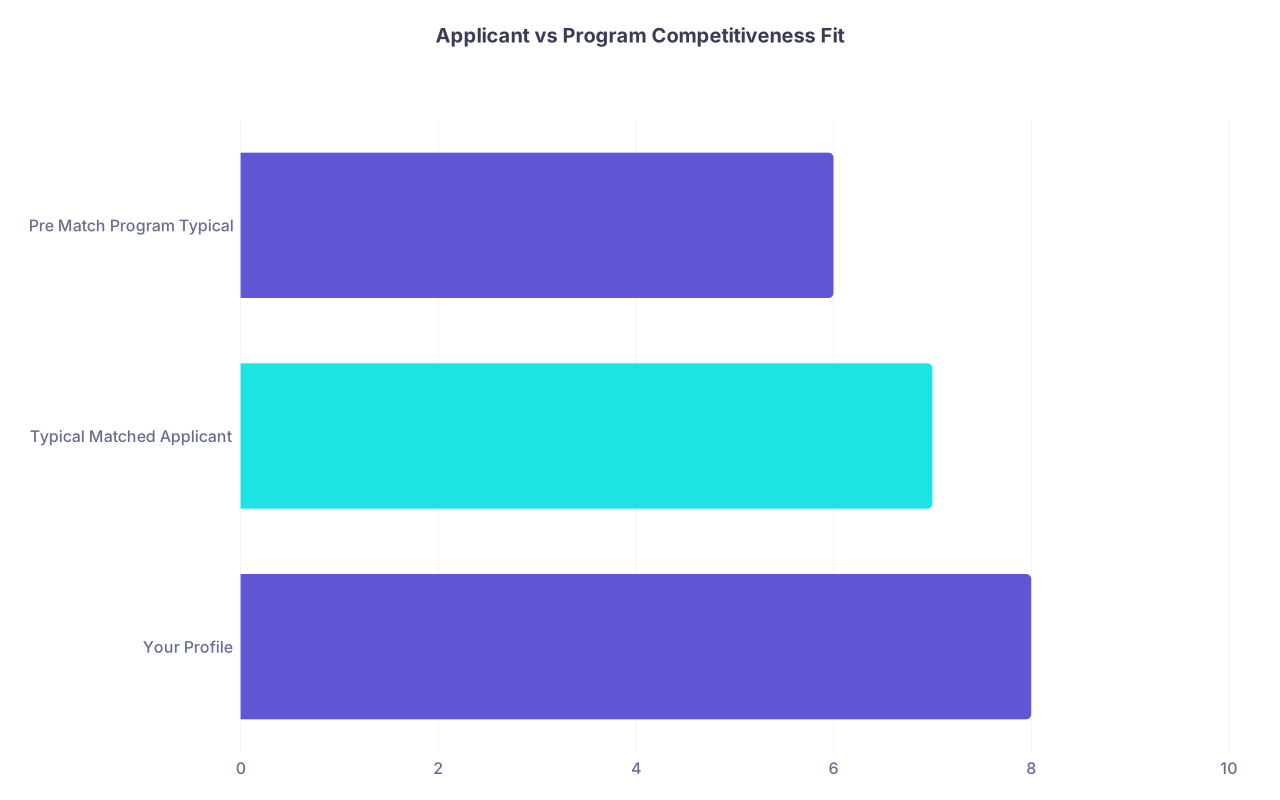
| Category | Value |
|---|---|
| Your Profile | 8 |
| Typical Matched Applicant | 7 |
| Pre Match Program Typical | 6 |
If you’re an “8” and you’re signing with a “6” program early because you’re anxious, that’s a potential regret later. If you’re a “5” and this 6-program loves you and wants to lock you in, that’s a win.
I’ve seen both:
- One internal medicine applicant with 260+ scores and great research signed early with an average community IM program out of fear. They later got multiple interview invites from big-name academic places they could’ve matched at. They regretted it for years.
- Another FM applicant with pass-level scores, 4 interviews, and one pre-match from a stable community program signed. That offer probably saved them from going unmatched.
Step 4: Line Up the Offer Against Your Career Goals
Now we’re out of “stats” and into “what do you actually want your career to look like?”
Ask yourself three blunt questions:
- Do I want fellowship, and what kind?
- Do I care about academic medicine vs community practice?
- Am I trying to be geographically flexible later, or stay local?
Example: You’re an IM applicant who wants GI or cards. A “safe” pre-match at a small community IM program that has never sent someone to GI or cards in 5+ years? That’s not competitive for your goals. It’s a mismatch.
On the other hand, if you’re:
- Planning on primary care
- Happy staying in that region
- Don’t need a big name for fellowship
- Like the vibe and residents
Then that same pre-match might be perfect.
Here’s how I’d frame it mentally:
| Your Goal | What You Need in a Program | Red Flag in Pre Match Offer |
|---|---|---|
| Competitive fellowship | Strong subspecialty exposure, track | No track record, no subspecialists |
| Academic career | Research, mentors, name recognition | No research, no mentorship structure |
| Community outpatient practice | Solid clinical training, bread-and-butter volume | Tiny volume, unstable clinic models |
| Geographical flexibility | At least regional name recognition | Completely unknown outside city |
If the offer doesn’t move you closer to your actual endgame, it’s not a competitive offer for you. It’s just…an offer.
Step 5: Risk Calculation – What Happens If You Don’t Take It?
This is where people get stuck. Fear of going unmatched is powerful. Programs know that.
So you quantify risk:
- How many interviews do you have in hand (not “promised”)?
- For your specialty, what’s a typical “safe” interview count?
- Are your scores/grades below, at, or above the median for that specialty?
Quick sanity chart:
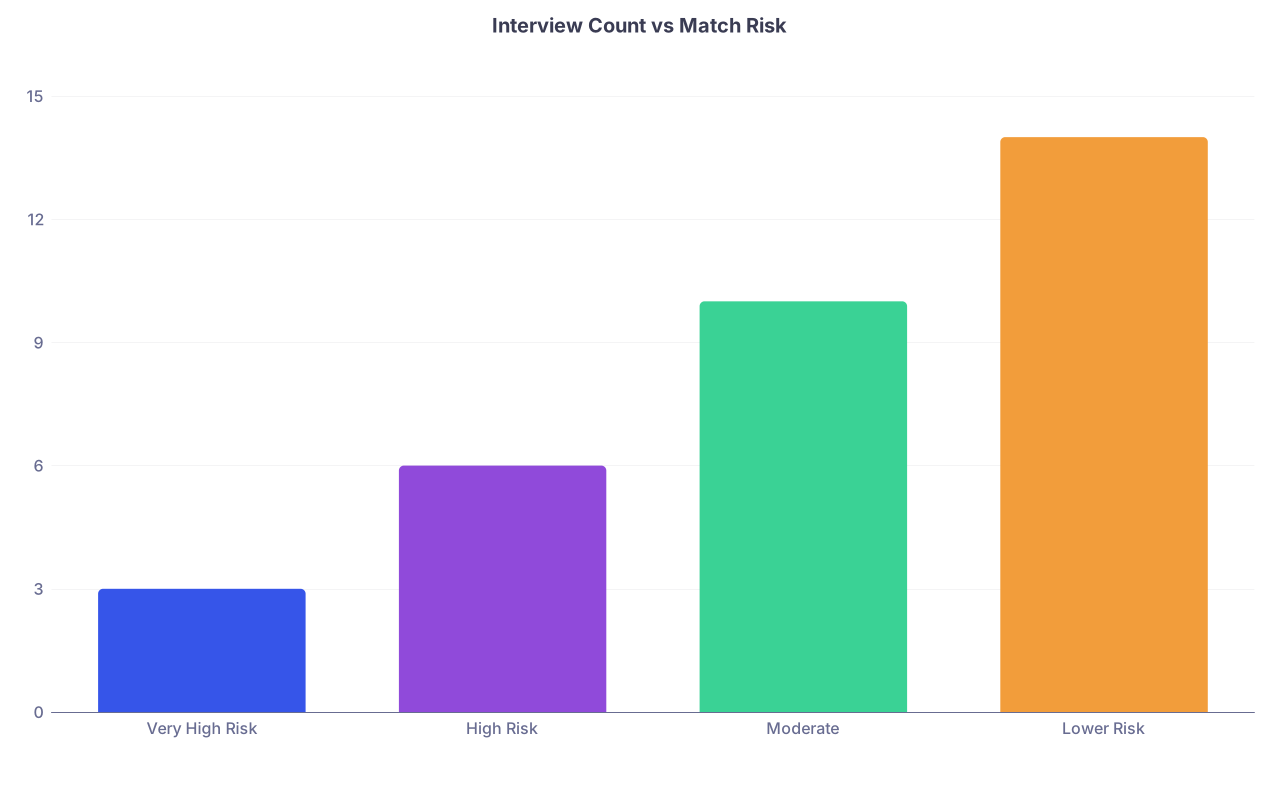
| Category | Value |
|---|---|
| Very High Risk | 3 |
| High Risk | 6 |
| Moderate | 10 |
| Lower Risk | 14 |
Not perfect, but as a rough guide (for US MD/DO, categorical positions, excluding ultra-competitive fields):
- 0–4 interviews: high risk of not matching
- 5–8 interviews: moderate risk
- 9–12+ interviews: generally safer, if they’re reasonably strong programs
If you have:
- 3–4 interviews total, one of which is offering a legit pre-match → strong reason to take that seriously.
- 12+ interviews, including some higher-tier places → much more reasonable to pass on a mediocre pre-match.
Also ask: how early is this offer?
If it’s very early in interview season, and you haven’t seen your full interview picture yet, I’d be cautious about locking in quickly unless your application is clearly fragile.
Step 6: Non-Negotiables You Should Not Ignore
There are some things that disqualify an offer from being “competitive” no matter how scared you are of going unmatched.
These are the big ones:
- Systemic toxicity: Residents warn you directly about bullying, retaliation, chronic understaffing.
- Training concerns: Documented prior probation, constant faculty turnover, or residents not graduating on time.
- Financial / contract red flags: Non-standard clauses, pay way below local norms, crazy non-compete language.
- Lifestyle that borders on unsafe: Unrealistic expectations, chronic 100+ hour weeks in violation of duty hours that everyone laughs off.
I’ve talked to too many residents who took “any offer” and then spent a year trying to survive a toxic program or transfer. That’s a nightmare. Going unmatched and doing a research year or prelim can be less damaging in the long run than signing up for abuse.
Step 7: Practical Framework – Should You Accept, Negotiate, or Decline?
Let’s put this into a simple decision path.

| Step | Description |
|---|---|
| Step 1 | Pre match offer |
| Step 2 | Strongly consider accept |
| Step 3 | Do not accept |
| Step 4 | Consider accept or rank highly |
| Step 5 | Politely decline and stay in Match |
| Step 6 | Enough interviews? |
| Step 7 | Program safe and non toxic? |
| Step 8 | Program in top half of your options? |
More concretely:
You should strongly consider accepting if:
- You have few interviews,
- Program is stable, residents seem reasonably happy,
- It’s not blatantly misaligned with your career goals,
- And there are no major toxicity red flags.
You should lean toward declining (or at least waiting) if:
- You have a robust interview slate with clearly stronger programs,
- Your stats suggest you’re competitive for better options,
- Or the offer program has obvious weaknesses for your intended path (e.g., no fellowship pipeline when you absolutely want one).
Negotiating? It’s limited, but you can clarify or tweak:
- Ask about call schedule, specific tracks, research time.
- Ask for things in writing: “So if I accept, I won’t be in the Match for this specialty, correct?”
- Clarify start date, salary, and expectations.
Just don’t treat this like a tech job negotiation. You have much less leverage, and you don’t want to annoy a program you might end up ranking.
Step 8: Concrete Questions to Ask Before You Decide
Here’s the short script I’d use with current residents and the PD:
For residents:
- “If you had to do it again, would you still come here?”
- “Where have your recent grads gone? Any into [your fellowship or job interest]?”
- “What’s the weakest part of your training here?”
- “Do people ever transfer out? Why?”
For program leadership:
- “How many residents did you graduate last year and where did they go?”
- “How much resident turnover have you had in the last 3–5 years?”
- “How is mentorship set up, especially for people interested in [your goal]?”
- “If I accept this pre-match, how does that affect my Match participation?”
Track their answers mentally. If they’re transparent and concrete, that’s reassuring. If you get evasive answers or “We don’t track that,” red flag.
Quick Comparison Table: Is This Pre-Match Offer Competitive For You?
| Dimension | Good Sign | Bad Sign |
|---|---|---|
| Specialty match | Program is at or above your expected tier | Program clearly below your realistic options |
| Interview context | Few interviews, this is best so far | Many better interviews already in hand |
| Career alignment | Supports your fellowship/job goals | No track record in your desired path |
| Resident vibe | Honest, mostly satisfied, would repeat choice | Evading questions, multiple would not return |
| Risk tolerance | You value security and stability | You’d regret settling if better options exist |
FAQs
1. Is it ever smart to accept a pre-match offer from a clearly average program if I think I could do better?
Sometimes, yes. If your application is borderline and your interview count is low, locking in “average but safe” can be the smarter move than gambling on a maybe. But if you have obviously strong stats and lots of interviews, signing with a clear step-down program just because you’re anxious is usually a bad trade. The risk of regret is high.
2. How do I tell if a program is actually toxic or residents are just venting?
Patterns. One disgruntled resident is noise; multiple independent people, at different times, saying the same specific things (“PD retaliates if you report issues,” “We’re constantly covering extra shifts with no backup”) is signal. Also look at how they talk about solutions. Programs that acknowledge flaws and describe fixes are far healthier than places that deny everything or blame residents.
3. What if the program says, ‘We’ll rank you to match’ — is that as good as a pre-match?
No. Not even close. That’s a non-binding statement, and programs have been known to say that to multiple applicants. It tells you they like you, which is good, but it doesn’t lock anything in. Treat it like a positive sign, not a guarantee, and don’t build your entire rank list on those promises.
4. Should I ever delay responding to a pre-match offer to see what other interviews I get?
You can ask for a bit of time (“I’m very interested; could I have a week to think and discuss with my family?”), and many programs will allow that. But don’t play games. If they give you a clear deadline, respect it. If you’re early in season and clearly a strong applicant, a short delay to see more of your options is reasonable; if you’re late in season with few interviews, dragging your feet can backfire.
5. How do I weigh location vs program quality when deciding on a pre-match?
Be honest about your non-negotiables. If your partner’s job, family care responsibilities, or visa situation ties you to a region, a slightly weaker program in the right location can absolutely be a “competitive” offer for you. On the flip side, if you’re free to move and have big fellowship/academic ambitions, I’d give program strength more weight than city preference for residency.
6. If I accept a pre-match offer, can I still apply or rank other programs?
This depends heavily on your system and the exact nature of the offer. In many true pre-match/contract scenarios, you’re agreeing not to participate in the Match for that specialty, and breaking that can burn bridges or worse. You need explicit clarity in writing from the program and to check rules with your dean’s office or GME. Don’t assume you can just “see what else happens” after signing; often, you can’t.
Key points to walk away with:
- A pre-match offer is only “competitive” if it’s at least aligned with your realistic Match prospects and your long-term goals.
- Don’t ignore red flags in training quality or toxicity just because you’re scared of going unmatched. That trade rarely works out well.
- Use your actual interview count, honest self-assessment, and career plans as the backbone of your decision — not anxiety and flattery from one program.