
It is late November. You have two pre-match emails open: one from a community program in the Midwest, another from a big-name academic center on the coasts. Both want an answer soon. The salary numbers look close enough that your brain starts to melt: $64,000 vs $69,000. Your friends keep saying “Cost of living is way higher there,” but no one can tell you what that actually means for your life.
Here is the fix: you stop guessing and build mock budgets for each city. Then you compare reality, not vibes.
This is not theoretical. I have watched residents sign for the “prestige” program, then spend three years living like they are permanently on call because they cannot afford anything. I have also seen people turn down excellent training because the base salary looked low, not realizing they would actually keep more money each month.
You want a method. Not more opinions. So here is the method.
Step 1: Get Out of “Salary-Only” Thinking
First thing: base salary alone is a trap. You know this. You just do not have a framework to replace it.
What actually matters is:
- Net monthly pay (after taxes, retirement, insurance).
- Typical monthly expenses in that city.
- What is left over every month (or not).
- Non-cash benefits that you will otherwise pay for yourself.
Think in months, not years. Your brain handles:
- “I will have $350 left each month”
much better than - “$5,000 more per year.”
You are deciding between lived realities: can you afford a 1‑bedroom near the hospital vs a 45‑minute commute, can you pay off some loans, can you fly home twice a year without using a credit card.
We will build a mock monthly budget for each offer and compare the leftovers.
Step 2: Build a Simple Comparison Template
You do not need fancy software. A basic spreadsheet or even paper is fine. But structure matters.
Create a table with each city as a column:
| Category | City A (Midwest) | City B (Coastal) |
|---|---|---|
| Gross monthly salary | ||
| Estimated taxes | ||
| Health insurance | ||
| Retirement (if any) | ||
| Net take-home | ||
| Rent + utilities | ||
| Transportation | ||
| Food | ||
| Insurance (non-med) | ||
| Loans & debt | ||
| Childcare (if needed) | ||
| Other fixed bills | ||
| Realistic extras | ||
| Monthly surplus |
You will fill this out city by city. Side by side. Brutally honest.
To keep yourself grounded, assume:
- You are living within 20–30 minutes of the hospital.
- You are not living with three random roommates in a basement unless you want to.
- You are not eating takeout every night, but you are also not cooking lentils every meal.
Step 3: Convert Each Offer to a Real Monthly Paycheck
Residents constantly underestimate how much taxes and deductions matter. That $70,000 offer is not $70,000.
3.1 Get the actual numbers from the offer
From each pre-match offer, pull:
- PGY level and base salary.
- Any signing bonus and when it is paid.
- Housing stipend, if any (monthly or annual).
- Meal stipends, parking subsidy, transportation benefits.
- Employee retirement match (many residencies do not match, some do).
- Health, dental, vision premiums and what you pay monthly.
- Expected call pay or moonlighting (do not assume high numbers unless guaranteed in writing).
If the letter is vague, email GME or HR and ask, in plain English:
- “What is the monthly employee cost for the base health insurance plan for a single resident?”
- “Is there a 401(k)/403(b) match during residency?”
- “What is the monthly parking cost for residents?”
Yes, you can and should ask.
3.2 Estimate net take-home pay
You are not doing a full tax return. You are approximating.
Use any reputable “paycheck calculator” or “US salary after tax” calculator. Plug in:
- State
- Filing status (usually single)
- Annual salary
- Basic retirement contribution if you plan to do it
Then:
- Divide annual net pay by 12
or - Use the calculator’s per paycheck result and multiply by number of paychecks per month.
If the program gives a housing stipend monthly, add that on top of your net.
Finally, subtract:
- Monthly health insurance premium (your share).
- Any mandatory disability insurance, union dues, etc.
What you have now: realistic net monthly income for each offer.
Step 4: Anchor the Big Three: Housing, Transportation, Food
These three categories will decide whether you are drowning or comfortable. Stop hand-waving and get actual numbers.
4.1 Housing: use real listings, not averages
Do not trust generic “cost of living” sites for rent. They are directionally right, but you are not renting the “average” apartment. You are renting near a hospital, often in a specific neighborhood.
Do this for each city:
- Go to Zillow, Apartments.com, or similar.
- Search for 1‑bedroom apartments within 20–30 minutes of the hospital.
- Filter for:
- Safe-enough neighborhoods (check crime maps / ask current residents).
- Not luxury high-rise, not the worst slum.
- Look at 5–10 listings, write down:
- Rent
- Whether utilities are included
- Parking costs (garage vs street vs none)
Pick:
- A conservative realistic option, not the cheapest one single outlier.
- If you plan to have a roommate, also write down a 2‑bedroom total and divide.
Add estimated:
- Electricity
- Internet
- Gas or heat if not included
Most residents under-call this. Round up by $50–$100 to be safe.
So your housing line for City A might look like:
- Rent: $1,200
- Utilities + internet: $200
- Parking: $75
Total: $1,475
City B:
- Rent: $2,200
- Utilities + internet: $250
- Parking: $200
Total: $2,650
There is your first big reality check.
4.2 Transportation: not optional; quantify it
You are going to commute. At 5 a.m. Sometimes in snow. Or paying for city parking that costs more than your phone bill.
Decide for each city:
Will you own a car or go car-free?
If car:
- Loan / lease payment (or realistic saving for eventual repairs if paid off).
- Insurance (get quotes using hospital ZIP code).
- Gas based on approximate miles/week (commute + errands).
- Parking at hospital and/or home.
- Maintenance (oil, tires, occasional repairs) – I usually budget $50–$100/month as a minimum.
If no car:
- Monthly subway/bus pass.
- Occasional Uber/Lyft for late nights, bad weather, or unsafe transit times (budget something, not zero).
Write an honest monthly number. Do not pretend you will bike to the hospital in January in the Midwest at 4:30 a.m.
4.3 Food: residents eat more than they think
You will eat:
- Some rushed breakfasts.
- Decent number of cafeteria or takeout meals on call.
- Groceries when life is semi-stable.
Split it like this per month (per city):
- Groceries (realistic, not fantasy).
- Cafeteria / hospital food (if no meal stipend).
- Eating out / delivery.
Keep it unsentimental. For many residents:
- Groceries: $300–$400 (single person, basic but not spartan).
- Cafeteria / coffees / random snacks: $100–$200.
- Eating out / delivery: $100–$200 depending on lifestyle and city.
If one program offers significant meal stipends (say $10 per call meal, multiple calls per week, or a monthly cafeteria allowance), discount some of the cafeteria/eating out cost there.
Step 5: Add the Less Obvious but Very Real Costs
This is where most people skip, and then are shocked six months into intern year.
5.1 Insurance beyond health
You will likely need:
- Renter’s insurance.
- Car insurance (already discussed).
- Maybe additional disability insurance if not well-covered by the program.
- Life insurance if you have dependents.
Get ballpark quotes. Do not just guess $20.
5.2 Loans and other debt
List:
- Federal student loan payments (if you plan to pay during residency; if pursuing PSLF, know you may still have income-based payments).
- Private loans (often non-negotiable payments).
- Credit card minimums.
If you are thinking, “I will put loans in forbearance,” write “$0” but also understand interest is quietly piling up. That is a separate conversation, but for the mock budget we stick with what will leave your account each month.
5.3 Childcare, partner support, dependents
If you have or will have:
- Children
- Non-working partner
- Family member you support
You must price:
- Daycare / nanny / after-school care.
- Extra healthcare or insurance.
- Extra food, clothing, etc.
For childcare, call 2–3 local daycares near the hospital in each city. Ask their full-time monthly rate for an infant/toddler. Do not assume it is $500; in many cities it approaches rent.
5.4 Other fixed recurring bills
Include:
- Phone bill.
- Internet (if not bundled in rent).
- Subscriptions you will realistically keep (Spotify, iCloud, etc.).
- Union dues if your hospital is unionized.
Step 6: Do the Mock Budget Math for Each Offer
Now you have:
- Net monthly income.
- Detailed expense estimates.
Put it together.
For each city:
Start with net monthly income.
Subtract:
- Housing + utilities.
- Transportation.
- Food.
- Insurance.
- Loans and debt.
- Childcare (if any).
- Other fixed bills.
Then add a line:
- “Realistic extras”:
- Clothing/shoes
- Occasional travel home
- Small emergency buffer
- Board fees / USMLE/COMLEX exams / in-training exam travel if not reimbursed
- Interview travel (if you will apply fellowship during residency)
Put at least $150–$300 here. If you are already negative before adding this, that is your warning.
- “Realistic extras”:
Whatever remains = monthly surplus (or deficit).
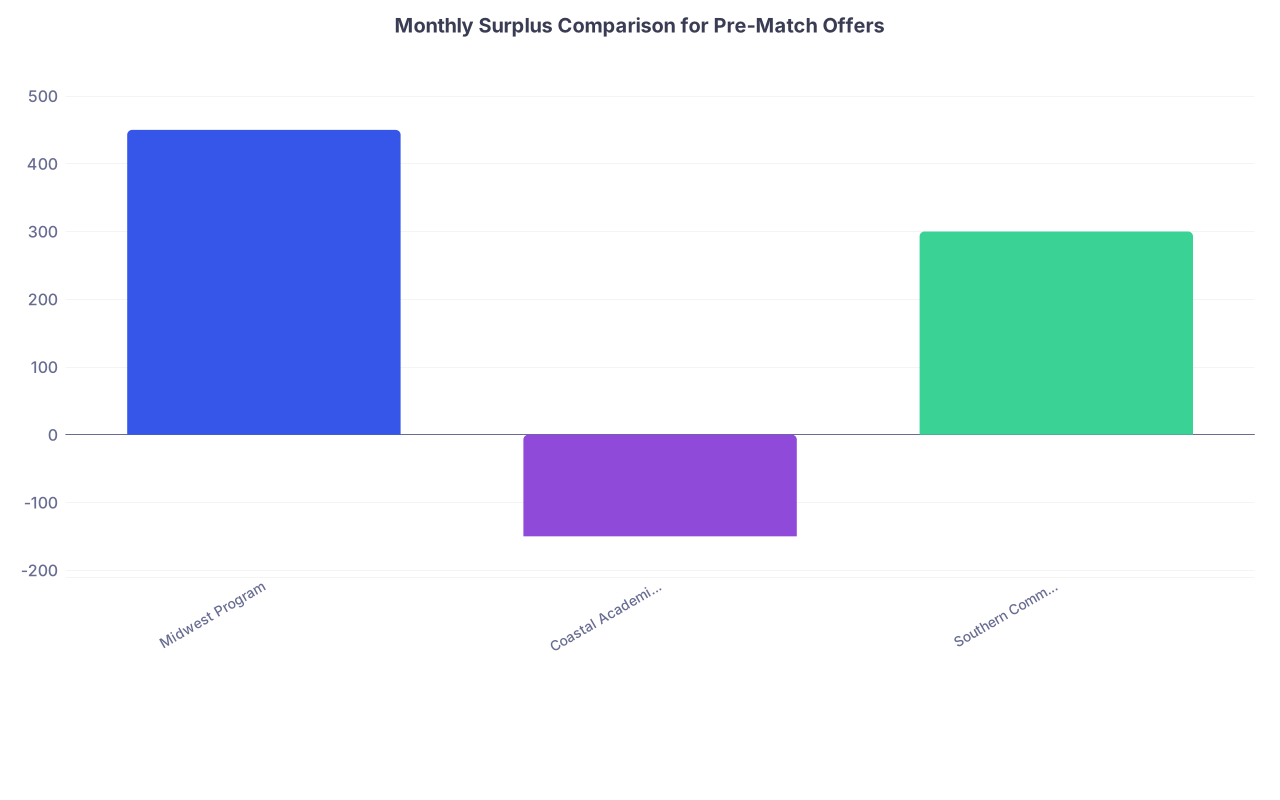
To visualize this, use a simple chart comparing surplus:
| Category | Value |
|---|---|
| Midwest Program | 450 |
| Coastal Academic Center | -150 |
| Southern Community Hospital | 300 |
A resident staring at “$69,000 vs $64,000” will often sign for the $69,000, but when you run this exercise, you may find:
- Midwest Program: +$450/month
- Coastal Academic Center: −$150/month (you will either burn savings or build credit card debt)
- Southern Community Hospital: +$300/month
Now you are not arguing about prestige. You are deciding whether you can afford to not go deeper in the hole.
Step 7: Adjust for Lifestyle Priorities (This Is Where Your Values Go)
I am not going to tell you the highest surplus is automatically the right choice. It is not. Training quality, mentorship, fellowship opportunities, and personal life all matter. But you need to be explicit about the tradeoffs.
Once you have the numbers, ask:
What am I buying with the “expensive” city?
- Better training?
- Dream fellowship pipeline?
- Family support nearby?
- Partner career opportunities?
What am I giving up with the “cheaper” city?
- Academic name recognition?
- Certain subspecialties on site?
- Certain lifestyle options?
Now overlay your mock budgets with your priorities:
- If Program A leaves you +$400/month but feels slightly less prestigious, and Program B leaves you −$200/month but has your dream fellowship pipeline, you must decide if that prestige is worth $600 per month of stress.
Write it down in one sentence for each offer:
- “Program A: I can save, travel twice/year, live 15 minutes away. Community program, fewer subspecialty options, but solid training.”
- “Program B: I will probably take on some credit card debt, live 40 minutes away, but has strong cardiology fellowship pipeline and my partner has better jobs nearby.”
Then decide like an adult, not like someone chasing logos.
Step 8: Incorporate Non-Cash Benefits Properly
Non-cash benefits are easy to ignore because they do not show up as salary. But they directly hit your monthly budget.
Examples:
- Free parking vs $200/month garage – that is $2,400/year.
- Health plan with low premiums and low deductibles vs high deductible disaster plan – you either pay upfront or get hit later.
- Meal cards or on-call meal reimbursements – if one program gives $200/month of cafeteria credit, lower the food line there.
- Housing stipend – if $500/month, that is effectively $6,000 extra salary after tax.
- Public transit pass included – drop that from your transportation line.
Do not list these separately and forget them. Bake them into the mock budget numbers.
Step 9: Build One Quick “Stress-Test” Scenario
Residency is not static. Rents go up. You might have a kid. Your car might die.
For your top 2–3 choices, run a quick stress-test:
- What if:
- Rent goes up 10% after the first year?
- You have to pay for a major car repair ($1,000 spread over 12 months ≈ $80/month)?
- Your partner cannot find work for 6 months in that city?
Add $200–$300 of surprise monthly cost to each city’s budget and see:
- Does the “cheap” city stay survivable?
- Does the “expensive” city become impossible?
If one offer is barely workable only if nothing goes wrong, that is a risk you should write down explicitly before you accept.
Step 10: Put It All in One Clear Comparison View
At this point, your brain might be drowning in numbers. So compress it.
Create a summary like this:
| Midwest Program | Coastal Academic | Southern Community | |
|---|---|---|---|
| Net monthly pay | $3,900 | $4,200 | $3,800 |
| Housing total | $1,475 | $2,650 | $1,300 |
| Transport total | $450 | $250 | $400 |
| Food total | $450 | $600 | $425 |
| Other fixed bills | $700 | $800 | $750 |
| Est. extras | $375 | $350 | $350 |
| Surplus / month | $450 | -$150 | $300 |
Then below that, add a few qualitative lines:
Training quality:
- Midwest: Strong clinical exposure, fewer research options
- Coastal: Big-name, strong fellowship pipeline
- Southern: Good mix, mid-tier reputation
Family / support:
- Midwest: 2 hours from family
- Coastal: Far from family
- Southern: Family nearby
Now you are weighing a clear financial picture against real career and life factors. That is how adults choose.
A Visual of the Process
If you want a mental model of the whole workflow:

| Step | Description |
|---|---|
| Step 1 | Receive Pre Match Offers |
| Step 2 | Collect Salary and Benefit Details |
| Step 3 | Estimate Net Monthly Pay |
| Step 4 | Research Local Housing Costs |
| Step 5 | Estimate Transport and Food |
| Step 6 | Add Loans and Other Bills |
| Step 7 | Calculate Monthly Surplus |
| Step 8 | Stress Test Budget |
| Step 9 | Compare With Training Priorities |
| Step 10 | Decide Offer and Deadline |
This is not busywork. This is how you keep future-you from calling HR in tears six months into internship saying you cannot afford your apartment.
Common Mistakes to Avoid
I have seen the same errors over and over:
Comparing gross salaries only
A $5,000 higher salary in a high-tax, high-rent state is often a net loss.Ignoring partner or family reality
If your partner cannot find work in Big Expensive City, your “household budget” is actually worse than a lower salary where they can work.Assuming you will happily live with three roommates
Maybe. For a year, sure. For 3–7 years of training with variable call and nights? Be honest.Forgetting board fees and exam costs
Step 3, specialty boards, travel. If the program does not fully reimburse, these hit hard.Not asking current residents
Ask 2–3 residents honestly:- “Do most people here feel financially squeezed?”
- “What do PGY-1s typically pay for rent?”
- “Is parking a big hidden cost?”
If two different PGY-1s say, “Everyone here is constantly broke,” believe them and find out why.
How to Do This Quickly When Deadlines Are Tight
Pre-match offers often come with short fuses. You may not feel like you have time for an entire budgeting exercise. You do. You just need a stripped version.
Here is the 90-minute version:
- Pull salary and key benefits from each offer email. (15 minutes)
- Use an online calculator to get approximate monthly net. (15 minutes)
- Search housing listings for each city, pick a realistic rent + utilities. (30 minutes)
- Rough in:
- Transport: car + parking or transit pass.
- Food: $400–$600 depending on city.
- Loans: current minimums.
- Other bills: ballpark what you pay now. (20 minutes)
- Subtract and see surplus/deficit. (10 minutes)
If you later decide between your final two options, you can refine. But even the rough version is miles better than guessing.
FAQs
1. How many mock budgets should I realistically build during interview season?
For every pre-match offer you are actually considering responding to, build at least a rough mock budget. For programs that are long shots or low on your list, do not waste time. Once you have 2–3 real offers (or likely options you would rank highly), do full, detailed budgets for each. Most people end up doing serious numbers for 3–5 programs at most.
2. Should I factor in potential moonlighting income into my budget?
Not in the base mock budget. Moonlighting is variable and often not allowed for interns. Some programs have heavy call that makes moonlighting unrealistic. Treat moonlighting as bonus money: run a separate “best case” scenario that includes it, but make your core decision assuming no moonlighting income. If a program explicitly guarantees a certain minimum moonlighting opportunity and current residents confirm they actually get it, you can cautiously include part of it.
3. What if my dream program clearly loses financially to a less prestigious one?
Then you decide with eyes open. Write it out plainly:
“By choosing Dream Program, I am likely giving up $X per month and may need to take on Y in extra debt over 3–4 years, in exchange for Z benefits (fellowship options, mentorship, location, partner career). Am I willing to pay that price?”
If the answer is yes, accept and stop second-guessing the money. If the answer is no, do not romanticize being financially miserable for the sake of a name. Either way, you are not a victim of “cost of living.” You are making a deliberate tradeoff.
Key points:
- Stop comparing just salaries; build side-by-side monthly mock budgets for each offer using real housing and cost data.
- Focus on net take-home, core expenses, and actual monthly surplus, then stress-test with likely surprises.
- Weigh that financial reality against training quality and personal priorities, and choose consciously, not reactively.