
You are sitting in front of your ERAS “Education” section.
Under your medical school entry, you see it: “Leave of Absence.” The school has already told you it will be reported. It was mandatory. You did not choose it. Now you are staring at the box that asks for an explanation.
And you are thinking: “Is this going to kill my chances?”
Here is the honest answer: handled poorly, it can hurt you. Handled correctly, it becomes a neutral factor for most programs and a mild positive for some. I have seen people match surgery, EM, radiology, anesthesia, even derm after documented LOAs. The pattern is always the same:
- They controlled the narrative.
- They aligned their explanation with the rest of the application.
- They did not get defensive, vague, or cute.
I am going to walk you through exactly how to do that.
1. Understand What Program Directors Actually Worry About
You cannot fix what you do not define. Program directors do not care about your LOA in the emotional way you do. They care about risk.
When PDs see “Leave of Absence,” their brain runs a quick risk calculator around three questions:
Will this person finish residency on time?
- Or are they likely to repeat years, have prolonged medical issues, or require frequent time away?
Will this person be safe for patients?
- Cognitive issues, untreated substance use, severe unaddressed mental illness: these are red-flag territory.
Will this person be a headache to manage?
- Chronic professionalism problems, legal trouble, repeated conflicts with the school.
That is it. They are not judging you for being human. They are assessing whether they are signing up for a multi-year problem.
If your mandatory LOA does not clearly reassure them on those three points, your explanation is failing.
What a LOA almost never does by itself
A LOA alone, especially a single, finite, clearly-resolved one, rarely “tanks” an application. What tanks people is the cluster:
- LOA + failures + vague explanation
- LOA + no recent strong clinical performance
- LOA + defensive attitude on interview day
Your job:
Turn the LOA from a vague red flag into a clearly defined, contained past event with a credible “we are done with this” story.
2. Identify Your LOA Type and Your Strategy
Different LOAs require different scripts. Stop trying to hide the category. Own it and shape it.

Here are the main LOA buckets and how PDs think about them:
| LOA Type | Main PD Concern |
|---|---|
| Medical/Health | Recurrence, ability to work safely |
| Mental Health | Stability, follow-up, insight |
| Academic Remediation | Knowledge gaps, test performance |
| Personal/Family | Ongoing instability, time demands |
| Conduct/Professional | Reliability, judgment, culture fit |
1. Medical / Physical Health LOA
Example: surgery, chemotherapy, serious illness, pregnancy with complications.
PD thought process:
- Is the condition resolved, stable, or well-managed?
- Can this person handle the physical demands of residency?
Your strategy:
- Briefly name the category (“a medical condition requiring surgery,” “treatment for a serious illness”).
- Emphasize resolution/stability, clearance by physicians, and full return to duties.
- Point to recent sustained performance as proof.
2. Mental Health LOA
Example: major depression, anxiety crisis, burnout leading to breakdown.
PD thought process:
- Has this person addressed the problem with appropriate care?
- Do they show insight and ongoing maintenance (therapy, medication, coping skills)?
Your strategy:
- Acknowledge this was a mental health issue without over-sharing details.
- Make it clear you engaged in formal treatment and it was effective.
- Emphasize ongoing supports and tools you use now.
- Tie it to improved functioning, not permanent fragility.
Handled well, mental health LOAs often earn you quiet respect. Handled poorly (“I just needed some time”) and PDs start imagining ongoing chaos.
3. Academic / Remediation LOA
Example: failed multiple courses, shelf failures, Step 1/2 failures, extended time to remediate.
PD thought process:
- Is this a persistent cognitive limitation or a past study / test-taking problem?
- Are there objective signs you can now handle exam-heavy residency?
Your strategy:
- Be honest about academic struggles.
- Show specific changes you made: tutoring, new study systems, disability evaluation if applicable.
- Use recent track record: strong clinical grades, improved Step 2 CK, solid shelf exams.
4. Personal / Family LOA
Example: caregiving for a very ill family member, complicated pregnancy, death in the family, major personal crisis (divorce, immigration, housing catastrophe).
PD thought process:
- Was this a contained crisis or an ongoing unstable life situation?
- Will this continue into residency and disrupt training?
Your strategy:
- State clearly that it was due to a significant family or personal circumstance.
- Show that the precipitating event is resolved or better controlled.
- Emphasize restored stability: housing, childcare arrangements, financial situation, etc.
5. Conduct / Professionalism LOA
Example: suspension for unprofessional behavior, Title IX issues, dishonesty, cheating.
This is the hardest group. Not impossible, but you have to be surgical here.
PD thought process:
- Is this a character issue or a one-time immature decision?
- Has this person genuinely changed, or are they just sorry they got caught?
Your strategy:
- Name it as a professionalism issue in general terms (do not rewrite history).
- Take direct responsibility without self-flagellation.
- Explain concrete behavior changes, mentoring, monitoring, and clean record since then.
- You need time + consistent professionalism to overcome this. No way around it.
3. Writing the ERAS LOA Explanation: A Template That Works
You get limited space in ERAS. You must be precise.
Structure it in three parts:
- Reason – one sentence, high level, no drama.
- Action / Resolution – what you did, how it was addressed, that the LOA ended.
- Current Status / Reassurance – why this will not impair residency performance.
General template
“During [time frame], I was placed on a mandatory leave of absence due to [brief category-level reason]. I used this time to [treatment / remediation / address family situation] and was subsequently cleared by [school / physician / committee] to fully resume my medical education. Since returning, I have [objective markers of stability and performance], and I have been able to maintain [full-time schedule / clinical responsibilities] without further interruption.”
Now let us get specific for each type.
Example: Medical LOA (non-mental health)
“During the spring of my second year, I took a mandatory leave of absence to undergo treatment for a significant medical condition. I completed the recommended treatment and rehabilitation and was cleared by my physicians and my medical school to resume full-time coursework and clinical duties. Since returning, I have successfully completed all remaining required and elective rotations without interruption and have been able to fully participate in overnight call and other clinical responsibilities.”
Key features:
- No oversharing (“Crohn’s flare with perianal fistula”) – not needed.
- Direct reassurance: cleared, full-time, overnight call is fine.
Example: Mental Health LOA
“At the end of my third year, I took a mandatory leave of absence related to a mental health condition that significantly affected my functioning. During this period, I engaged in formal treatment and developed effective strategies to manage my health. After being cleared to return, I completed my remaining clerkships and sub-internships with strong evaluations and without further interruption. I continue to maintain my mental health through regular follow-up and established coping strategies.”
Key features:
- You say “mental health condition.” Enough.
- You clearly show: treatment, clearance, sustained performance, ongoing maintenance.
Example: Academic / Remediation LOA
“During my second year, I was placed on a mandatory leave of absence to remediate multiple course failures. I used this time to work closely with learning specialists, adjust my study approaches, and complete the required remediation. Since returning, I have passed all subsequent coursework and clerkships, including [Step 2 CK / shelf exams] on my first attempt, and have consistently met or exceeded expectations in my clinical rotations.”
Key features:
- You own the failures. No excuses.
- You show a before/after story with hard data.
Example: Personal / Family LOA
“In my third year, I took a mandatory leave of absence due to a significant family circumstance that required my full-time involvement as a caregiver. Once the acute situation stabilized and alternative support systems were in place, I returned to medical school and completed my remaining clinical rotations on schedule. My current personal circumstances are stable, and I have the necessary supports arranged to fully participate in residency training.”
Key features:
- You do not turn this into a tragic memoir.
- You explicitly say your situation is now stable.
Example: Professionalism / Conduct LOA
“During my second year, I was placed on a mandatory leave of absence related to a professionalism concern. I took responsibility for my actions and used this period to work with faculty mentors, reflect on my behavior, and complete professionalism remediation as outlined by the school. Since my return, I have had no further professionalism concerns, and my subsequent clinical evaluations consistently describe me as reliable, respectful, and responsive to feedback.”
Key features:
- You accept responsibility. No blame-shifting to “miscommunication.”
- You show a multi-year clean record and specific traits PDs care about.
4. Align the Rest of Your Application with the LOA Story
The LOA explanation lives in one box. Program directors are not dumb. They cross-check.
You have to make sure your whole application sings the same song.
A. Your Personal Statement: Address it or not?
Rule of thumb:
You address it in the PS if:
- It fundamentally shaped your career choice or perspective.
- It is a big part of who you are now (e.g., cancer survivor → heme/onc).
- You had major academic or professionalism concerns and you need more space to show growth and insight.
You do NOT address it in detail if:
- It was a short, resolved event and is already well-handled in the LOA box.
- Bringing it up again would drag attention to it unnecessarily.
If you do include it, keep it to one compact paragraph. The point is growth and current capability, not dwelling on suffering.
B. Letters of Recommendation
Letters can either neutralize doubt or amplify it.
What helps:
- A letter that explicitly mentions your reliability, resilience, or ability to handle workload.
- For academic LOA: a letter that describes you as strong, prepared, and improving.
- For conduct LOA: a later supervisor describing you as professional, accountable, a positive team member.
What hurts:
- A letter that vaguely alludes to “struggles” without specifics.
- Damning faint praise: “shows up when expected,” “adequate knowledge base.”
If you have a mentor who knows the full LOA story and has seen your growth, ask them to subtly support the “this is resolved” narrative.
C. CV / Experiences
Fill the LOA time if allowed and truthful.
- Did you do research, remote coursework, therapy groups, caregiving, tutoring during the leave?
- List relevant, appropriate activities as experiences. Not to hide the LOA, but to show you did not go dark.
PDs like seeing that you used a bad situation to build something.
5. How to Talk About the LOA in Interviews Without Crumbling
You will get asked. Often like this:
- “I see you took a leave during MS2. Can you tell me about that?”
- “Your application mentions a mandatory LOA. What happened and how are you doing now?”
If you stumble, overshare, or get defensive, you re-activate their risk calculator.
Here is your move: a 3–4 sentence script, same structure as the written explanation.

| Step | Description |
|---|---|
| Step 1 | Asked about LOA |
| Step 2 | State brief reason |
| Step 3 | Explain actions/treatment/remediation |
| Step 4 | Describe current status and stability |
| Step 5 | Pivot back to strengths/interest in program |
Example: Mental health LOA, spoken
“During my third year I went on a mandatory leave related to a mental health condition. I realized I was not functioning safely, worked closely with a therapist and my physicians, and took the time to get appropriate treatment. I was cleared to return and since then I have completed all of my remaining rotations and Step 2 without interruption, and I continue regular follow-up to maintain my health. It was a hard period, but it forced me to build much better coping skills, which I think makes me more sustainable long-term as a resident.”
You answer, then you pivot. For example:
“That experience is part of why I am drawn to your program’s emphasis on resident wellness and long-term careers in our specialty.”
Things that kill you in LOA conversations
- Making it sound like it “just happened” and you did not actively fix anything.
- Giving confusing or inconsistent timelines that do not match ERAS.
- Oversharing gory detail that shifts the interviewer into “oh wow” mode.
- Sounding bitter toward your school for enforcing the LOA.
You do not need to be proud of what happened. But you need to be proud of how you responded.
6. Risk Management: Specialty Choice, Program List, and Red Flag Stacking
I am not going to sugarcoat this. Some combinations are harder sells.
A. Stack of red flags vs single event
A single mandatory LOA, clearly resolved, with strong performance afterward → manageable.
A stack:
- LOA + multiple Step failures
- LOA + professionalism issue + weak letters
- LOA + no recent robust clinical work
That is where doors start closing, especially in more competitive specialties.
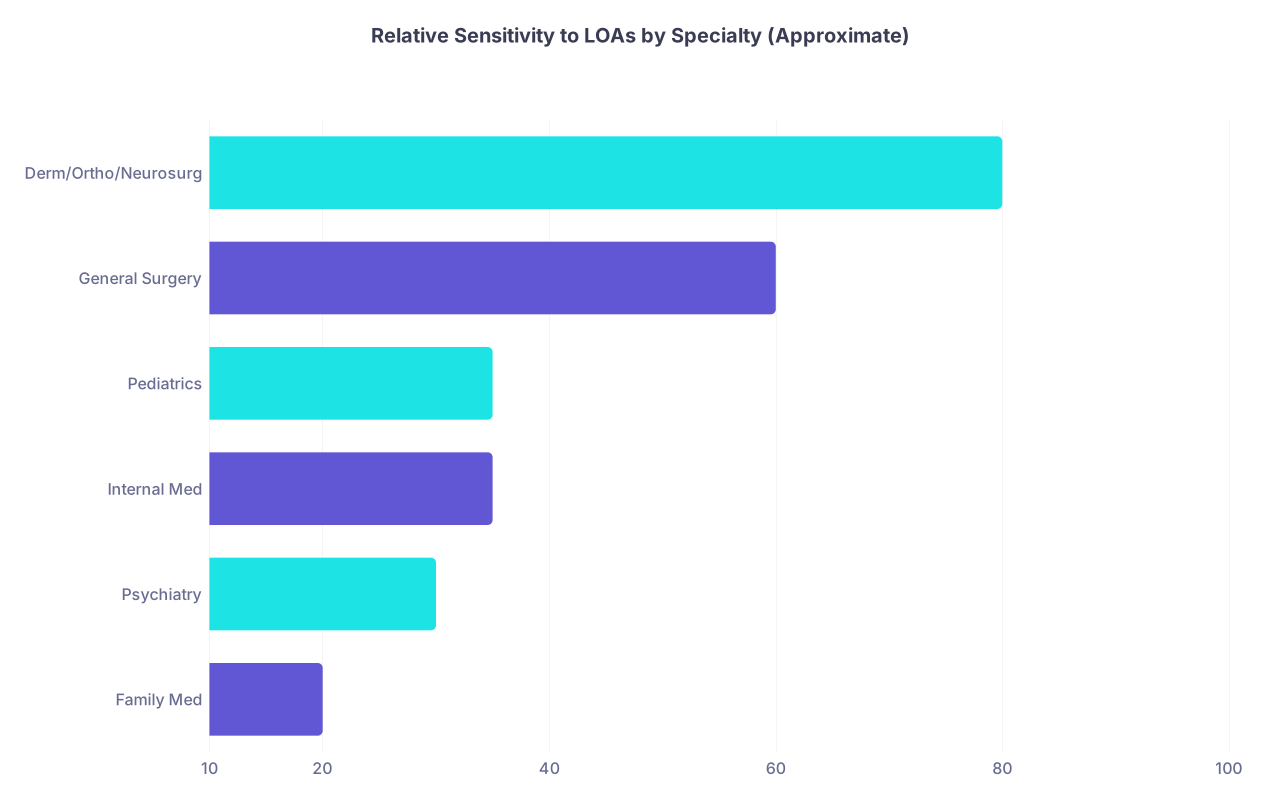
| Category | Value |
|---|---|
| Family Med | 20 |
| Psychiatry | 30 |
| Internal Med | 35 |
| Pediatrics | 35 |
| General Surgery | 60 |
| Derm/Ortho/Neurosurg | 80 |
(Think of this scale as “how likely a program is to care a lot about an LOA,” not a precise percentile.)
B. Adjusting specialty choice (if needed)
If your LOA is your only concern and your scores / clinical performance are solid, you generally do not need to change specialties. Be realistic but not fatalistic.
You may need to reassess specialty choice if:
- You have a conduct-related LOA and want a hyper-competitive field with tiny cohorts.
- You have multiple academic setbacks and a LOA for remediation.
In those cases, have a serious, data-based conversation with:
- Your school’s advisor
- A faculty mentor in the specialty
- The Student Affairs Dean who has seen actual match outcomes
C. Application strategy
Non-negotiables if you have an LOA:
- Apply to a broader range of program tiers than your classmates with spotless records.
- Include a solid group of community programs and mid-tier academic programs.
- Strong home program support matters a lot. Maximize it.
If you are in a competitive specialty with an LOA:
- Consider dual-applying (e.g., Rad Onc + IM, Ortho + prelim surgery/intern year).
- Do away rotations strategically where you can prove yourself in person.
7. Coordination With Your Medical School: Do Not Freelance
One mistake I see every year: students write one story, the Dean’s letter tells another.
You cannot afford that.
What you should do now
Meet with Student Affairs / Dean’s office.
- Ask exactly how the LOA will appear on:
- MSPE (Dean’s Letter)
- Transcript
- ERAS certification from the school
- Ask exactly how the LOA will appear on:
Align on language.
- You want your written explanation and their MSPE description to be consistent in:
- Dates
- General reason (medical / academic / personal / professionalism)
- Outcome (remediated, returned to full-time status, etc.)
- You want your written explanation and their MSPE description to be consistent in:
Clarify what they will or will not say.
- Some schools are extremely vague: “personal reasons.”
- Others are blunt: “due to academic performance concerns.”
- You need to know, so you can calibrate your level of detail.
Ask for advocacy where appropriate.
- Especially for academic or professionalism LOAs, a Student Affairs Dean who explicitly states “this student has demonstrated sustained improvement and is strongly supported for residency” can soften a lot of doubt.
Do not try to get them to lie. That backfires. The goal is accuracy with context.
8. Mental Game: Not Letting the LOA Own Your Whole Application
You will be tempted to build your entire application identity around “the LOA person.” That is a mistake.
The LOA is one line in your MSPE, one box in ERAS, and probably 2–3 minutes of one interview.
Your application is:
- Your clinical evaluations
- Your letters
- Your personal statement
- Your Step scores
- Your experiences and projects
- How you show up on interview day
If you let your anxiety about the LOA eat all the oxygen, you will neglect the parts that actually win offers.
Focus your energy where it moves the needle:
- Crush your sub-Is. Ask for very specific feedback and fix it fast.
- Pick letter writers who actually know you, not just “big names.”
- Get someone experienced to read your LOA explanation and personal statement.
- Practice your LOA interview answer out loud until it is boringly smooth.
Your goal: by the time a PD finishes reviewing your file, the LOA feels like background, not headline.
FAQ (Exactly 3 Questions)
1. Should I ever not mention the LOA if the school does not explicitly label it as such?
If your transcript and MSPE show an unexplained gap, you must account for it somewhere. If the school will not use the words “leave of absence” but there is a clear time period where you were not enrolled or progressing, you should address it briefly in either the Education section comments or your personal statement. Unexplained gaps are worse than straightforward, concise explanations.
2. Will a mandatory LOA completely block me from competitive specialties like derm, ortho, or radiology?
No, not categorically. But it raises the bar. You will need:
- Excellent board scores (especially Step 2 CK now),
- Strong clinical evaluations,
- Clear, consistent reassurance that the LOA issue is fully resolved,
- And heavy home institution support.
You should also apply more broadly and seriously consider dual-application strategies. I have seen applicants with LOAs match competitive specialties, but they had everything else in very strong shape.
3. Can I ask my letter writers or Dean to avoid mentioning the LOA at all?
You can ask, but you should not try to suppress accurate, required information. What you can and should request is that, if they reference the LOA, they also emphasize your subsequent growth and stable performance. The best advocacy letters acknowledge the past briefly, then spend most of their space describing how you have functioned since returning and why they believe you will succeed in residency.
Key points:
- Define your LOA clearly, own it briefly, and emphasize resolution and current stability.
- Align your written explanation, MSPE, letters, and interview answer into one consistent, low-drama story.
- Do not let the LOA dominate your identity; let your recent performance and professionalism carry the application.