
The brutal truth: most program directors assume a prior unmatched applicant is a problem until you prove otherwise.
Nobody says that in the glossy webinars. But I’ve watched PDs—medicine, surgery, EM, psych—flip through ERAS filters, see “prior applicant” or a time gap, and their body language changes. Shoulders tense. Brows furrow. The default reaction is suspicion.
Yet every year, some of those “red flag” applicants get second chances—and real offers. If you want to be one of them, you need to understand exactly how PDs decide who’s salvageable and who gets quietly screened out.
Let me walk you through how those conversations actually go behind closed doors.
How PDs Really See Prior Match Failure
The first thing you need to understand: prior match failure isn’t one red flag. It’s three separate questions PDs ask in order:
- Were you actually good enough the first time?
- Why did you fail to match?
- What have you done since to convince us this won’t happen again?
If they cannot answer all three in your favor, they move on. Quickly.
I’ve sat in meetings where a PD opens a reapplicant’s file and says to the chief:
“Okay, this guy didn’t match last year. Does he look like a normal candidate who got unlucky, or is there something actually wrong?”
That’s the mental fork in the road. Unlucky versus unsafe. Your entire strategy has to be aimed at moving yourself into the “unlucky but now clearly stronger” bucket.
The First Screen: Do You Even Look Competitive on Paper?
PDs do not start with your story. They start with your numbers and your trajectory. Cold.
Here’s what they check before they even care why you failed to match:
- Exam performance (USMLE/COMLEX and timing)
- Specialty fit (prior attempts vs current choice)
- Time since graduation
- Clinical recency and performance
- Any obvious professionalism or failure issues
If you fail at this level, your “great explanation” never gets read.
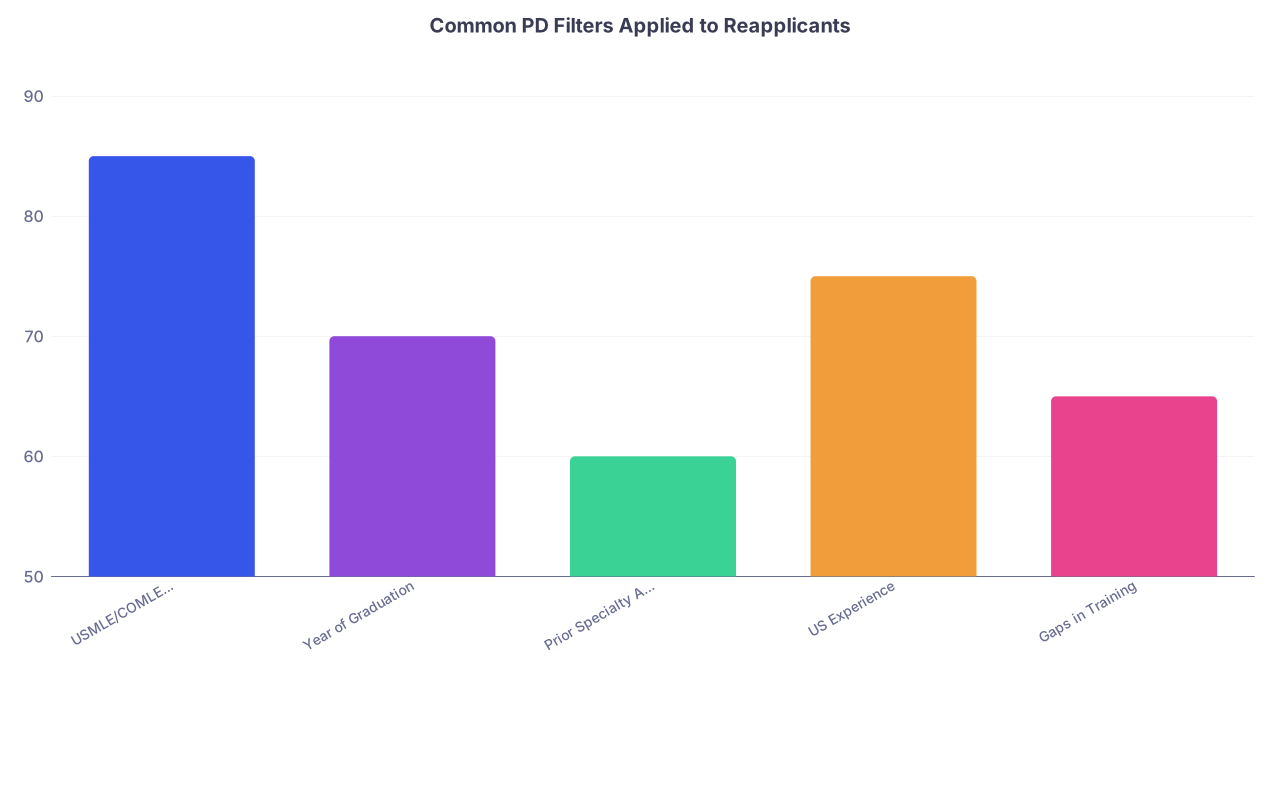
| Category | Value |
|---|---|
| USMLE/COMLEX Cutoffs | 85 |
| Year of Graduation | 70 |
| Prior Specialty Applied | 60 |
| US Experience | 75 |
| Gaps in Training | 65 |
Those numbers aren’t exact; they reflect how often I’ve watched these things kill a reapplicant before discussion even starts.
Exams: the hard gate
If you’ve got multiple failures, or barely-passing scores with no offsetting strengths, most PDs will not touch you as a reapplicant. Not because they hate you. Because they’ve already got 1,500 files of people without this problem.
What PDs want to see in a second-chance candidate:
- Any failed exam is followed by a clearly higher pass
- Step 2 CK (or Level 2) is meaningfully stronger than Step 1/Level 1
- No new failures since the last application cycle
When PDs see “recent strong Step 2” after a weak Step 1, they’ll say to each other:
“Okay, at least the test issue looks addressed. That I can work with.”
If your test story is “I failed, then barely passed on the second try, and haven’t taken anything since,” you’re asking them to gamble. Most won’t.
Time since graduation: the silent killer
The further you are from graduation, the steeper the hill. For many programs:
- ≤ 2 years out: still plausible
- 3–5 years out: only if you’ve been in active, relevant clinical work or another formal training
5 years: you need an unusually strong narrative and backing to get real traction
I’ve been in committees where someone says, “He’s 6 years out with no recent US clinical experience,” and the file is closed in under a minute. They do not hate you. They just don’t see a way to justify the risk when there are fresh grads on the table.
Specialty mismatch: they remember
If you applied to dermatology and now you’re applying to internal medicine, PDs will look for coherence. They absolutely notice when your past and present stories do not line up.
I’ve heard this exact line:
“So last year he wanted ortho, now he’s ‘always loved family medicine’? No thanks.”
A prior failed match is survivable. A prior failed match plus obvious opportunism is not.
The Question That Really Matters: Why Didn’t You Match?
Once you clear the basic competitiveness threshold, PDs move to the more interesting question: what actually went wrong?
They’re not looking for a perfect story. They’re looking for honesty paired with insight and growth.
Here’s how they mentally categorize prior non-matches:
| Category | PD Reaction |
|---|---|
| Overreached specialty/programs | Potentially forgivable |
| Weak app, no self-awareness | Negative |
| Late exams / incomplete apps | Cautious but fixable |
| Personal crisis with documentation | Sympathetic if verified |
| Behavior/professionalism issues | Almost never forgiven |
The “you rolled the dice and lost” group
These are the applicants who went all-in on hyper-competitive fields or top-heavy lists.
Example: 230s on Step 1, 240s on Step 2, minimal research, applied to 35 ortho programs, no backup. Didn’t match. Shocked.
PDs actually understand this group. They’ve watched students get bad advice from mentors who never matched anyone into that specialty.
What they want to see the second time around:
- A realistic specialty choice
- A rational list strategy
- Accurate self-assessment in your personal statement and at interviews
If your story the second time is, “I aimed too high, didn’t have the portfolio, and I’ve recalibrated honestly,” many PDs will give that a fair hearing.
The “late, disorganized, or chaotic” group
If your first cycle was torpedoed by late exam scores, late applications, half-finished ERAS, or interview cancellations, PDs will assume you’re disorganized until you prove otherwise.
I watched a PD in EM click through a reapplicant’s prior file and say:
“Last year he submitted in October and still hadn’t uploaded a Step 2 by November. I’m not going through that again unless things look completely different.”
To earn a second chance from this starting point, you need to show:
- Early, clean, complete application this time
- Exams done and uploaded before programs download ERAS
- Strong letters that comment on reliability, work ethic, and professionalism
You are not just fixing logistics. You’re proving you’re no longer the chaos person.
The “something big happened” group
Serious illness. Family crisis. Mental health collapse. Visa disasters. These are not disqualifying by themselves. But here’s the harsh truth: PDs will only override a red flag for this if:
- The crisis is clearly in the past or well-controlled
- You have third-party support (letters, dean’s note, faculty comments) confirming stability and performance
- You do not sound like you’re still in the middle of the storm
I’ve seen applicants move PDs to genuine sympathy in committee. And I’ve seen others sink themselves with vague, melodramatic explanations that leave everyone wondering if it’s going to happen again during intern year.
You need clarity, not drama.
The Three Things PDs Look For in a Comeback Story
Once a PD decides you’re not an automatic “no,” they start hunting for three specific elements in your file.
They almost never say these out loud to you, but they say them to each other all the time.
1. Evidence of clinical growth, not just “keeping busy”
This is where most reapplicants completely miscalculate.
Shadowing is useless. Volunteerism is marginal. Random non-clinical jobs are noise.
What makes a PD pay attention is meaningful, evaluated clinical work:
- A structured research year at an academic center with patient exposure and physician supervision
- A prelim year (medicine, surgery, transitional) with solid evaluations
- A non-US residency or post-grad training with clear responsibilities and documented performance
- Robust US clinical experience with real evaluation forms, not “he is a pleasure to work with” fluff
I have heard PDs say: “If he did a medicine prelim and the PD there is vouching hard for him, I don’t really care that he didn’t match last year. That’s his real audition.”
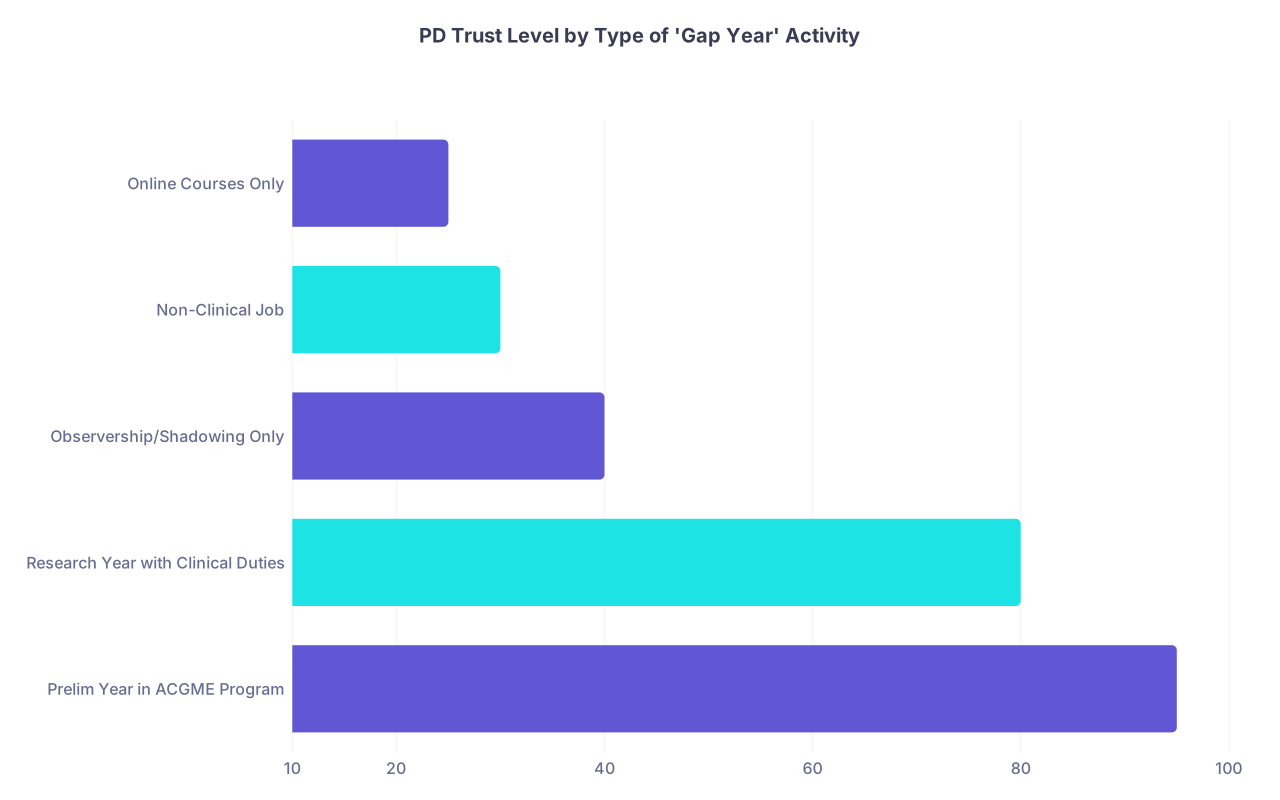
| Category | Value |
|---|---|
| Prelim Year in ACGME Program | 95 |
| Research Year with Clinical Duties | 80 |
| Observership/Shadowing Only | 40 |
| Non-Clinical Job | 30 |
| Online Courses Only | 25 |
You see the pattern. The closer your role is to what an intern actually does, the more they trust the story.
2. Third-party redemption: letters that actually move the needle
Your own explanation will never be enough. PDs are looking for someone with real authority to say, “I know they stumbled before, but I’d take them on my team.”
There are tiers of credibility here:
- Top tier: PDs, APDs, or core faculty in the same specialty at a US academic institution, commenting on reliability, fund of knowledge, and team function
- Mid tier: well-known community attendings who regularly teach residents and students with written evaluations
- Low tier: generic letters from “Medical Director of X Clinic” who barely knows you, or purely research PIs who never saw you with patients
The strongest “second chance” letters have lines like:
- “I am aware of his prior application history and would not hesitate to have him as an intern in our program.”
- “She has addressed the issues that limited her first application; I believe she is now ready to succeed in residency.”
PDs know exactly what that code language means. That writer is cashing in some of their credibility to support you. That matters.
3. A coherent, restrained explanation that matches your behavior
Here’s where most reapplicants either under-explain or overshare.
The bad versions:
- “I didn’t match for personal reasons.” (Raises more questions than answers.)
- A full-page confessional about every detail of your life imploding (signals lack of judgment).
What PDs want:
- A short, direct explanation that matches the facts in your file
- A clear description of what you changed after the failed match
- Evidence in your behavior (timely applications, strong new work, stable trajectory) that you actually learned something
When I read a good reapplicant statement, it goes something like:
“I applied broadly to X last year before my file was truly competitive. My clinical performance was solid, but my application lacked Y and Z. Since then, I’ve completed A, B, and C, with strong evaluations and updated letters. I’m now applying in [this specialty] because [specific, credible reasons] that are supported by my recent experiences.”
Short. Owned. Concrete.
Who Actually Gets a Second Chance? Real Patterns PDs Rely On
Let me give you four archetypes I’ve seen PDs fight for in committee, and four they won’t touch.

The ones who get defended in meetings
The overreach → recalibrated candidate
- First cycle: applied to highly competitive specialty with average stats, few interviews, no match.
- Between cycles: did a strong research/clinical year; got close mentorship; pivoted to a more realistic specialty that genuinely fits their strengths.
- Second cycle: clear story, strong fresh letters, early complete application.
You’ll hear PDs say: “He was misadvised the first time, but he’s got the goods now. I’d be comfortable ranking him.”
The prelim-year redemption story
- First cycle: borderline competitive, vague letters, no match.
- Between cycles: did a prelim medicine or surgery year and quietly crushed it. High marks, zero drama.
- Second cycle: letters from current PD and senior faculty explicitly advocating for them.
Committees trust actual residency performance more than any narrative.
The crisis-then-consistency candidate
- First cycle: family tragedy or health event during M4/M5 that derailed exams or interviews.
- Between cycles: stable, consistent clinical work with no new disruptions, supported by a program or department.
- Second cycle: a short, honest explanation plus clear evidence they’ve been functional and reliable for 12–18 months.
If your crisis is in the rearview mirror and your current performance is strong, many PDs will stick their neck out.
The international grad who built a true US track record
- First cycle: IMG with older graduation date, minimal US experience, no match.
- Between cycles: full-time US clinical or research job with genuine patient contact and evaluation; works closely with a PD or core faculty.
- Second cycle: clear, detailed letters from US faculty saying “I’d take them as my resident.”
This is the difference between “random foreign graduate” and “known quantity in our system.”
The ones who quietly get filtered out
The “same application, new year” person
No new scores. No new meaningful experience. Same weak letters, slightly tweaked personal statement. PDs see this and say, “So… what did they actually do this year?”The “chased prestige, now chasing anything” applicant
First year EM or ortho only. Second year suddenly applying to FM, psych, IM, even pathology in one shot.
That screams desperation, not insight. PDs do not want to be someone’s backup-of-a-backup.The chronic test struggler without a new win
Step failure → low pass → no new exams, or COMLEX-only applicant to USMLE-heavy programs, or repeating the same barely passing pattern.
No amount of “I’m not a good test-taker” talk fixes this if you haven’t produced a clearly better recent score.The unexplained wanderer
Gaps. Short stints in random clinical roles. No clear reason for specialty choice. Vague “I was exploring options” language.
PDs are not detectives. If they have to work hard to understand what you’ve been doing for the last two years, you’re done.
How PDs Decide in the Room: The Actual Dynamics
You probably imagine a PD single-handedly deciding your fate. That’s not how it works most of the time.

| Step | Description |
|---|---|
| Step 1 | Application Downloaded |
| Step 2 | Standard Review |
| Step 3 | Initial Screen: Stats & YOG |
| Step 4 | Filtered Out |
| Step 5 | Committee Discussion |
| Step 6 | Rank List Consideration |
| Step 7 | Prior Match Failure? |
| Step 8 | Recent Strong Activity? |
| Step 9 | Supportive Letters? |
In committee, what actually happens with reapplicants:
- A resident or faculty reviewer presents your file in 60–90 seconds.
- If you’re a prior non-match, they lead with that. Always.
- Then they give their interpretation: “But here’s why I think we should still rank them,” or “I don’t see enough to justify the risk.”
- The PD glances at the big-ticket items: exams, current role, letters, explanation.
- A decision is made in under 3–4 minutes, unless there’s a fight.
Your only chance is that first reviewer having something convincing to say. Something like:
- “Yes, she didn’t match last year, but she’s done a medicine prelim with great reviews and Dr. X says he’d take her in a heartbeat.”
- “He overshot last year going for EM, but his Step 2 is strong, he’s been working in our clinic, and his letters call him the best student they’ve worked with in years.”
If all the reviewer has is: “He didn’t match last year, and this year’s file looks… similar,” that’s the end.
What You Should Actually Do If You’ve Failed a Match
I’m not going to waste your time with bumper-sticker advice. Here’s the real playbook PDs silently expect from anyone who wants a real second chance.

1. Stop guessing. Get a brutal, honest post-mortem.
You are the worst person to evaluate your own application. Your friends and family aren’t better.
You need someone who actually sits on selection committees—ideally in your target specialty—to walk through your full prior application and interview record and tell you where you really stood. Not soothing feedback. Real feedback.
Most PDs will do this informally if you ask with humility and make it easy (send them the original ERAS plus your stats and what you’ve done since).
2. Commit to a path, not a scattershot.
Pick one specialty that matches:
- Your actual performance record
- Your concrete experiences
- Your letters and advocates
Then go all in on making yourself a high-value candidate for that one field. Applying to four specialties doesn’t make you safer. It makes you look lost.
3. Secure one anchor institution that will truly vouch for you.
Your year between applications should be anchored somewhere that gives you:
- Day-to-day exposure to attendings in your chosen specialty
- Real responsibility, even if limited
- The chance to earn 1–2 letters from people who are taken seriously by PDs
That might be:
- A prelim year
- A research fellowship with strong clinical overlap
- A full-time clinical job under one department that supervises you closely
Random piecemeal observerships won’t cut it.
4. Produce at least one measurable “win” before you reapply.
PDs want something tangible that wasn’t there before:
- A clearly higher exam score
- A string of stellar rotation or prelim evaluations
- A poster/paper or tangible product from your research year
- A clear leadership or responsibility role that someone else can attest to
You’re not just trying again. You’re showing up as a meaningfully stronger version of yourself.
5. Craft a narrative that matches your file, not your ego.
Your story has to reconcile:
- Why you didn’t match
- Why this specialty makes sense now
- Why your performance since then indicates future success
If it sounds like you’re still trying to save face instead of owning reality, PDs will pick up on that immediately. They’ve seen too many cycles.
The Hard Line: When PDs Rarely Give Second Chances
There are a few situations where, behind closed doors, PDs almost universally say no. You deserve to hear this straight.
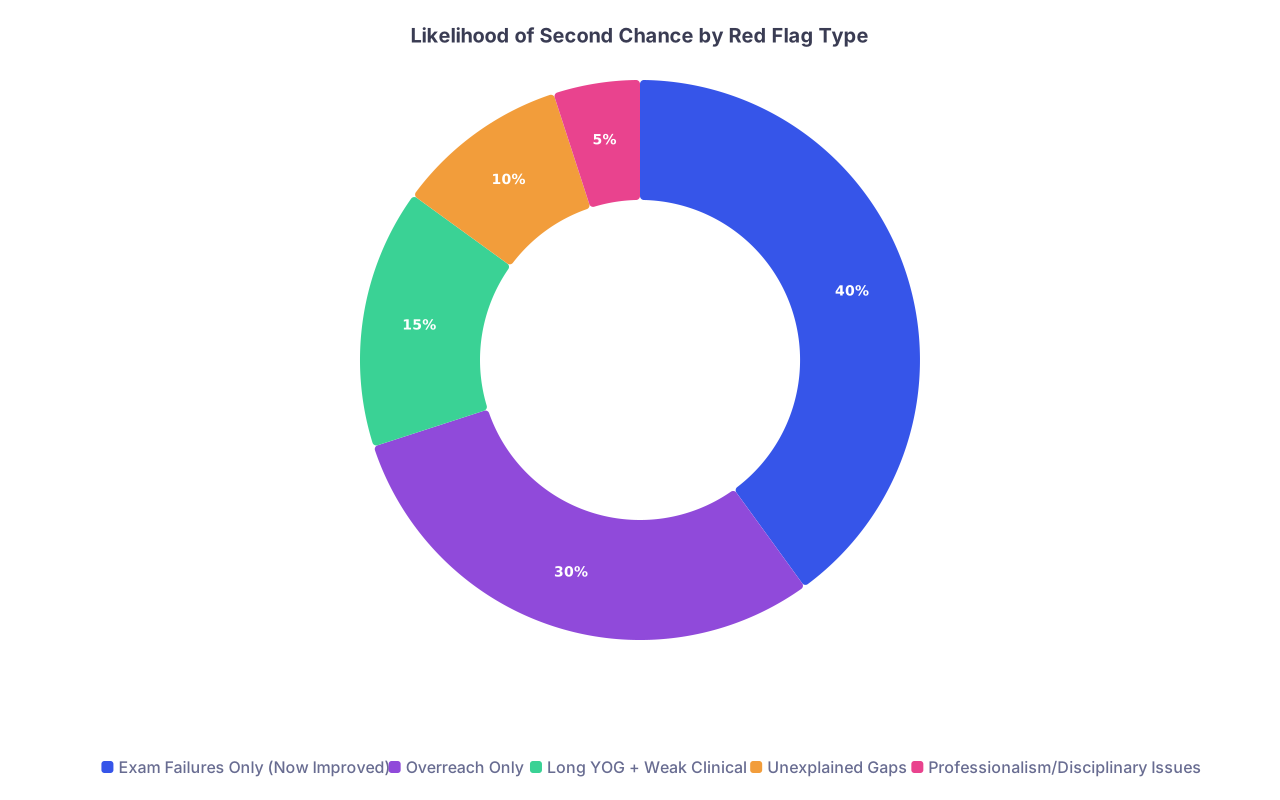
| Category | Value |
|---|---|
| Exam Failures Only (Now Improved) | 40 |
| Overreach Only | 30 |
| Long YOG + Weak Clinical | 15 |
| Unexplained Gaps | 10 |
| Professionalism/Disciplinary Issues | 5 |
The categories at the end of that distribution:
- Multiple, recent professionalism issues – recurrent unprofessional conduct, serious complaints, dishonesty. One incident with clear remediation is negotiable. A pattern is not.
- Ongoing test failure without clear improvement – PDs will not repeatedly gamble on someone who keeps failing high-stakes exams.
- Very long time since graduation with no robust clinical footprint – talking 8–10+ years out, no residency, no strong continuous clinical work.
In these cases, the conversations in committee are short and blunt. People move on. Not because you have no value as a physician—but because residency programs are risk-averse pipelines, not rehab centers.
Harsh. But honest.
The Bottom Line: What PDs Really Reward in Second-Chance Applicants
If you strip away all the language, the webinars, the “holistic review” statements, it comes down to this:
- They’ll forgive a failed match if you look like a smart, reliable, mature risk now.
- They won’t forgive it if all you’ve done is repackage the same weaknesses with more words.

Remember these three things:
- A prior non-match is a question mark, not a death sentence. Your job is to replace that question mark with clear, recent proof of competence, stability, and growth.
- PDs trust other PDs and concrete performance more than they trust your explanations. Strong new letters and real work in a structured role are your currency.
- The applicants who get true second chances don’t just “try again.” They return with a different, stronger file and a story that matches it. That’s who gets fought for in the room.