
The instinct to hide a “minor incident” that’s not on your MSPE is how people turn a small issue into a career-threatening problem.
If you remember nothing else, remember this: programs don’t torpedo applicants because of small professionalism bumps nearly as often as they torpedo them for dishonesty.
Let’s walk through this like adults and not like scared MS3s whispering in the call room.
The Real Question: Are You Ever Safer Not Mentioning It?
Here’s the blunt answer:
You are sometimes safer not mentioning it — but only if three things are all true:
- There’s no official institutional record linked to your student file (no dean’s letter, no committee letter, no notation in MSPE, no disciplinary transcript).
- It’s not something that would reasonably be discovered by:
- A background check, or
- A phone call reference from your school or a faculty member who knows about it.
- It doesn’t contradict something you explicitly attest to in ERAS (e.g., their questions about professionalism, convictions, dismissals, etc.).
If any of those three are shaky, “hiding” the incident is dumb. Not edgy. Not savvy. Dumb. Because residency programs and state medical boards care more about truthfulness and completeness than about whether you once had a professionalism chat with a clerkship director.
So the real decision isn’t “Should I hide it?”
The real decision is:
Does this actually require disclosure anywhere, and if it might come up later, can I afford to look dishonest?
Step 1: Know What’s Actually in the MSPE (and What Isn’t)
The MSPE (Dean’s Letter) is not your diary. It’s a curated document. Stuff gets filtered. Some examples:
- A single minor professionalism note that was resolved with a chat? Often never appears.
- A low-stakes lapse (late notes, minor dress code complaint) that got “counseling only”? Often omitted.
- Formal professionalism concern with remediation? Usually appears under “Academic/Professionalism Concerns.”
- Course/clerkship failure, LOA for disciplinary reasons, suspension? Almost always appears.
Before you start stressing about “hiding” something, do this:
- Read your MSPE carefully. Every line. What exactly does it say?
- Check your transcript and any professionalism summary from the school, if you have one.
- Ask your dean’s office (quietly, professionally):
“Is there any separate professionalism record that programs or state boards see that’s not visible on my MSPE or transcript?”
You can’t make a smart decision if you don’t know what’s already in the official record.
Step 2: Know What ERAS and Programs Actually Ask You
You don’t have to “confess” your entire life story. You do have to answer what’s asked.
Common categories where minor incidents might matter:
- ERAS “Adverse Actions” / “Medical Education Interruptions” sections
- Questions like “Have you ever been subject to disciplinary action, probation, suspension, or dismissal?”
- State board licensing (later) asking:
- “Have you ever been disciplined, warned, or sanctioned by a medical school, college, or university?”
- “Any criminal charges, even if dismissed/expunged?”
The rule is simple:
If they ask a clear, direct question that your incident reasonably falls under, you answer yes and explain.
If they don’t ask, and there is no official record anyone will see, and no one you list as a reference is likely to bring it up, then no — you don’t go out of your way to volunteer everything dumb you’ve ever done.
Step 3: Classifying Your “Minor Incident”
Let’s sort this into buckets. You’ll recognize your situation in one of these.

Bucket 1: Truly Trivial, Never Officially Recorded
Examples:
- One-time professionalism feedback: “Please don’t use your phone during rounds.”
- You were late a couple of times, got verbal feedback, improved.
- An attending got annoyed, but there was no written note, no meeting with the dean, no committee involved.
If:
- There’s no written documentation tied to your official record,
- It’s not on your MSPE or transcript, and
- It does not fit any question on ERAS (“disciplinary action,” “probation,” “interruption,” etc.)
Then:
You don’t mention it anywhere.
This is not “hiding.” This is “not oversharing irrelevant noise.”
Bucket 2: Informal But Documented Somewhere
Examples:
- A professionalism note in an internal system that led to a meeting with a clerkship director, but not escalation.
- A “letter of concern” that stayed within the course and never went to the dean’s office.
- A low-level “professionalism counseling” form that never shows on the MSPE.
Here you need to ask:
- Did this reach a formal institutional level (committee, dean, academic progress, professionalism board)?
- Would a thorough dean’s office summary for a state board include it?
If the answer is genuinely no, and it’s not anywhere visible or referenced in your MSPE, and nobody who’s writing for you will bring it up, you typically don’t disclose it on ERAS.
Where people get burned:
- They call it “minor” when it actually went to a formal professionalism committee.
- They say “no disciplinary action” on ERAS, but the school later reports “Yes, professionalism concern with remediation year 3” to a board or hospital.
If a formal committee was involved, default toward disclosure if asked. Don’t freelance your own definition of “minor.”
Bucket 3: Formal School Discipline (Even If Called “Minor” Locally)
Examples:
- Professionalism probation, even if short.
- Required remediation plan with documentation.
- Formal “warning” letter filed centrally.
- Temporary suspension, even if only a week.
- Required leave that’s coded as disciplinary.
If anything in this bucket happened and you’re directly asked:
- On ERAS: “Have you ever been subject to disciplinary action, probation, or suspension?”
- On a supplemental: “Any professionalism concerns during medical school?”
Then you disclose. Period.
Trying to hide this is how you end up in front of a state board later explaining why your ERAS answers don’t match your medical school file.
Step 4: What About Legal Issues That Aren’t in the MSPE?
Here’s another common category:
Undergrad or early med school minor legal stuff. Misdemeanors, public intoxication, expunged charges.
Programs vary. State boards are usually stricter.
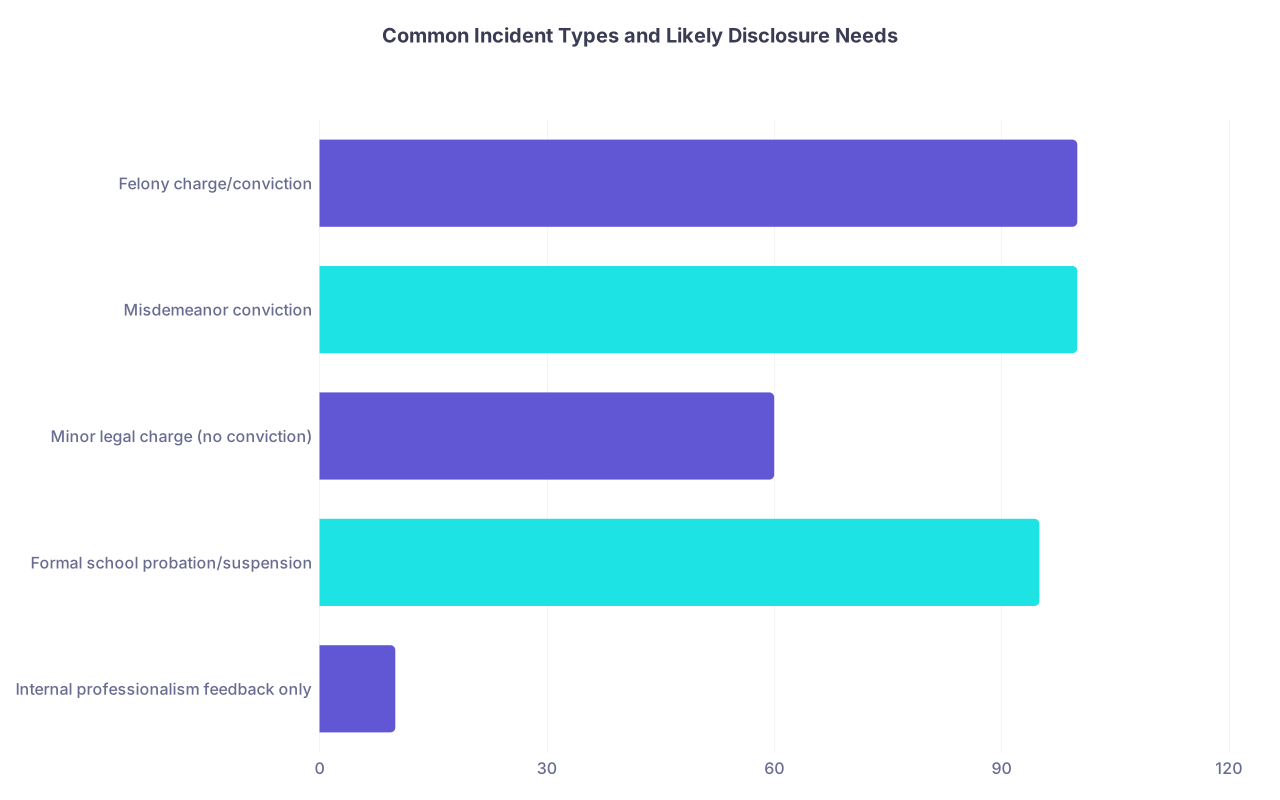
| Category | Value |
|---|---|
| Internal professionalism feedback only | 10 |
| Formal school probation/suspension | 95 |
| Minor legal charge (no conviction) | 60 |
| Misdemeanor conviction | 100 |
| Felony charge/conviction | 100 |
(Values roughly indicate percent of situations where disclosure is typically needed somewhere in the process.)
Key points:
- If an application or board form says “Have you ever been charged…” or “even if expunged,” they mean it.
- If they say “convicted” and your charge was dismissed or never filed, you don’t list it as a conviction.
But: undisclosed stuff has a nasty habit of resurfacing at the worst possible time — credentialing, DEA registration, or licensing.
Rule of thumb:
- Residency application: Follow exactly what’s asked. Don’t volunteer non-asked, non-conviction, non-record trivia.
- State license applications later: They’re more aggressive. Err on the side of disclosure there, with tight, non-dramatic explanations.
Step 5: How Programs Actually React When You Disclose
Everyone imagines the worst: “If I tell them, I won’t match.” That’s rarely true for minor stuff handled well.
What actually kills applicants:
- Long, defensive explanations.
- Blaming others (“The attending had it out for me”).
- Patterns — multiple incidents of the same behavior.
- Surprises — when what you said and what the school says don’t match.
Programs are much more tolerant when you:
- State the issue briefly and clearly.
- Take full responsibility without groveling.
- Show a concrete change in behavior.
- Avoid over-sharing emotional drama.
Example:
“I was placed on a brief professionalism remediation in my third year after missing several early-morning pre-rounds due to poor time management. I completed the remediation plan, adjusted my routines, and haven’t had any issues since. My later clerkship evaluations reflect that improvement.”
That’s it. No soliloquy. No self-flagellation.

Step 6: The One Thing That Will Haunt You: Inconsistency
Here’s where people get in real trouble:
They say “No issues” on ERAS.
Their MSPE hints at something (“Student was counseled regarding professionalism expectations”).
A faculty letter vaguely references “growth after an early professionalism concern.”
Or later, a state board form pulls a full summary from the medical school that lists a professionalism remediation that the resident never mentioned.
Now the board isn’t just asking “What happened?”
They’re asking “Why weren’t you honest on your initial applications?”
And that’s the nightmare scenario. Because questions about integrity are harder to fix than questions about judgment under stress as a 24-year-old.
Step 7: A Simple Framework: Should You Hide It or Not?
Here’s a bare-bones decision guide.

| Step | Description |
|---|---|
| Step 1 | Incident occurred |
| Step 2 | Do NOT disclose |
| Step 3 | Disclose briefly & clearly |
| Step 4 | Consider future board forms; lean to disclosure if unsure |
| Step 5 | Formal school or legal record? |
| Step 6 | Asked directly on ERAS? |
| Step 7 | Fits ERAS/board questions? |
Shortcut interpretation:
- No record + not asked = do not volunteer.
- Record exists + question fits = you disclose.
- Record exists + ambiguous question = talk to your dean; lean toward transparency if it might appear later.
How to Talk About a Minor Incident If You Do Disclose
Three parts. Keep it tight.
What happened (1–2 sentences, factual).
“During my second-year preclinical course, I submitted a group assignment late, which led to a professionalism concern being documented and a brief remediation plan.”What you learned / how you changed (2–3 sentences).
“I recognized I’d treated group work as flexible rather than a firm commitment to my colleagues. I began using a more structured task system and started confirming deadlines directly. Since then, I’ve consistently met expectations on clinical rotations, as reflected in my clerkship feedback.”Why it’s not an ongoing problem (1–2 sentences).
“There have been no further professionalism concerns, and attendings have specifically commented on my reliability and follow-through.”
That’s it. You’re done. Don’t reopen it in every paragraph of your personal statement. Don’t brand yourself “the remediation applicant.”
What You Should Not Do
A quick list of behaviors that scream “I’m hiding something” or “I’m not ready for residency”:
- Saying “No disciplinary action” when you were on anything called probation, suspension, remediation, or professionalism contract.
- Blaming faculty, “toxic culture,” or “unfair grading” as your primary explanation.
- Writing a full-page trauma essay about a single minor professionalism note.
- Having your story differ between your personal statement, interviews, and what your dean’s office says.
- Asking a letter writer who was directly involved in the incident to write you a letter without discussing how they’d frame it.
When to Get Actual Human Advice
There are situations where you shouldn’t rely on generic internet guidance:
- Anything involving legal charges (even if dropped or expunged).
- Multiple professionalism incidents, even if each one is “small.”
- Any time you had probation, LOA, or suspension, even if the MSPE tries to soften it.
- You’re applying in a hyper-competitive specialty and wondering if disclosure will effectively lock you out.
In those cases, do this:
- Speak to your dean or student affairs office explicitly about what’s in your file and what they recommend you disclose.
- If legal stuff is involved, talk to an attorney who knows healthcare licensing, not just a random criminal lawyer.
Bottom Line: Is It Ever Smart to Hide It?
Final answer:
If it’s truly trivial, never formally documented, not asked about anywhere, and not something that will appear later?
You’re not “hiding” anything by omitting it. You’re just not oversharing. That’s fine.If it’s formally documented, fits what you’re being asked (discipline, probation, professionalism concern, legal charge/conviction), or is likely to show up later in any official report?
Trying to hide it is not smart. It’s reckless. You’re trading a slightly stronger application today for a much bigger integrity problem later.
Your professional reputation isn’t built on having a perfectly clean record.
It’s built on what you do when you don’t.
Today, do this:
Pull up your MSPE, your transcript, and your ERAS application. For any incident you’re worried about, ask yourself: “If a state board reads everything in 5 years, will my story and my documents line up?” If the answer is no, fix that now.
FAQ: Red Flags, MSPE, and “Minor Incidents”
1. My MSPE doesn’t mention my professionalism remediation, but my dean’s office file does. Do I have to disclose it on ERAS?
If ERAS or a program asks about disciplinary actions, professionalism concerns, probation, or remediation, you should answer based on your actual school file, not just what’s in the MSPE. Programs and boards can (and do) get more detailed reports from schools later. If your dean’s office lists a remediation as an official action, treat it as disclosable when asked.
2. A faculty member yelled at me on rounds and wrote a negative comment, but there was no committee or dean involvement. Do I need to bring this up?
No. Harsh feedback or a single negative comment in an evaluation is not something you proactively disclose. It’s part of being a learner. You only start thinking “disclosure” when there’s a formal process (probation, remediation, suspension, professionalism committee) or a clear yes/no question you’d be lying to avoid.
3. I had a minor legal charge (e.g., public intoxication) in undergrad that was dismissed. MSPE doesn’t mention it. Do I tell residency programs?
For residency apps, follow the exact wording: if they ask about convictions and you weren’t convicted, you answer “no.” If they ask about charges or “even if dismissed/expunged,” then you disclose. Be prepared that state medical boards later are stricter and may require you to list even dismissed charges, with a short, factual explanation.
4. My school calls something a “professionalism concern” but says it’s not formal discipline. How do I know if it needs to be reported?
Ask your dean’s office these two questions:
- “If a residency program calls for a detailed report, will this be mentioned?”
- “If a state medical board asks for a full professionalism history, will this be included?”
If the answer to either is yes, and ERAS/programs ask about professionalism issues, lean toward brief, honest disclosure. If it’s truly local, informal, and never reported externally, you generally don’t volunteer it.
5. Will disclosing a minor professionalism issue automatically keep me from matching?
No. A single, well-explained minor issue almost never ruins a match, especially if your record since then is strong. What sinks people is a pattern of problems, a major event (like cheating or abuse), or dishonesty about what happened. Programs routinely rank applicants with one-time professionalism bumps who show growth. They’re much less forgiving when your story doesn’t match your documentation.