
The reflex to switch specialties after a failed match is usually wrong.
Not always. But often enough that I’d call it what it is in many cases: a panic move dressed up as “strategic rebranding.”
Let me walk through what the data and real program behavior actually show, not what panicked classmates, random Reddit threads, or that one “advising” dean with 10-minute slots are telling you.
The Myth: “Didn’t Match? Just Switch to Something Less Competitive.”
This is the story you hear in March:
- “You didn’t match derm? Just switch to IM, they take everyone.”
- “Ortho didn’t work out? Do anesthesia. They love surgical people.”
- “You went unmatched in EM? Just pivot to family med next cycle, you’ll be fine.”
On paper, it sounds logical: lower GPA? Aim for “less competitive.” Failed match? Choose a supposedly “safer” specialty. Problem solved.
Except that’s not how program directors actually read your application.
The NRMP Program Director Survey (go look at it, not the memes about it) makes one thing painfully clear: red flags matter more than almost any single positive metric, especially in crowded specialties. Failing to match and then suddenly switching fields is a red flag pattern unless the story is clean, coherent, and backed by real changes.
Most PDs won’t say this bluntly on Zoom or at meet-and-greet sessions. But in closed-door rank meetings, the language is different:
- “Why did this person really not match?”
- “Why the 180° change in specialty?”
- “Is this a back-up punt or a genuine pivot?”
- “Are we inheriting another program’s problem?”
You’re not just applying as “a candidate with new interests.” You’re applying as “the person who didn’t match in something else.” Those are not the same.
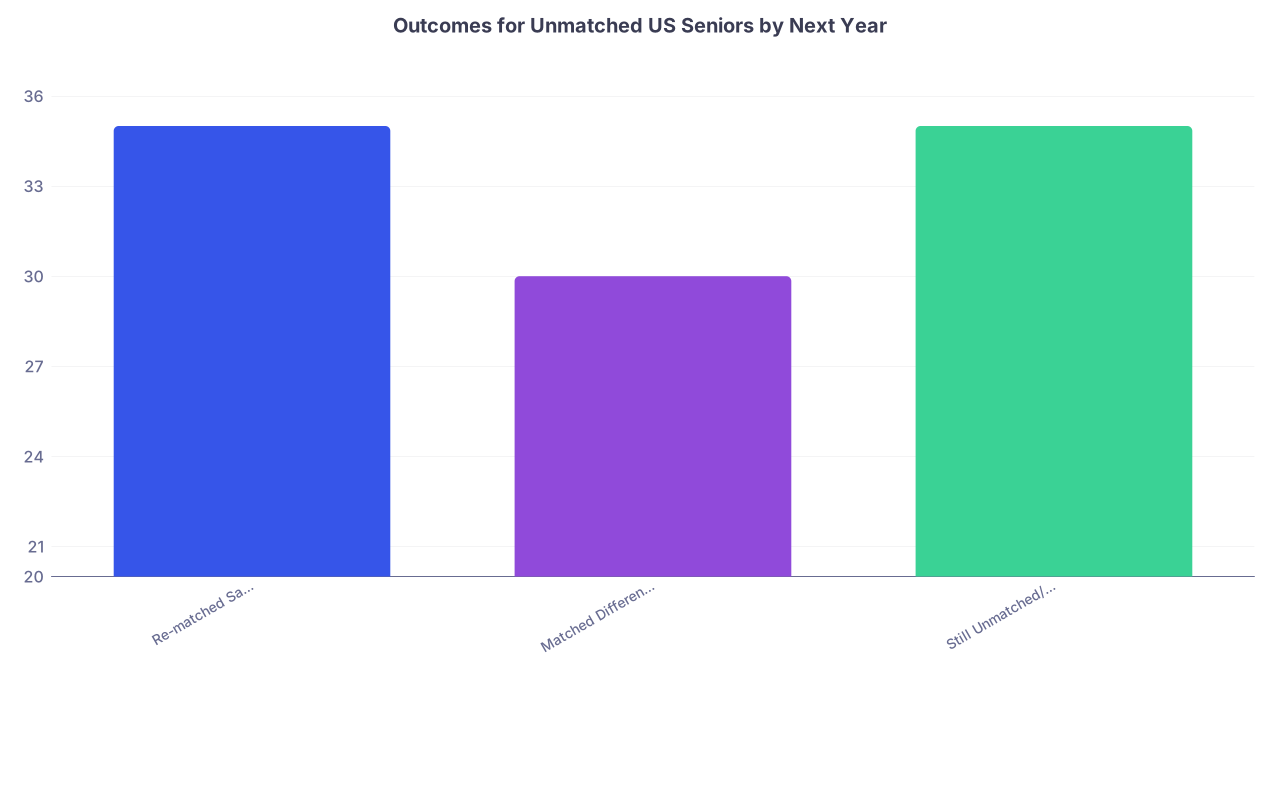
What the Data Actually Shows About Unmatched Applicants
| Category | Value |
|---|---|
| Re-matched Same Specialty | 35 |
| Matched Different Specialty | 30 |
| Still Unmatched/Out of Training | 35 |
These are ballpark estimates based on patterns in NRMP data and published analyses across years – exact numbers vary by cycle, but the trend is stable:
- A significant chunk of unmatched applicants never enter residency at all.
- Of those who match the next year:
- Roughly one-third match into the same specialty.
- Roughly one-third match into a different specialty.
- The rest either do prelim-only positions, research, or disappear from the match pipeline.
So yes, some people switch specialties and successfully match.
But that success group is heavily enriched with:
- Strong Step/COMLEX scores
- Solid clinical performance
- Clear, explainable reasons for the initial miss (late strategy, limited applications, geographic choke)
- Concrete work in the new specialty (not just a new personal statement)
Meanwhile, the ones who panic-switch without fixing underlying issues often just stack an additional problem: now they look indecisive, reactive, and vaguely suspicious.
Why Switching Specialties Can Be a Red Flag
Let’s be very clear: the switch itself is not the red flag.
The pattern is.
Here’s how it looks from the other side of the table when I’ve sat in selection meetings and seen this kind of file:
- MS4 unmatched in ortho
- Takes a research year in “sports medicine/orthopedics”
- Next cycle: applies to internal medicine with one token sports medicine LOR and a brand-new story about “lifelong passion for longitudinal patient care”
Everyone in the room is thinking: “So…what actually happened last year?”
There are four big red-flag signals programs pay attention to:
Narrative whiplash
Last year: “I’ve wanted to be a surgeon since I was five.”
This year: “What really drives me is chronic disease management and continuity.”
Is that impossible? No. Does it sound contrived 80% of the time? Yes.No real work in the new field
You say you “discovered your passion for psychiatry,” but between March and September you did:- No psych electives
- No psych research
- No psych volunteering
- No psych LORs
That’s not a pivot. That’s a bailout.
Unaddressed core weaknesses
If the original failure was due to:- Repeated exam failures
- Poor MS3 evaluations
- Professionalism concerns
…and none of those are addressed or improved, switching specialties is just moving the same bomb to a different room.
Timing and desperation tactics
Programs notice when you:- Apply broadly and inconsistently (“Why is this person applying to neurology, IM, FM, and psych?”)
- Send generic emails to 60+ PDs begging for any spot
- Don’t have a believable “why this specialty” beyond “I like X and Y”
These are read as character-level red flags: maturity, insight, reliability. Not just “wrong specialty.”
When Switching Actually Makes Sense (And Works)
Now, the contrarian twist: staying in the same specialty is not always the noble or honest move either. Sometimes switching is exactly right — but it has to be done like a grown professional, not a panicked grad.
It usually makes sense when at least two of these are true:
You discovered late, but genuinely, that your original specialty fit was poor
Example: You’re on a sub-I in general surgery and realize you resent the OR, love the consults, and light up on ICU rounds. A move to anesthesia, IM, or critical care–oriented pathways can actually be coherent.There’s a structural barrier in the original specialty that’s unlikely to change
Example: You applied to ENT with a 215 Step 1 and minimal research. You got no interviews. Data-wise, trying again with the same stats is a fantasy. Pivoting to a field where your numbers are aligned with matched residents is rational, not cowardly.You can build a real track record in the new specialty within 6–12 months
That means:- Rotations and hands-on clinical exposure
- At least one strong specialty-specific letter from someone who’s known in that field
- Concrete activities that echo your stated reasons (continuity clinic, QI projects, call shifts, etc.)
Your story is congruent with prior behavior
If throughout med school you:- Volunteered in outpatient community clinics
- Did a primary care–focused scholarly project
- Loved longitudinal clerkships
…and you originally chased derm or plastics for prestige, then flip to FM or IM after a crashed match, that’s not a red flag. That’s course correction, and the file often “reads true.”
The Bigger Problem: You’re Treating the Symptom, Not the Disease
Too many unmatched grads treat “switch specialties” as the solution, when it’s just one superficial knob to turn.
You need to answer three hard questions before you even think about rewriting your personal statement:
Why did I really not match?
Not the comforting version. The actual version. Common real causes I’ve seen:- Applied to 25 programs in a competitive field when you needed 60+
- Limited geography because of a partner/family situation
- Late letters, late ERAS, weak away rotations
- Mediocre MS3 comments that scream: “bare minimum effort”
- Odd behavior on interview day that multiple programs noted
What has changed since then?
Not “I’ve reflected a lot” or “I’m more mature.” Evidence. For example:- New Step 2 CK score that’s clearly stronger
- Completed a rigorous sub-I with excellent evals
- Fixed professionalism issue (and have someone credible who’ll say so)
- Completed a structured research year with publications or presentations
Would staying in the same specialty with a better strategy give me a better shot than jumping ship?
If you applied badly (too few apps, poor timing, no aways), you might have better odds staying put and actually doing it right the second time.
Here’s where people get this wrong: they assume “I didn’t match” = “I wasn’t competitive for this specialty.” Often it just means “I played the game badly.”
How Programs Actually Compare “Repeat in Same Specialty” vs “Switching Specialty”
| Profile Type | PD Gut Reaction |
|---|---|
| Same specialty, stronger file | Persistent, committed, maybe risky but understandable |
| New specialty, no clear path | Confused, unstable, possible hidden issues |
| New specialty, well-built case | Thoughtful pivot, potentially strong if story matches record |
Behind closed doors, PD conversations about reapplicants tend to sound like:
- “They stuck with anesthesia, did a dedicated research year, Step 2 went from 227 to 244, and the new letters are great” → often gets respect.
- “They bounced from EM to psych after not matching, but the application is copy-paste with new adjectives” → often gets a hard pass.
You need to decide which column you want to live in.
If You Do Switch, Build a File That Doesn’t Look Like Panic
You don’t fix this with a new specialty name at the top of ERAS and one different letter.
You fix it by building a record that forces a PD to say: “Okay, I see it.”
That usually means, over 6–12 months:
At least 2 rotations (home or away) clearly in the new field
2–3 specialty-specific letters, one from someone who’s an actual name locally or nationally
A coherent story that connects your prior path to this new one:
- Not: “I realized I love psych.”
- But: “Across my rotations, the parts I enjoyed most were prolonged conversations with patients, managing medication over time, and thinking about behavior and context. After going unmatched, I did X and Y experiences in psychiatry, which confirmed that’s actually where I do my best work.”
Evidence of reliability
Show showing up, doing hard things, and having someone vouch for your growth since the no-match. PDs are allergic to risk. Your job is to look boringly dependable.
When You Probably Should Not Switch (Yet)
Here’s when “switching to something easier” is usually self-sabotage:
Your personal issues are the real problem
Chronic lateness. Poor teamwork feedback. Boundary violations. Unprofessional emails. These will follow you regardless of specialty until you address them.You have no plan to fill your upcoming year
“I’ll just apply again next cycle and figure the rest out later” is not a plan. An empty year or vague “research” with no structure just compounds the red flag.You’re switching purely based on perceived competitiveness tiers
“Derm → FM” or “Neurosurgery → IM” with zero introspection and no track record in the destination specialty is transparent. Programs can smell it.Your initial application was weak across the board
Middle-of-the-road scores, lukewarm letters, few clinical standouts, and now you’re trying to “game” the system via specialty choice. Wrong axis. You need to become a better applicant, not just a different one.
A Smarter Framework: Fix, Then Decide
Before you rewrite your story, fix the facts.
A very practical sequence:
Get a brutally honest read on your prior application
Not from your best friend. From:- A PD or APD who will actually be blunt
- A specialty advisor who has seen dozens of unmatched cases Tell them: “Pretend I’m not here. Why did this application fail?”
Pick 2–3 fixable targets
You cannot redo med school, but you can:- Improve Step 2 or COMLEX Level 2
- Collect better letters
- Complete a structured, high-accountability research or clinical year
- Demonstrate maturity and reliability in a monitored environment
Only then decide: same specialty or switch?
If, after improving your file, the numbers and narrative still fight your original specialty, a pivot might be logical. But make it from a position of strength and clarity, not fear.
The Bottom Line
Switching specialties after a failed match is not automatically smart. It’s not automatically dumb either. But here’s what the data and real-world behavior actually support:
- Specialty switching can highlight red flags if it looks reactive, unplanned, and disconnected from your prior record.
- Many unmatched applicants are better off fixing strategy and strengthening their file in the same specialty than panicking into a new one.
- When a switch is truly appropriate, it has to be backed by a coherent story, new evidence, and a year of deliberate work — not just a different name on ERAS and a recycled personal statement with new buzzwords.