
The most dangerous thing a reapplicant can do is change nothing and hope the outcome magically improves.
You failed to match. That hurts. But the real disaster is what many people do next: rush back in with a slightly tweaked personal statement and a new coat of denial. Then they’re shocked when they fail again—often with worse options and fewer advocates.
You’re not just “applying again.” You’re applying with a red flag on your record. Programs know you didn’t match. They will look harder. You cannot afford sloppy thinking or lazy fixes this time.
Let me walk you through the errors that quietly kill second attempts—and how to not be that cautionary story residents tell interns in July.
1. Pretending “Bad Luck” Was the Only Problem
If you blame the failed match entirely on luck, you’re already setting up a second failure.
I’ve heard it so many times:
- “I had great interviews, just unlucky.”
- “Everyone said I’d match.”
- “My advisor was shocked.”
Sometimes luck plays a small role. But almost no complete miss in the Match is pure bad luck. The usual culprits:
- Unrealistic specialty list
- Terrible application strategy
- Weak letters
- Poor Step/COMLEX performance or timing
- Geography obsession
- Awkward interviews that no one had the heart to tell you about
The mistake: Treating last cycle as an act of fate instead of a data point.
What you should be doing instead:
- Sit with at least 2–3 honest people who know you and the process (PD, APD, core faculty, dean’s office, not just your buddy).
- Ask direct questions:
- “If you had to guess, why do you think I didn’t match?”
- “Was my specialty choice realistic?”
- “Were there concerns people weren’t telling me?”
- Demand specifics, not platitudes.
If nobody has done a full post-mortem with you (specialty choice, scores, grades, letters, number and distribution of programs, interview behavior), you’re going into your second attempt blind.
This is how people become three-time reapplicants. Don’t.
2. Reapplying in the Same Specialty With the Same Profile
This is the big one. The silent killer.
If your first application was truly competitive on paper, you probably wouldn’t have gone completely unmatched.

You need to ask a hard question: Has anything substantial changed in my application since last time?
Substantial means things like:
- New excellent letters from people known in the field
- Significant U.S. clinical experience (if you’re an IMG)
- Strong, clearly relevant research or a meaningful publication
- A new degree, certificate, or structured gap-year experience
- Dramatic Step 2 CK improvement (for those who applied with weak/absent scores)
- Clear clinical performance improvement with concrete evidence
Not substantial:
- Mildly rewritten personal statement
- Another generic volunteer thing
- A few random online modules
- “More time to reflect”
- One short observership with no real letter
When reapplying to the same specialty is a red flag
It often is if:
- You had:
- Below-average scores for the specialty
- No home program backing
- No strong specialty-specific letters
- No meaningful research or niche involvement
- And you:
- Haven’t added anything major
- Still insist on the same ultra-competitive specialty (derm, ortho, plastics, ENT, neurosurgery, etc.)
Programs can and do notice repeaters with static applications. Some literally filter them out. You need to be able to answer:
“What’s different about you this year that should change our decision?”
If your honest answer is, “Not much,” you probably should not be reapplying the same way to the same field.
3. Ignoring Specialty Competitiveness and Your Realistic Odds
Reapplicants love magical thinking about competitiveness.
“I know my Step 1 was low, but I have passion.”
“I really see myself as a surgeon.”
“I talked to a resident who said I have a shot.”
Passion doesn’t move percentile curves.
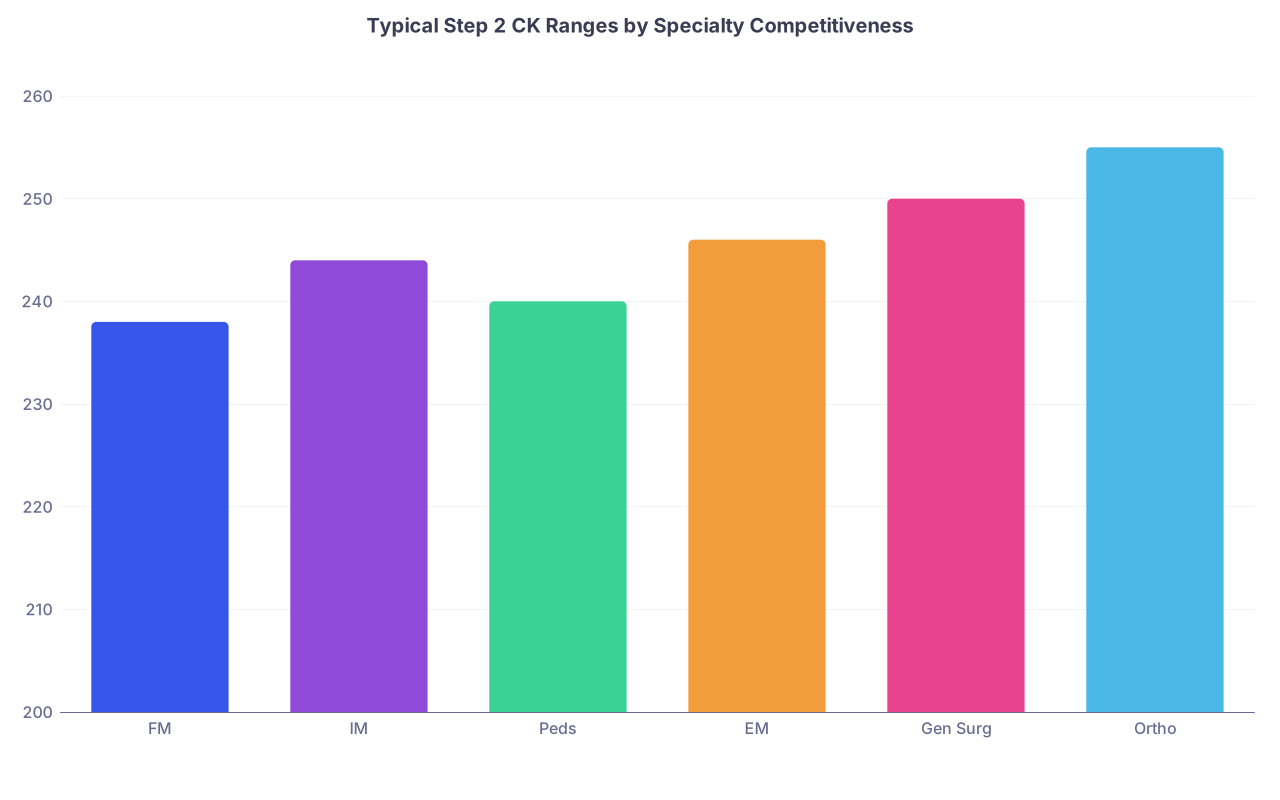
| Category | Value |
|---|---|
| FM | 238 |
| IM | 244 |
| Peds | 240 |
| EM | 246 |
| Gen Surg | 250 |
| Ortho | 255 |
If you already went through one match and didn’t land anything, your margin for error is tiny now. You need brutal realism:
Look at:
- Your Step/COMLEX scores
- Number of attempts
- Class rank
- Whether you’re AMG vs. DO vs. IMG
- Red flags (leaves, professionalism issues, failures)
Cross-compare with:
- NRMP Charting Outcomes data (or equivalent)
- Your school’s match outcomes (ask your dean’s office)
- What PDs in that specialty actually say they want
The mistake: Deciding your specialty based on identity (“I’m a future cardiothoracic surgeon”) instead of probability.
Sometimes the smartest, most adult move is pivoting to a less competitive field where you can actually have a career, instead of chasing a fantasy for three cycles and aging out of options.
Harsh? Yes. But I’ve watched good people ride their egos straight into permanent limbo.
4. Weak, Generic, or Recycled Letters of Recommendation
Your letters can quietly bury you—especially the generic ones.
Reapplicants often assume: “I already have three letters, I’ll just reuse them.” Huge mistake if:
- They weren’t from your core specialty
- They were lukewarm (“hard-working, pleasant to work with…” and nothing specific)
- They’re now stale (2+ years old, no ongoing relationship)
Programs absolutely care about:
- Who wrote the letter (name, reputation, specialty alignment)
- How recent it is
- Whether it says anything memorable or just filler
Red-flag moves:
- Using old letters without asking the writer if they’re still supportive
- Replacing a strong general letter with a weak “in-specialty” one just for optics
- Asking letter writers who barely remember you (“Remind me what rotation you were on?”)
You need letters that prove:
- Someone in the field has seen you do real clinical work
- You improved / matured since the last cycle
- You’re safe, reliable, and worth the risk as a reapplicant
If your letters last time were generic or off-target, and you repeat that, do not be surprised when your outcome repeats too.
5. Letting the Gap Year Look Aimless or Desperate
A failed match creates an uncomfortable question in PDs’ minds: “What did you do in the meantime?”
And they will ask.

Red flags:
- “I just studied and reapplied.”
- “I helped out at my cousin’s clinic informally.”
- “I traveled and reflected.”
- “I worked random jobs but nothing medical.”
Those might be great for your personal growth, but they’re poison on an application if not framed correctly.
Stronger gap-year activities:
- Formal research position with clear responsibilities and a potential letter
- Full-time clinical job: scribe, hospitalist extender, clinical educator, etc.
- Structured post-grad program (prelim/transitional year, MPH, research fellowship)
- Significant U.S. clinical experience (for IMGs)—with letters
What kills reapplicants:
- Unstructured, vague time
- No clear supervisor who can vouch for you
- No documented improvement or new output
- Looking like you were just “waiting it out”
Your gap year should scream:
“I stayed close to clinical medicine, grew as a professional, and people trusted me enough to back me.”
If your answer to “What did you do this past year?” makes you flinch, fix that before you reapply.
6. Applying Too Narrowly (Again) or in a Panic (New Mistake)
Some of you unmatched because you applied like this:
- 10 programs in New York
- All university, all competitive
- No community, no mid-tier, no backup specialty
Then you do it again. Maybe 15 programs this time. Same tier. Same geography fantasy.
You are not in a position to be picky. Not anymore.
On the flip side, some reapplicants panic and go the other way:
- Apply to 120+ programs
- Multiple specialties
- No coherent story
- Scattershot everything
Both extremes are bad.
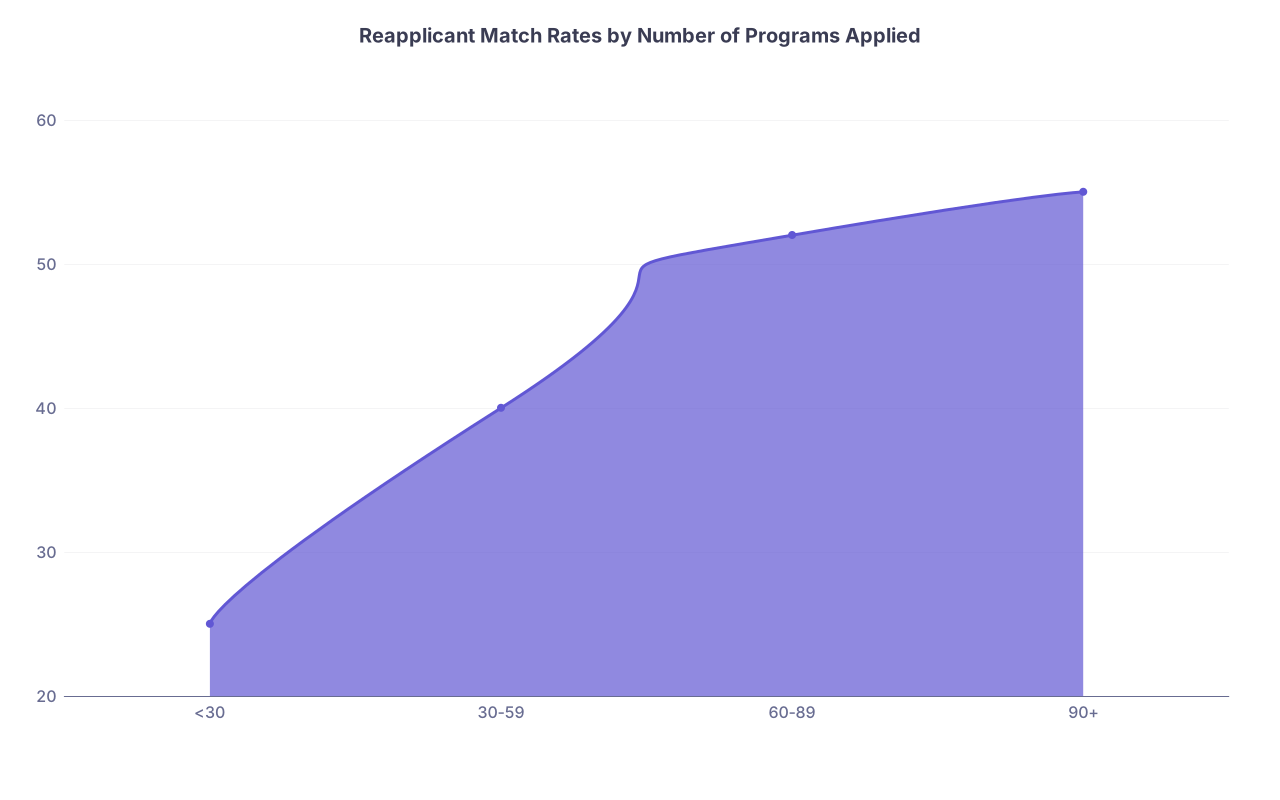
| Category | Value |
|---|---|
| <30 | 25 |
| 30-59 | 40 |
| 60-89 | 52 |
| 90+ | 55 |
More is NOT always better. More targeted is better.
You need:
- A realistic primary specialty
- A real backup specialty (not just “I listed FM on ERAS but my whole app screams ortho”)
- Thoughtful geographic spread: home region + other regions known to be more IMG/DO friendly if that’s relevant
- Enough programs to overcome your reapplicant status, but within reason
If last time you under-applied or over-concentrated, repeating that pattern is replaying a losing hand.
7. Reusing the Same Personal Statement and “Story”
Your old personal statement already failed its main job: convincing someone to rank you.
Yet a lot of people:
- Change a paragraph or two
- Add a sentence about “resilience after an unmatched cycle”
- Call it a day
Lazy. And obvious.

Problems I keep seeing:
- Same vague “I always wanted to help people” arc
- No mention of what you did during the gap year
- No real ownership of what went wrong last time
- Overcompensating with trauma dumping or melodrama
You must thread a needle:
- Acknowledge the failed match without sounding bitter or defeated
- Show reflection, insight, and concrete changes
- Emphasize growth, not excuses
Do not:
- Blame programs, advisors, or the system
- Over-explain or litigate why you think you should have matched
- Pretend it never happened (they can see your history)
Your narrative has to answer a silent question in every PD’s mind:
“Why should I trust that investing in this person now won’t backfire?”
If your statement reads like last year’s with a few band-aids, it won’t do that.
8. Poor Interview Story and Body Language About Not Matching
Reapplicants often underestimate how closely interviewers listen when the unmatched topic comes up.
And it will come up.
If you:
- Get defensive
- Sound angry or targeted
- Say “I think it was just bad luck” with no deeper reflection
- Blame your school, advisors, or a specific program
- Look visibly uncomfortable or ashamed
You’re done.
Your answer must:
- Take appropriate responsibility: “Here’s where I miscalculated.”
- Show insight: “I realized my application for that specialty wasn’t as strong as I believed, especially in X.”
- Show action: “So this year, I did Y, Z to address those gaps.”
- Demonstrate stability: “It was tough, but I stayed engaged in clinical work doing…”
Practice this answer. Out loud. With someone who doesn’t sugarcoat things.
A second major red flag: trying to hide that you’re a reapplicant or hoping they don’t ask. They know. You just look dishonest or embarrassed if you dodge it.
9. Ignoring Big Red Flags Instead of Containing Them
If you have serious red flags:
- Step/COMLEX failures
- Leaves of absence
- Remediation or professionalism issues
- Prior residency dismissal
You cannot wish those away.
| Red Flag | Bad Approach | Better Approach |
|---|---|---|
| Step failure | “It was unfair” | Own it + show later success |
| Leave of absence | Vague “personal reasons” | Clear, brief, stable resolution |
| Remediation | Blame faculty/system | Emphasize growth + strong evals |
| No prior interviews | “Bad luck” | Admit miscalculation + new plan |
| Prior non-renewal | Defensive, bitter tone | Factual, accountable, non-vindictive |
Programs do take chances on applicants with red flags—if they feel:
- You’re honest about what happened
- The issue is unlikely to recur
- You’ve demonstrated a sustained pattern of reliability since then
If your whole second application acts like the red flag doesn’t exist, that by itself becomes another red flag: lack of insight.
10. Not Talking to Program Directors (or Only Talking to the Wrong Ones)
Too many reapplicants spend all their time on Reddit and none talking to actual decision-makers.
Wrong audience:
- Random SDN/Reddit users with no stake in your career
- Friends who matched easily on first try
- Faculty outside your desired specialty or institution
Right audience:
- Specialty-specific advisors at your school
- PDs or APDs who will actually give you 10 honest minutes
- Faculty who write a lot of letters in your field
- Your dean’s office or IMG mentorship program

| Step | Description |
|---|---|
| Step 1 | Unmatched Result |
| Step 2 | Self Assessment |
| Step 3 | Talk to Specialty Advisor |
| Step 4 | Talk to Deans Office |
| Step 5 | Contact PDs for Feedback |
| Step 6 | Adjust Specialty and Strategy |
| Step 7 | Structured Gap Year Plan |
| Step 8 | Stronger Reapplication |
| Step 9 | Need Specialty Advice? |
You should be asking PD-level people:
- “If you saw my app last year, what would make it rankable this year?”
- “Do you think reapplying to this specialty is realistic?”
- “Would you consider someone with my profile if X, Y improved?”
If the answers are consistently hesitant or negative and you ignore them, you’re not being brave. You’re being reckless with your future.
11. Emotional Burnout and Sloppy Execution
One of the biggest, least-discussed risks: you’re exhausted, ashamed, and anxious… and it shows.
Reapplicants often:
- Submit personal statements with typos
- Miss program-specific instructions
- Upload wrong documents to wrong programs
- Send weird, over-sharing emails to PDs
- Come off flat or bitter on interviews
Because they’re running on fumes.
You need to:
- Stabilize your mental health before application season
- Get therapy if you need it (a lot of people do after a failed match; you’re not special for that)
- Build in a few people who can sanity-check your materials
Desperation leaks. PDs can smell it. Hopeful, earnest, grounded? Fine. Frantic and wounded? Not fine.
Take care of yourself or your second shot will be technically better but emotionally worse—and programs will pick up on that.
FAQ (4 Questions Only)
1. Should I always switch to a less competitive specialty after not matching?
No, not always. But you should seriously reevaluate. If your scores, letters, school background, and prior cycle showed you were a long shot, doubling down on the same competitive field with minimal upgrades is usually self-sabotage. Talk to multiple PDs and advisors who know your full profile. If they’re lukewarm about your chances despite changes, that’s a sign to pivot.
2. Is doing a prelim year better than taking a research or gap year?
Depends on your situation and specialty. A strong prelim year with good evals can help for fields like IM, anesthesia, neuro, or even surgery—if you perform well and secure high-quality letters. But a toxic or mediocre prelim year can actually make you look worse. A structured research/clinical year with strong mentorship and output might be better if you’re weak on scholarly work or U.S. experience. Don’t grab a prelim spot blindly just to “stay in the system.”
3. How many programs should a reapplicant apply to?
There’s no magic number, but as a reapplicant you generally need to apply to more than the median—strategically. For many IM/FP/psych reapplicants, 60–100 well-chosen programs makes sense. For very competitive specialties, reapplication may only make sense if your profile has changed dramatically; at that point you need specialty-specific advice about numbers. Applying to 150 programs in three different specialties with a confused story is not the answer.
4. Should I mention my unmatched year directly in my personal statement?
Usually yes, but briefly and strategically. One or two sentences acknowledging it and pivoting quickly to what you learned and how you grew is enough. Do not make the entire statement about your pain. Programs care far more about how you responded than about how bad it felt. If you try to hide it completely, your interviews will be much more awkward when it inevitably comes up.
Remember:
- Reapplying with a barely changed application and a “bad luck” story is how you fail twice.
- Your second attempt must show clear, documented growth in clinical work, judgment, and self-awareness.
- You’re not just fixing an application—you’re proving to risk-averse programs that taking a chance on you now makes sense.