
Getting fired from a research position or job is not a “small bump.” It is a red flag. Program directors talk about it. Faculty remember it. And if you handle it badly, it will quietly sink your residency application.
Handled correctly, though, it becomes exactly what most programs want to see: evidence that you can get knocked down hard and still show up, fix your weaknesses, and work well on a team again.
Let me walk you through how to actually rebuild your CV after a firing—step by step, no fluff.
Step 1: Get Honest About What Actually Happened
Most people who get fired do the same three things:
- Minimize it (“It was just a misunderstanding”)
- Externalize it (“My PI was toxic”)
- Avoid it (“Maybe it will not come up”)
That is how you stay radioactive.
You cannot rebuild a credible CV until you have a clean internal narrative of:
- What happened
- What you did wrong
- What you changed
You do NOT need to share every painful detail with programs. But you do need a clear, truthful core.
Ask yourself, bluntly:
- Why was I fired? (e.g., data integrity concerns, unprofessional behavior, missed shifts, chronic lateness, conflict with supervisor)
- What specifically did I do (or fail to do) that contributed?
- What feedback did I receive—verbally or in writing?
- What have I already done to address it?
- If I were my own PD, would I trust myself again? If not, what would I need to see?
Write this out in one paragraph for yourself. Do not sanitize it yet. This is your “unfiltered version.” You will later refine it into the professional version you use in emails, ERAS, and interviews.
If you cannot do this step, everything else will look fake to experienced program directors.
Step 2: Contain the Damage on Your Existing CV
You cannot rewrite history, but you can stop making it worse on paper.
A. Decide how to list the position
If you were fired from:
- A formal employment position (hospital job, scribe, MA, industry role)
- A paid research position (staff, postdoc, paid RA)
- A longitudinal research role that is easily verifiable
…then omitting it entirely is usually a bad idea. Gaps raise as many questions as a short, neutral entry—sometimes more.
List it neutrally, without drama or spin:
- “Research Assistant, Department of Cardiology, X University”
- “Clinical Research Coordinator, Y Hospital”
- “Medical Assistant, Internal Medicine, Z Clinic”
Use start and end dates as they actually happened. Do not extend the end date to make it look voluntary. That is how you get “dishonesty” tagged in your file, which is worse than being fired.
B. Keep your bullet points factual and boring
This is not where you “explain” anything. It is where you quietly state what you did.
Bad:
- “Collaborated with team until unforeseen circumstances led to role transition”
Good:
- “Managed patient enrollment and data collection for prospective heart failure registry”
- “Drafted IRB amendment submissions and maintained REDCap database”
If you left on bad terms, resist the urge to delete all evidence you were ever there. You need a coherent career trajectory more than you need to pretend this chapter did not exist.
Step 3: Build a Concrete Rehabilitation Plan (6–12 Months)
You will not erase a firing with one letter and a few nice bullets. You need a track record of reliable performance after the incident.
Think of it as a structured rehab program for your professional reputation.
A. Identify the core issue and match it with specific fixes
Most firings in academic medicine fall into a few categories:
| Primary Issue | Rehab Strategy (Next 6–12 Months) |
|---|---|
| Professionalism / behavior | Long-term clinical volunteering with strong supervisor feedback |
| Reliability / attendance | Shift-based role with documented excellent reliability |
| Data integrity / research | Small, closely supervised project with clear documentation and QA |
| Communication / teamwork | Team-based clinical work + faculty mentor letter |
| Boundary / harassment issues | Formal professionalism training + monitored role with mentor |
If you do not match rehab activities to the specific problem, evaluators will feel that disconnect immediately.
B. Get into a role where someone credible can vouch for you
Your #1 goal now: obtain one or two supervisors who can say, in writing and in conversation, something like:
“I am aware of their previous issues. Over the last year working with me, I have seen consistent reliability, strong professionalism, and no repeat of those problems.”
Where to find these roles:
- Department volunteer roles (ED volunteer, clinic assistant, discharge follow-up calls)
- New research projects with different PIs who know your past and still take you on
- Paid clinical jobs (scribe, ED tech, MA) with stable supervisors
- Quality improvement projects embedded in clinical teams
Do not hide your history from the new supervisor. That backfires when your old and new worlds inevitably cross.
Here is a script that works:
“I want to be transparent as I am working toward residency. I previously had a research position that ended early due to concerns about [e.g., reliability with timelines]. I have worked on [specific changes], and I am looking for an opportunity where I can demonstrate that growth over time. I understand if that gives you pause, but I would rather be upfront.”
People are far more willing to help you if they feel you are honest with them.
C. Focus your rehab timeline
If you are:
18 months from applying: You have time to build a strong new chapter.
- 6–12 months from applying: You need to move fast and be intentional.
- In this cycle already: You focus on damage control and narrative clarity, not full rehab.
This is where planning matters. Use the next chart as a simple sanity check.
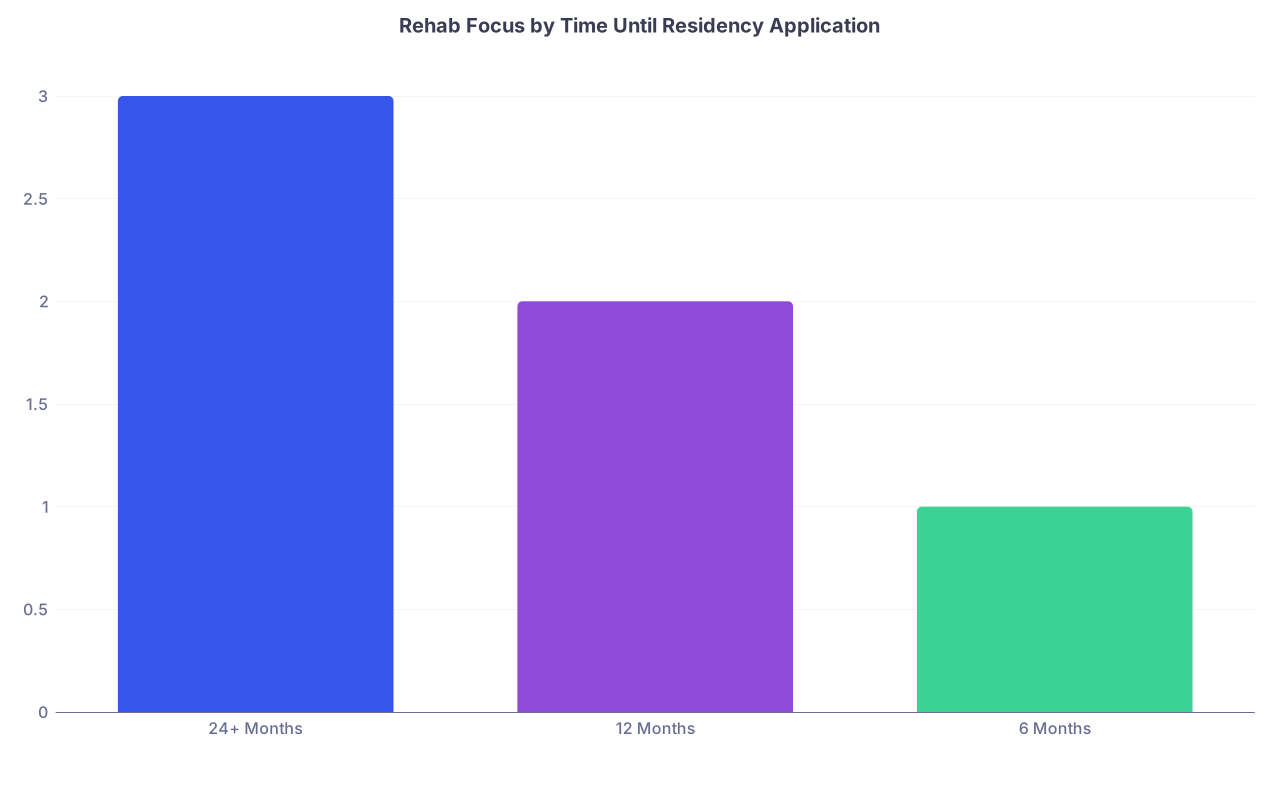
| Category | Value |
|---|---|
| 24+ Months | 3 |
| 12 Months | 2 |
| 6 Months | 1 |
Legend (informal):
3 = Can build entirely new track record
2 = Can partially offset red flag
1 = Mainly narrative and damage control
Step 4: Secure the Right Kind of Letters of Recommendation
You cannot out-essay a reputation problem. You need live humans backing up your story.
A. Who you want letters from
Prioritize:
- Supervisors after the firing who saw you consistently over at least 6 months
- Clinical faculty who can speak to your professionalism and reliability
- A program director, clerkship director, or PI who explicitly acknowledges your growth
A lukewarm letter from a “big name” who barely knew you is worse than a strong, detailed letter from a mid-level attending who worked with you daily.
B. How to brief your letter writers
Do not just email, “Can you write me a strong letter?” and hope they magically fix your narrative.
You need to ask for specific help:
“I am applying to residency this cycle. You are aware that I previously had a research position that ended early related to [brief description]. Since working with you, I have focused on improving [reliability, teamwork, communication].
If you feel comfortable, I would be very grateful for a letter that can speak to:
– My reliability and follow-through on tasks
– How I handle feedback and correction
– My teamwork and professionalism with staff and patientsIf you have any hesitation about writing a positive letter, I completely understand and would prefer you let me know.”
This gives them:
- Context
- Specific angles to address
- An exit if they cannot support you (which is better than a vague or negative letter)
Step 5: Rewrite Your CV to Highlight Stability and Growth
Now you start reshaping the story your CV tells.
A. Emphasize continuity and trust
You want patterns like:
- 9–12 months in one role, not 3 jobs in 6 months
- Progressive responsibilities (e.g., “Volunteer → RA → Project lead”)
- Repeated work with the same supervisor or team
On your CV, this looks like:
- Longer-term roles at the top
- Bullets focused on responsibility and ownership:
- “Primary resident liaison for X project”
- “Independently managed Y process under faculty supervision”
- “Trusted to orient and train new volunteers”
B. Use your activities to quietly counter the original concern
If you were fired for:
- Unprofessional communication → Show involvement in peer teaching, committee work, patient education
- Attendance issues → Show roles with fixed shifts, call schedules, consistent presence
- Research misconduct or sloppiness → Show quality-focused tasks: “implemented data validation checks,” “maintained audit-ready documentation”
You do not label it as “See? I am better now.” But a PD reading between the lines should sense: this person has lived under scrutiny and performed.
Step 6: Decide How and Where to Disclose the Firing
The worst approach is inconsistency: acting like the firing never happened on paper, then blurting out a half-explanation when cornered in an interview.
You need a consistent strategy across:
- ERAS application
- MSPE / Dean’s letter
- Personal statement (maybe)
- Supplementary statements (if applicable)
- Interviews
A. ERAS application
ERAS will not directly ask, “Were you fired?” But it will expose:
- Gaps in time
- Short employment / research stints
- Leaves of absence or professionalism issues if the school documented them
You do not need to write “fired” in your experience description. That is what interviews and, sometimes, secondary questions are for.
What you must avoid:
- fake dates
- invented roles
- pretending a mandatory departure was a “completed internship” if it was not
Honesty on structure; restraint on explanation.
B. Personal statement: when to mention it
You mention the firing in your personal statement only if:
- It significantly changed your trajectory or specialty choice, AND
- You can describe it concisely and maturely, AND
- You already have evidence of improvement (letters, later roles)
Bad use:
- Spending half the statement defending yourself
- Vague, self-pitying language
Better use (short, direct):
“During a prior research position, I was dismissed following concerns about my adherence to established data protocols. That experience forced an uncomfortable but necessary examination of my work habits and communication with supervisors. Over the past year, I have worked under Dr. X and Dr. Y, who have helped me build more structured workflows and seek feedback earlier rather than assuming alignment. Their mentorship, and my commitment to changing those patterns, have reshaped how I approach both research and clinical care.”
One paragraph. Not your whole story.
C. Interview: your 60–90 second firing script
You will get some version of:
- “I see you left this research position after four months. Can you tell me about that?”
- “Were there any professionalism concerns in your prior roles?”
- “Can you explain this gap?”
You need a crisp, calm script that:
- States what happened
- Accepts responsibility for your part
- Describes specific changes
- Ends on your current functioning
Template:
“In that research position, I was let go. The core issue was [brief, specific problem: e.g., not meeting agreed-upon deadlines and not being proactive in communicating when I was behind]. My PI and I had several conversations, and ultimately he decided to terminate the position.
Looking back, I agree with his concerns. I was not using structured systems to track tasks, and I avoided difficult conversations when I knew expectations were not going to be met. Since then, I have…
– Used structured tools to manage my work (for example, [brief concrete example])
– Asked for feedback earlier and more regularly
– Taken on roles where my reliability is visible, like [current role].My current supervisors, Dr. X and Dr. Y, are aware of that history. They have both shared that they have not seen those issues recur in the time we have worked together.”
You are not begging for forgiveness. You are presenting evidence of change.
Step 7: Coordinate Your Story With Your Institution
If your firing was tied to:
- A formal professionalism concern
- A Title IX or HR investigation
- A significant academic action (LOA, probation, suspension)
Then some version of it may already live in:
- Your MSPE / Dean’s letter
- Internal notes that PDs can ask about
- References from prior supervisors
You must know what is in writing about you.
Actions:
- Meet with: Dean of Students, academic advisor, or your school’s residency advising office.
- Ask directly:
- “How is this documented in my file?”
- “How will this be described in my MSPE?”
- Align your story with what they are going to say. Not word-for-word, but directionally.
If your Dean’s letter says:
“The student had a professionalism lapse related to failure to follow research protocols, which resulted in termination from a lab position. They have since completed remediation and have had no further issues.”
And you tell programs:
“I left that lab for personal reasons; it was mutual.”
You just failed the truthfulness test. Game over.
Step 8: Target Programs Strategically
Some programs will never touch a candidate with a firing or professionalism mark. Do not waste cycles trying to charm them.
You want programs that:
- Regularly take non-traditional applicants
- Have experience with remediated residents and structured support
- Are mid-tier or community-based rather than ultra-competitive powerhouses
You can sometimes get a sense from:
- Program websites emphasizing “second chances,” “holistic review,” “supportive environment”
- Residents with non-linear paths (former nurses, older grads, IMGs, prior careers)
Your job is not to convince every PD. It is to find the subset who believe in growth and give them rock-solid evidence that you are low-risk now.
Step 9: Build a “No Surprises” Culture Around You
One firing is survivable. Two is a pattern. You do not get a third.
Going forward, your operating rules should be:
Over-communicate problems early
If you are behind, say it. Before deadlines. Not after.Document expectations in writing
“To confirm our discussion, I will [X tasks] by [date].”Ask for mid-rotation / mid-project feedback explicitly
“Is there anything I am doing that concerns you or that I should adjust?”Avoid high-drama environments and toxic PIs
You cannot afford another political blowup, even if “you are right.”Protect your reputation the way you protect patient safety
One careless act can undo a year of good work.
You are not walking on eggshells. You are being deliberate.
Quick Visual: Recovery Path After a Firing

| Step | Description |
|---|---|
| Step 1 | Fired from Research/Job |
| Step 2 | Honest Self-Assessment |
| Step 3 | Contain CV Damage |
| Step 4 | Rehab Role with Trusted Supervisor |
| Step 5 | Strong Letters Demonstrating Growth |
| Step 6 | Consistent Story: CV, PS, Interviews |
| Step 7 | Targeted Program List |
| Step 8 | Match to Program Aligning with Your Story |
This is the loop. You cycle through these steps carefully instead of just “hoping” the firing fades away.
FAQs
1. Should I ever completely leave the fired position off my CV or ERAS?
You leave it off only if:
- It was very short (a few weeks),
- It is not documented anywhere formal (no HR file, no Dean’s letter mention, no payroll trail that matters), and
- Excluding it does not create a suspicious gap.
If it was a formal, clearly documented role (especially on campus or in a major academic center), omitting it is a major risk. Program directors compare stories. If your name comes up in conversation and your CV does not match reality, the narrative shifts from “had a firing” to “is dishonest.” The latter is far more damaging.
2. Can I still match into a competitive specialty after a firing?
You can, but the bar is higher and the strategy has to be aggressive and clean:
- You need stellar exam scores and clinical evaluations to offset the risk.
- You need at least one highly respected faculty member in that specialty willing to go to bat for you and explicitly address your past and current performance.
- You probably need to apply more broadly, including prelim and backup options.
Very competitive fields (Derm, Ortho, Plastics, ENT) are often risk-averse. Some will not even consider you. Aim for programs with a track record of supporting non-traditional applicants and be brutally realistic: your job is to find the subset that believes in redemption and show them a documented, sustained pattern of reliability after your firing.