

The worst career damage new attendings suffer is not from red-flag training. It is from moving at the wrong time afterward. Too early, too late, or in the wrong way.
You survived a problematic residency or fellowship. Maybe you even left a toxic program. Now you are in Attending Year One, and the question hangs over everything: when do you move, and how do you time it so your past does not keep hurting your career?
I will walk you through this chronologically: pre-attending months, each quarter of Attending Year One, and what to do if the red flags are severe (fellowship dismissal, gaps, bad PD letter).
6–12 Months Before Attending Job Start: Quiet Damage Control
At this point you should stop thinking like a trainee and start thinking like someone managing a 30-year career asset: your reputation.
Step 1: Define exactly what your “training red flag” is
Write this down in one sentence. No fluff.
Examples:
- “Withdrew from a general surgery residency PGY-3 after remediation and program–resident conflict.”
- “Non-renewal of anesthesia contract after PGY-2 due to professionalism concerns.”
- “Transferred IM residency programs after major conflict with PD.”
- “Completed residency but with one failed step/board attempt and an extra year.”
You are not just labeling the past. You are defining the story you will have to explain, over and over, for years.
Step 2: Map how bad programs and employers will see it
Brutally honest assessment:
- Minor red flags:
- 1 failed Step or board exam, later passed
- One leave of absence with clear medical/family reason
- Transfer between programs with good letters
- Moderate:
- Extended training (extra year), probation that ended well
- Gaps of several months not cleanly explained
- Major:
- Non-renewal of contract
- Dismissal from residency/fellowship
- No program director letter or blatantly negative one
You should know where you sit on that spectrum because it dictates how early you must plan your first move and how careful you must be about timing.
Step 3: Pre-attending narrative prep (3–6 months before)
Before you even start your first attending job, you should:
Draft a 30–60 second explanation of the red flag:
- Brief context
- Clear ownership of your part
- Concrete evidence of improvement
- Clean ending: “That is now fully resolved, here is how I practice today.”
Test it with:
- A trusted faculty mentor
- One co-resident who will not sugar-coat anything
- Someone outside medicine who can flag defensive or confusing language
If they say, “That sounds complicated,” it is not ready. Fix it now, not during a future job interview.
Month 0–1 of Attending Year One: Lock Down Stability
You just started your first attending job. This is not the time to be browsing job boards like you are still in PGY-2. At this point you should be building a record that dilutes your training red flags.
Your goal for the first month
By the end of Month 1, you want:
- A schedule that is stable and sustainable
- Baseline relationships with:
- Department chair
- Clinic manager / nursing leadership
- At least 1–2 senior attendings who actually know your name
- Zero new professionalism or performance issues
You might hate aspects of the job already. Fine. You can move later. But a second short, messy stint as an attending will look far worse than almost any residency red flag.
Concrete tasks in Month 1
- Show up early. Every day. For the first month, you are overcorrecting for any whisper of “unreliable” in your training file.
- Ask for expectations in writing:
- RVU goals
- Call responsibilities
- Evaluation schedule
- Identify one “documentable” contribution you can start:
- QI project
- Protocol revision
- Teaching involvement
You are not doing this for fun. You are building evidence you can use later: “At my first attending job, I led X, improved Y, and consistently met Z metrics.”
Months 2–3: Prove Competence, Stay Put
At this point you should not be applying out yet, unless your current job is truly unsafe or untenable. Your job in Months 2–3 is to show you can perform consistently.
Focus areas
Clinical performance:
- Solid, boringly safe care
- Good documentation (no chronic late notes, no compliance headaches)
- Avoid being “the outlier” on anything (complaints, metrics, interpersonal drama)
Early reputation:
- Ask one trusted colleague: “How am I coming across so far?”
- Listen without defending. Fix issues fast.
Data collection: Start tracking:
- Patient volumes
- RVUs / productivity
- Patient or colleague feedback (formal or informal)
That spreadsheet will become your lifeline when you later need to prove: “Whatever happened in training, I have now delivered X months of clean, high-quality attending work.”
End of Quarter 1 (Month 3): First Decision Point
At the 3-month mark, you should stop and formally assess:
Is this job:
- Safe?
- Reasonably stable?
- Not actively poisoning your reputation (e.g., sketchy billing, unsafe staffing)?
Are your red flags still dominating the narrative in your head?
Here is the key: You still should not move now unless there is real harm in staying. A 3-month attending job on your CV is a new, giant red flag. Most department chairs read that as: “Problem.”
Quarter 2 (Months 4–6): Strategic Positioning, Not Jumping
By this point you should be settled clinically. Your margin for career strategy is slightly bigger now.
Month 4: Document and solidify
Tasks:
- Ask your division chief or chair for:
- Brief mid-year feedback
- One specific goal they want you to hit in the next 3–6 months
- Start a “future letter fodder” file:
- Emails thanking you for good care
- Notes about successful cases, projects, presentations
You are curating the exhibits for your future defense: “I have been a strong, reliable attending since day X.”
Month 5: Quiet recon and networking
Now you can start exploring—quietly.
- Reach out to:
- Former faculty who liked your work
- Alumni from your med school or residency now in better jobs
- Professional society contacts
Your line is simple:
“I am in my first year as an attending and planning out my next 2–3 years. I would value any advice on where to grow, and what programs value early-career attendings who have had a non-traditional training path.”
You are not saying “I hate my job, get me out.” You are signaling future interest and gathering intel about what hiring timelines look like in your specialty.
Month 6: Reality check and timing plan
At Month 6 you should decide your provisional timeline to move:
- If your red flag is minor/moderate
Aim for 12–24 months in the first attending job before moving. - If your red flag is major (dismissal, non-renewal, no PD letter)
You generally need 18–36 months of clean attending work to push that into the background.
Do not like those numbers? I have watched people ignore them, jump at 6 months, and then spend years explaining two problematic stops instead of one. It is ugly.
Quarter 3 (Months 7–9): Build Leverage, Not Desperation
At this point you should be solidly functional as an attending. Now the focus shifts: build leverage for your future move.
Months 7–8: Strengthen your “portfolio”
Target at least two of these:
Teaching:
- Regularly precepting residents/med students
- A scheduled lecture in a local program or CME event
QI / admin:
- Lead or co-lead a small QI project with measurable outcomes
- Committee involvement where your name appears in minutes or reports
Research / scholarship:
- Case report
- Retrospective chart review
- A talk at a local or regional meeting
Do not overcomplicate this. One simple, completed project is better than five half-finished “initiatives.”
Month 9: Start active, but targeted, search (if planning to move)
If your plan is to move around the 18–24 month mark, Month 9 is when you:
- Identify target employers (geography + practice type)
- Learn their hiring seasons:
- Academic departments often hire on 6–12 month lead time
- Private groups often hire closer to need (3–6 months)
At this point you should not apply widely. Focus on intel and relationships, not blasting CVs.
Quarter 4 (Months 10–12): Decide Whether to Ride Out Year Two Here
At this point you should have a clear view: is this job tolerable for another year, and is it giving you good “optics” to future employers?
Month 10: Performance conversation
Schedule a formal or semi-formal meeting with your division chief or chair.
Your agenda:
- Review performance (numbers, feedback)
- Ask: “If I continue on this trajectory, what do you see for me here over the next 2–3 years?”
You are testing:
- Do they see you as stable and valuable?
- Are there promotion, leadership, or niche opportunities?
- Would they likely write a strong letter?
If the answer is yes, you have more safe runway to time your move. If the answer is vague or negative, your urgency to move after Year One increases.
Month 11: Get at least one strong letter commitment
By the end of Month 11 you should know who can write for you when you apply out.
Options:
- Department chair
- Section chief
- Senior colleague who has seen you clinically and in projects
You ask like this:
“I am starting to consider my longer-term career moves. If I were to apply for positions in the next year or two, would you be comfortable writing me a strong letter?”
If they hesitate or dodge, they are not your letter writer. Better to know now.
Month 12: Year-One review and go/no-go
End of Year One is your big checkpoint.
At this point you should:
- Have:
- 12 months of clean, documented attending work
- At least one credible letter writer
- A clear, rehearsed explanation of your training red flag
- Decide:
- Stay one more year and then move (common and often optimal)
- Begin a serious search now to move between Months 18–24
- In rare cases, accelerate if the environment is truly damaging your reputation
When You Should Not Move in Year One
I will be blunt. Moving in Year One is usually a horrible idea unless:
- The job is legitimately unsafe (dangerous staffing, illegal practices)
- Actual abuse or harassment that leadership refuses to address
- The group is imploding (loss of contracts, nonpayment, bankruptcy risk)
If your reason is:
- “I am bored.”
- “I do not like call.”
- “The city is not fun.”
You stay. You fix the optics first. You give your CV a stable, boring line: “Hospital X, Attending, 2026–2028.”
How Training Red Flags Change the Timeline
Different red flags affect how long you should stay and how carefully you move.
| Training Red Flag Type | Suggested Minimum in First Attending Role |
|---|---|
| Single failed Step/board, passed | 12 months |
| Extra residency year, resolved | 18 months |
| Transfer with decent letters | 18–24 months |
| LOA with clear medical/family cause | 12–18 months |
| Non-renewal of contract | 24–36 months |
| Dismissal or no PD letter | 24–36 months |
Harsh, but I have watched this play out:
- The person who did 24 clean months after a dismissal gets hired with pointed questions, but they get hired.
- The person who hops after 6–9 months to a second messy job? Perpetual skepticism. Some places will not even interview them.
Special Cases and Timing Tweaks
If you left fellowship early or were dismissed
Your first attending job is doing double duty: training completion + reputation rehab.
Timeline adjustments:
- You may need 3+ years at the first job, especially in procedural fields.
- Focus early on:
- Procedural competency logs
- Objective outcomes
- Collegial feedback from anesthesia, nursing, other services
You do not move until your logbook and outcomes make people forget the fellowship story.
If your PD refused to write a letter
You cannot fix the past, but you can bury it.
- Secure multiple strong attending letters by Month 18–24.
- Make your explanation simple:
“Our relationship was strained in residency. I have since had consistently strong evaluations as an independent attending, and I have multiple current supervisors who can speak to my work.”
Your current chair’s letter, if strong, will often matter more than a missing PD letter—if you have been stable for 2+ years.
Visualizing the Overall Timeline
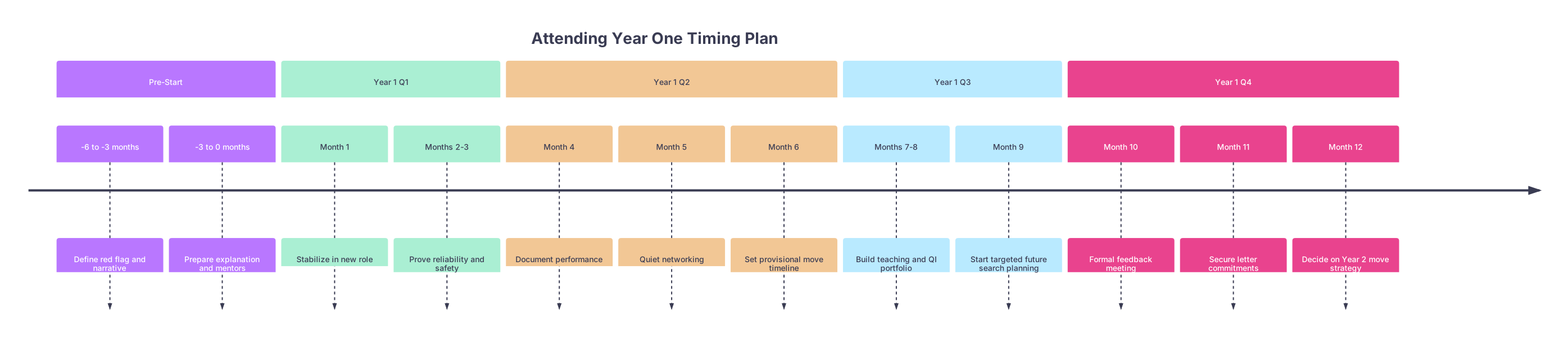
| Period | Event |
|---|---|
| Pre-Start - -6 to -3 months | Define red flag and narrative |
| Pre-Start - -3 to 0 months | Prepare explanation and mentors |
| Year 1 Q1 - Month 1 | Stabilize in new role |
| Year 1 Q1 - Months 2-3 | Prove reliability and safety |
| Year 1 Q2 - Month 4 | Document performance |
| Year 1 Q2 - Month 5 | Quiet networking |
| Year 1 Q2 - Month 6 | Set provisional move timeline |
| Year 1 Q3 - Months 7-8 | Build teaching and QI portfolio |
| Year 1 Q3 - Month 9 | Start targeted future search planning |
| Year 1 Q4 - Month 10 | Formal feedback meeting |
| Year 1 Q4 - Month 11 | Secure letter commitments |
| Year 1 Q4 - Month 12 | Decide on Year 2 move strategy |
Year Two and Beyond: When You Actually Pull the Trigger
Most people with training red flags should aim to start applying for the next job sometime between Month 18 and Month 30 of their first attending role.
Signs you are ready to move
At this point you should be seeing all of the following:
- At least 18–24 months of uninterrupted, clean practice
- Documented productivity and quality data
- 2–3 strong letters from current role
- A concise, practiced story about training red flags that now ends with:
“Since then I have had X years of strong, independent attending performance.”
When you interview, the red-flag discussion should:
- Occupy <10% of the conversation
- Lead quickly into your current successes and contributions
If you are still spending half the interview talking about your residency issues, you applied too early or you did not build enough of a portfolio in your first job.
What To Do Today
Open a blank document and write one sentence that describes your training red flag in the harshest but honest terms. Then draft a 4–5 sentence explanation that ends with what you have done well since.
Next, look at your current attending job start date. Count forward 18–24 months and put three calendar reminders: “Am I ready to move yet?” at Months 12, 18, and 24.
Timing your move is not about hope. It is about giving yourself enough clean, boring, competent time as an attending that your past becomes a footnote, not the headline.


