
The day you certify your rank list is not a celebration. It is a safety inspection. Treat it like signing a contract you cannot escape for at least a year, sometimes seven.
What gets people burned is not “picking the wrong #1.” It is missing red flags that should have knocked a program down, off the list, or into the “only if the algorithm hates me” zone.
Here is a time‑locked, step‑by‑step checklist for the day you certify. Not two weeks before. Not in some theoretical ideal world. This is what you do from the morning you intend to certify until you finally click “Submit and Certify.”
Morning – Before You Open NRMP: Hard Reset On Your Priorities (30–60 min)
At this point you should not be staring at your current draft yet. You start by resetting your brain so you are not hypnotized by interview-day charm or big-name logos.
Step 1: Re‑define your “non‑negotiables” (10–15 min)
Grab a single sheet of paper. Not your notes app. Handwriting slows you down enough to think.
Write 3 columns:
- Column A – Absolutely required
- Column B – Strongly preferred
- Column C – Nice but irrelevant to safety
Examples for Column A (these are safety and red‑flag related):
- Reasonable duty hours actually followed (not just “we follow ACGME” lip service)
- Respectful culture: no routine humiliation, no screaming attendings as “normal”
- PD and chair seen as stable and supportive, not rotating every 6–12 months
- Evidence residents match into decent fellowships or jobs
- Real support for wellness and leave (pregnancy, medical issues, family emergencies)
- No credible pattern of racism, sexism, harassment being ignored
Column B might be:
- Location near partner/family
- Prestige / fellowship pipeline
- Specific niche (global health, research, rural track)
Column C:
- Free food
- New building
- “Residents seemed chill on the one day I visited”
At this point you should have 5–10 items in A and B combined. If you have 25, you will paralyze yourself. Tighten it.
Step 2: Quick reality check against specialty norms (10–15 min)
Some “bad” things are normal for your field. Others are truly red flags.
Use this time to remind yourself what baseline rough looks like for your specialty:
- Surgery: longer hours, more overnight cases, higher stress. That is not automatically toxic.
- Psychiatry: if you saw chronic violations of duty hours there, that is more concerning.
- EM: busy and chaotic is expected, but consistent stories of unsafe boarding and no backup are different.
If you are unsure, text or call one trusted upper‑year, chief, or mentor:
“Quick gut check: how worried should I be about [x] in a [specialty] program?”
At this point you are not asking them to rerank for you. You are calibrating what counts as a true red flag vs “this field is hard.”
Late Morning – Program‑by‑Program Safety Triage (60–90 min for full list)
Now you look at each program in order and do a safety pass, not a preference pass.
You are asking:
“Given what I know today, is there a reason this program should NOT be allowed to sit this high on my list?”
Step 3: Build a compact red‑flag scorecard
Create a quick grid (paper or spreadsheet). Each row is a program. Columns are specific red‑flag domains.
| Program | Culture | PD Stability | Duty Hours | Resident Outcomes | Safety/Support | Overall Concern |
|---|---|---|---|---|---|---|
| Program A | 0 | 1 | 2 | 0 | 1 | 4 |
| Program B | 2 | 2 | 1 | 1 | 2 | 8 |
| Program C | 0 | 0 | 0 | 0 | 0 | 0 |
Use a rough 0–2 scale per column:
- 0 = No serious concern
- 1 = Mild concern, watch closely
- 2 = Major concern / clear red flag
At this point you should go down your current rank list top to bottom and fill this out from memory first. No doom‑scrolling yet.
What you are looking for:
- Any program with 2s in multiple columns that still sits high on your list.
- Any program where you wrote “something just felt off” after interview day.
Midday – Deep Dive On Suspect Programs (90–120 min)
Now you go hunting. You do not need to re‑research every program. Only the ones that tripped something in the scorecard.
Step 4: Re‑read your own post‑interview notes (30–45 min)
At this point you should open whatever mess you used during interview season:
- Notion page
- Word doc
- Scratched notebook margins
- Spreadsheet comments
Look for three specific patterns:
Repeated soft warnings you dismissed at the time
- “PD talked over residents a lot”
- “Residents looked exhausted but said ‘it’s fine’ too fast”
- “Nobody could clearly explain how complaints are handled”
Conflicting stories
- Residents say: “We rarely exceed 60 hours a week.”
- Faculty jokes: “You basically live here PGY‑2, but you will survive.”
Missing information
- You still do not know their fellowship match outcomes.
- No one could tell you how many residents left in the last 5 years.
If you wrote “red flag” or drew a big question mark at any point, do not ignore it now. This is why you took notes.
Step 5: External intel check – but time-box it (30–45 min)
Set a timer. 45 minutes maximum. You are not trying to write an exposé.
Hit these sources in order:
People you trust (if you have them)
- Upper‑years from your med school who matched there
- Recent graduates in that region
- A chief or faculty member you can text: “Any reason I should be cautious about [Program X]?”
Public data / official stats
- Program’s website: look at resident list over the last 5 years. Any obvious disappearances mid‑training?
- ACGME or program brochures for case numbers, fellowship match lists, board pass rates.
Anonymous online info (last resort, very filtered)
- Reddit / SDN / specialty forums: read only recent comments, and look for consistent patterns, not one angry post.
- If multiple independent posts say the same specific thing (e.g., “4 residents left last year,” “PD fired with no communication”), bump your concern level.
Stop when your time is up. If you cannot find information, that in itself is data. Some programs aggressively hide problems by saying very little.
Early Afternoon – Explicit Red‑Flag Categories Check
Now you run each program near the top of your list through a focused red‑flag safety lens. You are not ranking vibes. You are screening for landmines.
At this point you should pull up your top ~8–10 programs and go category by category.
1. Culture and behavior
Look for:
- Regular stories of attending yelling, shaming, or punishing residents in front of others
- Residents describing the program as “sink or swim,” “trial by fire,” “you just survive”
- PD / APD making jokes that felt a bit too comfortable with racism, sexism, or homophobia
- Residents who seemed fearful with faculty present, then different when alone
- No one could name a single conflict that was resolved in a healthy way
If any program high on your list matches multiple bullets here, it is unsafe. That is a drop‑at‑least‑several‑spots situation.
2. Leadership stability and transparency
Ask yourself:
- Has the PD or chair changed more than once in the last 3 years?
- Did residents seem uncertain about “new leadership,” “restructuring,” or “pending accreditation issues”?
- Did anyone dodge direct questions about why residents recently left?
A single leadership change is not a death sentence. A pattern of chaos is.
3. Duty hours and workload reality
This one is where people get gaslit.
You are looking for:
- Residents who laugh when asked about duty hours, then say, “We always log 80” with a wink
- Multiple residents mentioning “coming in on days off to finish notes” or “pre‑rounding off the clock”
- Call schedules that look mathematically impossible if you actually stay until tasks are done
- Chronic under‑staffing with no plan to add residents or APPs
If your specialty typically runs hot, some fatigue is expected. But if you heard “Do not report duty hours or we all get punished,” that is a giant red flag.
4. Resident outcomes and attrition
At this point you should verify, program by program:
- Do they publish where graduates go (fellowship / jobs)?
- Are there obvious gaps in classes (e.g., “Class of 2023 – 6 names; 2024 – 4 names”)?
- Did anyone hint that residents transferred out or left under the radar?
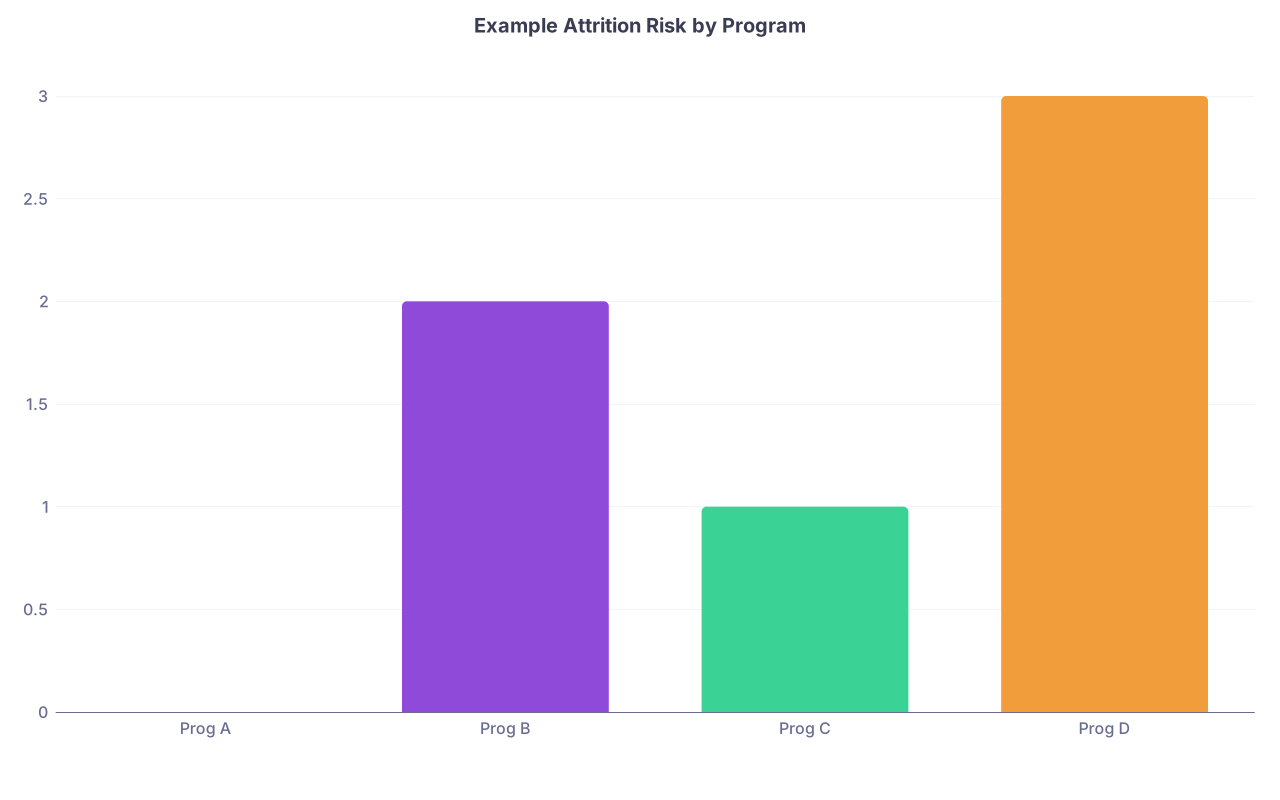
| Category | Value |
|---|---|
| Prog A | 0 |
| Prog B | 2 |
| Prog C | 1 |
| Prog D | 3 |
If a program has a pattern of residents leaving and you still cannot get a straight story, that program does not deserve a high rank. Period.
5. Safety, wellness, and support
This is where programs love to lie with swag and wellness lectures.
You are screening for:
- No specific process for medical leave, parental leave, or mental health crises
- Residents saying things like “We have wellness half days… that always get cancelled”
- Stories of residents punished or retaliated against after raising concerns
- Hand‑wavy answers on backup coverage when someone is sick
If a program cannot describe how they support a resident with severe illness or pregnancy, imagine being that resident there. That is your answer.
Late Afternoon – Re‑Order Based On Safety, Not Ego (45–60 min)
At this point you should be emotionally tired. That is fine. Now you make the actual moves.
Step 6: Separate “unsafe” from “less ideal”
Take your existing list and mark each program with one of three labels:
- Green – No significant red flags. Mostly about preference and fit.
- Yellow – Concerns exist but probably manageable with eyes open.
- Red – Serious safety, culture, or leadership issues. You would dread matching here.
Now do something most people skip:
Pull all “Red” programs to the bottom block of your list.
- Do not delete them yet. Just isolate them.
- If you truly would rather go unmatched than train there, then yes, remove. But be honest: for most people, “nightmare but necessary backup” still has a place.
Re‑order within Green and Yellow based on how much of Column A (non‑negotiables) they meet.
- A “less prestigious” program that respects residents and is stable goes above a big‑name program with serious culture issues.
- This is where many people make their biggest mistake—chasing prestige over safety.
Step 7: Sanity check against your future self (15–20 min)
At this point you should step away from the screen for 10 minutes. Then come back and ask:
“If I matched at Program #1 and it is as advertised, could I see myself functioning and growing there for the next 3–7 years?”
Do the same for:
- Program #3
- Program #5
- The first Yellow program on your list
- The top Red program at the bottom
If imagining yourself at a certain program makes your stomach knot, that program is too high. Move it down until the knot eases, or off the list entirely if it never does.
Early Evening – Technical Safety Checklist Before Certifying (20–30 min)
Now you switch from content safety to process safety. People have been burned by simple mistakes here too.
Step 8: Mechanical NRMP cross‑check
At this point you should log into NRMP but not hit any final buttons.
Go through this checklist:
- Confirm every program and track is listed exactly once (categorical vs prelim vs advanced).
- Confirm you did not accidentally rank:
- A prelim you hate above a categorical that is safe.
- A program in the wrong city with a similar name (yes, it happens).
- Confirm your couples match link (if applicable) is correct:
- No unmatched / unmatched pairs left by accident.
- No “both get something terrible” pairing at the top that you built as a placeholder.
Read the entire rank list out loud once, top to bottom. You will catch absurdities faster that way.
Night – Final Red‑Flag Pass and Emotional Check (30–45 min)
You are almost done. Do not rush the last part.
Step 9: One last explicit red‑flag question per program
For each of your top 10 programs, answer yes/no to this:
“Do I have any unresolved red flag that, if it turned out to be as bad as my worst suspicion, would make me regret ranking this program this high?”
If “yes”:
- Either move it down until your answer becomes “no,”
- Or accept that you are trading safety for something else (prestige, location). But make that choice consciously, not accidentally.
Step 10: Check your emotional bias
You are vulnerable to three big distortions right now:
- Recency bias – Last interview feels best.
- Halo effect – Big‑name institution blinds you to terrible culture.
- Sunk‑cost fallacy – “I spent lots of time on this program, it has to stay high.”
Counter them explicitly:
- Compare your #1 and #2 on non‑negotiables only, ignoring name.
- Ask: “If these two swapped names, would I keep the same order?”
- If not, admit the brand is driving your decision. Decide if you are okay with that.
Certification – The Actual Click (5–10 min)
At this point you should be looking at a list that is:
- Free of obvious, severe red flags at the top.
- Structured so each lower program is genuinely less desirable or less safe than the one above it.
Now:
- Click Certify List.
- Read the confirmation statement slowly.
- Take a screenshot or print to PDF. Save it somewhere obvious.
Do not play with the list after this unless:
- You receive genuinely new, credible information about a major safety issue.
- A trusted mentor strongly alerts you to a specific red flag you had not understood.
If that happens, repeat a mini‑version of the process: reassess, adjust, recertify.
Quick Reference – Same‑Day Red‑Flag Checklist
Use this condensed list to make sure you actually hit the critical steps:
| Step | Task |
|---|---|
| 1 | Write non-negotiables and priorities |
| 2 | Fill red-flag scorecard from memory |
| 3 | Re-read post-interview notes |
| 4 | Time-boxed external intel check |
| 5 | Category-by-category red-flag review |
| 6 | Mark programs Green/Yellow/Red |
| 7 | Re-order list based on safety first |
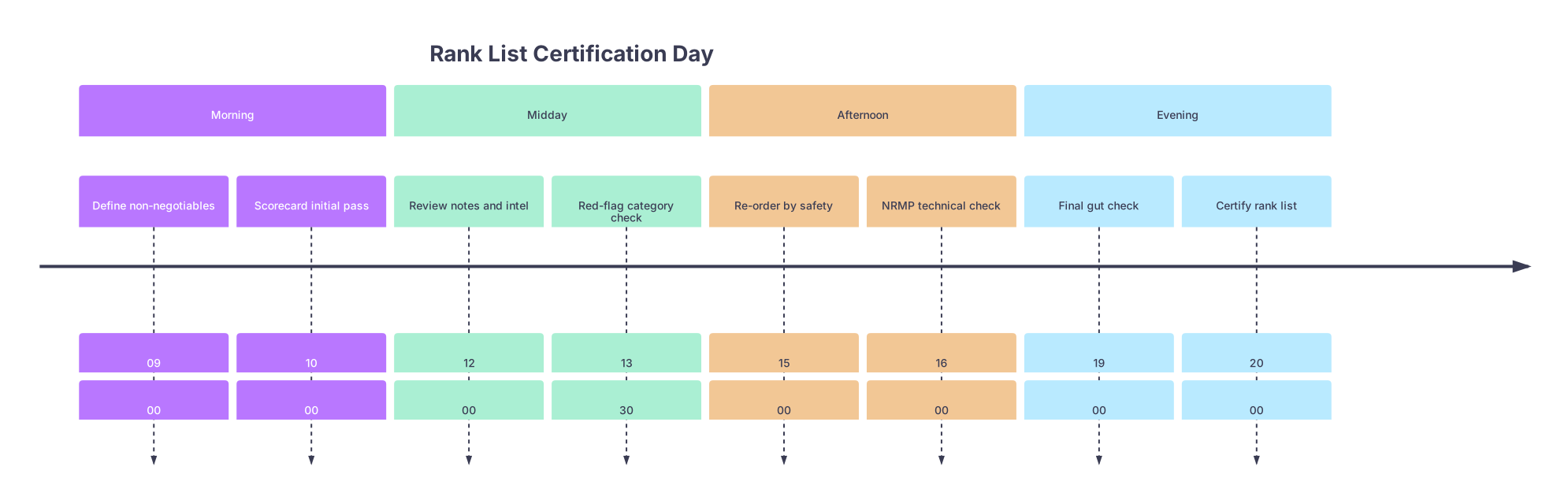
| Period | Event |
|---|---|
| Morning - Define non-negotiables | 09 |
| Morning - Scorecard initial pass | 10 |
| Midday - Review notes and intel | 12 |
| Midday - Red-flag category check | 13 |
| Afternoon - Re-order by safety | 15 |
| Afternoon - NRMP technical check | 16 |
| Evening - Final gut check | 19 |
| Evening - Certify rank list | 20 |
Final Thoughts
Three points to walk away with:
- Safety beats prestige. A stable, respectful, slightly less famous program is almost always better than a toxic brand name.
- Red flags do not fix themselves. If a program looked chaotic or abusive during recruitment season, you will not be the one who magically changes it as an intern.
- Your rank list should reflect conscious trade‑offs. If you choose to tolerate a risk (for location, name, or opportunity), do it with your eyes open, not because you never took the time to look.


