

The most dangerous red flags in residency are the ones you only recognize during fellowship application season.
You thought you were over that bad rotation. That malignant senior. That ugly professionalism comment. Then ERAS for fellowship opens and suddenly you are reliving intern year with a much bigger audience and much higher stakes.
Let me walk you through, chronologically, how to re‑evaluate prior red flags during your fellowship application year so they do not quietly sabotage you.
Big Picture: Your Year‑Long Timeline
At this point you are somewhere between late PGY‑2 and early PGY‑4 (depending on specialty and fellowship). The exact months vary by field, but the pattern is the same.
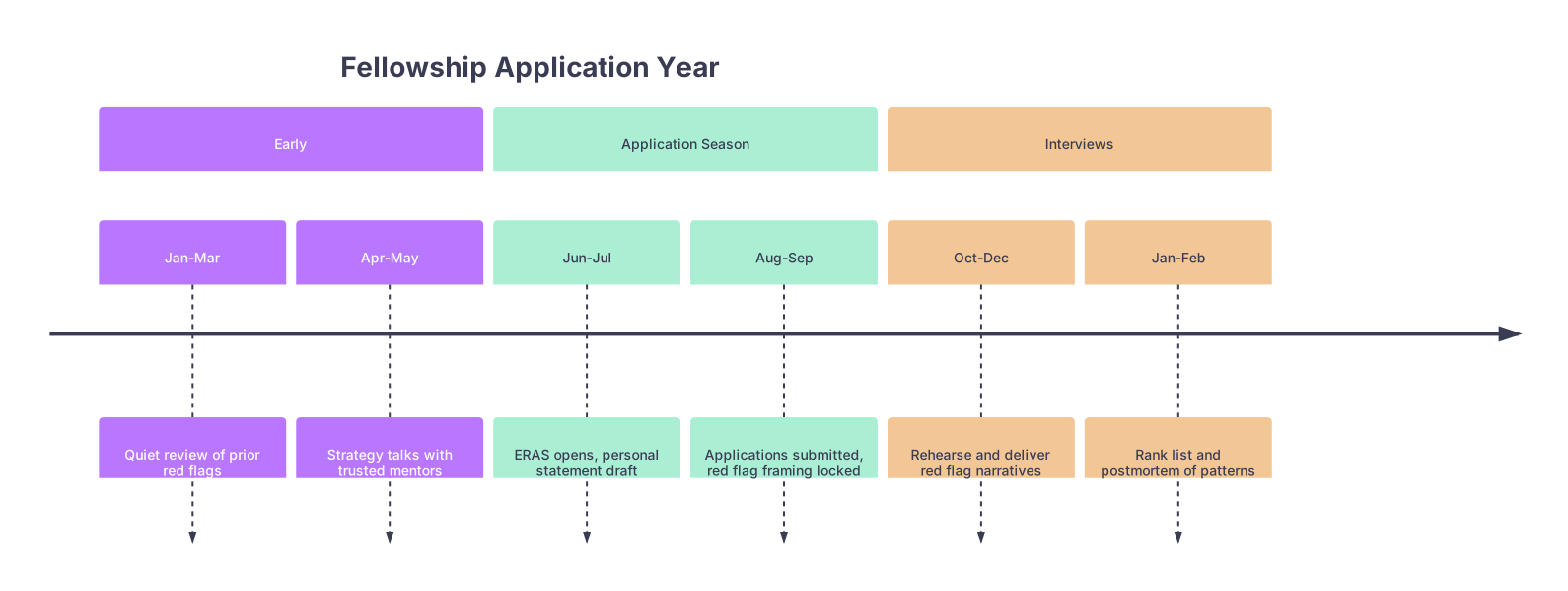
| Period | Event |
|---|---|
| Early - Jan-Mar | Quiet review of prior red flags |
| Early - Apr-May | Strategy talks with trusted mentors |
| Application Season - Jun-Jul | ERAS opens, personal statement draft |
| Application Season - Aug-Sep | Applications submitted, red flag framing locked |
| Interviews - Oct-Dec | Rehearse and deliver red flag narratives |
| Interviews - Jan-Feb | Rank list and postmortem of patterns |
At each point in this year, you should be doing something very specific with your past red flags.
January–March: Inventory and Autopsy of Old Red Flags
This is the part almost everyone skips. They remember “a few bumps,” then are blindsided when a PD brings up that one CCC note in detail.
Step 1: Build Your Red Flag Inventory
By January–March of your fellowship application year, you should block off a weekend and pull everything:
- Official evaluations (CCC, semi‑annual reviews)
- Letters from your current program director
- Any remediation plans, emails, or “developmental” comments
- Prior application materials (med school MSPE, old ERAS, USMLE transcript)
- Any incident reports, wellness leave documentation, professionalism concerns
Now, at this point you should build a brutally honest list in a single document:
Performance issues
- Low in‑training exam scores (e.g., bottom quartile two years in a row)
- Rotation failures or needing to repeat a block
- “Below expectations” boxes checked in patient care, communication, etc.
Professionalism / behavior
- Formal write‑ups, even if “resolved”
- Comments about lateness, documentation delays, response times
- Conflicts with nurses, colleagues, or attendings that reached leadership
Gaps and anomalies
- Time off outside usual vacations (medical leave, FMLA, personal leave)
- Switching programs or specialties
- Step failures, COMLEX repeats, board deferrals
Program‑level red flags that might splash onto you
- Program on probation during your training
- High resident attrition or public accreditation problems
You are not doing damage control yet. You are doing forensics.
Step 2: Classify Each Issue by Severity and Visibility
Not every “red flag” is equal. Some live only in your head; others live in your PD’s weekly talking points.
At this point you should classify each item:
| Type | Severity Level | Visibility Risk | Examples |
|---|---|---|---|
| Exam or score issues | Low–Medium | High | Step failure, low ITE |
| Single bad rotation | Low–Medium | Medium | 1 month of poor evals |
| Formal professionalism | High | Very High | Written warning, remediation |
| Leave of absence | Medium–High | High | 3+ months off, gap in training |
| Program probation | Medium | Medium | ACGME warning while you trained |
Ask for each:
- Will this automatically appear in ERAS / MSPE / transcripts?
- Can a fellowship PD see it without asking my PD?
- Is it likely my PD will mention it if they are being candid?
If the answer is “yes” to any of those, it is not optional to address. You will need a coherent, rehearsed narrative.
Step 3: Autopsy the Context, Not Just the Event
Now you go one level deeper. For each red flag, document:
- What actually happened (facts, dates, location)
- Who was involved (attending, senior, chief, PD)
- What you did immediately after (apology, meeting, remediation)
- What formal steps occurred (probation, extra evaluations, counseling)
- What has measurably changed since
This is where people either look mature or evasive in fellowship interviews. If you cannot articulate the process and the change, PDs assume you learned nothing.
Write this out in plain language. Not for submission, for your own clarity.
April–May: Strategy Talks and Reframing
This is the corrective lens phase. You stop referring to things as “it was kind of blown out of proportion” and start framing them as specific, measurable growth.
Step 4: Select Your Inner Circle of Advisors
By April, you should have:
- 1–2 trusted faculty in your target fellowship field
- Your current PD or APD (assuming at least neutral relationship)
- Possibly a former chief or senior who knows the real story
At this point you should do three separate conversations:
With a field mentor (not your PD)
- Goal: How this will look to outside programs in this subspecialty.
- Ask:
- “If you saw X on an application, what would you suspect?”
- “What would you need to hear in an interview to feel reassured?”
With your PD or APD
- Goal: Align narratives. Their letter and your story cannot conflict.
- Ask directly:
- “What concerns do you think fellowship PDs will have about my application?”
- “If someone called you about [incident], how would you describe it now?”
With a peer who is brutally honest
- Goal: Check if you sound defensive, blaming, or vague.
- Practice explaining the issue in 2–3 minutes and let them critique.
You are not trying to spin. You are trying to anticipate the worst reading of your history and neutralize it with facts and growth.
June–July: Application Construction and Quiet Damage Control
This is when ERAS (or SF Match, NRMP subspecialty, etc.) opens and you lock in your story in writing. If you wait until then to think about red flags, you will write a panicked, clumsy disclosure section.
Step 5: Decide What Must Be Explicitly Addressed in Writing
At this point you should create three categories for each item:
Must be disclosed explicitly in ERAS / personal statement
- Step failure
- Leave of absence during med school or residency
- Formal remediation / professionalism plan that will appear in letters
- Program transfers
Should be addressed only if directly asked
- Single rotation with critical feedback but overall normal record
- Personality clash that never escalated formally
- Mild in‑training exam underperformance with later improvement
Should be buried and replaced by evidence of growth
- Vague early‑intern comments that have clearly resolved
- “Needs to work on efficiency” when your recent evals say the opposite
- Minor documentation delays from your first month
You are prioritizing. You will not turn your personal statement into a confession booth.
Step 6: Write Tight, Chronological Growth Narratives
For each “must disclose” item, you should have a 3‑part structure:
- What happened – concise, specific, no drama
- What you did in response – actions, not feelings
- What has changed, with objective evidence – scores, roles, evals
Example for a Step 1 failure:
- “During my second year of medical school, I failed Step 1 on my first attempt after underestimating the structured study time required.”
- “I met with academic support, created a detailed study calendar, and completed 4,000+ practice questions with weekly faculty check‑ins before retaking the exam.”
- “On my second attempt, I scored 225, and since starting residency I have scored in the top third on our in‑training exams and frequently teach board review sessions for interns.”
Same template works for professionalism issues, leave of absence, or bad rotations. The key is chronological cause→response→result.
Do not write: “This experience taught me resilience.” Every PD has read that sentence 200 times. Show resilience through what you did and sustained over time.
August–September: Submission and Pre‑Interview Rehearsal
Applications go out. You cannot edit ERAS anymore. What you can control now is how you sound when a PD says, “Tell me about this note in your file.”
Step 7: Build an Anticipated Question List
At this point you should assume the most cynical reader possible and list questions they might ask, such as:
- “Why did you fail Step 2 when your med school grades were strong?”
- “Your program director mentioned a professionalism concern during PGY‑1. What happened?”
- “I see you took a 5‑month leave of absence. Can you explain?”
- “Why did you transfer programs after PGY‑1?”
- “Your program has had multiple residents leave. Should I be worried that you are difficult to work with?”
Write them all down. Then under each, jot bullet answers using the same three‑part structure: event → response → current evidence.
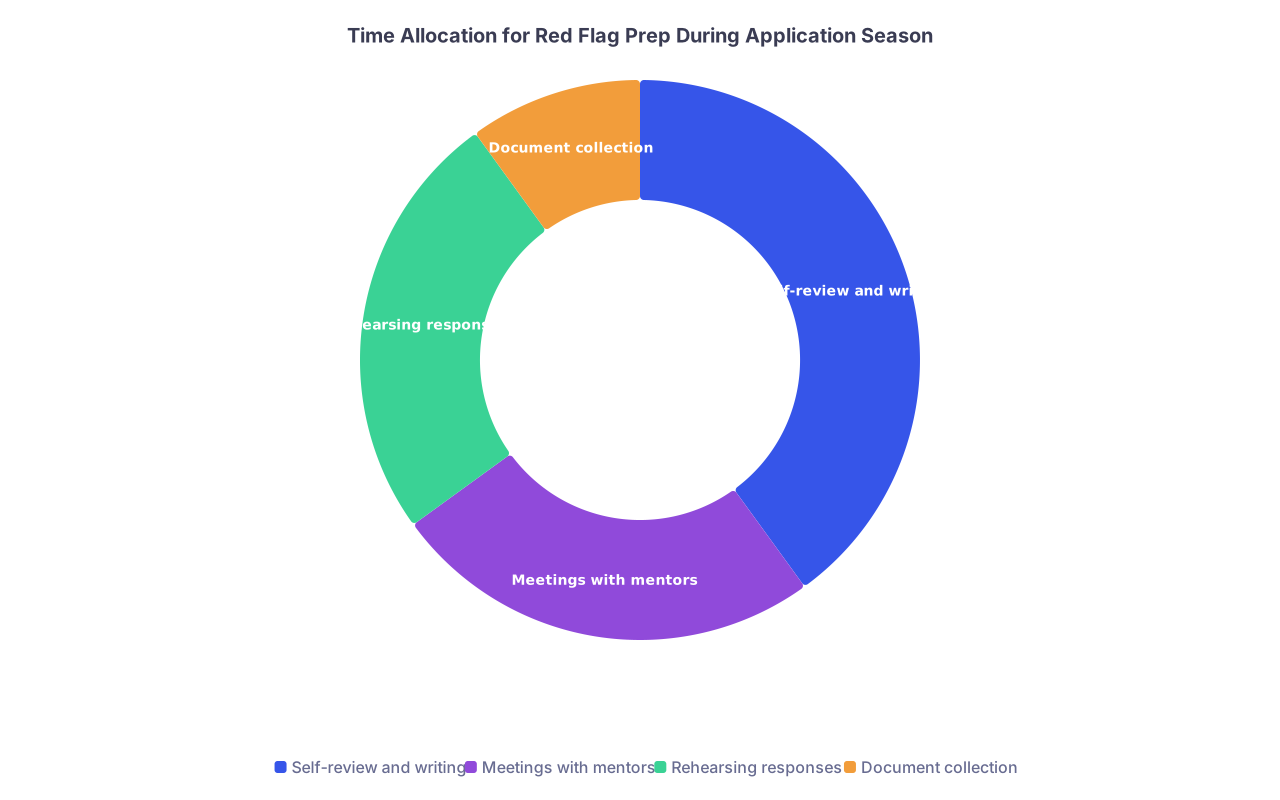
| Category | Value |
|---|---|
| Self-review and writing | 40 |
| Meetings with mentors | 25 |
| Rehearsing responses | 25 |
| Document collection | 10 |
Step 8: Rehearse Out Loud Until It Loses Its Sting
By September you should be saying these red‑flag narratives out loud regularly:
- With a mentor once or twice
- With a co‑resident who will not sugar‑coat
- Alone in a room, recording yourself and playing it back
What you are fixing:
- Rambling backstory – PDs do not want a 7‑minute saga about your intern year.
- Blame‑shifting – “The attending overreacted” is fatal.
- Over‑apologizing – You are not there to beg forgiveness, you are there to demonstrate growth.
Strong answer rhythm usually sounds like:
- “In early PGY‑1, I … [brief event].”
- “My program responded by … and I took the following steps …”
- “Since then, the measurable changes have been … and my most recent evaluations / roles reflect that.”
If you cannot say it in under 90 seconds, it is too long.
October–December: Interview Season – Real‑Time Re‑Evaluation
This is where you see whether your red flags are actually hurting you or if they were mostly ghosts you carried from prior years.
Step 9: Track Which Red Flags Actually Come Up
During interview season, you should maintain a simple log after each interview day:
- Program name
- Which concerns they asked about (if any)
- Tone: curious, concerned, or already reassured
- Your sense of how your answer landed
Patterns matter.
If 8 out of 10 programs do not mention your old professionalism note, you probably overestimated its visibility. If 6 out of 10 keep drilling on your program’s probation status, that is a new insight — your program’s red flag is overshadowing your own history.
You adjust emphasis accordingly mid‑season.

Step 10: Tighten Answers Based on Live Feedback
By the 3rd–4th interview, you will know which questions you are repeatedly getting. That is free data.
At this point, you should:
- Rewrite any answer that made you feel cornered or defensive.
- Drop unnecessary detail that invites more probing.
- Add one concrete, recent example of changed behavior for any answer that felt weak.
For example, if they keep asking about “communication issues with nurses” from PGY‑1, you add:
- “In response, I asked to be the resident representative on our nursing‑resident communication committee this past year, and I have led two joint workshops on handoff expectations. Recent nurse‑submitted feedback in my evaluations has been strongly positive.”
That kind of detail ends a line of questioning quickly. You are showing receipts, not just insight.
January–February: Rank List, Retrospective, and Future Proofing
When interview season slows, you finally have enough data to re‑evaluate those old red flags in hindsight.
Step 11: Separate Real Career‑Limiting Red Flags from Noise
Now you should critically look at:
- Interviews received vs. applications sent
- Which programs rejected you early vs. which showed strong interest
- Frequency and intensity of red‑flag questions
If you applied widely and still got almost no interviews, and you have a major objective red flag (multiple failures, extended LOA, serious professionalism sanction), you now know that this is not a small bump. It is a structural barrier.
That is harsh, but you need the clarity to plan. Maybe:
- You do a chief year to build an undeniable positive track record.
- You pivot to a less competitive fellowship or a different clinical niche.
- You pursue a research‑heavy year with strong mentorship and publications.
If, on the other hand, you had normal or strong interview traction and only occasional questions about your past, your “red flag” might now be downgraded to “early‑career turbulence that you have outgrown.”
Step 12: Document Your Narrative for the Next 5 Years
Programs talk. Careers are long. What you should not do is reinvent your story every time someone asks about PGY‑1.
By the end of the season, you should have:
- A standard written paragraph for each major past issue.
- A short spoken version you can use on the spot with anyone (future employers, credentialing committees, etc.).
- A folder with supporting documents:
- Final positive CCC letters
- End‑of‑training PD letter
- Evaluations showing improvement
- Evidence of added responsibilities or leadership roles
You will use versions of this narrative during:
- Credentialing at your fellowship and later jobs
- Immigration/visa processes
- Future leadership positions (section chief, program director)
The red flag never fully disappears. But it can become a footnote instead of a headline.
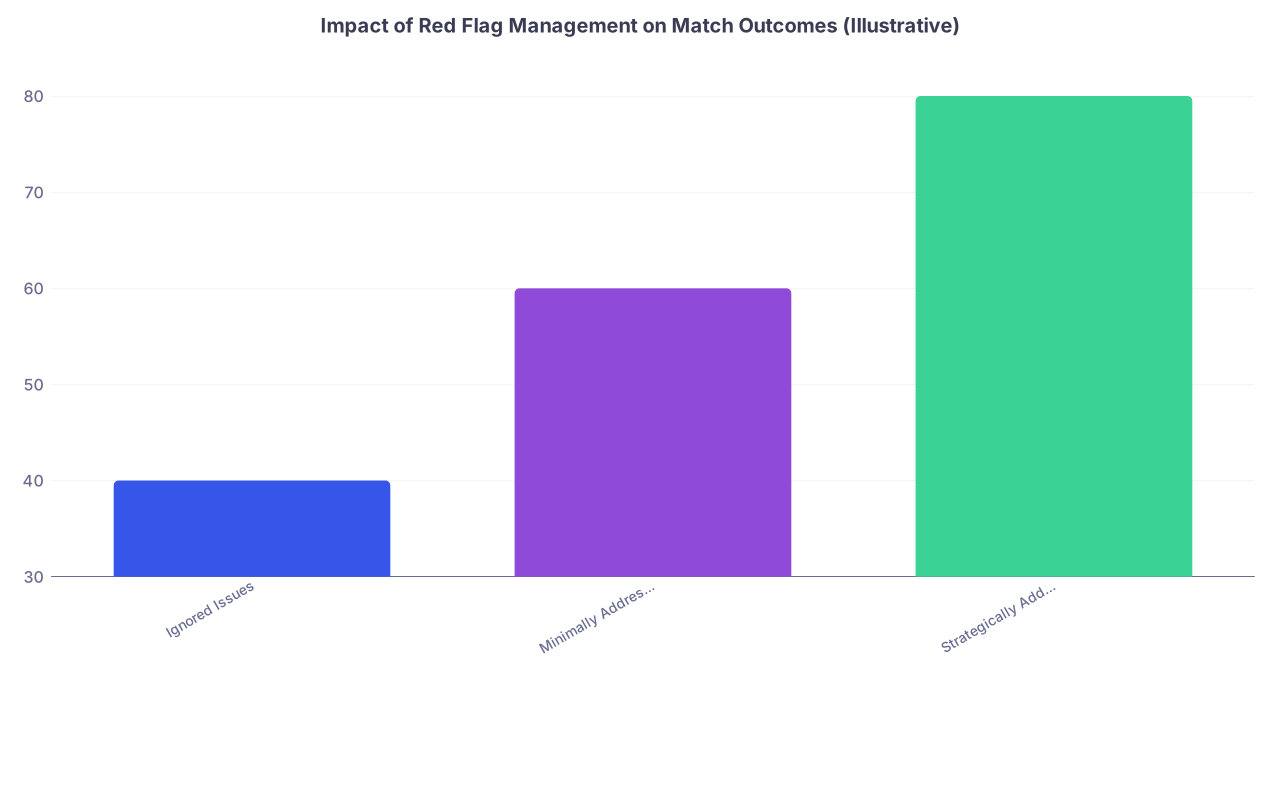
| Category | Value |
|---|---|
| Ignored Issues | 40 |
| Minimally Addressed | 60 |
| Strategically Addressed | 80 |
Looking Beyond Fellowship: Program Red Flags vs. Your Red Flags
One last piece you cannot ignore: sometimes your biggest “red flag” is actually your program’s culture or reputation, not your actions.
During this process, pay attention if:
- Multiple interviewers ask why so many residents left your program.
- You get questions about ACGME citations or probation.
- People seem more concerned about your training environment than your exam scores.
At that point you should:
- Have a diplomatic but honest line about what has improved at your program.
- Emphasize what you did to seek additional experiences (outside electives, research at other institutions, external courses).
- Start planning how you will choose better environments going forward, using what you learned the hard way.
Sometimes the real hindsight lesson is: I should never ignore institutional red flags again.
Quick Chronological Checklist
If you want this in bare‑bones form, here is what you should do at each phase:
Jan–Mar
- Pull all evaluations, letters, transcripts
- Build a complete list of possible red flags
- Classify by severity and visibility
- Write factual timelines for each major issue
Apr–May
- Meet with mentor, PD, honest peer
- Align how your PD will describe you with your own narrative
- Decide which items require explicit disclosure
Jun–Jul
- Draft personal statement with minimal, strategic disclosure
- Write 3‑part growth narratives for each major flag
- Confirm your PD letter does not contradict your framing
Aug–Sep
- Submit applications
- Build list of anticipated tough questions
- Rehearse out loud until answers are under 90 seconds and blame‑free
Oct–Dec
- Log which issues programs actually ask about
- Tweak narratives based on live questioning
- Add concrete, recent evidence of growth to weaker answers
Jan–Feb
- Evaluate whether past red flags were truly career‑limiting or mostly noise
- Document a stable long‑term narrative with supporting evidence
- Use what you learned to judge institutional red flags in your future jobs

Today’s next step is simple: block 60 minutes, pull your last two CCC letters and your USMLE/COMLEX transcript, and start a one‑page list of every potential red flag. No editing, no spin. Just write the raw list so you finally know what you are dealing with this fellowship season.


