

The biggest residency red flags do not show up on interview day. They’re already in front of you during MS3 spring.
You’re walking the halls, watching interns drown in notes, seeing who actually teaches, noticing who rolls their eyes when a code is called. That’s the real data. Interview days are theater. Third-year rotations are surveillance.
Here’s how to use MS3 spring—month by month, week by week, even day by day—to start spotting residency red flags early, while everyone else is still “just trying to pass the shelf.”
February–March MS3: Start Watching the System, Not Just the Patients
At this point you should stop seeing rotations as “classes” and start seeing them as live residency auditions—for them, not just for you.
Weeks 1–2 of a New Rotation: Baseline Scan
During your first two weeks on any service, your job is simple: observe without judgment, but record everything.
Daily, pay attention to:
- How residents talk about their program when they forget you’re there
- Who actually seems to be learning vs just surviving
- How people react at 4:30 pm, not just 7:00 am
Use a tiny mental checklist on rounds:
- Are interns asking questions comfortably, or are they terrified?
- Does the senior resident teach, or just bark orders?
- Do attendings know residents by name and level, or are they interchangeable bodies?
Already, you’re collecting data on potential red flags.
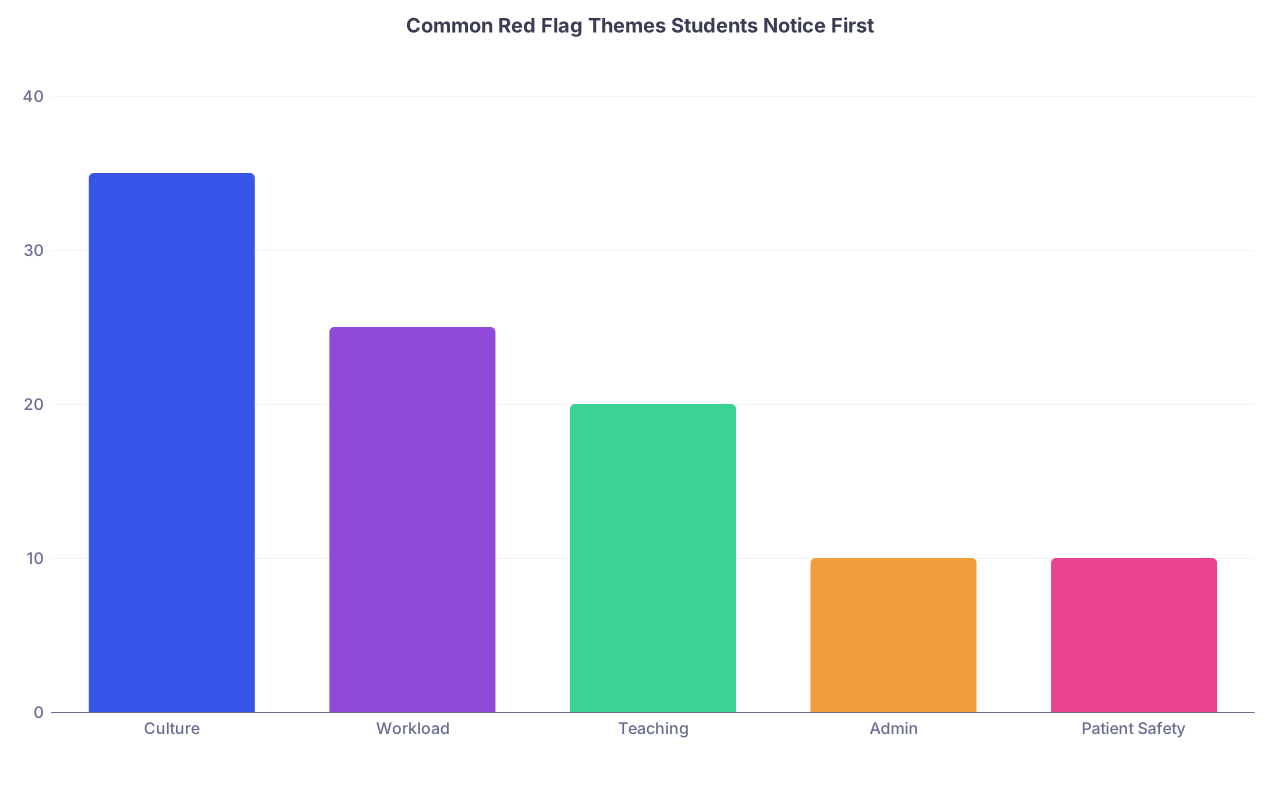
| Category | Value |
|---|---|
| Culture | 35 |
| Workload | 25 |
| Teaching | 20 |
| Admin | 10 |
| Patient Safety | 10 |
I consistently see one pattern: culture problems are what students notice first, even before insane workloads or bad teaching. You feel it before you can name it.
Red Flags You Can Spot This Early
By the end of Week 2 on a service, you should be able to answer:
Do people look dead inside, or just tired?
There’s normal fatigue, and then there’s that hollow, checked‑out look. If multiple residents have it, the program is probably burning people out, not training them.Is complaining the default language?
A little venting is normal. Constant, bitter trash‑talk about the program, leadership, or “the system” is not.How do they talk about duty hours?
- Green flag: “Yeah, we run close to 80 sometimes, but we log honestly and they actually fix things.”
- Red flag: “Log 80 no matter what. Do not rock the boat.”
At this point you should start writing quick notes after call days—just 3–4 bullet points: what you saw, what felt off, who seemed miserable. Don’t trust your future self to remember accurately.
April MS3: Map Patterns Across Different Services
By mid-spring, you’ve usually seen at least 2–3 core rotations. Now the goal shifts: you’re not just noticing isolated moments—you’re connecting patterns across departments and hospitals.
Early April: Compare Rotations A vs B
Take one evening and ask yourself, rotation by rotation:
- Where did residents seem genuinely supported?
- Where did they seem abandoned?
- Where did attendings model teaching vs intimidation?
Make a simple 3-column list for each site:
| Site/Service | Big Green Signal | Big Red Flag |
|---|---|---|
| Community IM | Senior resident taught daily | Interns stayed 2+ hrs post-signout |
| Academic Surgery | Strong operative teaching | Constant yelling in OR |
| County EM | Great autonomy | No debriefs after critical cases |
You’re building your internal compass for what “good” and “bad” actually look like, so you’re not fooled by glossy program websites later.
Mid–Late April: Zoom In On Residents’ Lives
At this point you should start asking residents targeted, time‑anchored questions, not the generic “So, do you like your program?”
Try these during a quiet moment (note how they answer, not just the words):
- “Walk me through a typical call day—when do you realistically leave?”
- “What’s the worst month of the year here?”
- “Who protects you when things go wrong? Anyone?”
- “What made your co‑resident struggle the most this year?”
Listen for red-flag answers:
- “It depends on the attending whether you get destroyed or not.”
- “Honestly, it’s survival. Teaching is whatever you pick up along the way.”
- “We don’t really call out; it’s kind of frowned upon.”
These should light up your internal alarm system.
Day-Level Red Flags: What You’ll See On Any Given Shift
Every single day on the wards gives you chances to spot early residency red flags. Look for these specific, concrete scenarios.
Red Flag #1: Systematic Disrespect Is “Normal”
You’re on rounds. An attending humiliates an intern in front of the team. Not just tough questioning—public shaming.
Key question: What happens after?
- Green-ish: Attending debriefs later, apologizes for tone, focuses on teaching.
- Red: Everyone shrugs. “That’s just how she is.” No one checks on the intern.
One ugly event is data. But a culture that absorbs it as “just how it is” is a problem.
Red Flag #2: No One Has Time to Teach. Ever.
I don’t mean a few busy days. I mean:
- Week after week of “No time to talk, just get the notes done.”
- No structured morning report, no chalk talks, no case discussions.
- Residents tell you: “We’re supposed to have teaching, but it always gets canceled.”
Teaching gets deprioritized everywhere sometimes. When it’s always sacrificed, it’s not an accident; it’s a structural choice.
Red Flag #3: Patient Safety Corners Get Cut Routinely
Watch what happens around:
- Discharge pressure
- Overnight cross-cover
- Handoffs
If you repeatedly see:
- “Just sign it, we don’t have time to actually see them again.”
- “We don’t call the attending at night, they hate being paged.”
- “Yeah, I didn’t document that. It’ll be fine.”
At this point on your rotation, you should start asking yourself: Would I trust this team with my family member? If the answer is frequently “no,” file that away.
May MS3: Specialty-Specific Red Flags
By late spring, most students have a sense of which fields they’re leaning toward. Now your lens should narrow: what are the red flags for the specialties you’re actually considering?
For Medicine-Like Fields (IM, Neuro, Peds, Psych)
In these programs, watch over a full week:
- Are residents constantly behind on notes, staying hours late?
- Is clinic seen as an annoying obligation, or a core part of training?
- Do residents know their patients well, or just their labs?
Specific red flags:
- No one has time to pre-round properly; physical exams are superficial.
- Morning report is a box-check, not a serious teaching conference.
- Seniors do all the thinking; interns are data-entry machines.
For Procedure/OR Fields (Surgery, OB/GYN, Ortho, ENT)
On each OR day, track:
- Who scrubs vs who holds retractors all day.
- Whether juniors ever get to do more than skin.
- If attendings explain what they’re doing or just operate in silence.
Red flags here:
- PGY-3s who admit they’ve done very few core procedures independently.
- Residents competing viciously for cases, with no transparency.
- Open hostility in the OR that everyone accepts as “surgical culture.”

For Shift-Based Fields (EM, Anesthesia, Radiology)
Your schedule gives you different data points:
- Are shift changes clean and respectful of time?
- Do attendings staff cases early or at the last second?
- How do residents feel about nights—manageable or soul-crushing?
Red flags:
- Frequent “off the clock” work—finishing charts or call-backs after shifts.
- No structured feedback; you never hear attendings discuss reasoning.
- Residents tell you they feel more like scribes or technicians than physicians.
At this point in May, you should be keeping a running specialty spreadsheet: columns for programs/locations, rows for red/green signals you’ve actually seen or heard.
Week-by-Week Micro-Timeline: How to Systematically Collect Red Flag Data
Here’s how to structure your last few MS3 rotations so you’re not just vibing—you’re building a real picture of future residency options.
Week 1 of Any New Rotation
Focus: First impressions and vibe check
Daily actions:
- Notice how you’re welcomed (or not) by residents.
- Track who introduces themselves and who ignores you.
- Write down one thing each day that felt healthy, and one that felt off.
This is when your “gut” forms. Don’t ignore it.
Week 2
Focus: Resident behavior under stress
You should intentionally pay attention during:
- Post-call mornings
- High-volume days in ED/OR
- Late afternoon bottlenecks
Ask yourself:
- Who gets thrown under the bus when things go wrong?
- Are seniors protective of interns, or do they push work downhill?
- Do attendings blame individuals, or talk about system fixes?
By end of Week 2, jot a quick paragraph: “If I matched here, my biggest concern would be ______.”
Week 3
Focus: Program structure and leadership
Now you start asking more pointed questions, spread out casually:
- “How responsive is the PD to concerns?”
- “Have schedules changed in the last year to improve things?”
- “Any co-residents think about leaving or transferring?”
Look for:
- Residents who roll their eyes at leadership’s name.
- Stories about retaliation for raising issues.
- “We had someone leave last year, but no one talks about it.”
If three different people independently warn you about the same issue? That’s not noise.
Week 4 (or Last Week)
Focus: Would you actually apply here?
At this point you should:
- Revisit your notes from Week 1–3
- Decide: “Apply,” “Maybe,” or “Hard no” for this place/department
- Write a 3–4 sentence summary you can read next year during ERAS
Do this before nostalgia and distance blur things. You’ll be shocked how many students say, “I knew this place was toxic last year, but the interview day seemed so nice.”
Structural Red Flags You Can Infer From Rotations
Sometimes you won’t see the PD or read the block schedule, but you can still infer deeper problems by what leaks out at the bedside.
Major structural red flags:
Chronic Violations Handled Quietly
If everyone jokes about 100-hour weeks but logs “80,” leadership either doesn’t know or doesn’t care. Both are bad.No Graduated Responsibility
If seniors are still micromanaged like interns, or juniors are thrown into senior roles with no support, the program doesn’t understand progression.Residents Fear Being Honest Around Students
If every answer feels scripted—“Everything is great, we are like family”—with tight smiles and quick subject changes, something’s off. Happy residents will absolutely vent about specific annoyances. Completely sanitized responses are suspicious.High PGY Attrition Rumors
You hear: “We’ve had a lot of people leave, but that was just poor fit.” Translation: people are miserable and leadership won’t own it.
How to Use This Information Without Burning Bridges
You still need grades. LORs. Possibly this department’s support. So you can’t wander around declaring, “Red flag! Red flag!”
At this point you should:
- Keep your observations private and descriptive, not judgmental, in your notes.
- Focus outwardly on learning and working hard.
- Share honest concerns only with people you deeply trust outside the institution.
When you hit MS4 application season, cross-reference:
- What you saw on rotations
- What residents say on interview day
- What alumni or upperclassmen quietly tell you
If multiple signals line up—believe them.
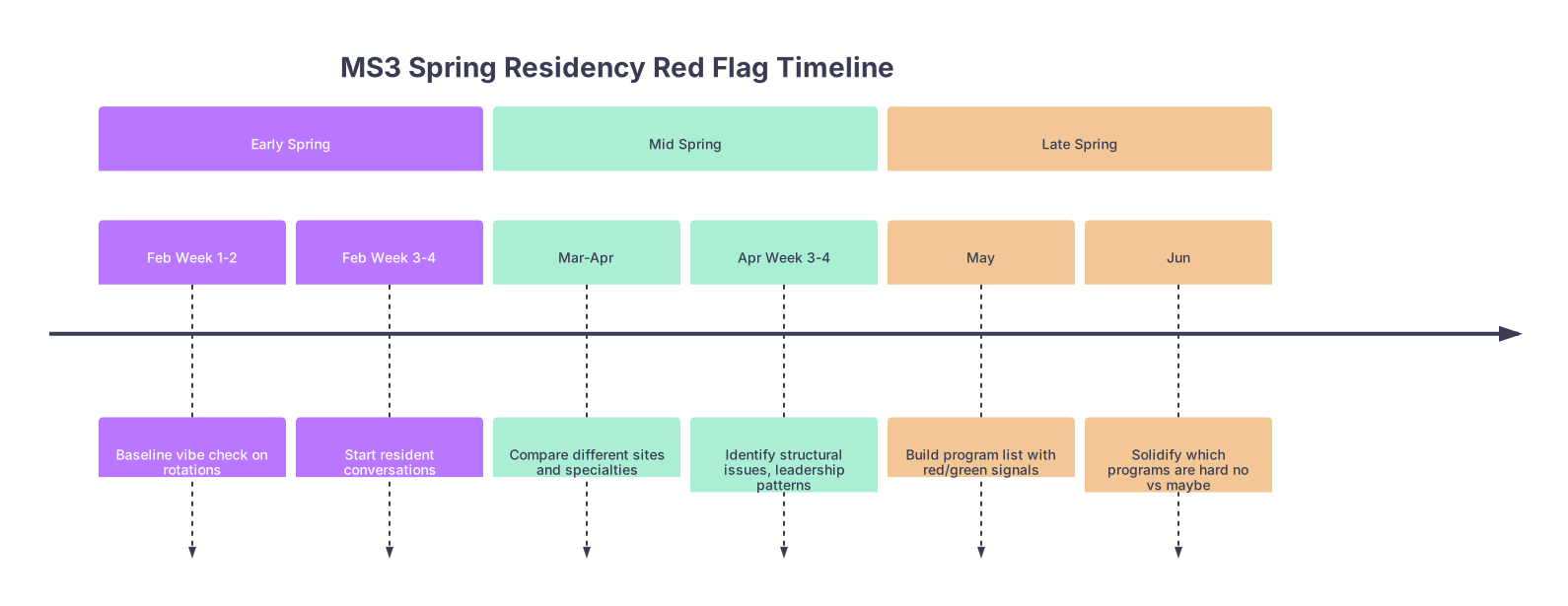
| Period | Event |
|---|---|
| Early Spring - Feb Week 1-2 | Baseline vibe check on rotations |
| Early Spring - Feb Week 3-4 | Start resident conversations |
| Mid Spring - Mar-Apr | Compare different sites and specialties |
| Mid Spring - Apr Week 3-4 | Identify structural issues, leadership patterns |
| Late Spring - May | Build program list with red/green signals |
| Late Spring - Jun | Solidify which programs are hard no vs maybe |
FAQ (4 Questions)
1. How early in MS3 should I start thinking about residency red flags?
By your second full rotation—often around late winter or early spring—you’ve seen enough to know what feels normal. That’s when you should consciously start paying attention to culture, teaching, and how residents are treated. Before that, you’re usually too overwhelmed to see clearly.
2. What if a program has great teaching but a toxic culture? Is it still worth considering?
I’d be cautious. You can’t out-learn a bad culture. Three to seven years in a place where residents are disrespected or unsafe will wear you down, no matter how strong the didactics are. Great teaching plus basic human decency is non-negotiable. If you have options, do not trade your sanity for a slightly better board pass rate.
3. How do I separate one bad attending from a true program-level red flag?
Patterns. One malignant attending with residents rolling their eyes and supporting each other is a nuisance. The same behavior across multiple faculty, with residents dismissing it as “normal,” is a red flag. Track recurring themes, not isolated jerks.
4. I really liked a program’s residents, but heard horror stories from upperclassmen. Who do I believe?
Blend both. Residents you see might be an unusually cohesive class, or they might not feel safe being fully candid. Upperclassmen who rotated there before you often have a longer view. If trusted MS4s consistently warn you away from a place you “liked,” treat that seriously and keep it lower on your list, not at the top.
Key points: Use MS3 spring to quietly collect real data on residency culture. Watch residents under stress, not just on good days. And when your observations, upperclassmen warnings, and resident comments line up? Believe the pattern.


