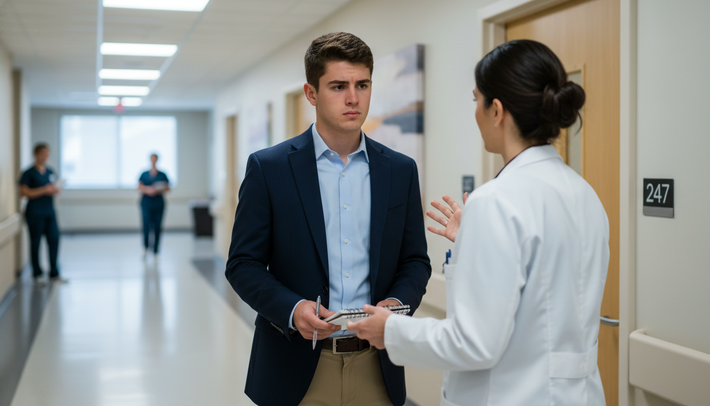
You are standing just inside the doorway of a hospital room, pressed slightly against the wall, clutching a small notebook you are not sure you should even be holding. A white-coated physician is speaking rapidly in medical jargon. A resident is typing on a computer on wheels. A nurse is adjusting an IV pump. A person in navy scrubs with “PA” on their badge is double-checking orders. Someone mentions “the intern,” “the fellow,” and “the attending” in the same sentence.
You nod as if you understand who is who. You do not.
This is exactly where most premeds and early medical students find themselves during their first shadowing experience: overwhelmed, fascinated, and quietly confused about the healthcare team hierarchy. Let me break this down specifically so your next shadowing day feels less like chaos and more like a structured learning lab.
(See also: Shadowing in the Operating Room: Stepwise Etiquette and Safety Primer for more details.)
The Core Hierarchy: Who Actually Makes the Decisions?
Before zooming into specific roles, anchor yourself to one central idea:
On the medical side, the attending physician is ultimately responsible for patient care decisions.
Around that role, multiple layers of learners and collaborators operate with varying degrees of independence.
On the nursing and allied health side, there are parallel hierarchies with their own chains of responsibility and expertise. During shadowing, you are not expected to manage any of this. You are expected to observe it intelligently.
Think of the team in three vertical “tracks”:
- Physician and Physician-Trainee Track
- Advanced Practice Provider Track (NPs and PAs)
- Nursing and Allied Health Track
You will see them all interacting. Your job is to decode who is doing what, why they are doing it, and how they communicate.
The Physician Ladder: Student → Intern → Resident → Fellow → Attending
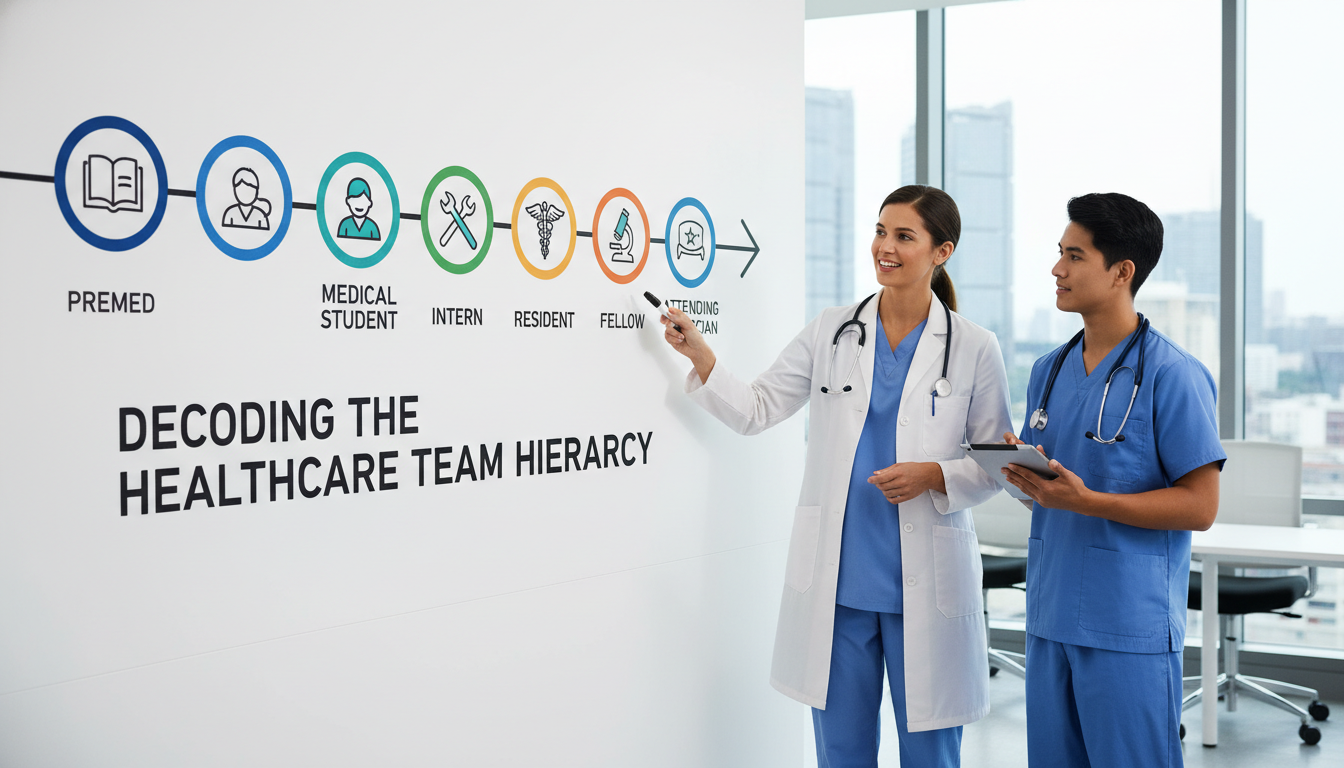
1. Premed and Medical Students: The Observers and Early Learners
Who they are:
- Premed students: college or post-bacc students exploring medicine
- Medical students: in M1–M4 years (preclinical and clinical phases)
How to recognize them:
- Short white coat (often hip-length) vs long white coat for attendings (in many institutions)
- Badges that say “Medical Student” or “Student Observer”
- Often standing slightly behind the main cluster of the team
What they do clinically:
As a premed shadowing, your role is purely observational:
- No physical exams
- No independent patient interaction (unless invited and supervised)
- No order entry, no notes in the chart, no touching equipment
As a clinical medical student (M3–M4):
- May take histories, perform parts of physical exams
- Present patients to residents/attendings
- Write notes that may be used as part of the medical record (depending on institution)
- Always supervised; no independent ordering
What you should watch for during shadowing:
- How medical students present a patient: concise, structured (CC → HPI → PMH → meds → assessment/plan)
- How students “pre-round” early and then update the team
- How they receive feedback, often in real time (“Refocus your assessment on the main problem”)
Understanding the student role will help you envision your near-future responsibilities and expectations.
2. The Intern (PGY-1): The Front-Line Physician in Training
Who they are:
- First year after graduation from medical school
- Officially a physician (MD/DO), but in their earliest supervised practice year
- Called PGY-1 (Post-Graduate Year 1)
How to recognize them:
- Long white coat, badge that says “Resident Physician” or “PGY-1”
- Often doing a lot of “grunt work”: writing notes, calling consults, putting in orders
- They look busy, because they are
What they do clinically:
- Take full histories and perform physical exams
- Write daily progress notes
- Enter most orders in the electronic medical record
- Call other specialties for consults
- Communicate with nurses about patient status
- Discharge planning, admission workups
The attending is ultimately responsible, but the intern is doing the bulk of hands-on management under supervision.
What you should watch for:
- How interns triage their time across a list of patients
- How they answer nurses’ pages and respond to “something is wrong with room 312”
- How they balance following resident/attending plans while still thinking independently
If you are shadowing on an inpatient service, the intern is often the best person to quietly ask for clarification during pauses. They still remember what it was like to be confused.
3. Senior Residents (PGY-2+): The Middle Managers of the Team
Who they are:
- Physicians in their second year and beyond of residency (PGY-2, PGY-3, sometimes higher)
- Have more clinical experience and autonomy than interns
How to recognize them:
- Badge may specify “Senior Resident” or PGY level
- Often leading the discussion on rounds, with the attending adding higher-level perspective
- They might stand closer to the attending and more often “run the list”
What they do clinically:
- Supervise interns and sometimes medical students
- Lead rounds: present plans, refine assessments
- Direct workflow (“We will see ICU patients first, then floor patients”)
- Handle more complex procedures (central lines, lumbar punctures, etc., depending on specialty)
- Make overnight decisions in some settings, calling the attending for major issues
What you should watch for:
- How they translate the attending’s broad strategy into specific orders and tasks
- How they teach interns and students while still moving quickly
- How they prioritize the sickest patients first
When you hear, “Run the list,” that is usually directed at the senior resident. They are orchestrating care moment-to-moment.
4. Fellows: The Subspecialty Experts in Training
Who they are:
- Physicians who have completed a residency and are training in a subspecialty
- Examples: Cardiology (after Internal Medicine), GI, Heme/Onc, Endocrinology, Neonatology
How to recognize them:
- Badge may say “Cardiology Fellow,” “GI Fellow,” etc.
- Often seen heavily involved in complex cases or specialized procedures (cardiac cath, endoscopy, etc.)
What they do clinically:
- Deeper expertise in one area
- Supervise residents on subspecialty services
- Perform specialized procedures
- Offer consult recommendations to primary teams
What you should watch for:
- How they synthesize complex data (e.g., multiple imaging studies, specialized lab tests)
- How they communicate recommendations to primary teams concisely
- How they balance teaching with high-stakes procedures
During shadowing on a subspecialty service, you may interact with fellows more than with residents, especially in procedural areas.
5. Attendings: The Ultimate Clinical Authority
Who they are:
- Fully trained, independently practicing physicians
- Have completed residency (and fellowship if applicable)
How to recognize them:
- Often longer white coats, badges with “Attending Physician,” “Staff Physician,” or “Consultant”
- Others defer to them for final decisions
- They lead family meetings, sign off on orders, and handle major conflicts
What they do clinically:
- Final responsibility for patient care and safety
- Confirm or adjust diagnostic and management plans
- Supervise and evaluate residents and students
- Communicate big-picture issues to families, consultants, and administrators
What you should watch for:
- How they frame the case at a high level (“The unifying diagnosis here is…”)
- How they manage team dynamics and teaching while maintaining authority
- How they handle disagreement calmly (with residents, consultants, or families)
From a shadowing standpoint, the attending is often your sponsoring physician. Even if you are following the whole team, your official link is usually to them.
Parallel Track: Advanced Practice Providers (NPs and PAs)

You will often see Nurse Practitioners (NPs) and Physician Assistants (PAs) working alongside physicians, sometimes even in what looks like the same role. The details differ by state, institution, and specialty, but you should understand the general structure.
Nurse Practitioners (NPs)
Background:
- Advanced practice registered nurses with master’s or doctoral preparation
- Often trained with a nursing-centric approach emphasizing holistic and longitudinal care
Roles during your shadowing:
- In outpatient: manage their own panels of patients, do follow-ups, chronic disease management
- In inpatient: co-manage services, perform admission and discharge work, coordinate care
Hierarchy and supervision:
- Varies:
- Some NPs practice with significant independence, especially in primary care and in states with full practice authority
- Others work closely under physician oversight (e.g., in ICU teams)
Physician Assistants (PAs)
Background:
- Trained under a medical model in PA programs (usually master’s level)
- Licensed to diagnose, treat, and prescribe under physician supervision
Roles during your shadowing:
- In surgical specialties: assist in OR, manage pre-op and post-op care
- In hospital medicine: perform admissions, follow daily patients, execute the care plan
Hierarchy and supervision:
- Always work in collaboration with physicians, but often with considerable autonomy in day-to-day patient care
- May function in roles parallel to residents on a service, particularly on non-teaching or mixed teams
How to interpret their position on the team
During shadowing, you might see:
- An NP or PA running their own clinic session, then reviewing complex cases with an attending
- PAs and NPs covering evenings or weekends when residents rotate off
- NPs or PAs providing continuity while resident teams change
Key point for you:
They are not “assistants” in the informal sense. They are independent licensed providers with defined scopes of practice. Watch how they communicate with attendings and how much responsibility they carry.
The Nursing Structure: Parallel Expertise, Different Priorities

Premeds often underestimate nursing hierarchy. That is a mistake. Nurses have their own structured ladder, and during shadowing, you will see that they control multiple critical aspects of care.
Registered Nurses (RNs)
Who they are:
- The primary bedside providers managing the 24/7 delivery of care
- Assess patients, give medications, monitor for deterioration, coordinate services
What they actually own:
- Medication administration and reconciliation
- Vital sign monitoring and response
- Direct patient education (discharge instructions, disease management)
- Immediate problem identification (“This patient is suddenly short of breath”)
During shadowing: watch for:
- How nurses are often the first to detect subtle deterioration (changes in mental status, new confusion, reduced urine output)
- How they escalate concerns: calling the intern, then resident, then rapid response or code
- Their workflow across multiple patients; time constraints are very real
Charge Nurses
Usually one per unit per shift.
Roles:
- Oversee unit staffing and bed assignments
- Coordinate admissions and discharges at the systems level
- Resource person for complex clinical issues or conflict resolution
You might hear, “Let me check with the charge nurse about that bed,” or “The charge nurse is talking to the family.” They are the operational backbone of the unit.
Nurse Managers and Clinical Nurse Specialists
You may not see them during casual shadowing, but:
- Nurse Managers: administrative oversight, staffing, quality metrics
- Clinical Nurse Specialists: advanced practice nurses focused on improving nursing practice and patient outcomes across a unit or hospital
Recognizing that nurses have their own expert path helps you avoid the misconception that “the doctor is in charge of everything.” In practice, responsibility is distributed.
Allied Health Professionals: The Less Visible but Essential Layers
Beyond physicians, NPs, PAs, and nurses, many other clinicians shape patient care. During shadowing, you might interact with:
Pharmacists
Roles:
- Review and verify medication orders
- Recommend dosing adjustments (renal dosing, anticoagulation)
- Counsel patients on new medications, side effects, interactions
In high-acuity areas (ICU, oncology, transplant), pharmacists are often physically present during rounds. Pay close attention when they talk; their input can change management plans.
Physical and Occupational Therapists (PT/OT)
Roles:
- PT: mobility, strength, gait, discharge safety (can the patient walk at home?)
- OT: activities of daily living (bathing, dressing, cooking, cognition)
During discharge planning, their assessments often determine where a patient can safely go: home vs rehab vs skilled nursing facility.
Respiratory Therapists (RTs)
Especially important in ICUs and step-down units.
Roles:
- Manage ventilators
- Execute breathing treatments, CPAP/BiPAP setups
- Perform arterial blood gas sticks in some institutions
Watch how physicians defer to RTs about ventilator settings, weaning plans, and oxygen requirements.
Social Workers and Case Managers
Often less visible but central to the bigger picture.
Roles:
- Housing instability, substance use resources, insurance issues
- Organizing home health, rehab placement, durable medical equipment
- Family meetings for complex disposition decisions
During shadowing, look for how the team talks about “case management” or “social work” when a medically stable patient is still stuck in the hospital. This is the systems side of medicine.
How Hierarchy Shows Up in Real-Time: Typical Scenarios You Will See

Let us walk through a few realistic inpatient and outpatient scenarios and decode the hierarchy in action.
Scenario 1: Inpatient Morning Rounds on a Teaching Service
You might see:
- Medical student pre-rounds, talks to the patient, does a quick physical, then steps out to write a note.
- Intern reviews overnight events, checks labs, updates orders.
- Senior resident quickly reviews all patients, prioritizes order of rounding.
- Attending arrives. Team stands outside patient room to “run the list.”
- In the room:
- Student presents brief summary.
- Intern adds key updates and concrete plan items.
- Senior resident refines and confirms.
- Attending asks probing questions, finalizes and verbalizes the plan.
- Nurse provides bedside input: “He was more short of breath overnight,” “Pain is uncontrolled.”
- Pharmacist may comment on anticoagulation, dosing, or interactions.
You, as the shadower, are usually:
- Standing slightly behind and off to the side
- Silent during patient encounters
- Free to ask questions between patients or after rounds
Watch: who changes the orders, who communicates with the nurse, and who explains the plan to the family. These are often different people.
Scenario 2: Outpatient Specialty Clinic
Common structure:
- Attending physician runs the clinic, possibly with residents or fellows.
- NPs/PAs may see follow-up or lower-acuity patients independently.
- Residents or fellows see new patients first, then present to attending.
- Nurses or MAs (medical assistants) take vitals, reconcile meds, update history.
A typical flow:
- Nurse brings patient back, takes vitals.
- Resident or fellow interviews and examines the patient.
- Resident/fellow steps out, presents concise summary to attending.
- Attending and trainee return to room, confirm key findings, finalize plan.
- NP/PA might see a different patient simultaneously and run their plan by attending later if needed.
Your observation goals:
- Notice how the attending modulates their coaching based on trainee level.
- Pay attention to how each team member explains things in lay language to patients.
- Watch how the clinic runs on a schedule; time pressure is real.
Scenario 3: Emergency Department Team Dynamics
The ED is less linear and more chaotic, but the hierarchy still exists.
You might see:
- Attending ED physician supervising multiple residents and PAs/NPs simultaneously
- Senior resident managing the pod, delegating cases, triaging urgency
- Interns and PAs seeing new patients, ordering initial tests and imaging
- Nurses controlling room assignment, triage vitals, medication administration, and many procedures (IVs, EKGs)
- Techs or paramedics drawing blood, transporting patients, doing EKGs
Shadowing here, focus on:
- How the attending quickly prioritizes: “Sick vs not sick.”
- How nurses and residents negotiate who gets which bed on a crowded day.
- Who responds first when something acutely deteriorates (often the bedside nurse and whoever is physically closest).
How to Navigate the Hierarchy as a Shadower Without Getting in the Way
You are not responsible for anything clinical. But you are responsible for professional behavior and situational awareness.
Who you can ask what
- Attending: Big-picture questions about diagnosis, specialty choice, career paths. Ask when they are not rushed: between patients, at the end of the day, or when they explicitly invite questions.
- Residents / Fellows: “Why did we choose test A instead of test B?” “How do you think about ruling out X?” They remember being in your shoes.
- NPs/PAs: “How does your role differ from the residents on this service?” “What does your typical day look like?”
- Nurses: “From your perspective, what makes a good doctor to work with?” “What are the biggest challenges for patients on this unit?”
Where to stand
- On rounds: slightly behind the main cluster, not between the team and the patient or computer.
- In the ED: stay near your supervising physician unless instructed otherwise.
- In clinic: they may seat you in the corner of the exam room.
When in doubt, quietly ask, “Where would you like me to stand so I am out of the way?”
What to avoid doing
- Do not touch patients, equipment, computers, or charts without explicit invitation and proper training.
- Do not interrupt patient interviews or teaching moments.
- Do not answer patient questions about their care; redirect to the team: “That is an important question; Dr. X can address that.”
Your presence should be low-impact on workflow but high-yield for your learning.
Using the Hierarchy to Structure Your Learning
Instead of just “watching,” use the hierarchy as a framework for what you are trying to understand.
For each new team member you spot, ask yourself:
- What is their training level and background?
- Who supervises them?
- Who do they supervise, if anyone?
- What specific tasks are they doing today?
Then, mentally map:
- Decision-making flow: Who proposes? Who approves? Who executes?
- Communication flow: Who speaks first? Who summarizes? Who documents?
Over several shadowing days, patterns will emerge:
- The same nurse is often the one who catches early signs of sepsis.
- The intern frequently calls the cardiology fellow for consults.
- The attending decides to escalate to ICU transfer.
That pattern recognition is a core preclinical skill. You are already learning systems-based practice, even if you are years away from residency.
FAQ: Decoding Healthcare Team Hierarchy During Shadowing
1. How can I quickly tell who is who on the team when I first arrive?
Start by reading badges. Look specifically for MD/DO, NP, PA-C, RN, or “Student.” Coat length can help (short coats often students, long coats often physicians), but this is not universal. If you are unsure, ask early in the day: “Could I confirm everyone’s roles so I understand the team structure?” People are usually happy to clarify once rather than have you confused all day.
2. As a premed shadower, is it appropriate to ask residents or nurses questions during patient care?
Yes, but only at appropriate times. Avoid interrupting patient encounters, procedures, or intense discussions. A good strategy is to jot down your question and ask between patients, during hallway walking time, or at natural breaks. You can say, “When you have a moment later, I would like to ask about why we chose that imaging study,” so they can decide when the timing works.
3. What if a patient asks me about their diagnosis or treatment plan while I am in the room?
You should not provide medical information or advice. A safe response is: “I am just observing today and part of the learning team. That is a really important question for your doctor or nurse.” Then promptly let the team know the patient has that concern. This respects both patient safety and the team hierarchy.
4. How do NPs and PAs fit into teaching services with residents and medical students?
On some services, NPs and PAs work on non-teaching teams and primarily collaborate with attendings. On others, they are integrated with residents, functioning in parallel roles. They may manage their own patients, precept students, or help with procedures and coordination. Pay attention to whether they are primarily managing continuity and logistics, or actively involved in teaching; this varies by institution and specialty.
5. Is it rude to ask people directly about their training path and why they chose their role?
If asked respectfully at an appropriate time, it is usually welcome. Many clinicians enjoy explaining their paths. You could say, “I am trying to understand different careers in healthcare. Would you be willing to share how you decided to become a [resident/NP/PA/nurse] and what your training involved?” Avoid asking in the middle of a time-sensitive task or emotionally charged patient situation.
6. How can I show that I understand and respect the hierarchy during shadowing?
Arrive on time, dress professionally, and introduce yourself clearly as a premed or student observer. Ask where to stand. Direct clinical questions up the appropriate chain (intern or resident before attending when possible). Thank people for explanations and be mindful of their time. When you demonstrate awareness that you are a guest in a complex system, you will be trusted with more nuanced observation and, later, more meaningful responsibilities.
With this mental map of the healthcare team hierarchy, you are no longer just a passive observer on your shadowing days. You are decoding structure, authority, and collaboration in real time. As you move from premed to medical student and beyond, the labels on your own badge will change—but the underlying logic of how teams function will remain.
The next step in your journey is not only to understand who does what, but to start imagining where you will fit, how you will contribute, and what kind of teammate you intend to become. That deeper identity work begins as early as these shadowing experiences, and it will shape every phase that follows.