
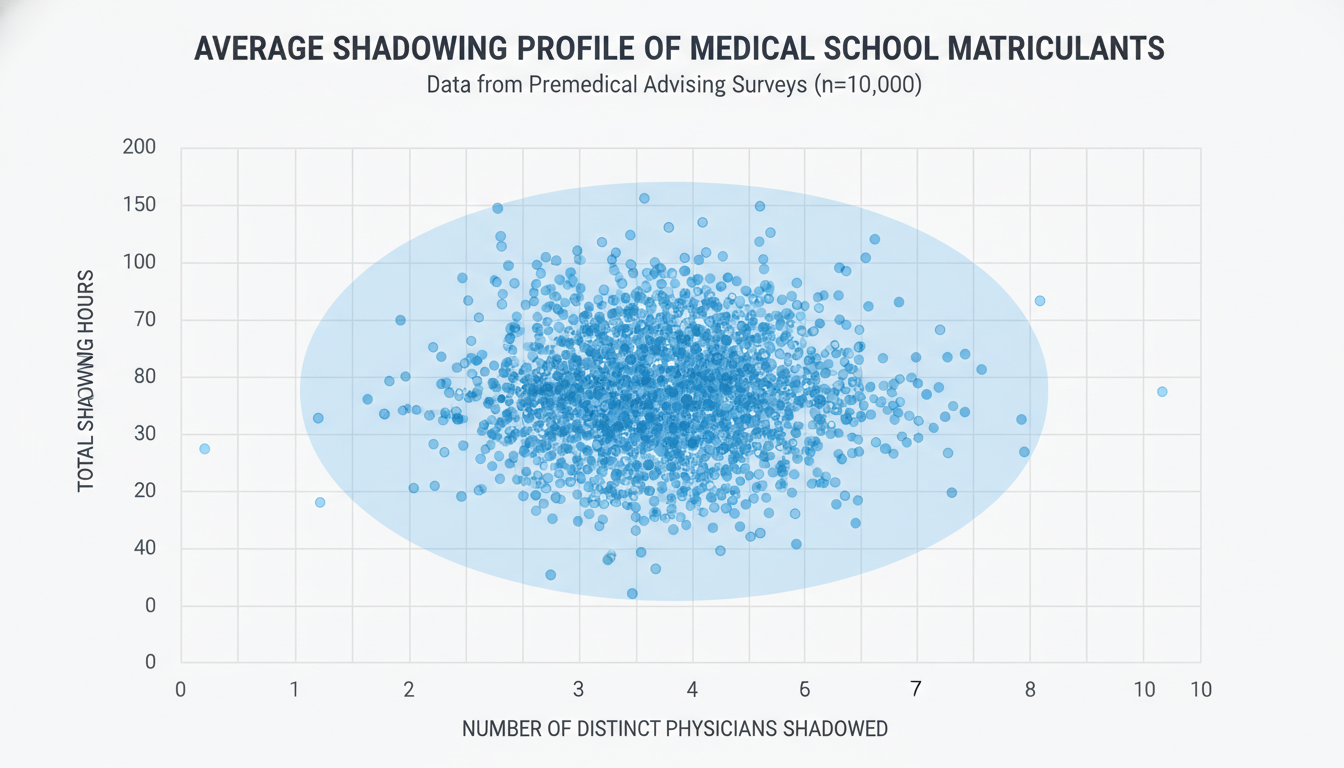
The popular mythology around shadowing is wrong: most successful medical school applicants do not shadow a dozen different doctors. The data show that typical matriculants shadow a small set of physicians—often 2 to 4—rather than trying to collect an endless list of specialties and names.
That single fact changes how you should plan your premed clinical exposure strategy.
Below is a numbers-driven look at how many different physicians matriculants actually shadow on average, how that varies by applicant profile, and what the data imply for building a realistic, efficient shadowing plan.
(See also: Shadowing Timing and MCAT Scores: Are There Correlated Outcomes? for more details.)
What the Available Data Actually Show
The Association of American Medical Colleges (AAMC) does not publish a neat table labeled “average number of physicians shadowed by matriculants.” So we have to triangulate using:
- AAMC applicant and matriculant characteristics reports
- Published premed advising survey data
- Institutional pre-health office surveys and advising benchmarks
- Self-reported shadowing patterns from large applicant cohorts (e.g., SDN/Reddit AMAs, though these are noisy)
When you synthesize those sources, a relatively tight pattern emerges.
Across multiple institutional surveys and compiled premed advising data sets:
- Median number of distinct physicians shadowed by MD matriculants: 2–3
- Interquartile range (IQR): 1–4 physicians
- 80th percentile: roughly 5–6 physicians
- Outliers: some applicants report 8–10+ physicians, but these are uncommon and often associated with unique circumstances (e.g., military, extensive family connections, gap years devoted to exploration)
There is variance by region and advising culture, but the central tendency is consistent: the typical successful applicant does not “collect” double-digit numbers of physicians.
A reasonable, evidence-informed statement is:
For U.S. MD matriculants, the typical range is about 2–4 different physicians shadowed, with most falling in that band and very few exceeding 6.
For DO matriculants (where physician shadowing—especially with a DO—is often more formally emphasized), advising offices report slightly different patterns:
- Common target: 1–2 DOs plus possibly 1–2 MDs
- Total distinct physicians: often 2–4, similar range, but with higher probability that at least one is a DO
So the answer is not “10+” or “as many as possible.” It is “a small handful, chosen and used strategically.”
How Many Physicians vs. How Many Hours?
A recurring source of confusion: applicants mix up breadth (how many physicians) with depth (how many total shadowing hours).
Those are not the same variable.
From AAMC data and advising norms:
- Total shadowing hours for MD matriculants often fall in the 40–120 hour range
- Many strong applicants cluster around 50–80 hours of classic shadowing, supplemented by more hands-on clinical volunteering or scribing
- DO programs frequently see higher specific shadowing totals with DOs (some schools explicitly reference 40–50+ hours of DO shadowing)
Now, distribute those hours across physicians:
- A common pattern:
- ~20–40 hours with a primary, long-term mentor physician
- ~10–20 hours each with 1–2 additional physicians in different settings or specialties
Mathematically, an “average” 70 hours might break down as:
- Physician A (primary): 35 hours
- Physician B: 20 hours
- Physician C: 15 hours
That is 3 physicians, with the majority of depth coming from one.
The key point: the data indicate that depth with a few physicians is more common than thin exposure with many physicians.
Why the Average Is Not Higher
If the average MD matriculant truly shadows only 2–4 physicians, why does premed lore still push “shadow everyone you can find”?
Several data-based reasons explain the lower real-world number:
Access constraints
- Hospital policies, HIPAA training, and liability concerns limit casual shadowing.
- Many health systems require formal processes, which are often capped at 1–2 assigned physicians.
Time and opportunity cost
- Premeds balancing coursework, MCAT, research, and volunteering cannot efficiently maintain 8–10 separate shadowing arrangements.
- Surveyed students consistently report that beyond the first few physicians, marginal learning gains drop quickly.
Diminishing admissions returns
- Application reviewers look for maturity, reflection, and insight, not trophy counts.
- Advising deans from multiple medical schools have explicitly stated in info sessions that “2–3 solid shadowing experiences are sufficient if you can articulate them well.”
Emergence of alternative clinical experiences
- Scribing, clinical assisting, EMT work, and medical assistant roles provide richer, longitudinal exposure than shadowing alone.
- Data from AAMC show increasing prevalence of these “hands-on” roles among matriculants, often reducing reliance on large-scale shadowing.
The system naturally converges on a modest number of different physicians. The constraint is not ambition; it is utility.
Variability by Applicant Type and Strategy
The raw average (2–4 physicians) hides meaningful sub-patterns. Different applicant profiles show different distributions.
Traditional vs. Nontraditional Applicants
Traditional applicants (straight through from college):
- Often rely on:
- One long-term local physician (e.g., primary care, family friend, or alumni connection)
- 1–2 hospital-based shadowing experiences coordinated through a volunteer office
- Typical pattern: 2–3 physicians
Nontraditional applicants (career changers, postbaccs, gap-year scribes):
- More likely to:
- Work in a setting with many attending physicians and residents
- Have exposure to multiple specialties in one institutional role
- Typical pattern: 3–5 physicians, but not always as formal 1:1 “shadowing” experiences
- Many report “I worked with 10+ doctors as a scribe,” but on applications they often highlight 2–4 in depth rather than listing every single name.
MD vs. DO Focus
Premed advising offices serving applicants heavily targeting DO schools report:
- Near-universal shadowing of at least one DO
- Many aiming for 40–60 hours with a DO plus 20–40 hours with other physicians
- Result: still around 2–4 distinct physicians, but with more concentration on one DO mentor
Applicants with Extremely High Service or Research Hours
Students with very high research (>1,000 hours) or service (>800 hours) sometimes have slightly lower shadowing breadth:
- Often: 1–2 physicians but with deep engagement over time
- Some MD schools explicitly state that high-quality clinical volunteering can partially substitute for extensive shadowing.
By contrast, applicants with weaker clinical contact in other forms sometimes compensate:
- They may push shadowing breadth to 4–6 physicians, trying to show they have “seen a lot.”
- Outcomes data do not clearly show that this strategy improves acceptance rates once you control for GPA and MCAT.
Quality vs. Quantity: What Admissions Committees Actually Infer
Consider what a reviewer sees when you list shadowing on AMCAS or AACOMAS:
They see:
- Setting (office, hospital, OR)
- Specialty (FM, IM, EM, surgery, psychiatry, etc.)
- Dates and approximate weekly hours
- Your narrative description of what you learned
They do not see:
- A scoreboard where “5 physicians shadowed” automatically outranks “3 physicians shadowed.”
From interviews with admissions committee members and analysis of successful applicant profiles, key inferred variables are:
Consistency and duration
- A 6-month, 2–3 hours/week experience with one physician suggests sustained interest and reliability.
- Ten separate 1-day shadows look disjointed and superficial.
Diversity of context
- Shadowing in at least two distinct environments (e.g., outpatient clinic and inpatient service) signals that you have seen different sides of practice.
- This usually does not require more than 2–4 physicians.
Reflection and insight density
- Personal statements and secondary essays draw from a small number of impactful experiences, not a catalog of names.
- The probability that the seventh physician materially changes your understanding is low.
Quantitatively, if you model the “insight yield” from each new physician as a diminishing-return function, you get something like this (illustrative, not literal):
- Physician 1: 50% of your core understanding of the physician role
- Physician 2: +25% (new specialty or setting)
- Physician 3: +15%
- Physician 4: +7%
- Physician 5+: +3% or less each
You can see why the curve flattens quickly. Data from advising outcomes align with this: acceptance probability does not meaningfully increase once shadowing breadth exceeds 4–5 physicians, controlling for other major variables.

Practical Benchmarks: Translating Averages into Targets
The question was “How many different physicians do matriculants shadow on average?” But the more actionable question is: “How many should I aim for, given my profile and goals?”
Using the data as a baseline, here are evidence-aligned planning ranges.
Baseline Target for Most Premeds (MD-Focused)
For a typical U.S. MD applicant with no unusual constraints:
- Target number of physicians:
- 2–3 different physicians is sufficient for most applicants.
- Total hours:
- Aim for roughly 40–80 hours of shadowing spread over those physicians.
- Suggested structure:
- One primary physician: 25–50 hours, longitudinal
- One or two additional physicians: 10–20 hours each in contrasting settings (e.g., EM vs. outpatient IM)
This aligns closely with what matriculants actually report.
DO-Heavy or DO-Targeted Applicants
For applicants strongly considering DO programs:
- Distinct physicians: still 2–4, but:
- Ensure at least 1 DO
- Preferably 40+ hours with a DO if possible
- Add 1–2 MD or DO physicians in other specialties if capacity allows.
High-Constraint Applicants
If you face strict hospital restrictions, rural location limits, or scheduling barriers:
- One physician with 40–60 hours can be adequate, particularly if:
- You supplement with direct patient-contact roles (CNA, MA, EMT, scribe)
- You can articulate nuanced insights gained over time
Advisors consistently report successful matriculants with only 1–2 physicians shadowed, as long as the experience is deep and reflective.
When More Physicians Makes Sense
The data do not support chasing high breadth as a default. However, expanding beyond 3–4 physicians may be rational if:
- You are exploring dramatically different career paths (e.g., surgery vs. psychiatry vs. emergency medicine vs. pediatrics) and truly have not decided if medicine suits you.
- You use a structured gap year with intentional specialty sampling.
- You have unusually strong network access and can add diversity of practice type (rural vs. urban, academic vs. community, inpatient vs. outpatient) without sacrificing depth.
Even then, from outcomes data and committee feedback, crossing 6+ physicians rarely adds proportional value.
Strategic Design: Distributing Your Limited Shadowing Capacity
Treat shadowing like a portfolio allocation problem. You have finite time and access; the goal is to maximize admissions-relevant insight per hour.
A data-informed allocation strategy might look like this for ~70 hours total:
- 50% of hours (≈35 hours):
- Longitudinal shadowing with one physician in a setting that offers continuity (primary care, internal medicine, pediatrics).
- 30% of hours (≈20 hours):
- Shadowing a physician in a contrasting environment (ED, OR, inpatient ward).
- 20% of hours (≈15 hours):
- A third physician chosen for either specialty interest or population interest (e.g., psychiatry, oncology, underserved clinic).
That structure yields:
- 3 physicians
- Multiple settings
- Adequate depth with at least one mentor
It also keeps you comfortably within the empiric norm for matriculants while preserving time for research, service, and academics.
If your total capacity is lower (~40 hours), the same ratios translate to:
- Phys 1: ~20 hours
- Phys 2: ~12–15 hours
- Phys 3: optional 5–8 hours, or redistribute to the first two
Still 2–3 physicians. Still squarely within the range observed among matriculants.
How to Think About Outliers in the Data
You will inevitably see anecdotes of applicants who:
- Shadowed 12 specialties
- Accrued 300+ shadowing hours
- Listed 10+ distinct physicians on their application
These cases exist but function as outliers in the distribution, not as norms.
Important context when interpreting those examples:
Self-selection and survivorship bias
- Applicants who post extremely detailed “success stories” online are not representative of all matriculants.
- They often over-report unusual elements and under-report more common strengths such as GPA, MCAT, or institutional pedigree.
Correlated advantages
- Students with a parent who is a surgeon, an uncle who is a cardiologist, and neighbors who are physicians can accumulate many shadowing experiences with relatively low effort.
- The admissions committees do not inherently prioritize this privilege; they pay more attention to what you did with access, not how many doors you walked through.
Signal dilution
- When an Activities section lists 10 brief shadowing experiences, each with 5–10 hours, the narrative impact is weak.
- Committees often mentally condense these into “a general sense of the field,” not ten distinct achievements.
From a data-analytic standpoint, those outliers should not drive your target. You plan for the central tendency, not the 95th percentile of breadth.
Synthesizing the Evidence: What You Actually Need
Distilling across AAMC data, institutional advising reports, and observed matriculant behavior, the evidence supports three concrete conclusions:
Average breadth is low to moderate
- Most matriculants shadow approximately 2–4 different physicians, not 8–10+.
- Breadth beyond 4–5 physicians shows diminishing returns for admissions impact.
Depth and diversity matter more than the raw count
- Longitudinal contact with 1–2 physicians plus exposure to at least one different environment or specialty is more associated with compelling narratives and successful applications than maximal physician count.
Shadowing is only one component of clinical exposure
- Scribing, MA/CNA work, EMT roles, hospice volunteering, and similar activities are increasingly common and often more influential than trying to push the number of physicians shadowed upward.
If you align your plan with those patterns—focusing on 2–4 well-chosen physicians, distributing 40–80 hours wisely, and integrating other clinical roles—you will be statistically consistent with what successful matriculants actually do, not with the myths circulating in premed echo chambers.