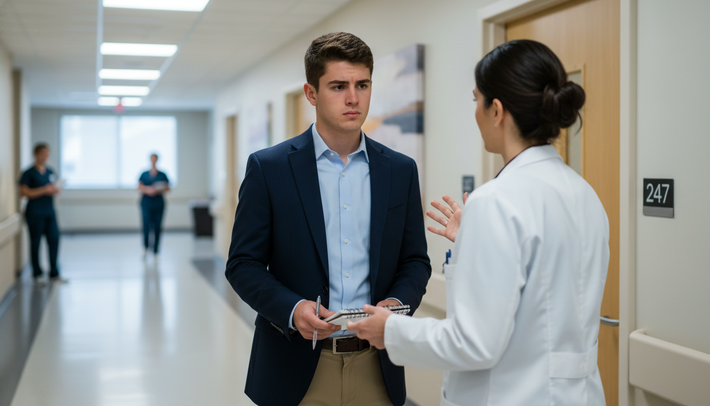
The obsession with “100+ hours of shadowing” is lazy, copy‑paste advice—and it is not what gets people into medical school.
Most successful applicants do not have some magical 100‑hour shadowing threshold checked off in perfect blocks. What they do have is coherent clinical exposure, clear reflection, and evidence that they actually understand what physicians do.
Let’s dismantle this shadowing-hours mythology and look at what adcoms, published data, and actual outcomes show.
Where the “100+ Hours of Shadowing” Myth Comes From
The myth didn’t fall from the sky. It’s a game of telephone gone wrong.
Here’s the usual sequence:
- A few schools or advisors casually suggest “substantial clinical exposure,” sometimes tossing out a ballpark like 50–100 hours of clinical experience.
- Premeds on Reddit and SDN merge that with “shadowing” and treat it as a hard rule: “You need 100+ hours of shadowing or you’re done.”
- Commercial advising services reinforce it in blog posts because “100+ hours” sounds decisive and easy to remember.
- Next cohort panics and starts chasing a number instead of actual understanding.
The problem? When you actually read what schools say—UCSF, Michigan, Mayo, UChicago, even smaller programs—they almost never specify a shadowing minimum. They talk about:
- Meaningful clinical exposure
- Understanding the role and realities of physicians
- Ability to articulate motivations for medicine with insight
Shadowing is one tool. Not the only one. And certainly not measured in magic-hour increments.
What Medical Schools Actually Care About (Not the Number on Your Spreadsheet)
Let’s cut straight to the criteria that matter.
When adcoms talk about shadowing or clinical exposure, they’re looking for evidence that you:
Know what physicians actually do
- Not TV medicine. Not Instagram medicine. Real workflows, EMR time, difficult conversations, insurance frustrations, boring clinic days, and everything in between.
Have tested your fit with the environment
- Can you see yourself in that space? Do you understand the tradeoffs—call, documentation, emotional load, ethical ambiguity?
Can reflect, not just log hours
- They want to see: "I saw X → I thought Y → It changed how I see Z.”
- Reflection shows maturity. Hours alone show… that you know how to sit quietly in a clinic.
Have breadth or depth, with a story that makes sense
- Example A: 20 hours with a family medicine doctor + 25 hours with a hospitalist + 30 hours in ED scribing
- Example B: 40 hours with one PCP over months, seeing longitudinal patient care
- Both are fine. Neither needs to be 100+ hours of passive hallway-standing.
Mini-myth embedded in here: “If it doesn’t show up as ‘Shadowing’ on AMCAS, it doesn’t count.” False. Clinical jobs and volunteering that put you in patient-care settings often matter more than classic “shadowing.”
What the Data and Accepted Students’ Profiles Actually Show
Let’s talk numbers, but real ones—not Reddit fiction.
Medical schools don’t publish “average shadowing hours” the way they publish MCAT and GPA. But we can triangulate from:
- AAMC applicant data
- Matriculant surveys
- Publicly shared accepted student profiles
- Advising offices at large universities
What emerges is very consistent:
1. There is huge variance in shadowing hours among accepted students
Examples from real advising offices and applicant reports:
Accepted to mid-tier MD:
- ~30 hours of physician shadowing total
- 1 year (150–200 hrs) clinical volunteering in a hospital
- Strong reflection in personal statement and secondaries
Accepted to T20 MD:
- 15 hours pediatrics shadowing
- 12 hours surgical shadowing (OR + clinic)
- 2 years as paid ED scribe (800+ hrs, heavily patient-facing and physician-exposure)
- Zero “100-hour block” of anything
Accepted to DO programs:
- 20–40 hours DO-specific shadowing
- Often recommended because DO schools like explicit exposure to osteopathic practice and philosophy
- But even there, it’s rarely a hard numerical rule
Pattern: shadowing hours are not treated like MCAT scores. Nobody is ranking you based on 60 vs 100 vs 150 hours. They’re asking: “Does this person clearly understand what a physician’s job is and what they’re signing up for?”
2. Clinical experience often outweighs pure shadowing
Plenty of accepted students have modest shadowing but substantial clinical roles, such as:
- Medical assistant in primary care
- CNA in nursing home or hospital
- ED tech
- EMT
- Scribe (ED, outpatient, inpatient)
These roles give you:
- Direct patient contact
- Collaboration with physicians and nurses
- Exposure to documentation, time pressure, systems issues
Many adcom members will quietly tell you: they’d rather see 400 hours of hands-on clinical plus 20–30 hours of targeted shadowing than 150 hours of silent observing and nothing else.
3. AAMC guidance does not back a magic number
The AAMC’s competency frameworks and core data reports emphasize:
- Service orientation
- Social skills
- Ethical responsibility
- Reliability and dependability
- Capacity for improvement
- Knowledge of the healthcare environment
They do not say: “Applicants must complete 100+ hours of shadowing.” That number lives in group chats, not in official criteria.
So What Is “Enough” Shadowing?
Here’s the part you actually came for.
No, there isn’t a perfect number. But based on patterns among successful applicants and what adcoms actually value, a reasonable, defensible range of shadowing is:
- Total shadowing: ~20–60 hours
- Lower end: If you have substantial direct clinical experience already
- Higher end: If shadowing is your main exposure to physicians
Then, consider:
- Breadth: 2–3 different specialties or settings
- Example: outpatient internal medicine, emergency department, one surgical or procedural specialty
- Duration spread out over time: Seen over a few months, not one single week of binge shadowing
- Some primary care exposure: Many schools like to see at least some work with family med, internal medicine, or pediatrics
If you’re aiming for MD only, 20–60 hours well chosen and well reflected on is usually sufficient when combined with solid clinical experience.
If you’re targeting DO programs, you’ll often see requirements or “strong recommendations” like:
- 20–40 hours shadowing a DO physician specifically
- Enough to talk meaningfully about osteopathic philosophy and practice
That’s still nowhere near the 100+ myth.
When You Actually Might Want More Hours
There are a few scenarios where going beyond ~60 hours is rational—not because of some imaginary rule, but because your story has gaps.
1. You started late and have almost no clinical exposure
If you’re a senior or gap-year applicant with:
- 10 hours of shadowing
- 0 structured clinical volunteering or working
Then yes, you’re in trouble. In that situation:
- You might aim for:
- 40–60 hours shadowing across at least 2 settings
- 100–200 hours clinical volunteering or a part-time clinical job started ASAP
- Not because of the hours per se, but because your understanding of medicine is clearly underdeveloped.
2. You’re switching from another career and need to “catch up”
Someone pivoting from finance at age 28 with no prior exposure needs more than a sophomore biology major who’s been volunteering in a hospital since freshman year.
The nontrad may honestly need:
- 40–80 hours of shadowing
- Ongoing weekly clinical involvement over 6–12 months
Again, the goal is credibility: can you convince a skeptical committee that you know what you’re leaving and what you’re walking into?
3. You’re trying to explore specialties intentionally
If you’re using shadowing not just as a checkbox, but as a tool to:
- Decide whether you’re drawn to outpatient vs inpatient
- See how surgeons vs hospitalists spend their days
- Compare academic vs community practice
Then logging more hours across varied specialties can be strategically smart. But you stop when your questions are answered—not when you hit a magic number.
The Part Everyone Ignores: Quality of Shadowing
Two applicants both report “50 hours of shadowing.” They look equal on paper. In reality, one is far stronger.
Thin, low-yield shadowing
- 50 hours following a surgeon who:
- Barely talks to you
- Lets you stand in the corner of the OR and see very little clinic interaction
- Doesn’t debrief cases with you
- You emerge with generic reflections: “Teamwork is important. Surgery is hard. Surgeons work long hours.”
This is almost useless.
High-yield shadowing
- 25 hours with:
- 10 in outpatient internal med clinic
- 10 in ED nights
- 5 in a family med clinic in a medically underserved area
- Physicians regularly:
- Explain decision-making
- Talk about system frustrations
- Ask your thoughts and have real conversations
You emerge with:
- Concrete patient stories that shaped your thinking
- Specific understanding of workflow, constraints, and emotional burden
- Real insights into disparities, access issues, or chronic disease management
Guess which one adcoms remember when you write about it.
Quality comes from:
- Choosing doctors who are willing teachers
- Asking good questions (between patients)
- Taking notes after sessions so you don’t forget the details
- Looking at the system, not just the hero-physician
How to Strategically Plan Shadowing Without Chasing Arbitrary Hours
Here’s a rational way to design your shadowing portfolio.
Step 1: Secure one anchor experience
Aim for:
- ~15–30 hours with one physician
- Ideally in primary care or a generalist field (family med, internal med, peds, or a hospitalist)
Why?
- You see continuity, follow-up, chronic disease, not just drama
- You grasp what “most medicine” looks like, not edge-case emergencies
Step 2: Add 1–2 contrasting settings
Then add shorter blocks:
- 5–15 hours in:
- Emergency medicine or urgent care
- A surgical specialty (general surgery, ortho, OB/GYN)
- Or a specialty aligned with your interests (neuro, psych, oncology)
You don’t need 100 hours in surgery to say, “I observed enough to understand the basic rhythm and tradeoffs.”
Step 3: Pair with real clinical exposure
Make sure you also have at least one of:
- Hospital volunteer role with regular patient interaction
- Longitudinal free clinic volunteering
- Paid roles: scribe, MA, CNA, EMT, patient care tech
This is often where your “most meaningful experience” will come from, not shadowing.
Step 4: Reflect in real time
After each shadowing day, jot down:
- 1–2 specific patient encounters (de-identified, obviously)
- What surprised you
- What seemed emotionally or ethically complex
- What you learned about system-level challenges
When you sit down to write secondaries or prepare for interviews, this is gold.
Common Shadowing Myths You Can Ignore Immediately
Let’s clear a few more pieces of nonsense off your mental whiteboard.
Myth: You must shadow a physician at a “big-name” hospital.
Reality: Community physicians in average clinics often give you better teaching and more realistic exposure.Myth: Only MD shadowing counts for MD schools.
Reality: They want physician exposure. DO, MD, and even NP/PA exposure can all be valuable—though DO schools usually want DO-specific shadowing at some level.Myth: If it isn’t labeled “shadowing” by the institution, it doesn’t matter.
Reality: Scribing, MA work, and similar roles often give you more substantial physician contact than traditional shadowing. Describe what you actually did.Myth: You should hide low hours because they “look bad.”
Reality: 20–40 hours, clearly explained and well reflected on, is perfectly normal. Inflating or faking hours is how you get screened out, not in.
The Bottom Line: What’s Actually Enough?
Strip away the noise, and you’re left with this:
You don’t need 100+ hours of shadowing.
You need enough exposure—often in the 20–60 hour range—to genuinely understand physicians’ work and speak about it with detail and insight.Clinical experience + thoughtful reflection > raw hour counts.
Longitudinal patient-facing roles plus targeted shadowing will beat 150 hours of silent hallway-watching every cycle.Your goal isn’t to hit a number; it’s to build a credible story.
If your experiences allow you to answer, “Why medicine?” and “Do you know what this life entails?” with specific, grounded examples, you’re already beyond what the “100+ hours” myth promises.