You are in a cramped workroom off a medicine floor. Your shadowing physician just came out of a patient room, sat down at the computer, and opened the EMR. The screen explodes with data: vitals, labs, dozens of notes, a medication list that seems to scroll forever. The doctor is clicking quickly, narrating a little, but your eyes are stuck on the chaos.
You are wondering:
What should I actually pay attention to here?
What would be useful for me to learn, as a premed or early medical student, versus what is just background noise?
Let me break this down specifically.
Why the EMR Matters During Shadowing
(See also: Shadowing on Rounds: Decoding Orders, Notes, and Hand‑Offs in Real Time for more insights.)
Shadowing is not just about standing in the corner of exam rooms. A huge portion of modern medicine lives in the EMR. If you only pay attention to face‑to‑face encounters and ignore the screen time, you miss:
- How physicians build a mental model of a patient
- How they prioritize problems
- How decisions are actually made and documented
- How communication happens across teams
However, as a premed or early medical student, your cognitive budget is limited. Trying to “understand everything on the screen” is a recipe for confusion. You need a filter.
The core principle:
Follow the physician’s reasoning, not the software’s structure.
That means focusing on the small set of EMR elements that map directly to clinical thinking, and intentionally ignoring or de‑prioritizing the rest.
Ground Rules: Privacy, Etiquette, and Boundaries
Before we talk about what to read, you need to be crystal clear on what you are allowed to see and how to behave.
HIPAA and access: know your lane
As a premed shadowing:
- You usually do not have your own EMR login.
- You are typically “covered” under the physician’s role as an observer for educational purposes, but you are not an independent care team member.
- You should never touch the keyboard or mouse unless explicitly directed and permitted, and even then, usually only for non‑patient‑specific things (e.g., scrolling a reference page).
If you are an early medical student on an official clinical experience:
- You may have a student login with limited access.
- Your institution will set specific policies on how and when you can access and write in the EMR.
- You must treat any access like direct patient care: only open charts for patients you are assigned or asked to see, and log out every time you leave a workstation.
When a physician opens a chart during shadowing, assume:
- You can look at the screen.
- You cannot “go exploring” other patients’ charts.
- You should not write anything in the record unless explicitly instructed as part of your role.
If it feels unclear, say one sentence early in the day:
“Just to confirm, when you’re going through the EMR, is it okay for me to look along with you?”
That shows maturity and awareness, which attendings and residents notice.
Where to stand and what to say
Two practical things:
Positioning
Stand or sit where you can see the screen without crowding the physician. Do not lean over their shoulder. If there is a second monitor, ask: “Would it help if I sat here so I’m out of your way?”When to ask questions
The worst time: when they are managing orders in a code sepsis or entering controlled medication orders.
The best times:- After the visit, when they are doing a quick note
- During natural pauses in clinic between patients
- When they are reviewing old notes and not under time pressure
You can always jot down a question and circle back:
“When you were in Ms. X’s chart earlier and looked at her labs, what were you focusing on?”
The Mental Model: How Doctors Use the EMR
Before going field‑by‑field, understand the basic pattern of how many physicians mentally “walk through” a chart. Very roughly, their cognitive flow looks like this:
Who is this patient?
- Demographics, “headline” problem, why they are here
What is the clinical story so far?
- Key diagnoses, recent admissions, problem list
What is the patient’s status right now?
- Vitals, brief exam, current meds, most recent labs and imaging
What has already been done or decided?
- Previous notes, consultant opinions, major results
What needs to happen next?
- Assessment and plan, orders, follow‑up
When you watch them click through: map each screen to one of those questions. That is much more educational than memorizing where certain buttons live.
The Core: What to Focus on in the EMR While Shadowing
Here is the short list that actually matters for your level:
- Reason for visit / chief complaint
- Brief background: problem list and key past history
- Today’s vitals and basic monitoring data
- Medication list (at a conceptual level)
- Labs and imaging headlines
- The structure of notes: H&P, progress note, consult, discharge
Let us break these out.

1. Reason for visit: start with the “why”
This is where clinical thinking begins. On the EMR, this lives in:
- “Chief complaint”
- “Reason for visit”
- Triage note (for ED)
- Brief scheduling note in outpatient charts
As a shadower, ask yourself:
- Why is this person here today?
- How does that fit (or not fit) with their chronic conditions?
For example:
- A 68‑year‑old with diabetes and COPD, here for “shortness of breath x 3 days”
- A 24‑year‑old with no past history documented, here for “palpitations”
You do not need to know the full differential diagnosis yet. You just need to anchor to the main problem so that everything else you see—meds, labs, imaging—has a context.
2. Problem list and key background: the “who is this patient” layer
Most EMRs have a Problem List area. This might show:
- Type 2 diabetes mellitus
- Hypertension
- CKD stage 3
- History of MI (2018)
- Tobacco use
As a premed/early student, do not worry about every ICD‑10 code. Focus on:
- Which problems are chronic and modifiable (e.g., diabetes, smoking)
- Which are “big ticket” events that shape everything else (e.g., prior stroke, known cancer)
- How many systems are involved (cardiac, renal, endocrine, etc.)
Your goal is to build a quick snapshot:
“Middle‑aged patient with long‑standing diabetes, hypertension, and prior MI, at baseline medically complex.”
You can ask your preceptor:
“When you look at a problem list like this, what jumps out to you as most important for today’s visit?”
That question shows you are trying to prioritize clinical significance, not just read everything.
3. Vitals: the anchor for “how sick is this person right now?”
Vitals are often the most concrete, accessible part of the EMR for beginners. Focus on:
- Temperature
- Heart rate
- Blood pressure
- Respiratory rate
- O2 saturation
You do not need to interpret subtle trends. Just notice:
- Stable vs abnormal
- A sudden recent change (e.g., HR jumps from 80 to 120 overnight)
- If anything seems “off” given what you saw in the room
If you are shadowing in:
- Hospital medicine or ICU: pay attention to trends and any highlighted abnormal values.
- Outpatient clinic: usually a single set of vitals; note hypertension, tachycardia, weight/BMI in primary care.
You can use vitals to ask targeted questions:
- “Her blood pressure was 90/60 this morning—how does that affect what medications you choose?”
- “His O2 saturation is 91% on room air—what level would start to worry you?”
You are not trying to “catch” anything. You are trying to understand how data translates to decisions.
4. Medication list: patterns, not pharmacology trivia
The med list can be overwhelming. Long names, doses, multiple insulins, PRNs, home meds vs inpatient meds. As a premed, do not try to memorize every drug.
Instead, look for:
- Categories, not specifics:
- Antihypertensives (e.g., lisinopril, amlodipine, metoprolol)
- Diabetes meds (metformin, insulin)
- Anticoagulants (warfarin, apixaban, heparin)
- Psychiatric meds (SSRIs, antipsychotics)
- Polypharmacy: is the list very long? Multiple drugs for the same problem?
- New vs old: which meds were started during this admission or this visit?
Ask yourself:
- Does the medication list make sense given the problem list?
- Are there obvious interactions in the story? (e.g., someone with GI bleed on warfarin)
Useful question to your preceptor:
“When you first open a chart, what do you scan for in the medication list before you go see the patient?”
That initiates a discussion of risk, side effects, and priorities.
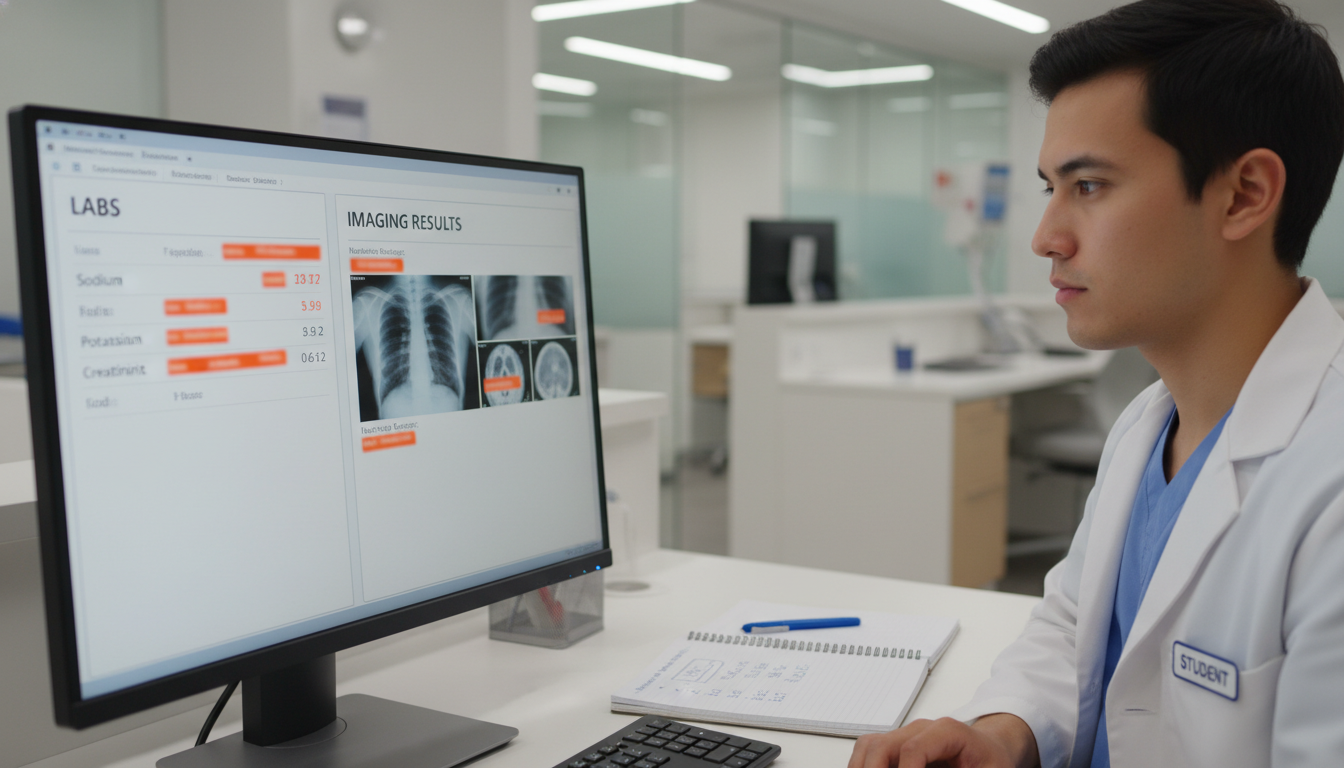
5. Labs and imaging: focus on the “headline” results
You are not expected to interpret every lab. But you can start to see which ones the team cares about.
On a typical lab panel, pay attention to:
- CBC:
- Hemoglobin / hematocrit (anemia, bleeding)
- White blood cell count (infection, inflammation)
- Platelets (bleeding risk)
- BMP / CMP:
- Creatinine and BUN (kidney function)
- Sodium, potassium (big impact on cardiac/electrical stability)
- Glucose
- Liver enzymes only at a conceptual level (AST/ALT, bilirubin)
- Key disease‑specific ones:
- Troponin for chest pain
- BNP for heart failure
- HbA1c for diabetes control
- INR for patients on warfarin
With imaging, do not worry about scrolling through CT slices. Instead:
- Scan the Imaging Reports section.
- Read just the Impression line(s), which summarize the radiologist’s view.
For example:
- “Impression: Right lower lobe pneumonia. No effusion.”
- “Impression: No acute intracranial process. Chronic microvascular changes.”
This is the level where you can track how data shapes the plan:
- “Because the CT head was negative, they are less worried about stroke.”
- “Because the troponin is trending down, they think the MI is resolving.”
6. Note structure: learn the skeleton, not every sentence
The EMR is full of notes, and they vary wildly in length and quality. When you read notes as a shadower, you are not trying to absorb every detail. You are trying to see how information is structured.
Most physician notes–especially inpatient “progress notes” and H&Ps–follow a pattern:
HPI (History of Present Illness)
The story: why the patient is here, how symptoms evolved.PMH/PSH/Medications/Allergies/Social/Family History
Context: chronic illnesses, surgeries, lifestyle, relevant family patterns.ROS (Review of Systems)
Systematic symptom checklist; as a learner, you can skim.Physical Exam
Objective findings by system (general, HEENT, heart, lungs, abdomen, neuro, etc.).Assessment and Plan
The key clinical reasoning section. Often organized by problem:- Pneumonia – improving; continue antibiotics, wean O2.
- Diabetes – blood sugars elevated; adjust insulin regimen.
- Disposition – likely discharge in 1–2 days if afebrile.
If you only have time for one part, read the Assessment and Plan.
Questions to consider:
- How many active problems are they managing at once?
- How specific are their plans (labs ordered, meds changed, follow‑up arranged)?
- How do they link data to decisions?
A high‑yield move:
Ask your preceptor if you can read yesterday’s note on a patient before you see them, then see the patient, then read today’s note. Notice how the story changed.
What to Largely Ignore (or De‑Prioritize) at Your Stage
Here is the part that will save you a lot of frustration. There are EMR features and data streams that are very important for clinicians, but not a good use of your cognitive energy as a premed or early student.
1. Deep navigation and configuration of the EMR
- Custom flowsheets
- Order set libraries
- Personal macros and smart phrases
- In‑basket management details
- Billing and coding interfaces
These are critical for efficiency and compliance, but they do not teach you foundational medicine. You can note that they exist, but you do not need to understand how they work.
If a physician is clearly rushing through orders, do not interrupt with:
“What’s that order panel you’re using?”
Save that sort of question for a slower moment at the end of clinic if you are genuinely interested.
2. Every single lab or micro result
Scrolling through dozens of:
- Electrolytes you have never heard of
- Autoantibody panels
- Culture sensitivities
- Historical lab values from years ago
As a learner, limit yourself to:
- Today’s basic labs (CBC, BMP/CMP) and any that come up in discussion.
- The “positive” or “negative” status of a key test that the team is talking about (e.g., “blood culture positive for MRSA”).
If you find yourself mentally stuck on “what does LDH mean?” during shadowing, you are misallocating attention. Instead, listen for how the physician uses the result in a sentence: “LDH is up, which supports the diagnosis of hemolysis.”
3. Full free‑text documentation for long stays
Some inpatients have:
- Dozens of progress notes
- Every consultant writing detailed narratives
- Nursing shift notes every 12 hours
You do not need to read someone’s entire three‑week hospital course to learn. If the stay is long and complex:
Read:
- The admission H&P
- The most recent consult note (if relevant)
- The last 1–2 days of progress notes
Ask the team for a brief verbal summary: “Can you give me the short version of what has kept him in the hospital so long?”
This is very close to how residents get oriented on a busy day.
4. Detailed billing and regulatory content
You may see:
- “Level of service” codes
- Documentation checklists
- Compliance pop‑ups
These are critical in the background, but they do not help you decide “how do I think like a doctor?” Ignore them for now.
5. Nursing documentation minutiae
This is not a statement about importance; nursing documentation is essential for safe care. But for your current educational goals, you can de‑prioritize:
- Detailed I&O flowsheets
- Hourly neuro checks
- Wound dressing change logs
If you are specifically interested in nursing or interprofessional care, you can ask a nurse to walk you through what they document. During physician shadowing, however, your primary task is to follow the physician’s reasoning.
How to “Read Along” in Real Time
Let us put this all into a concrete, stepwise strategy you can use next week on a shadowing day.
Before the first patient
If possible, say:
“Would it be alright if, when you open the EMR, you point out the main sections you focus on so I can follow your reasoning better?”
You will get one of three responses:
- A quick rundown: “Sure, I usually scan vitals, meds, labs, then notes.”
- A demonstration: they talk through a patient chart in detail.
- A brief “We’ll see how the day goes” (they are pressed for time).
Even a 30‑second overview helps you map their clicks to your mental model.
For each patient, follow this internal script
When the chart opens, silently ask:
Why are they here today?
- Locate the chief complaint or reason for visit.
Who is this person medically?
- Glance at the problem list.
- Notice 2–3 major chronic conditions.
How sick are they right now?
- Scan vitals.
- Note any clearly abnormal numbers.
What treatments are they on that matter for today?
- Look at 3–5 major meds from the list (insulin, anticoagulants, antihypertensives).
What are the key labs/issues the team cares about?
- Look for:
- Today’s CBC/BMP
- Any highlighted abnormal results
- The impression from any recent imaging
- Look for:
You will not always have enough time for all five steps. That is fine. If you only get to 1–3, you are still aligning with the physician’s thought process more than most shadowers.
After leaving the room
In the hallway or workroom, ask 1–2 specific questions that tie the EMR data to clinical decisions. For example:
- “You seemed particularly focused on his creatinine. How would that change what medications you can use?”
- “Her blood pressure was quite high today—does that change your plan for follow‑up?”
- “The CT scan was negative, but you still wanted to keep her overnight. What else are you thinking about that’s not just the imaging result?”
Notice how each question references something visible in the EMR but pushes into reasoning.
Common Pitfalls and How to Avoid Them
Pitfall 1: Staring at the screen, ignoring the patient
It is easy to get drawn into the EMR and forget the human being you just met. The EMR is a tool to support care, not the point of care itself.
Practical fix:
- In your notes after each patient, write one EMR‑based fact and one human detail:
- EMR: “HbA1c 11.2, uncontrolled diabetes.”
- Human: “Worried about missing work if hospitalized.”
That trains you to integrate both.
Pitfall 2: Treating the EMR like a test rather than a teaching tool
Some students panic: “If I do not understand every lab, I am failing.” That is not the expectation.
You are not being evaluated on EMR mastery during basic shadowing. You are being evaluated (informally) on curiosity, respectfulness, and your ability to ask level‑appropriate questions.
If you see something you do not recognize, mental script:
- “Is this core to understanding today’s problem?”
- If yes: make a note to look it up later.
- If no: let it go.
Pitfall 3: Asking questions at the wrong time
You might feel proud that you noticed a lab trend, but asking while the physician is trying to reconcile meds on discharge will not land well.
Heuristic:
- If they are placing orders, signing discharge paperwork, or fielding pages, observe silently.
- If they are scrolling and narrating, or pausing and thinking, one thoughtful question is welcome.
Over a full day, 8–10 solid questions spaced out is more than enough.
Using the EMR Experience in Your Applications and Interviews
Shadowing with EMR awareness gives you a more realistic picture of modern medicine than just “I saw doctor‑patient conversations.” It can also feed into your personal statement or interview answers, if you frame it correctly.
Examples of how you might articulate this experience:
“During my shadowing in an internal medicine clinic, I saw how much of the physician’s cognitive work happened in the EMR: scanning vitals, synthesizing problem lists, and translating lab data into a clear assessment and plan. I started paying attention not just to the diagnoses, but to how the structure of the chart reflected clinical reasoning.”
“On a hospital medicine service, I watched residents walk through an admission note and then compare today’s vitals and labs to yesterday’s. Seeing the EMR used as a living narrative rather than a static database helped me understand that good documentation is an extension of good thinking.”
Avoid clichés like, “I realized data is important in medicine.” Be specific about how you learned to see data through the lens of decision‑making.
Final Thoughts: What to Take Away
Three core points:
Filter ruthlessly. When you look at the EMR while shadowing, anchor on: reason for visit, problem list, vitals, a few key meds, major labs, and the assessment/plan. Let the rest blur into the background for now.
Follow the reasoning, not the clicks. Your main goal is to understand how clinicians turn EMR data into decisions, not how to navigate every tab or memorize every value.
Stay human‑focused. Use the EMR to deepen your understanding of patients, not replace it. Pair each chart detail with a human detail from the encounter so you train yourself to keep both in view.
If you can do that, the EMR stops being a wall of noise and becomes one more window into how real medicine is practiced.