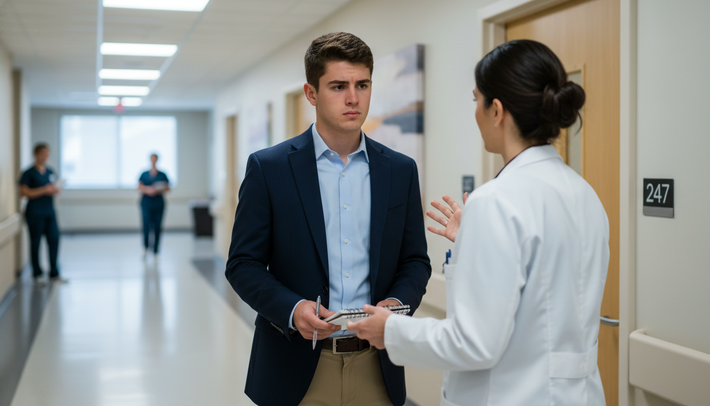
It's 7:45 a.m. on a Tuesday.
You’re standing in the lobby of a gleaming private practice—water wall, coffee bar, soft music—wearing your best business-casual, waiting to shadow a doctor you found through a family friend.
Fast-forward three weeks.
Now it’s 5:50 a.m. You’re in a massive academic hospital, white coat on, badge crooked, clutching a clipboard as residents swirl around you. You’re shadowing an attending whose name you mispronounced the first two days.
Here’s the part almost no one tells you: those two environments are evaluating you in completely different ways. The same “you” will be read very differently in a private practice versus an academic center.
(See also: Red‑Flag Behaviors Attendings Clock Within 10 Minutes of Shadowing for more details.)
And the attendings? They notice far more than “Are you interested in medicine?” or “Did you ask a few questions?”
Let me walk you through what doctors actually see when you shadow in private practice vs academic centers—and how that plays into letters, opportunities, and ultimately, your trajectory.
How Shadowing Really Works Behind the Scenes
Let’s start with the unspoken reality: shadowing is not just “come follow me around.” It’s a silent audition, even when everyone smiles and says, “No pressure, just observe.”
In both private practice and academic hospitals, three things are always being evaluated, even if nobody says the words out loud:
- Are you safe to have around patients?
- Are you going to slow down or disrupt the day?
- Are you worth investing in?
The difference is how each environment weights those three.
In private practice, the doctor is usually thinking:
- “Will this student make my patients uncomfortable?”
- “Will this hurt my schedule or revenue today?”
- “Will this cause any liability problems?”
In academic centers, the attending is also thinking:
- “Is this someone I might want as a student… or eventually a resident?”
- “Could I write this person a letter?”
- “Is this someone I can trust with small tasks without hand-holding?”
Same activity. Completely different lens.
What Doctors See in Private Practice Shadowing

Let’s strip the varnish off private practice shadowing.
In a typical outpatient private practice—family medicine, dermatology, ortho, GI, cardiology—structure tends to be:
- 15–20 minute slots, back-to-back
- Revenue tied directly to how many patients are seen and billed
- Staff lean enough that everyone is doing several jobs
So when you walk in as a shadower, here’s what the physician and office staff actually clock almost immediately.
1. Your “patient presence” is everything
Private practice attendings watch how you exist in the room far more than what you ask outside the room.
They notice:
Do you introduce yourself clearly and briefly?
(“Hi, I’m Alex, a premed student shadowing Dr. Rao today. Is it okay if I’m in the room while you’re being seen?”)Do you know when to fade into the background?
Not leaning on counters, not blocking the screen, not staring at sensitive areas during pelvic/breast/GU exams.Do you scan the patient’s nonverbal cues?
When you step in and the patient crosses their arms, stops making eye contact, or glances quickly at you—good physicians will pause and ask, “Would you prefer that the student steps out?” They’re watching you at that moment. Do you look offended? Relieved? Professional?
I’ve seen private docs decide in under two days whether they’ll let a student stay for procedures or sensitive encounters based almost entirely on this “presence” factor.
The students who:
- put their bag down out of the way
- step to the corner opposite the computer
- ask permission once, then stay quiet and observant
get invited to more, see more, and often get better letters.
2. Efficiency is sacred
In a busy private practice, a student who even slightly slows the flow is a problem. The physician may be polite to your face, but what they say to their staff afterwards is what matters.
Behind closed doors you’ll hear things like:
- “Nice kid, but I can’t run 20-min slots with them asking questions every room.”
- “They keep blocking the MA from the blood pressure machine.”
- “They’re always in the hallway when patients are getting roomed.”
They’re not mad that you’re curious—they’re protecting their day.
So the students who get invited back do something very specific: they time their curiosity.
They:
- Ask content questions between patients, on the way to the next room, or at natural pauses
- Keep “What’s that?” style questions to procedures or imaging, not routine visits
- Save bigger questions (“How do you decide between medication A and B?”) for lunch or end-of-day
Most docs in private practice will not correct you. They’ll just stop inviting you as often, or never offer that “If you ever need a letter…” line. Silence is the feedback.
3. Staff opinions carry more weight than you think
In private practice, medical assistants, front desk, and nurses often have the doc’s ear in a way you do not appreciate as a student.
You might think you’re being evaluated only by the physician. You’re not.
Here’s what happens when you leave for the day:
The MA might say:
- “That student is really respectful; they help wipe the exam table and always say thank you.”
- Or, “They never say hi when they walk in, just stare at their phone until the doctor comes.”
Guess which one gets you invited back or mentioned favorably to the physician’s friend who runs the residency program at the local hospital.
In a surprising number of practices, I’ve heard doctors ask their staff:
“What do you think of that student? Are they okay with patients? Weird vibes?”
Your interactions at the front desk, how you respond when a staff member teaches you something basic, or whether you say thank you when given a spare snack—those details feed the narrative about you.
4. The “letter of recommendation calculus” in private practice
Private doctors know their letters carry a certain kind of weight:
“Observed in clinical setting, long-term, knows how real outpatient medicine looks.”
Here’s the inside calculation they’re making:
- Did you show up reliably and on time, without reminders?
- Did your presence make their day harder or easier?
- Did you demonstrate consistency over multiple days or weeks?
If a student shadows for 2 afternoons and then emails, “Can you write me a strong letter?” here’s the real internal response 90% of attendings have but won’t say:
“Strong? No. Polite? Sure. But I barely know you.”
The students who get strong private-practice letters typically:
- Come weekly for a month or more
- Show progressive sophistication in questions over time
- Earn genuine trust: the doc feels safe introducing them as “someone who’s been with me for a while”
And there’s a twist: many private practice docs have connections—former trainees, colleagues on selection committees. They sometimes quietly email those people about standout students. That never shows up on AMCAS, but it absolutely influences how your file is read.
What Doctors See in Academic Center Shadowing

Now switch scenes: large academic center, teaching hospital, tertiary care.
The vibe, the stakes, the attention—it’s all different.
1. You’re being read as a future trainee, not just an observer
In an academic setting, attendings and residents subconsciously ask:
- “Could I see this person as a third-year medical student on my team?”
- “Would I trust this person to not disappear when things get hard?”
- “Do they have the baseline maturity to handle real medicine?”
So they look for different cues:
Can you handle standing and walking for hours without complaining?
Do you stay engaged even when the topic isn’t what you “like”? (Plastics-obsessed premeds who go dead-eyed on medicine rounds get noted.)
Are your questions grounded in what’s happening, or are they purely abstract?
“Why is this patient on three vasopressors?” hits very differently than, “What specialty makes the most money?”
Academic attendings are used to teaching. They’re less worried about you slowing them down and more concerned with whether you can plug into a teaching environment without being a distraction.
2. The hierarchy test
Unlike private practice, academic medicine is full hierarchy mode: attending → fellow → senior resident → intern → student → you.
Shadowers who misread that hierarchy stand out in all the wrong ways.
Red flags that attendings hear about:
- You answer a question out loud that was clearly directed to the medical student
- You pepper the attending with questions while the intern is trying to present
- You linger near the attending and ignore the residents
Here’s what gets you quiet points instead:
- Asking the intern or med student questions first, before going up the chain
- Walking with the team but gravitating toward the residents, not the attending’s elbow
- Saying, “Is it okay if I ask you a couple of questions about this case later?” instead of launching in without permission
What you don’t see: after rounds, a lot of attendings will ask the team, “How’s that premed doing?” They’re checking your fit within the ecosystem as much as your interest in medicine.
3. Exposure vs depth: what impresses academic physicians
Academic attendings know you’re not going to deeply understand transplant immunology or the finer points of sepsis on day one. They’re not grading your knowledge.
They’re looking for:
Pattern recognition of your own limits
(“I’m not sure I understood why we chose this antibiotic over that one—could you explain?” is gold.)Capacity to synthesize over time
Students who return for multiple sessions and start making connections:
“Last week we saw a patient with decompensated cirrhosis; is this patient similar or different?”Respect for patient vulnerability
In ICU, oncology, psych, OB—if you look visibly bored during family meetings or sit on your phone during a miscarriage counseling session, that will kill your prospects with that attending forever.
Shadowers who are invited to come back for more advanced experiences—sitting in on sign-out, visiting the OR, watching procedures—are those who show growing insight, not raw brilliance.
4. LORs and “quiet endorsements” from academic docs
Here’s one of the biggest myths I see:
Students think one shadowing day with a big-name academic at MGH or Stanford is better than a longitudinal relationship with a local doc.
Program directors do not read it that way.
A strong academic letter usually comes from:
- A sustained relationship: repeated shadowing, research, or formal teaching
- Direct observation of how you operate around patients and teams
- Evidence that you can function in the real academic machine
If you only shadowed, many academic attendings will hesitate to write you a “strong” letter. Not because you’re bad—but because they know what selection committees want, and it’s more than, “They followed me around twice.”
But here’s the insider piece: academic attendings sit on admissions or residency selection committees. Even if they don’t write your letter, they might recognize your name in a pile. Or their colleague might call and ask, “You had this applicant shadow, what did you think?”
Those backchannel comments matter.
They remember:
- Punctuality without excuse-making
- Whether you vanished during the “less glamorous” parts
- How appropriate you were with patients and staff
If you’re good, they may flag your name with a simple, “This one’s solid. Mature. I’d take them.”
That comment might never reach you—but it changes how some programs discuss you in the room.
Private Practice vs Academic: What You Actually Learn

Once you’ve shadowed in both settings, you start to see two different versions of “being a doctor.”
Private practice quietly teaches you:
What day-to-day continuity looks like
Same patients, follow-ups, watching chronic disease management in real time.How business and medicine intertwine
Scheduling, insurance issues, prior authorizations, patient satisfaction pressures.The reality of lifestyle and autonomy
You see when they leave, how often they step out to call their kids, what “being your own boss” actually costs in stress.
Academic medicine reveals:
The intensity of complex, high-acuity care
Transplants, multi-organ failure, trauma, rare diseases. Things you’ll never see in routine clinic days.Team-based decision-making
Rounds, consults, multi-disciplinary meetings. You’re exposed to how consensus and conflict work in medicine.The culture of teaching and research
Residents presenting papers at journal club, attendings mentioning clinical trials, the expectation that people are constantly learning and publishing.
Doctors in each environment notice different reactions from you.
Private practice docs notice if your eyes light up when you see a full, efficient clinic humming along and you say, “This looks like a good life.”
Academic docs notice if you lean forward when complex ICU patients are discussed and say, “I like thinking through all those moving parts.”
And if your affect never changes in either environment, that gets noticed too.
How This Plays Into Your Applications (That No One Tells You)
Admissions committees skim your “shadowing hours” section faster than you think. They’re not looking at the raw number first.
They’re asking:
- Did you see both sides of medicine—outpatient and inpatient, private and academic?
- Does your personal statement and activity descriptions reflect any actual insight from those experiences?
- Are your letters consistent with the narrative you’re selling?
On the back end, when faculty read your file, the kind of shadowing you did signals different things:
Heavy private practice shadowing with good letters suggests:
- You can handle real-world outpatient flow
- Patients and staff were comfortable around you
- You’ve seen “normal” medicine, not just edge cases
Strong academic exposure suggests:
- You’ve seen higher acuity and complex systems
- You’re comfortable in the teaching environment
- You understand what you’re signing up for in clerkships and beyond
The killer combination?
A file that shows both, with clear reflection:
- “In Dr. X’s private cardiology clinic, I saw how medication choice often hinged on insurance and cost.”
- “At the university hospital, I watched the same conditions play out a decade later as advanced heart failure.”
When your experiences talk to each other like that, reviewers know you didn’t just collect hours; you actually paid attention.
How to Behave Differently in Each Setting (From the Physician’s Eye)
I’ll give you the distilled insider version.
In private practice, doctors are most impressed when you:
- Don’t interrupt the flow of clinic
- Ask patients for permission smoothly and respectfully
- Show obvious respect to staff and gratitude for their time
- Appear low-maintenance: water bottle, quiet shoes, no constant phone checking
In academic centers, they’re most impressed when you:
- Respect hierarchy without disappearing
- Ask structurally thoughtful questions (content, then process, then career)
- Show up for the boring parts: pre-rounding, sign-out, long family meetings
- Look like someone who could be on the team without creating drama
Both sets of doctors are watching how you handle discomfort:
- The crying patient.
- The angry family.
- The procedure that makes you queasy.
- The long stretch of nothing happening.
You’re not expected to be perfect. You are expected to be teachable, aware, and appropriate.
Those are the students whose names physicians remember—years later—when a dean or PD asks, “Do you know this applicant?”
FAQs
1. Is private practice or academic shadowing more “impressive” to admissions committees?
Neither wins by default. Committees care less about the logo on the building and more about what you learned and how it shaped your understanding. A deeply engaged, longitudinal experience at a community cardiology practice can beat a one-day “tourist” shadow at a famous academic center. The strongest applications usually show both environments and clear reflection about their differences.
2. Can I get a strong letter of recommendation from shadowing alone?
It’s possible but uncommon. Most physicians feel they need more than passive observation to write a truly strong letter. That usually means repeated shadowing over time, plus some form of deeper engagement—helping with a small project, sitting in on teaching sessions, or being present enough that they’ve seen your behavior across different situations. Two half-days and a nice handshake almost never translate into a powerful letter.
3. Should I act differently with residents vs attendings in academic settings?
Yes, but not dramatically. With residents, you can be a bit more informal, ask “basic” questions, and seek practical advice about training and lifestyle. With attendings, keep your questions more focused on clinical reasoning and big-picture career thinking. Never bypass residents to get to the attending; ask residents first, then say, “Would it be appropriate to ask Dr. ___ about this as well?” That respect for hierarchy is exactly what attendings look for.
4. What if a patient seems uncomfortable with me in the room—what should I do?
Default to the patient’s comfort, always. If you sense discomfort—avoidant eye contact, guarded posture, short answers—you can say quietly to the physician, “I’m happy to step out if that’s better.” Many attendings will ask the patient directly, but your willingness to remove yourself is noticed and respected. Forcing your presence in sensitive exams or discussions is one of the fastest ways to lose trust from both patients and physicians.
Key points to walk away with:
- Private practice and academic centers evaluate you through different lenses—efficiency and patient comfort vs team dynamics and teachability.
- Doctors notice how you move, where you stand, when you talk, and how you treat staff far more than you realize.
- The real value of shadowing is not the hours; it’s the insight and relationships you build across both worlds of medicine.