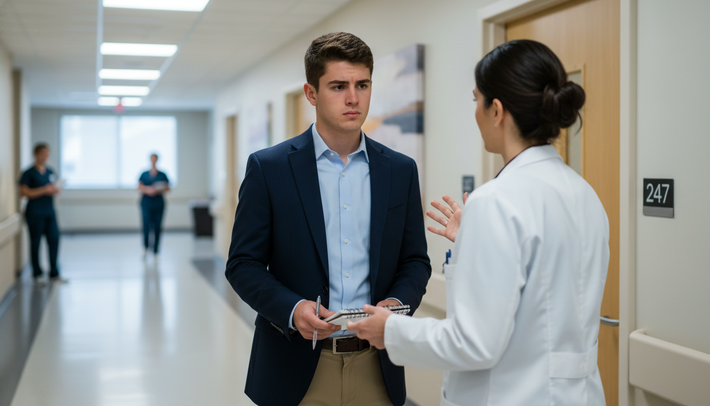
The ugly truth is this: attendings size you up in the first 10 minutes, and they’re usually right.
You think you’re “just shadowing.” They think they’re watching a potential future colleague, intern, or letter candidate under a microscope. And in that tiny window—from the moment you introduce yourself to the first patient encounter—most of the damage is already done.
Let me walk you through what attendings actually clock in those first ten minutes, the red‑flag behaviors that torpedo you before you even realize you’re being evaluated, and how people get quietly blacklisted without anyone ever saying the word out loud.
What Attendings Are Really Doing in the First 10 Minutes
Attendings don’t need hours to form an opinion. They’ve trained for years reading patients’ faces, residents’ excuses, nurses’ tone of voice. Reading you is easy.
They’re not thinking, “Does this student know pathophysiology?” They’re thinking:
- Will this person embarrass me in front of patients or staff?
- Can I trust them with sensitive information?
- Are they going to slow my clinic/rounds to a crawl?
- Do I ever want to write this person a letter?
(See also: Shadowing Etiquette Doctors Expect but Never Explain Out Loud for more details.)
And they get their answers from very small, very specific behaviors.
Most premeds and early med students assume the red flags are about knowledge gaps. They’re not. Ninety percent of the time, the biggest red flags are attitude, self‑awareness, and professionalism.
Let’s walk through the ones that silently kill your reputation.
Red Flag #1: Walking In Like a Tourist, Not a Team Member
This is the first thing they see. Before you speak. Before you open your notebook. Before you ask a single question.
You can spot the “tourist” student instantly: they stroll up to the nurses’ station, slightly wide‑eyed, scanning around like they’re on a hospital tour. Backpack still on, coffee in hand, sometimes even AirPods still in one ear “just until we start.” They stand in the middle of traffic lanes. They don’t know where to be, and more importantly, they don’t realize it’s their job to figure that out quickly and quietly.
Attendings clock this as: “This one’s going to be in the way all day.”
The worst early move: standing there waiting to be told every tiny step. “Where do I put my bag? Where do I stand? Where should I go?” All within the first two minutes.
Let me tell you what a seasoned attending at a large academic hospital (think Mass General, Hopkins, UCSF level) told me once:
“If a student comes in and treats the hospital like a museum instead of a workplace, I know they’ve never actually watched how medicine really works.”
What they expect instead is simple:
You arrive early. You’ve already found the unit. Your bag is out of the way. Your phone is silenced and not visible. Your body language says, “I’m ready to plug into your day, not make you design mine.”
You don’t need to be invisible. But you do need to be low‑maintenance.
Red‑flag variation: sitting down before anyone offers you a seat, or taking the one chair usually used by the nurse or resident. Staff notice this faster than you think.
Red Flag #2: Over‑Eager Talking, Under‑Skilled Listening
Within 10 minutes, attendings know if you’re going to be a chatterbox liability.
The classic offender: the student who’s so desperate to show they care that they don’t stop talking.
They over‑introduce themselves: “I’m Jordan, a premed, I go to X university, I’m really passionate about cardiology, I’ve shadowed at Y hospital, and I’m just so excited to be here…”
By the time you finish the paragraph, the attending has already decided you’re going to slow them down.
Attendings are fine with you being enthusiastic. What they cannot stand is someone who doesn’t read the room.
They watch:
- Do you cut people off when you’re excited?
- Do you start answering questions that weren’t directed at you?
- Do you jump into patient conversations without being explicitly invited?
In one internal medicine clinic I know, a premed shadowed a well‑known attending. Within the first 10 minutes of the first patient visit, the student interrupted to ask the patient a question about their “diet and exercise routine” because they’d “read in an article that lifestyle is so important.” The patient looked confused. The attending smiled politely but later told the coordinator, “Don’t schedule that one with me again.”
Why? Because unsolicited interjections are a liability. You’re untrained. You don’t know what’s been discussed before, what’s sensitive, what’s time‑critical.
If an attending feels like they have to guard the conversation from you, you’re done.
Shadowing is 80% observing, 20% thoughtfully engaging. Too many students flip that ratio.
Red Flag #3: Being Weird About Patients’ Bodies or Stories
This one ends careers before they start.
Within minutes, attendings can tell if you’re mature enough to be in patient rooms.
Two big mistakes:
- Facial reactions you don’t control.
Students flinch at wounds, wince at smells, raise eyebrows at weight, ages, social situations. You think you’re being subtle. You’re not.
Attendings see you not watching the patient; they see the patient watching you.
I know an attending in EM who had a premed banned from the ED because, during a pelvic exam, the student clearly looked uncomfortable and stared at the ceiling the entire time, then avoided eye contact with the patient afterward. No words said, but the patient asked later, “Why did that student look so horrified to be there?”
- Inappropriate curiosity.
Asking, “How did this even happen?” or “Wow, that must have been really bad, right?” in a tone that sounds more like gossip than clinical curiosity.
Or, outside the room, asking the attending for “the crazy stories” or “the worst thing you’ve ever seen.”
This screams: “I’m here for entertainment, not empathy.”
Hospitals are full of people on the worst day of their lives. If you show even a hint that you’re here for the drama, you get mentally blacklisted immediately.
Red Flag #4: Acting Above Your Training Level
Nothing irritates attendings faster than a student who doesn’t know their lane.
This shows up in different ways:
- You introduce yourself to patients as “working with the doctor today” instead of “a student who’s observing.”
- You touch the patient, move the gown, or start an exam maneuver without being asked to.
- You ask for permission to “present the patient” in front of them during your first hour.
- You start explaining labs, diagnoses, or plans to the patient.
At one Midwest academic program, a pre‑clinical med student shadowing in cardiology told a patient, “It sounds like your EF is pretty low; that’s basically heart failure, right?” The attending heard about it from the nurse. That student never shadowed there again. Letter potential gone.
From the attending’s perspective, the calculation is brutal:
If you’re already overstepping when you’re just supposed to observe, what are you going to be like when you actually have some authority?
You can be engaged without cosplaying as an intern.
Ask to listen to hearts or lungs only after you’ve been there a bit and the attending invites you into the workflow. Do not volunteer yourself into the exam.
The smartest students err on the side of slightly under‑assertive early, then calibrate based on how the attending uses them.
Red Flag #5: Phone Behavior That Instantly Sinks You
Here’s the rule attendings actually use, even if nobody writes it down:
If I see your phone more than once, I mark you as unprofessional.
Some specifics that get you quietly written off:
- Checking your phone “just real quick” between patients without excusing yourself.
- Using your phone to take notes without saying what you’re doing, so it looks like you’re texting.
- Taking photos of anything clinical without explicit permission (this is a massive HIPAA and professionalism violation).
- Having notifications constantly buzzing in your pocket.
One surgical attending at a big-name program told me:
“I don’t care what generation you are. If you can’t stay off your phone for a half‑day of shadowing, you can’t stay present with patients either.”
Counterpoint: many students do use their phones legitimately—to check medical references, look up terms, or jot notes. That can actually be a plus if you handle it correctly.
The difference is clarity and timing. You say, “Is it OK if I jot a few notes on my phone so I remember what we talked about?” And you only do that when you’re not in front of a patient or in the way.
If an attending mentions phone issues to a coordinator, you’re usually done rotating with that service. They may still be polite to your face. The door just closes quietly behind you.
Red Flag #6: Performing Interest Instead of Showing Genuine Curiosity
Attendings can tell when you’re “on” rather than present.
Students think interest = saying, “That’s so interesting” every five minutes. Or dropping, “I’m really interested in your specialty” into every conversation.
You know what it looks like from the attending’s side?
Desperation.
Here are the red‑flag flavors of fake interest:
- You say you’re “passionate about surgery” but you go pale when you see a small amount of blood.
- You insist you’re “definitely going into pediatrics” but seem impatient with kids or unconcerned with parents’ questions.
- You claim to be “really into research” and then ask surface‑level questions that show you haven’t read a single abstract in that field.
At one large children’s hospital, an attending told me:
“I had a med student tell me peds was their life dream. By lunchtime, they were scrolling on their phone outside a room while a child was getting an IV placed, visibly annoyed by the crying. That’s not peds. That’s theater.”
Genuine curiosity sounds different. It’s specific. It often comes at natural pauses, not machine‑gunned between rooms.
Red‑flag variation: you ask questions that are easily Google‑able (“What’s an A1c again?”) instead of using questions to deepen what you’re seeing (“Why did you pick insulin over another GLP‑1 agonist in this patient?”).
Attendings are not grading your knowledge; they’re grading your judgment about when and how to ask.
Red Flag #7: Disrespecting the Invisible Power Structure
This one burns you in ways you will never see directly.
Every attending watches how you treat everyone who is not them.
They know you’re going to be nice to the person who can write you a letter. That’s obvious. They’re much more interested in how you interact with:
- Nurses
- Techs
- MAs
- Unit secretaries
- Janitorial staff
- Residents
Here’s the behind‑the‑scenes reality: these people tell attendings what they think of you. Usually the same day.
I’ve seen this exact scene repeat across multiple institutions:
Student is warm and attentive with the attending. Smiles, nods, asks “great questions.”
Ten minutes later, at the nurses’ station, they’re slightly dismissive. They ask a nurse, “Is Dr. X ready for me now?” like the nurse is a receptionist. They leave their stuff on the counter in the way. They don’t say thank you when shown where supplies are.
Nurse later to attending, casually: “That student seemed…a little full of themselves.”
Translation inside the attending’s brain: Not safe to recommend. Not team material.
On the other hand, if the MA says, “That student was really polite and helpful,” your stock jumps instantly. You’ve passed a hidden test most students don’t know exists.
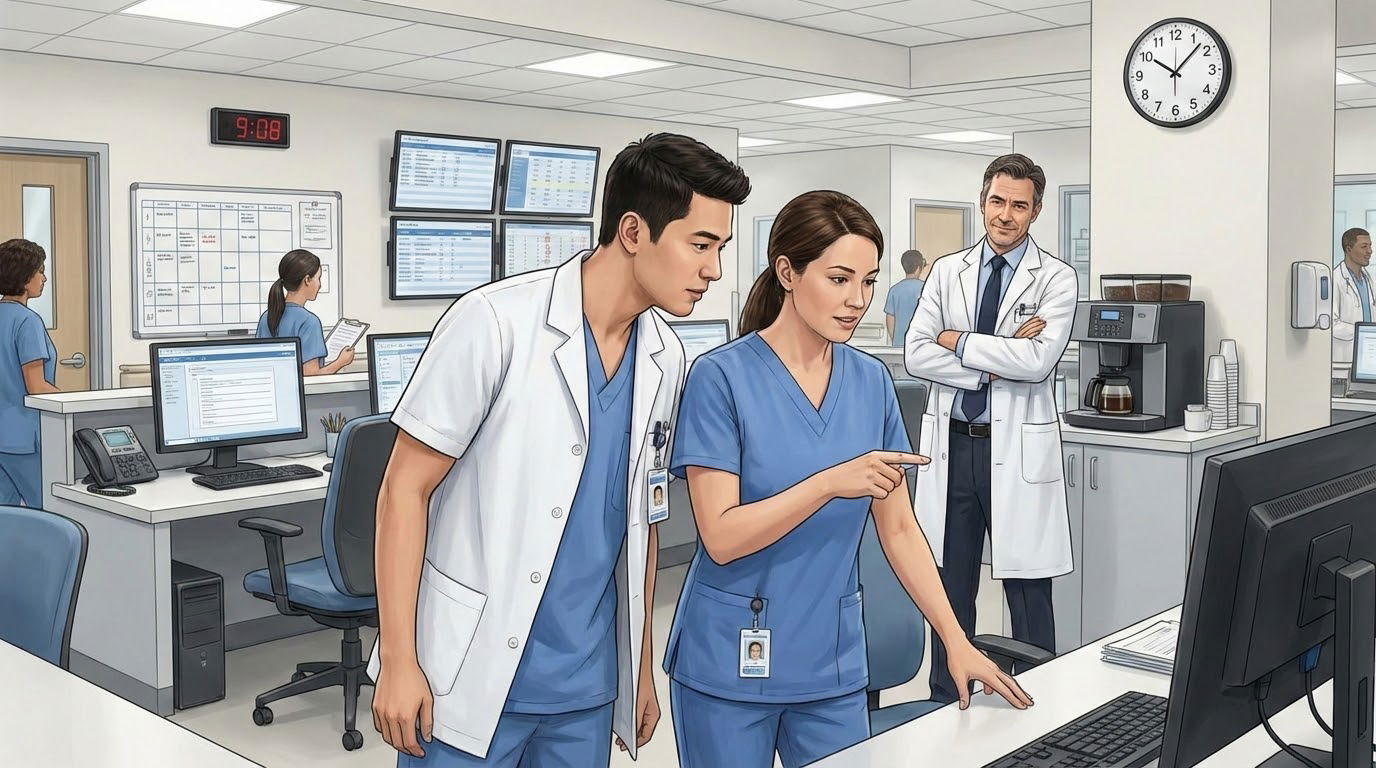
Red‑flag variation: ignoring residents or treating them like obstacles to bypass so you can get more attending time. Residents often have more influence than you realize, especially on anything involving future rotations and informal recommendations.
Red Flag #8: Boundary Issues and Oversharing
Shadowing is a professional encounter. Too many students treat it like a mentorship coffee chat on steroids.
Red flags in this territory:
- Telling the attending your entire life story within the first few minutes.
- Bringing up your MCAT score unprompted. Ever.
- Complaining about your school, other physicians, or prior shadowing sites.
- Asking for letters of recommendation on day one or even hinting at it (“I’m really hoping to get a strong letter from someone in this specialty…”).
One attending at a Texas academic center told me about a student who, within 10 minutes of meeting, confessed they’d “had some professionalism issues on a prior rotation but it wasn’t really my fault.” That attending immediately decided: never getting involved with this student’s career. Too much drama.
Another subtle red flag: trying to turn every quiet moment into a career‑therapy session.
“What do you think my chances are of getting into med school with X GPA?”
“Should I retake the MCAT?”
“Do you think my research is good enough?”
You think you’re showing ambition. They experience it as emotional labor on a day they’re already overloaded.
It’s not that attendings never want to help. Many will happily talk about careers—later. After you’ve shown you can behave professionally with patients and the team. When they’ve seen you for more than 10 minutes.
Early oversharing communicates one thing: you view them as a resource for you, not as a professional you’re temporarily joining.
Red Flag #9: Being a Passive Shadow That Contributes Zero
Yes, over‑eagerness is a red flag. But being a ghost isn’t neutral either.
Attendings notice students who are so terrified of making mistakes that they contribute nothing at all. No questions. No engagement. No sign of cognitive wheels turning.
They look bored, even if they’re actually just anxious.
There’s a difference between respectful quiet and dead air. After 10 minutes, an attending knows which type you are.
Here’s what attendings often say in private:
“If I can’t tell what’s going on in your head at all, I can’t vouch for you. You could be brilliant or completely lost—I have no data.”
Being purely passive says:
- I’m here for the checkbox, not the experience.
- I’m waiting for you to spoon‑feed me.
- I’m afraid to think out loud.
Red‑flag variant: when the attending does invite you in—“What do you think is going on with this patient?”—and you shrug and say, “I have no idea.” Not even a tentative thought.
Attendings are fine with wrong. They’re not fine with blank.
The students who avoid this red flag don’t dominate. They ask one or two well‑placed questions. They answer when invited, even if they’re unsure: “I’m not completely sure, but I was thinking maybe X because of Y.”
That’s enough signal to separate you from the herd.
Red Flag #10: Ignoring Confidentiality and Space
Shadowing means being near information and situations you’re not used to handling. Attendings watch how you move through that space.
Red‑flag behaviors that show up fast:
- Glancing at computer screens you’ve not been invited to see.
- Standing too close behind someone entering orders or notes.
- Talking about cases in the elevator in front of other people.
- Mentioning identifiable patient details to friends or family—even casually—while you’re still in the building.
One coordinator at a university hospital told me about a premed who tweeted (publicly!) about a “wild trauma patient” they’d seen during an ED shadowing shift. No names, but enough details that someone could connect dots. That student lost all access to that hospital. Word spread to the local med school.
Attendings do not want to be anywhere near students who treat patient stories like content.
The metric is simple:
Do you treat everything you see and hear as sacred, or as stories you now own?
If they even suspect it’s the latter, you don’t get invited back.
How Attendings Decide to Invest in You (or Not)
Here’s the harsh calculus many attendings are making on a typical day:
They’re overbooked, running behind, fighting bureaucracy and burnout. A shadowing student is either going to make their day slightly better…or slightly worse.
They’re not usually looking for perfection. They’re looking for signal.
Within 10 minutes they’ve usually categorized you into one of three boxes:
- Red Flag / Liability – “Don’t schedule them with me again.”
- Neutral / Background – “Fine to have around, but not worth more effort.”
- Potential / Worth Investing – “If they come back, I’d consider mentoring or writing for them.”
You cannot talk your way out of Box #1. You can, however, quickly fall into it with the behaviors we just walked through.
The “potential” students aren’t magical. They just avoid the landmines.
They come in prepared, on time, and low‑maintenance.
They’re respectful and present with patients and staff.
They ask a couple of thoughtful questions at reasonable times.
They seem genuinely interested in learning, not performing.
That’s it. But almost nobody does it consistently.
FAQs
1. Can I recover if I realize I’ve already made a bad first impression while shadowing?
Sometimes. If the mistake is minor—talking a bit too much, asking a premature question—you can recalibrate in real time. Pull back, observe more, and let your later behavior override the early misstep. If you’ve violated confidentiality, overstepped with a patient, or argued with staff, that’s harder to fix. In those cases, the smartest move is a brief, sincere acknowledgment (“I realize I overstepped earlier with that question; I’m sorry about that”) and then flawless professionalism for the rest of the day. Arguing or over‑explaining will just dig the hole deeper.
2. Is it ever appropriate to ask for a letter of recommendation from someone I’ve only shadowed?
Yes, but not after a single afternoon and not in the first 10 minutes of knowing them. Attendings write strong letters when they’ve seen you more than once, watched you interact with patients, and had time to assess your reliability. If you’ve shadowed multiple days and built a natural rapport, you can ask near the end: “If you feel you know me well enough, would you be comfortable writing a strong letter of recommendation?” That phrasing gives them an out if their answer is really no.
3. How much medical knowledge am I expected to have as a premed shadowing for the first time?
Very little. Attendings do not expect premeds to know pathophysiology, drug mechanisms, or management algorithms. They do expect basic awareness: what HIPAA is, why confidentiality matters, and that you should not touch patients or equipment without permission. If you know the difference between the attending, resident, and nurse, and you’re not asking questions you could answer with a five‑second Google search, you’re already ahead of most.
4. What should I actually do in the first 10 minutes to avoid these red flags?
Arrive early, find the unit, and tuck your belongings away. When you meet the attending, introduce yourself clearly and briefly: name, level (premed, M1), and that you’re there to observe and learn. Ask once where they’d like you to stand or sit during encounters, then adapt. Keep your phone silent and out of sight. In the first patient encounter, say nothing unless you’re introduced, and focus on the patient’s comfort and privacy. After you leave the room, one or two thoughtful questions about what you just saw are enough to signal engagement without overstepping.
Key takeaways:
Attendings are reading you within minutes, and most of what they care about has nothing to do with medical knowledge. Red‑flag behaviors—tourist energy, poor boundaries, disrespect for staff, and overstepping with patients—get noticed fast and quietly close doors. If you treat shadowing like joining a professional team, not consuming a hospital spectacle, you’ll land in the small group attendings actually want to help.