
Hypothetical answers are not the villain you have been told they are. Used correctly, they can actually save you in a residency interview.
You have probably heard the dogma:
“Never answer hypothetically.”
“Always use real examples.”
“Past behavior is the best predictor of future behavior.”
That last line comes straight from industrial-organizational psychology research… and like most things dragged out of context into med-ed folklore, it’s been turned into a sloppy rule instead of a nuanced guideline.
Let me be blunt: if you walk into a residency behavioral interview thinking hypothetical answers are forbidden, you’re tying one hand behind your back. Program directors are not scoring you on whether your verbs are in the past tense. They’re trying to figure out:
- how you think
- how you’ll behave with limited information
- how you handle situations you actually have not faced yet
Sometimes, a hypothetical is the only honest way to answer that.
Let’s separate myth from reality.
What Behavioral Interviews Actually Measure (And What They Don’t)
Behavioral interviews came from corporate HR before they migrated into medicine. The classic format:
“Tell me about a time you…”
- had a conflict with a colleague
- made a mistake
- managed competing priorities
- dealt with a difficult patient or family
The claim: past behavior predicts future behavior.
There is data behind this. Meta-analyses in personnel psychology show that structured behavioral interviews have higher predictive validity for job performance than unstructured “so, tell me about yourself” chats. Some numbers from the IO psych world:

| Category | Value |
|---|---|
| Unstructured Interview | 0.2 |
| Structured Behavioral Interview | 0.45 |
| Cognitive Ability Test | 0.5 |
| Work Sample | 0.54 |
No, these aren’t residency-specific numbers, but the pattern holds: structured, behavior-based approaches beat vibes-based interviews.
Here’s where the myth creeps in. People copy the surface of behavioral interviewing (past-tense questions) and then invent their own rule:
“Therefore, hypotheticals must be useless – they’re not about past behavior.”
Wrong.
Residency selection is not evaluating who you were at 20 during your first EMT shift. It’s trying to estimate who you’ll be at 3 AM with a crashing patient and a pager screaming. Past examples are useful proxies, but they’re not complete. For some scenarios, you simply have no real story yet. Pretending otherwise is worse than answering hypothetically.
The Myth: “Never Answer Hypothetically”
I’ve heard advisors tell students this verbatim:
“If they ask, ‘What would you do if…?’ always redirect to a real story. Hypothetical answers are fluff.”
This advice sounds smart. It’s clean, absolute, and easy to remember. That’s how you know it’s probably wrong.
Here’s what’s actually going on:
Some questions are poorly written
Interviewers sometimes mash together a behavioral and a hypothetical:
“Tell me about a time you disagreed with an attending. What would you do if your attending asked you to do something unsafe?”
You cannot answer that with one clean “real story only” response. You’d be dodging half the question.Some situations you truly haven’t had yet
- PGY-0 applicants are asked, “Tell me about a time you supervised a resident”
- MS4 asked, “Tell me about a time you led a code as team leader”
If you invent something, they’ll smell it. If you “force” a weak half-example, you look evasive. A thoughtful hypothetical is the only honest route.
Programs care about judgment in novel scenarios
There is no “tell me about a time you responded to a once-in-a-century pandemic as an intern” story. Everyone was improvising. What matters is your reasoning, your ethics, your risk assessment. Hypothetical thinking is not a bug. It’s literally what we do in medicine when there’s no guideline for the exact situation.
The absolute ban on hypotheticals is lazy shorthand passed down from people who never actually read the underlying research.
What The Evidence Actually Says About Hypotheticals
Let’s talk data, not folklore.
There are two broad interview types studied in the IO literature:
- Behavior Description Interviews (BDI) – “Tell me about a time you…” (past behavior)
- Situational Interviews (SI) – “What would you do if…” (hypothetical future behavior)
SIs are exactly the format everyone tells you to avoid. Except the research doesn’t agree they’re useless.
Multiple meta-analyses show:
- Both BDI and SI have moderate to high predictive validity for job performance.
- SIs often perform about as well as BDIs, especially when questions are well-structured and scored with rubrics.
- Combining both types yields better prediction than relying on one alone.
A rough summary from the organizational psych world:
| Interview Type | Approx. Validity Coefficient (r) |
|---|---|
| Unstructured | 0.20 |
| Situational | 0.35–0.45 |
| Behavioral | 0.40–0.50 |
| Combined BDI + SI | 0.45–0.55 |
Again, these numbers are not from residency interviews specifically, because GME research is chronically weaker and smaller. But everything we do have from residency selection points the same way: structured, scenario-based tools (like SJTs – situational judgment tests) add value beyond grades and test scores.
Look at the UK Foundation Programme (their post-med school match equivalent). Situational Judgment Tests have been heavily used and studied there:
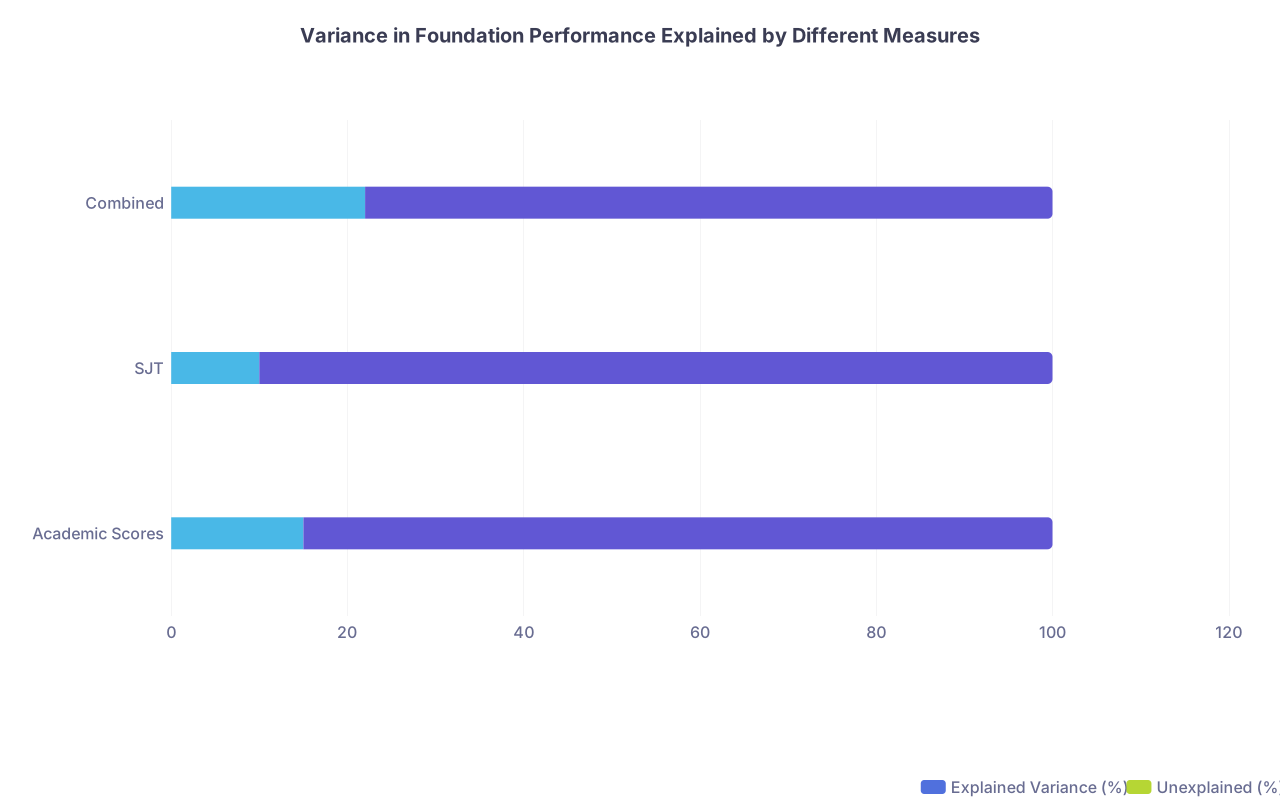
| Category | Explained Variance (%) | Unexplained (%) |
|---|---|---|
| Academic Scores | 15 | 85 |
| SJT | 10 | 90 |
| Combined | 22 | 78 |
Adding an SJT (basically well-designed hypotheticals) improves predictive power. Not magic, not perfect, but clearly not “useless.”
Residency programs copying those design principles in their behavioral questions are not off base when they mix in hypothetical “What would you do if…” prompts.
The problem isn’t hypotheticals. It’s bad hypotheticals and unstructured scoring.
When Hypothetical Answers Actually Help You
So when should you lean into a hypothetical in a behavioral interview? Three concrete scenarios you’ll probably see:
1. You Truly Lack a Comparable Experience
Example question:
“Tell me about a time you managed a high-acuity patient as the primary decision-maker.”
You’re an MS4 who’s never been primary decision-maker for a crashing patient. Not really. You had suggestions, you followed instructions, you maybe called shots in a low-stakes clinic situation.
You have three options:
- Lie or heavily exaggerate your role.
- Force some barely-related story where the acuity was low but you pretend it’s equivalent.
- Be honest: explain your current level, then walk through what you would do.
Choice 3 is the only one that doesn’t make you sound delusional or dishonest. For example:
- Start with a partial behavioral: “I haven’t yet been sole decision-maker for a crashing patient, but on my sub-I I did X where I took the lead on…”
- Then pivot: “…As an intern, if I were the first to evaluate a rapidly decompensating patient, I would first… [walk through ABCDE, call for help early, assign tasks].”
That second half is hypothetical, and it’s fine. It shows judgment, prioritization, humility. That’s what they care about.
2. The Question Is Explicitly Situational
Sometimes programs intentionally test ethical reasoning and professionalism:
- “What would you do if you saw a co-resident chart something they clearly didn’t do?”
- “If a patient’s family demanded a treatment you felt was not indicated and potentially harmful, how would you respond?”
- “If an attending was berating a nurse in front of the team, how would you handle it?”
Those are situational questions by design. They don’t care if you have an identical story. They care whether you:
- recognize the ethical / interpersonal problem
- balance patient safety, hierarchy, and professionalism
- choose a reasonable, defensible path
Here, an all-past-behavior answer that never addresses the actual scenario is a miss. For instance:
Bad approach: “Well, I’ve never really seen that specific thing, but one time I had a conflict with a nurse and…” and then you never come back to the “what would you do” part.
Better: “I haven’t seen that exact scenario, but based on similar dynamics I’ve experienced, here’s what I’d do…” and then you give a structured, thoughtful hypothetical.
3. You’re Explicitly Asked to Forecast Your Behavior as a Resident
Common ones:
- “As an intern, how will you handle cross-covering multiple sick patients at once?”
- “If you’re behind on notes at the end of your shift, what’s your plan?”
- “How will you respond if you strongly disagree with your senior’s plan?”
These are about future behavior in a specific role you haven’t had yet. If you only talk about what you did as a student, you miss the point. They’re testing your mental model of residency.
You can and should reference prior behavior for credibility, but the core answer is hypothetical:
“On surgery, I often had to juggle prerounding, notes, and cases. I learned that what worked for me was X. As an intern, I’d use the same framework but adjust by…”
You’re drawing a line from past to future, not pretending you’ve already been a resident.
How to Use Hypotheticals Without Sounding Vague or Naive
Most hypothetical answers fail for one of three reasons:
- They’re vague: “I’d communicate better” or “I’d be more assertive.” That tells them nothing.
- They’re performative perfection: “I’d calmly de-escalate everyone, flawlessly prioritize, and no one would be upset.” Unrealistic.
- They’re ethically tone-deaf: throwing colleagues under the bus, ignoring escalation pathways, pretending hierarchy doesn’t exist.
You avoid this by structuring your hypothetical answers almost like a mini-mental simulation. A stripped-down version:
Anchor to reality
- “I haven’t been sole decision-maker, but on my ICU rotation I watched our interns handle this a lot. What seemed to work was…”
State your priorities explicitly
- “My first priority would be patient safety; second, looping in the right level of supervision; third, communicating clearly with the team.”
Walk through concrete steps, not abstract traits
- Bad: “I’d stay calm and manage the situation.”
- Better: “I’d quickly assess ABC, check vitals, and at the same time call my senior and say, ‘I’m at bedside with X, hypotensive to 70s, tachy to 140, I’ve done A, B, C, what else can I start while you’re on your way?’”
Acknowledge limits and supervision
- “I’d involve my senior early because I know as an intern my experience will be limited, and patient safety matters more than appearing independent.”
Reflect briefly on potential pitfalls
- “The risk is getting tunnel vision on one sick patient and losing track of others, so I’d make sure to hand off or redistribute tasks with the team.”
That’s a hypothetical answer programs can actually score. It shows you understand workflow, safety, and your place in the hierarchy.
Combining Behavioral and Hypothetical: The Power Move
The best candidates don’t choose past vs hypothetical. They stack them.
Formula that works beautifully:
- Brief real example → 2) Extract principle → 3) Apply principle to the hypothetical
Example question: “What would you do if you had a serious disagreement with your attending about patient management?”
Strong answer outline:
- “I haven’t had an outright conflict with an attending over management, but I’ve had smaller disagreements, like on my medicine sub-I when…” (short 30–40 second story)
- “What I learned from that was that I do better when I first clarify their reasoning, then share my concerns in specific, non-accusatory language.”
- “So, if as an intern I had a more serious disagreement, I would first say something like, ‘Can you walk me through your thinking so I understand what we’re aiming for?’ Then, if I still had concerns, I’d say, ‘I’m worried about X because of Y; would we consider Z as an alternative?’ If I believed there was real risk to the patient and we couldn’t resolve it, I’d escalate through the usual channels – maybe involving the senior or chief – rather than just letting it go.”
That answer is half-behavioral, half-hypothetical. And very strong.
Programs do not dock you for that mix. If anything, it’s closer to how they’re trying (and often failing) to design these questions.
When Hypotheticals Really Are Useless
I’m not going to pretend all hypotheticals are good. Some are garbage. Some you should avoid.
Hypothetical answers hurt you when:
You clearly had a relevant real example and dodged it.
- Question: “Tell me about a time you made a clinical error.”
- You: “Well, if I ever made a serious error, I’d…”
Translation: I either lack insight or I’m not honest about mistakes.
You speculate wildly outside your lane.
- As an MS4, you’re opining about ICU ventilator settings strategy like you’re an attending.
You use hypotheticals to stay emotionally distant.
- Question: “Tell me about a time you received difficult feedback.”
- You: generic, “If someone gave me tough feedback, I’d thank them and improve.”
No vulnerability, no real reflection. That’s a miss.
In other words: hypotheticals are bad when they replace self-awareness you should have by now. They’re good when they supplement real experience you realistically don’t.
Practical Strategy for Residency Interviews
Here’s the saner, evidence-aligned rule set to go in with:
1. Default to real examples when you genuinely have them. Use past behavior for:
- conflict
- feedback
- time you dropped the ball
- working in teams
If you have a story and dodge it, they notice.
Use hybrid answers when you’re transitioning roles.
- “As a student I did X; as an intern I’d adapt that by Y.”
This shows insight into the difference between student and resident.
- “As a student I did X; as an intern I’d adapt that by Y.”
Lean into hypotheticals when:
- The question is clearly future-oriented.
- You lack comparable experience.
- The scenario is ethical/rare/edge-case.
4. Make hypotheticals concrete.
- Specific steps, actual phrases you’d use, who you’d call, what you’d prioritize.
- Do not memorize scripts.
Interviewers can tell when you’re reciting a consultant’s canned “I-statements” about conflict. Practice frameworks, not paragraphs.
Years from now, no one will remember whether you labeled your answer “behavioral” or “situational.” What they will remember is whether, sitting across from you for 20 minutes, they believed you’d be safe, honest, and teachable at 3 AM.
Hypothetical answers, used honestly and precisely, can help you show exactly that.