
You’re allowed to pause and take brief notes in a behavioral interview. If anyone tells you otherwise, they’re wrong.
The real question isn’t “Can I?” It’s “How do I do it without looking awkward, robotic, or unprepared?” Let’s answer that.
You’re in residency interview season. You get hit with:
“Tell me about a time you had a conflict with a team member.”
Your brain floods with six different stories. You want to be thoughtful instead of blurting out the first half-baked thing. Can you pause? Can you jot a few words on a pad? Or will the interviewer think you’re clueless?
Here’s the honest breakdown.
Short Answer: Yes, You Can Pause. Notes Are Sometimes OK.
Let me be specific.
- Pausing before answering behavioral questions is not just acceptable; it usually makes you look more thoughtful and mature.
- Using notes during a live behavioral interview is situationally acceptable, but you need to do it right—and sparingly.
- For virtual interviews, glancing at a simple outline or “prompt sheet” is fine; reading from a script is not.
Residency interviewers are not timing your reaction speed. They’re evaluating judgment, self-awareness, and communication. A 3–8 second pause before answering a complex question is completely normal.
What worries them is:
- 30 seconds of silence with a panicked stare.
- Obviously reading from a prepared paragraph.
- Shuffling through pages of notes like it’s open-book Step 2.
So your goal is controlled, intentional pauses and minimal, subtle notes—used as support, not as a crutch.
How To Pause Before Answering (Without Being Awkward)
Here’s the playbook that works in real interviews, not just on paper.
Use an “anchoring phrase”
If you’re going to pause longer than 2–3 seconds, say something short to show you’re thinking, not freezing:
- “That’s a great question—let me think for a moment.”
- “I want to choose a good example for that. Just a second.”
- “Let me think of the best situation that fits.”
Then pause. Quietly. No nervous laughter, no “uhhhh” filler words.
A normal, confident pause is 3–8 seconds. You’ll feel like it’s 30. It’s not.
Pick one story and commit
Behavioral questions invite chaos in your head. You remember:
- The rough ICU rotation
- The conflict with a nurse
- The patient complaint
- The miscommunication with a co-intern
If you hesitate because you’re cycling through 5 examples, you look indecisive. Do this instead:
- Pause.
- Quickly pick one story with:
- Clear conflict or challenge
- Your specific actions
- A tangible outcome / lesson
- Commit to it. Don’t half-switch midway.
Use a mental template (not a script)
If you rely on full scripts, you’ll sound memorized and stiff. Use a simple structure instead:
Most people know STAR. I’d tweak it slightly for residency:
STARR: Situation – Task – Action – Result – Reflection
Think like this:
- Situation: “On my medicine sub-I…”
- Task: “I was responsible for…”
- Action: “So I did…”
- Result: “As a result…”
- Reflection: “From this, I learned…”
You don’t say those labels out loud. You use them in your head to organize the answer. The pause lets you quickly map your story onto that structure.
Can You Take Notes During Behavioral Questions?
Let me separate two things that get mixed up:
- Taking notes before answering (jotting 2–3 words)
- Using pre-written notes as a reference (virtual or in-person)
1. Jotting notes right after they ask the question
In some settings, it’s totally reasonable to briefly write 2–5 words to anchor your thoughts. For example:
- You think: “Conflict case → nurse / new orders / follow-up”
- You write on your pad: “Nurse / orders / debrief”
That’s it. Not full sentences. Just hooks.
How to do it without looking weird:
- Ask permission once if it’s not obvious:
“Do you mind if I jot down a couple of words while I think? It helps me stay organized.” - Keep it under 5 seconds.
- Do not stare at the paper the entire time you’re talking. Glance, then look back at the interviewer.
In my experience, most academic programs won’t care. Some will actually see it as organized and thoughtful. Community programs vary more—but very few will be bothered if you’re subtle.
Where this is more natural:
- Multiple mini interviews (MMIs) with prompt stations
- Panel interviews where questions are long and detailed
- Virtual interviews where you already have a pen and notepad in front of you
Where I’d be cautious:
- Informal “coffee chat” style interviews
- Very conversational, rapid-fire settings (e.g., a 15-minute dean’s interview with quick hits)
2. Using a “cheat sheet” of pre-written notes
Let’s be blunt: if it looks like you’re reading, you’re done.
You can absolutely have:
- 5–10 bullet prompts on paper for virtual interviews
- A one-page sheet of:
- 6–8 key stories (leadership, conflict, failure, ethics, difficult patient)
- 2–3 key strengths
- 2–3 programs-specific points
But the paper is for you, not for them. You glance if you need a memory jog. That’s it.
If you’re virtual:
- Put the notes right below your webcam.
- Use large font / simple bullets so you’re not scanning.
- Keep your eyes mostly on the camera; brief downward glances are fine.
If you’re in-person:
- Don’t bring a stapled packet and start flipping pages.
- A small professional notebook with a few bullet reminders is acceptable.
- Don’t open a laptop to “check notes.” That screams unprepared and inconsiderate of time.
What Interviewers Actually Think When You Pause or Use Notes
Interviewers are not secretly grading you on whether you answer in 0.5 seconds. They’re watching for entirely different things.
Here’s how it usually plays out in their minds.
| Behavior | Typical Reaction |
|---|---|
| 3–8 second thoughtful pause | Positive / neutral |
| 15–20 second silent freeze | Concern about communication |
| Brief note jotting (2–5 words) | Neutral / “organized” |
| Reading from a script | Strong negative |
| Occasional glance at bullet list | Neutral if eye contact is good |
Most faculty have sat through hundreds of interviews. They know:
- Behavioral questions are broad.
- You’re under pressure.
- You might need a second to pull the right story.
What worries them more:
- Rambling 4-minute answers.
- No clear point.
- Blaming others, lack of reflection.
- Defensive tone when discussing mistakes.
So if pausing and jotting 2–3 words helps you give a crisper, more reflective answer? They’d rather you do that than ramble.
Concrete Scripts You Can Use
Let’s make this painfully practical. Here are plug-and-play phrases and how to use them.
When you need a pause
Question: “Tell me about a time you received critical feedback.”
You say:
- “That’s a really important question. Let me think for a moment about the best example.”
[pause 4–6 seconds]
Then: “On my surgery rotation as a third-year, there was a case where…”
Or:
- “I have a couple examples coming to mind; let me pick the clearest one.”
[pause, then answer]
When you want to jot quick notes
You say:
- “Do you mind if I jot down a couple of words as I think? It helps me organize my thoughts.”
[Write 2–4 words; look back up]
Then answer.
Do not say:
- “Hold on, this is hard, let me write this out.”
- “Wait, I prepared for this, I know I have something written down…”
You want to look intentional, not panicked.
Training Yourself To Pause (Instead of Ramble)
If you’re like most high-achieving med students, silence makes you uncomfortable. You fill space with words. That backfires in behavioral interviews.
Here’s a simple practice routine:

| Step | Description |
|---|---|
| Step 1 | Pick 10 common questions |
| Step 2 | Record yourself answering |
| Step 3 | Force a 3 second pause before each answer |
| Step 4 | Watch video, note filler words |
| Step 5 | Refine stories using STARR |
| Step 6 | Repeat with a friend or mentor |
Steps in real life:
Write down 10 core behavioral questions:
- Conflict with a team member
- Mistake / failure
- Difficult feedback
- Ethical concern
- Time you went above and beyond
- Time you advocated for a patient
- etc.
Use your phone. Record yourself:
- Hear the question (from a list or friend)
- Force yourself to pause 3 full seconds before talking
- Answer in 60–90 seconds
Watch the recording:
- Are your pauses calm or anxious?
- Are you saying “uhm, like, you know” instead of actual silence?
- Are your stories structured, or wandering?
Repeat with a resident, faculty mentor, or trusted peer. Ask them directly:
- “Did my pauses feel thoughtful or awkward?”
- “Does it look weird if I jot down one or two words?”
You’ll quickly calibrate what looks natural for you.
Special Case: Asynchronous / Recorded Video Interviews
Some programs still use asynchronous video platforms where:
- You see a prompt on screen
- You get 30–60 seconds to think
- Then you have 1–3 minutes to respond
Here, pausing and notes are expected.
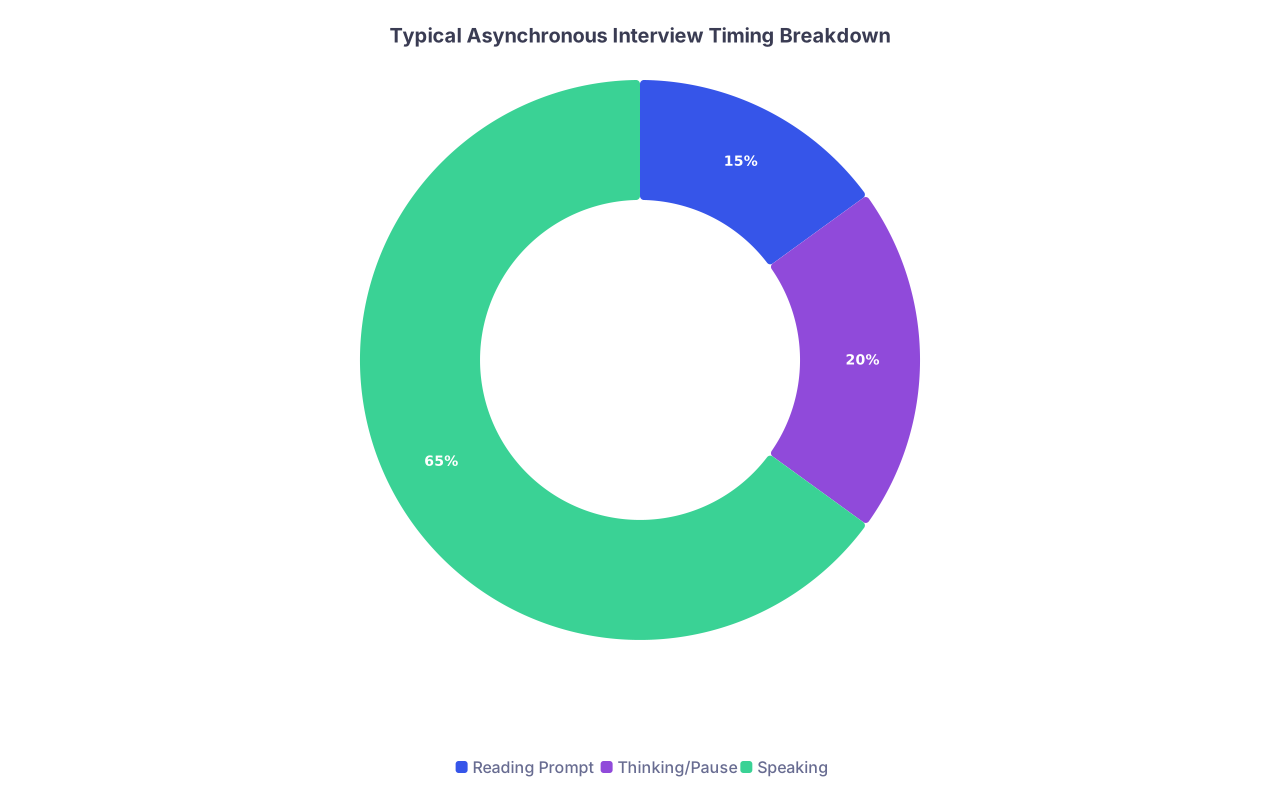
| Category | Value |
|---|---|
| Reading Prompt | 15 |
| Thinking/Pause | 20 |
| Speaking | 65 |
Smart way to handle these:
- Use the built-in thinking time fully. Don’t start talking immediately.
- Jot 3–4 hook words using STARR:
- “Intern conflict – new orders – pre-round – apology – debrief”
- When recording starts, you can:
- Pause 1–2 seconds (looks natural)
- Then speak to your notes, not read them.
Interviewers know you had prep time. They care that your answer is coherent, concise, and reflective.
What To Avoid Completely
Let me be blunt about what will hurt you.
Reading from a script or paragraph.
Interviewers can see your eye tracking. They know what you’re doing.Over-written, word-for-word stories.
These sound plastic and inauthentic. Real stories have slight imperfection and natural language.Long monologues with no pause at all.
Non-stop speaking for 3 minutes looks rehearsed and anxious. Controlled pauses show composure.Shuffling through pages of notes.
Looks like you’re unprepared and searching for the “right” preplanned answer.Apologizing excessively for thinking.
“Sorry, I’m so nervous, I can’t think.”
No. You can say, “Let me think,” and then just think.
Quick Comparison: Good vs Bad Use of Pauses and Notes
| Area | Good Behavior | Bad Behavior |
|---|---|---|
| Pausing | 3–8 sec with a brief anchoring phrase | Long silent freeze; constant filler words |
| Notes | 2–4 key words, subtle glance | Reading full sentences; shuffling pages |
| Delivery | Conversational, structured using STARR | Monotone, memorized, or rambling |
| Eye Contact | Mostly on interviewer/camera, brief note glances | Eyes down at paper or screen most of the time |
| Tone | Calm, thoughtful, reflective | Apologetic, frantic, or defensive |
FAQ: Behavioral Interview Pauses and Notes
1. Will pausing make me seem like I do not know the answer?
No. A short, intentional pause makes you look thoughtful and composed. What makes you look unprepared is:
- Saying “uhh… umm…” for 15 seconds
- Starting to answer, then backing up repeatedly
- Rambling without a clear story
If you pair a brief pause with a well-structured answer, you’ll come across as more competent, not less.
2. Is it okay to bring a notebook into an in-person residency interview?
Yes, as long as you use it lightly and professionally. A small notebook with:
- The interviewer’s name
- A few pre-written questions for them
- Space to jot quick keywords
That’s fine. What’s not fine: flipping through pages to find your “conflict story” script or writing long paragraphs during the interview.
3. Can I have a full list of stories and answers open during a virtual interview?
You can, but you shouldn’t rely on it. A dense script will tempt you to read, and interviewers will notice. Better: a one-page “cheat sheet” with:
- 6–8 story titles (e.g., “ICU handoff error,” “angry family member,” “peer professionalism concern”)
- 2–3 key strengths
- 2–3 program-specific talking points
You should know each story well enough to tell it naturally without reading.
4. How long is too long to pause before answering?
Rough guideline:
- 1–3 seconds: Feels completely natural
- 4–8 seconds: Still good if you gave an anchoring phrase
- 10–15+ seconds: Starts to feel like you’re stuck
If you need more time, talk through your process briefly:
“I’m thinking of an example where I both made a mistake and clearly grew from it… okay, I have one.” Then go.
5. What if I start answering and realize halfway it’s the wrong example?
Happens all the time. Don’t panic. You can redirect cleanly:
“Actually, I’m realizing there’s a clearer example that fits better.”
Then briefly restart with the better story. That shows self-awareness and adaptability, which interviewers like more than stubbornly finishing a poor example.
Key takeaways:
- You can absolutely pause—and you should. Thoughtful beats fast.
- Brief, targeted notes are fine as a support, but never as a script.
- Structure your stories, keep eye contact, and use pauses intentionally. That combination will do more for your behavioral answers than any memorized speech ever will.