
It’s January. You’ve got a residency interview tomorrow. You’re pacing your apartment, rehearsing answers in your head, and one question keeps hunting you down:
“So tell me about a time you felt overwhelmed or burned out… and how you handled it.”
And your brain goes straight to that rotation where you were crying in your car between cases, eating vending machine dinners, and googling “non-clinical careers for doctors” at 2 a.m.
You’re stuck on this loop:
If I tell the truth, they’ll think I’m weak and can’t handle residency.
If I lie or sugar-coat, I’ll sound fake or shallow.
If I give some polished “I was a little stressed but managed my time better” answer, I’ll sound like a robot.
So you’re sitting there thinking: how honest can I actually be about burnout in a residency behavioral interview without nuking my chances?
Let me be blunt: you can’t just trauma-dump your worst meltdown story. But you also shouldn’t pretend you’re some superhuman who’s never struggled. The trick is this very uncomfortable middle zone: honest but curated.
Let’s walk through what that actually looks like.
What Programs Are Actually Thinking When You Mention Burnout
You and the program are afraid of different things.
You’re afraid they’ll hear “burnout” and mentally stamp: “Do not rank. Fragile. Will quit.”
They’re afraid of something else:
- Residents who fall apart and become unsafe
- People who blame everyone else and never adjust
- People who hide problems until they explode mid-year
- People who can’t take feedback or ask for help
They know residents get tired, overwhelmed, emotionally depleted. They’ve watched interns cry in stairwells. They’ve had chiefs burn out. The PDs have been there themselves.
What scares them isn’t burnout. It’s untreated, unacknowledged burnout with no insight or plan.
So when you talk about burnout, what they’re silently grading is:
- Do you recognize it in yourself?
- Do you take responsibility for how you handled it?
- Did you change anything as a result?
- Are you someone they’d trust at 3 a.m. with a crashing patient and no supervision right next to you?
That’s the bar.
How Honest Is “Too Honest”?
Here’s the part you’re really asking: where’s the line between “real” and “red flag”?
If your burnout story sounds like:
- “I completely shut down and stopped showing up / responding”
- “I was so resentful I started cutting corners”
- “I still don’t really know how to handle it; it just sucked”
- “Everyone around me was the problem; they were all toxic”
That’s going to land badly.
If it includes phrases like:
- “I hated my patients”
- “I didn’t care what happened to them”
- “I almost walked out mid-shift and never came back”
That’s too raw for an interview. Right or wrong, that’s how it’ll be heard.
You want real struggle, but not ongoing, uncontained chaos.
Think: “Hard chapter with clear growth arc,” not “I’m still barely holding it together.”
A Simple Rule: Past, Processed, and Productive
Here’s the rule I use with students when we rewrote their answers at 11 p.m. the night before interviews:
If you talk about burnout, it has to be:
- Past – not still acute, not this month, not “I’m currently drowning.”
- Processed – you’ve reflected on it, not just endured it.
- Productive – it changed how you work or care for yourself now.
If any of those three are missing, the answer feels risky.
So if they ask:
“Tell me about a time you felt burned out or overwhelmed. How did you handle it?”
You don’t say:
“Honestly, this past month on ICU I’m barely sleeping and I feel like I can’t keep up.”
Even if that’s true. That’s what you tell your therapist, not a PD.
You instead pick something like:
- MS3 surgery clerkship
- A stacked month of sub-I + research deadlines
- Step studying combined with family issues
Something that happened before and clearly influenced how you now manage stress.
What a “Good” Burnout Answer Actually Sounds Like
Let me give you a template you can actually plug your story into.
The structure that works:
- Set the scene briefly (high demand + limited control)
- Own your reaction (don’t blame, don’t dramatize)
- Show what you changed (concrete, specific)
- Show the outcome and what you do differently now
Here’s a sample. Let’s say this is you on medicine during MS3:
“On my internal medicine rotation, we were short-staffed for a few weeks, and as the student I was trying to prove myself. I started coming in earlier, staying later, pre-charting on everyone, and I was basically living on caffeine and adrenaline. After about two weeks, I realized I was snapping at my partner, I was dreading pre-rounds, and I was constantly anxious I’d miss something. That was the closest I’ve felt to burnout in med school.
I didn’t handle it perfectly at first. My default was just to push harder and tell myself to tough it out. But I finally talked with one of the residents I trusted. She helped me realize I was doing a lot of ‘extra’ that wasn’t actually helping patient care, and that I needed to be more deliberate.
I started doing a few concrete things: planning my work the night before, prioritizing the two or three patients who needed the most attention, and giving myself a hard cutoff to leave the hospital unless there was something truly urgent. I also started taking short real breaks instead of just scrolling my phone on the unit.
The workload didn’t magically shrink, but I started feeling more present with patients and less constantly on edge. Since then, I’ve been much more proactive about recognizing when I’m getting into that unsustainable mode and adjusting earlier—whether that’s asking for help, re-prioritizing, or even just being honest with my team that I need to step away for ten minutes and reset.”
Notice the key things here:
- You name burnout-like feelings
- You admit you didn’t handle it perfectly
- You show that you sought support and changed behavior
- You don’t sound like you hate medicine, patients, or humans
That’s honest. But it’s also safe.
Stuff That Quietly Freaks Interviewers Out
Some language is subtle poison in these answers. I’ve seen applicants sabotage themselves without realizing it.
Phrases that raise their blood pressure:
- “There was nothing I could do” (sounds helpless)
- “The system is just toxic” (may be true, but they hear: chronic resentment)
- “I just powered through” (no insight, just brute force)
- “It made me question if I wanted to be in medicine at all” (this screams flight risk)
Can you have those thoughts in real life? Absolutely. Most of us do, at some point.
Do you say them in a 15-minute behavioral interview where they’re deciding if you’ll survive their program? No.
Replace them with things like:
- “I felt stuck at first, but I realized I needed to…”
- “I was frustrated with the environment, so I focused on what I could control…”
- “My initial instinct was just to push harder, but that clearly wasn’t sustainable…”
Same core honesty. Different framing.
How Programs Listen For “Insight” vs. “Liability”
What they’re really listening for isn’t: “Have you ever been burned out?”
It’s closer to:
- Will this person tell us when they’re struggling?
- Do they externalize everything or take some ownership?
- Are they aware of warning signs in themselves?
- Do they have even a basic toolkit for regulating themselves?
Here’s how different answers sound in their mental sorting hat:
| Answer Style | How Programs Interpret It |
|---|---|
| “I’ve never really felt burned out.” | Naive, out of touch, or dishonest |
| “I was destroyed; everything was awful; I just hated it.” | High risk, low coping skills |
| “It was hard, I pushed too far, then I adjusted and learned X.” | Realistic, coachable, resilient |
| “Everyone else was the problem; the culture was toxic.” | Blame-heavy, potential complainer |
| “It sucked, but I learned how to speak up and set limits.” | Insightful, self-aware |
You’re not trying to prove you’re unbreakable. You’re showing that when you do bend, you don’t completely snap.
What If My Burnout Was Really Bad?
Now the part your brain keeps circling back to at 1 a.m.:
“But what if I was actually in scary territory? Depression. Passive SI. Seriously contemplating quitting.”
You don’t have to air your deepest crisis in a residency interview. You’re not lying by choosing which story to tell.
Here’s how to handle it:
- Pick a less extreme example of overwhelm or burnout that’s still true
- Focus on coping, help-seeking, and change, not on the darkest emotional details
- You can acknowledge you’ve learned to watch for early signs without describing the worst episode
Something like:
“Earlier in medical school, I pushed myself to the point where I wasn’t sleeping well and was constantly anxious. Since then, I’ve gotten much better at recognizing those early warning signs and adjusting sooner—whether that’s reaching out to mentors, setting clearer boundaries for myself about how long I’ll stay in the hospital, or prioritizing recovery time on days off.”
That can be 100% honest and non-alarming.
If you had serious mental health symptoms: those are real and valid. But this isn’t a therapy room. You’re allowed to protect yourself.
Should You Ever Say the Word “Burnout” Directly?
You can. But you don’t have to.
If the question is literally about burnout, sure, you can say it:
“That was the closest I’ve come to burnout.”
If it’s broader (“Tell me about a challenge” / “time you failed” / “conflict on a team”), you can talk about feeling overwhelmed, depleted, stretched too thin without stamping “burnout” in red letters across your forehead.
The more specific the question is, the more directly you can name it.
The more generic the question, the more I’d lean into describing it rather than labeling it.
Practice: Rewrite Your Worst Burnout Story
You probably already have “the story” in your head. The one that scares you to say out loud.
Take that story and do this:
- Timebox it in the past. “During my third year…”
- Remove the most extreme 10% of the details (the darkest thoughts, the scariest symptoms).
- Keep the emotional truth: you were overwhelmed, exhausted, doubting yourself.
- Add 2–3 specific things you did differently afterward.
- End with: “Now when I notice [X early sign], I do [Y concrete action].”
That last line is gold. It shows you won’t just silently disintegrate.
Quick Reality Check: How Common Is This, Really?
You’re not the only one gaming this out. Programs know it.
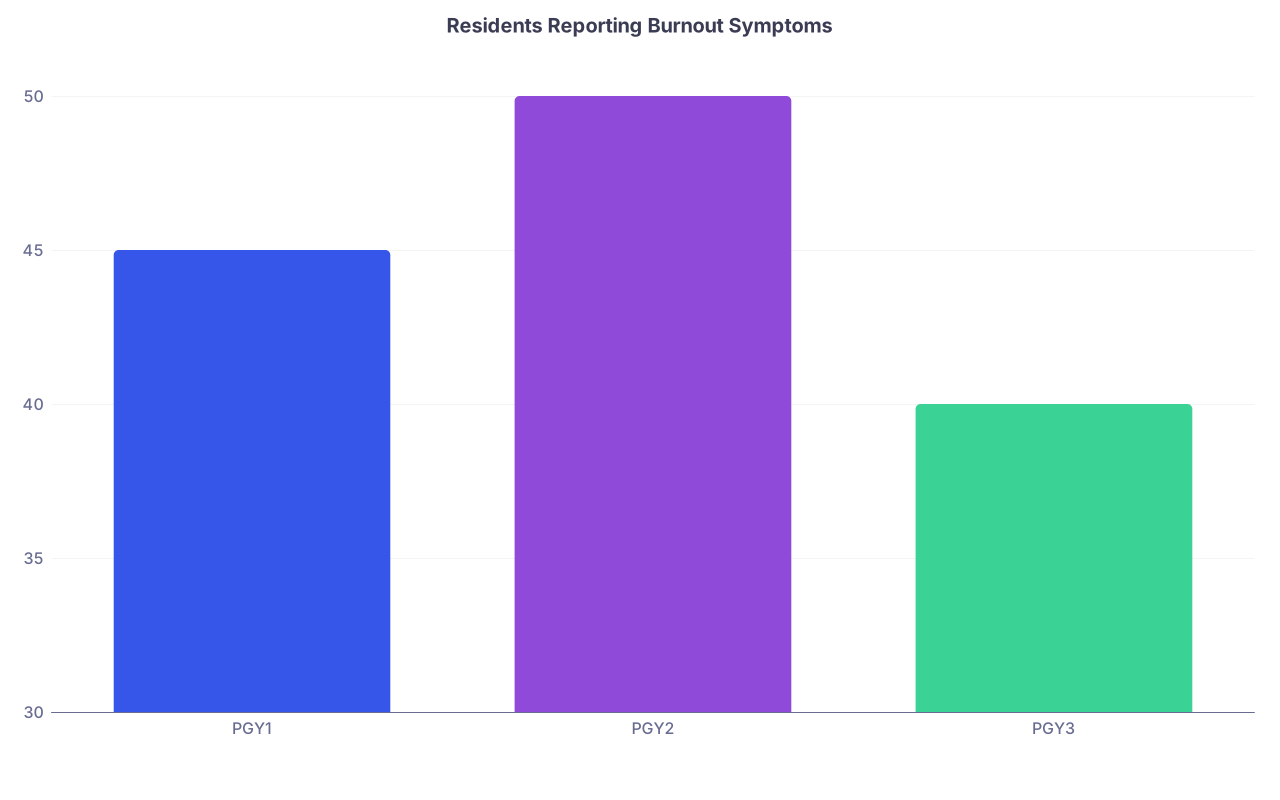
| Category | Value |
|---|---|
| PGY1 | 45 |
| PGY2 | 50 |
| PGY3 | 40 |
Numbers bounce around across studies, but it’s consistently high. Close to half of residents report burnout symptoms. Some programs are quietly relieved when someone can talk about struggle without sounding reckless or bitter.
They’re not looking for robots. They’re looking for people who won’t implode in silence.
Red-Flag vs Safe Answers: Side-by-Side
To make this painfully clear, here’s a comparison.
| Version | Red-Flag Wording | Safer, Still Honest Wording |
|---|---|---|
| A | “I was totally burned out, I hated going in, and honestly I just stopped caring as much.” | “I realized I was starting to dread going in and felt emotionally drained, which was a wake-up call that something had to change in how I was approaching the rotation.” |
| B | “The whole culture was toxic; everyone just expected you to kill yourself for the team.” | “The culture on that team emphasized pushing through at all costs, and I initially bought into that. I’ve now learned I do better when I set more sustainable limits and communicate with my team early.” |
| C | “I just kept my head down and survived it. That’s all you can do.” | “My first instinct was to just put my head down and push through, but I realized that wasn’t sustainable. I started checking in with a mentor and prioritizing tasks more intentionally.” |
Both columns describe the same reality. One version sinks you. The other makes you look like someone they’d actually trust with a pager.
What To Do Tonight If You’re Still Panicking About This
Don’t just keep spinning in your head. Do something small and concrete:
- Write out one burnout/overwhelm story in full, messy detail.
- Underline anything that sounds like: “I had no control,” “everyone else sucked,” or “I gave up.”
- Rewrite those parts to focus on: what you learned, what you changed, what you’d do earlier next time.
- Practice saying it out loud once, pacing your room like a weirdo. That’s fine.
You’ll feel the difference in your own body when it shifts from “confessional” to “professional but real.”

| Step | Description |
|---|---|
| Step 1 | Pick a real burnout moment |
| Step 2 | Is it past and processed? |
| Step 3 | Choose a different example |
| Step 4 | Describe struggle briefly |
| Step 5 | Show what you did to cope/change |
| Step 6 | Explain what you learned |
| Step 7 | Connect to how you handle stress now |
FAQ: Burnout in Behavioral Interviews (5 Questions)
1. What if they directly ask, “Have you ever been burned out?” Do I have to say yes?
You don’t have to deliver a dramatic confession. You can say something like, “I’ve had periods where I felt close to burnout or was definitely stretched too thin, yes,” and then pick one story to illustrate it with insight and growth. Denying any struggle at all usually sounds fake or naive.
2. Is it safe to mention therapy, counseling, or mental health treatment?
Careful here. I’d avoid specifics like, “I was in therapy for severe burnout and depression.” That’s vulnerable and valid, but programs may quietly worry about stability and backup. You can frame it more generally: “I reached out for support, including talking with mentors and using wellness resources,” without naming diagnoses or treatment details.
3. What if my worst burnout experience was this year and still feels raw?
Don’t use the raw, still-bleeding story. It will come across as unresolved. Pick an earlier, less intense example where you can genuinely say, “Here’s what happened, here’s what I changed, and here’s how I’m better prepared now.” You’re not lying by choosing an earlier chapter; you’re choosing a safer one for this context.
4. Can I say I questioned medicine or my specialty during burnout?
I wouldn’t. Even if that happened (and for a lot of people, it does), saying it out loud in an interview can set off alarm bells about commitment. You can say you questioned your approach or your balance, and that it clarified what you need to stay sustainable, without wording it as, “I wasn’t sure I wanted to be a doctor anymore.”
5. How long should a burnout story answer be in the interview?
Aim for about 60–90 seconds. Long enough to show real emotion and growth, short enough that you’re not spiraling into every painful detail. If you find yourself giving a whole saga with five subplots, cut it down. Setup (10–15 seconds), struggle (20–30), what you changed (20–30), and what you do differently now (15–20). That’s it.
Open your notes app right now and write a one-paragraph answer to: “Tell me about a time you felt close to burnout and what you did about it.” Don’t overthink it—just get a draft down. Then look at that last sentence. Does it show what you do differently now? If not, fix that one line first. That one line is your safety net.