
Your “difficult attending” story is a loaded weapon—aim it wrong, and you shoot yourself.
You think you are proving resilience. They might be hearing: This applicant trashes colleagues, cannot handle authority, and will be a nightmare when things get hard.
Let me be blunt: the “difficult attending” anecdote is one of the most common ways otherwise strong applicants quietly destroy an interview. I have watched it happen in real time. Good Step scores. Solid letters. Decent CV. And then they launch into a story about “this one attending who was so toxic…” and you can see faculty mentally checking out.
You are applying to a hierarchy-driven profession. Your future attendings are the people across from you. Any story that smells like “I had a problem with someone above me” is high‑risk territory.
You can still talk about conflict, feedback, and stressful interactions. You just need to stop making these predictable mistakes.
The Hidden Trap: Why “Difficult Attending” Stories Raise Red Flags
Interviewers do not just listen to the surface content of your story. They are scanning for risk. For patterns. For subtle signs that you will be trouble on a busy service at 2 a.m.
Here is what they are really hearing when you start with, “I once worked with an attending who was very difficult…”
They are quietly asking:
- Does this person respect hierarchy and team dynamics?
- Will they escalate conflict instead of managing it?
- Are they going to bad‑mouth us to others when they are frustrated?
- How do they talk about supervisors and colleagues when those people are not in the room?
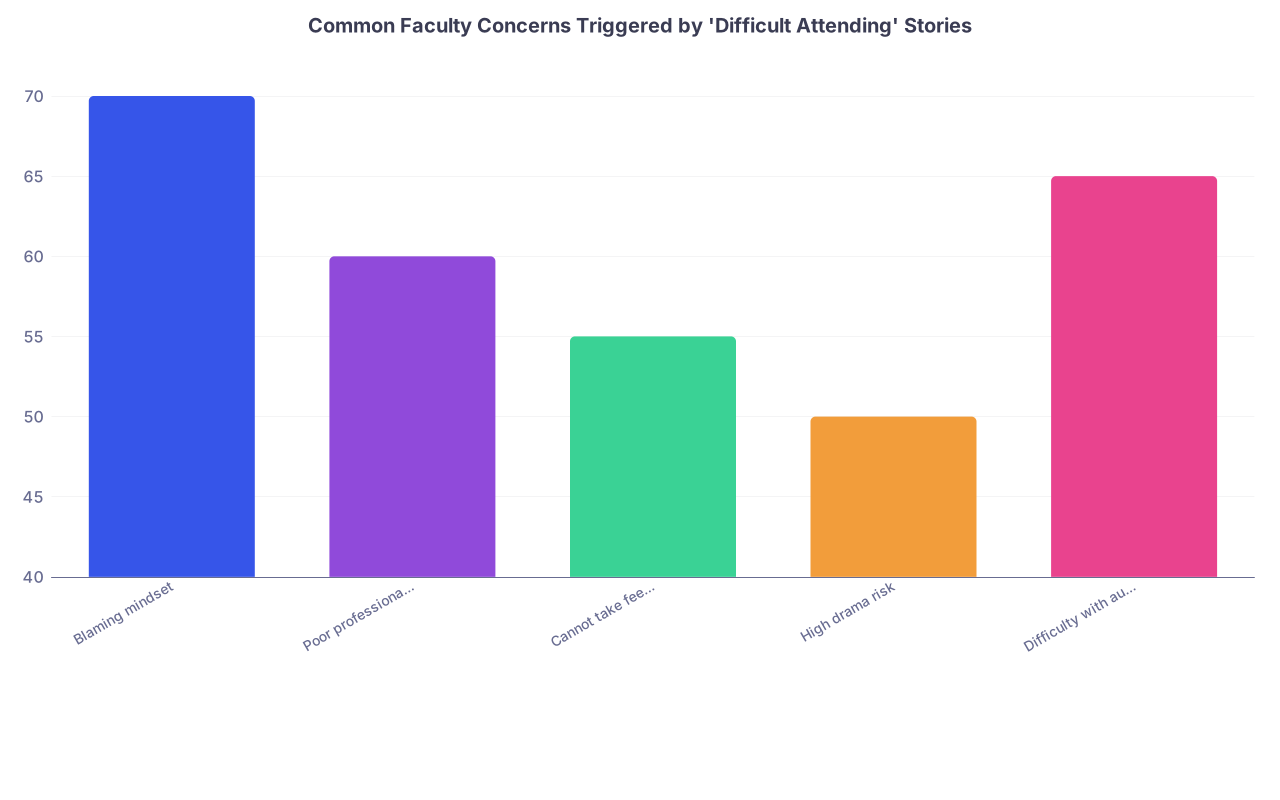
| Category | Value |
|---|---|
| Blaming mindset | 70 |
| Poor professionalism | 60 |
| Cannot take feedback | 55 |
| High drama risk | 50 |
| Difficulty with authority | 65 |
Those concerns are not imaginary. They come from experience with residents who:
- Blamed every bad evaluation on an “unfair attending.”
- Turned minor feedback into full‑blown conflicts.
- Wrote scathing emails or complained to everyone but the person involved.
- Needed constant damage control from chiefs and program leadership.
So when you cheerfully roll out your best “this attending was awful but I survived” story, they are not thinking, “What resilience!” They are thinking, “Is this our next problem resident?”
Even if your story is true. Even if the attending really was awful. The truth does not save you from bad framing.
Mistake #1: Venting Instead of Demonstrating Professionalism
The fastest way to tank your “difficult attending” answer is to sound even slightly like you are venting.
Listen for phrases like these in your own stories:
- “She was extremely toxic.”
- “He would just constantly humiliate students.”
- “Honestly, everyone hated working with him.”
- “It was so unprofessional the way he treated us.”
Do not fool yourself. You might think you sound reasonable. To an interviewer who has heard 200 versions of this, you sound like:
- Someone who exports blame.
- Someone who gossips.
- Someone who enjoys taking down others once they are safely out of the room.
You can describe a challenging situation without character assassination. The line is actually very clear:
Bad: “He was a bully who loved making students feel stupid.”
Better: “This attending gave feedback in a very direct, harsh style that was hard for me at first.”
Bad: “She was toxic and created a horrible environment for everyone.”
Better: “The tone on that rotation was tense, and I struggled initially with how feedback was delivered.”
In both “better” versions, you describe the behavior and your experience, not attack the person’s character. Interviewers listen closely for that distinction.
Mistake #2: Making Yourself the Hero and the Attending the Villain
Another common pattern: the applicant as noble victim-hero.
The structure usually goes like this:
- Attending is unreasonable, hostile, or irrational.
- You rise above it with grace and strength.
- Everyone else is impressed by your resilience and maturity.
I have heard this story enough times to know: faculty are tired of it.
Because real professional conflict is almost never that black‑and‑white. And when you frame it that way, you reveal something important about yourself:
- You oversimplify complex interpersonal situations.
- You do not see your own contribution, even minor.
- You prize being “right” more than being collaborative.
The moment your story sounds like a movie script with a clear villain, your credibility drops.
A more mature answer has nuance:
- You acknowledge what you learned.
- You admit something you could have done earlier or differently.
- You show curiosity about why the attending might have reacted that way.
That does not mean excusing bad behavior. It means you are capable of two thoughts at once: “This was not okay” and “I still had choices about how I responded.”

Mistake #3: Ignoring Power Dynamics (And Sounding Naïve)
Here is something applicants underestimate: attendings know exactly what it feels like to be the “difficult attending” in someone else’s story.
They have:
- Given blunt feedback that a learner hated.
- Failed a student or resident and gotten a complaint.
- Been accused of being “toxic” when they were enforcing standards.
So when you talk about a “difficult attending,” they naturally wonder: would I be your difficult attending?
This is where ignoring power dynamics hurts you. You are not just talking about a random person. You are describing a person in the exact role your interviewers hold.
Red flags that you do not understand this:
- Casual use of strongly negative labels: “toxic,” “abusive,” “narcissistic” used without clear justification.
- Describing yourself confronting them in a dramatic, aggressive way.
- Implying you “corrected” the attending or put them in their place.
- Bragging about going above their head in a way that sounds retaliatory, not protective.
You can absolutely talk about advocating for yourself or for patients. But if your advocacy sounds like attack, or like you forgot there is a hierarchy, faculty will see a future HR headache, not a courageous resident.
Mistake #4: Centering the Attending Instead of Your Growth
If most of the story is about how awful the attending was, you are already losing.
Behavioral questions are not about what happened to you. They are about what you did with what happened to you.
Interviewers are listening for:
- How you regulate your emotions under stress.
- How you communicate upward and downward.
- How you adapt your behavior to a challenging environment.
- How you extract lessons from bad situations.
A dangerous pattern: 90% of the story is description and blame, 10% is rushed “and I learned to be more resilient.” That will not cut it.
Flip the ratio. The attending is background. Your growth is foreground.
Ask yourself:
- What did I change about my communication style?
- How did I seek feedback differently after this?
- What future situation did I handle better because of this experience?
If you cannot answer those quickly and concretely, the story is not ready for an interview.
When a “Difficult Attending” Story Is Actually Appropriate
Sometimes you genuinely need to reference a problematic supervisor:
- You are explaining a professionalism narrative that might appear in your file.
- You are asked directly about a grade change, remediation, or leaves of absence tied to conflict.
- You are asked a specific question like, “Tell me about a time you disagreed with a supervisor.”
In these situations, dodging the reality helps nobody. The key is how you frame it.
Use this mental checklist before you say the story out loud:
| Question | Safe Signal |
|---|---|
| Can I describe the issue behaviorally, not as an attack on character? | Yes |
| Do I clearly own my part, even if it was small? | Yes |
| Do I have a specific, believable lesson that changed my behavior later? | Yes |
| Am I calm and neutral when I talk about it (not visibly angry)? | Yes |
| Could this story be confirmed (or at least not contradicted) by my MSPE/letters? | Yes |
If you have mostly “no” answers, do not use this story. Pick another conflict or challenge.
How to Reframe a Risky Story Without Sounding Fake
You do not need to sugarcoat reality. You do need to sound professional, measured, and self‑aware.
Here is a structure that tends to work:
Brief, neutral context.
“On my third‑year surgery rotation, I worked with an attending whose feedback style was very direct and at times harsh, which I initially found difficult.”Your internal reaction (own it, do not justify it).
“My first reaction was to feel defensive and anxious before rounds, and I caught myself focusing more on avoiding criticism than on preparing thoughtfully.”Specific actions you took.
“I asked a senior resident how they approached working with this attending. Based on that, I started pre‑rounding earlier, writing out my plans more clearly, and I asked the attending at the end of the week for specific areas I could improve.”Concrete shift or result.
“The feedback was still blunt, but I noticed it became more targeted to my clinical reasoning rather than presentation. My anxiety decreased because I had a clearer sense of their expectations.”What you learned that you now use.
“That experience taught me to separate tone from content and look for the useful pieces of feedback, even when delivery is not ideal. As a result, on later rotations I actively sought out the toughest evaluators, because I realized I could still grow a lot from them.”
Notice what this version avoids:
- No character attacks.
- No implication that the attending was “wrong.”
- No savior narrative.
- Clear ownership and growth.
That is what interviewers want.
Better Alternatives: Safer Stories That Prove the Same Skills
You do not need a “difficult attending” to prove you can handle conflict, stress, or disagreement.
In fact, safer and often more impressive options include:
- A conflict with a peer where you owned part of the problem.
- A miscommunication with a nurse that you resolved respectfully.
- A situation where you received harsh feedback and changed your behavior.
- A disagreement about a patient plan where you advocated appropriately and respectfully.
These show:
- Emotional regulation.
- Ability to repair relationships.
- Respect for interprofessional teams.
- Humility and coachability.
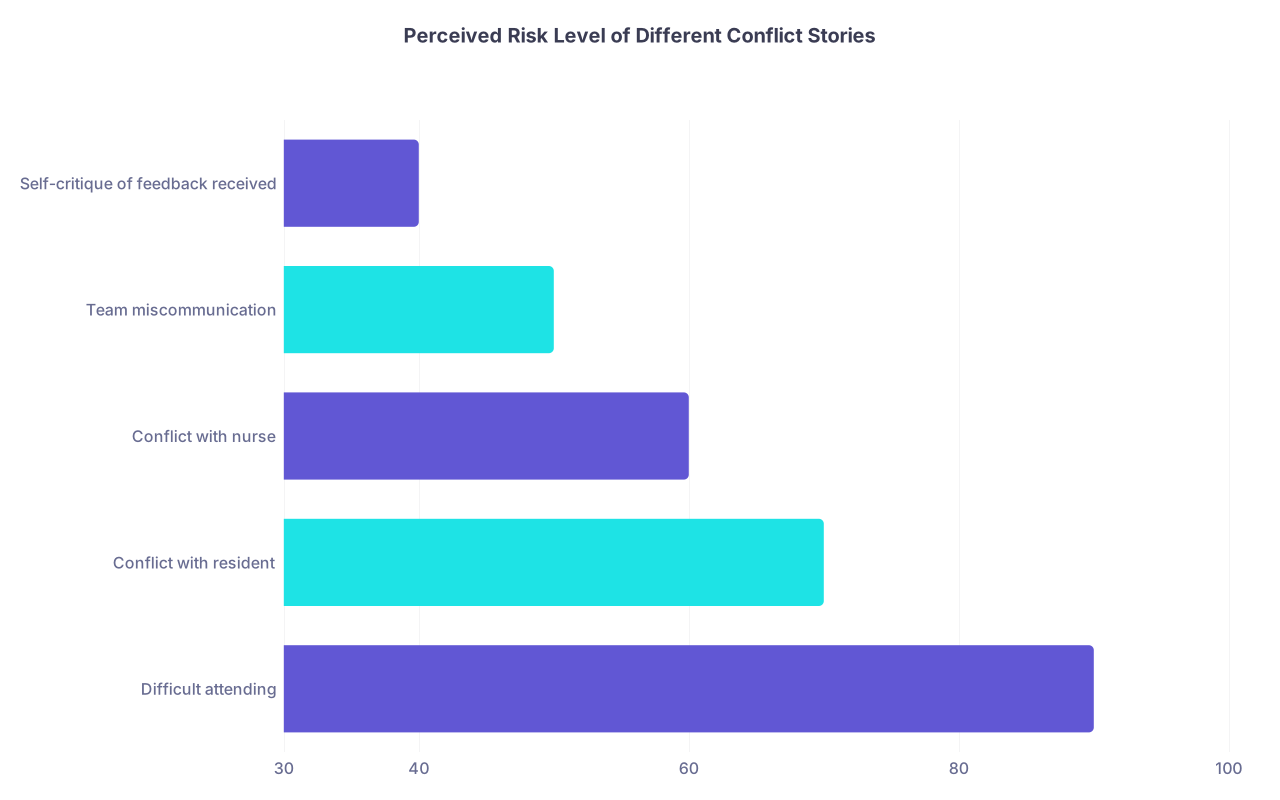
| Category | Value |
|---|---|
| Difficult attending | 90 |
| Conflict with resident | 70 |
| Conflict with nurse | 60 |
| Team miscommunication | 50 |
| Self-critique of feedback received | 40 |
If you can demonstrate professionalism and growth without attacking someone above you in the hierarchy, do that. Save the attending story for your friends, not your interviewers.
How Interviewers Actually Judge These Answers
I have sat in debrief meetings where faculty said things like:
- “Good applicant, but she really went after that attending in her story. I worry how she will talk about us.”
- “He blamed everything on other people. I did not hear a single ‘I could have.’”
- “That story felt rehearsed and self‑righteous. Something was off.”
They are not keeping formal scorecards, but mentally they are rating you on:
- Humility vs. defensiveness.
- Professionalism vs. gossip.
- Nuance vs. black‑and‑white thinking.
- Growth mindset vs. victim mindset.
They know you will be under enormous stress as a resident. They are trying to guess: what happens when something feels unfair? When you get a rough evaluation? When a senior snaps at you in the middle of a code?
Your stories are their only data.
A Simple Pre‑Interview Exercise to Avoid Self‑Sabotage
Before your next interview, sit down with your list of “go‑to” stories. Especially for:
- “Tell me about a conflict.”
- “Tell me about a time you received critical feedback.”
- “Tell me about a challenging interaction with a supervisor or team member.”
For each story, do this:
Underline every adjective you use to describe the other person.
If most of them are negative, you have a problem.Circle every sentence where you talk about your own contribution or mistake.
If you have none, or only one at the very end, you have a problem.Highlight where you clearly state what you learned and how you changed future behavior.
If this is vague (“I learned to communicate better”), you have a problem.
Then rewrite the story so that:
- Your language about others is behavioral and specific, not character‑based.
- Your own role is clear and honest.
- Your learning is concrete and tied to a later example: “Later, when X happened, I handled it differently by…”
This simple edit can be the difference between “risk” and “resilient” in your interviewer’s mind.
The One Thing You Must Stop Doing Immediately
If you remember nothing else, remember this:
Stop using your “difficult attending” story as entertainment.
You know the vibe. The story you tell on Zoom socials that makes everyone laugh. The one where you get to perform outrage, roll your eyes, and bond over how awful that rotation was.
That might work with co‑students. It is poison in an interview.
You are not there to prove you are fun to complain with. You are there to prove you are safe to supervise.
The admissions committee is not asking, “Do we agree that this attending sounded bad?” They are asking, “What does this story reveal about you when you feel wronged, stressed, or criticized?”
Do not give them ammunition.
FAQs
1. What if the attending’s behavior really was abusive or discriminatory—should I never mention it?
You can mention it, but you must do so carefully and with purpose. Focus on:
- Specific behaviors (e.g., “made repeated derogatory comments about my accent”) rather than global labels.
- Concrete steps you took to protect yourself or others (reporting to the appropriate office, seeking support).
- How you processed and healed from it, and what boundaries or advocacy skills you developed.
If the situation appears in your MSPE or an institutional report, you should be prepared with a calm, non‑inflammatory explanation. Your goal is not to recruit the interviewer to hate that attending. Your goal is to show you responded in a professional, thoughtful way, even to something genuinely wrong.
2. What if the interviewer directly asks, “Have you ever worked with a difficult attending?”
You do not need to perform sainthood or pretend everyone was wonderful. You can say something like:
“I have worked with attendings whose communication styles were very different from mine and at times challenging. In those settings, I focus on understanding their expectations, separating tone from content, and asking for specific, actionable feedback. That approach has helped me grow on some of my toughest rotations.”
If they push for a specific example, pick the most moderate version you have, frame it neutrally, and emphasize your adaptation and growth rather than the attending’s flaws.
3. How do I know if my story sounds blaming or unprofessional?
Test it out loud with someone who will be honest with you—ideally a resident, faculty mentor, or advisor, not just a peer who loves your drama. Ask them three direct questions:
- “If you were the attending in this story, would you feel attacked or fairly represented?”
- “Do I sound like I am owning my part, or mostly blaming the other person?”
- “What three adjectives would you use to describe me based only on this story?”
If you hear words like “bitter,” “defensive,” “self‑righteous,” or “rigid,” you need to rework or replace the story before you bring it into a residency interview.
Open your list of planned interview stories right now and cross out any where the main character in conflict is a “difficult attending.” Then replace at least one of them with a story that shows you handling feedback, conflict, or stress without attacking the person above you.