Your Ultimate Guide to Navigating SOAP: Strategies to Secure a Residency Spot
Navigating the Supplemental Offer and Acceptance Program (SOAP) can feel intense, emotional, and time-pressured—but it is also a powerful second chance in your residency journey. Even strong applicants can go unmatched or partially matched for reasons that have little to do with their potential as physicians: specialty competitiveness, limited interview numbers, or unexpected shifts in program needs.
SOAP exists to help you move forward.
This guide explains how SOAP works, how to prepare before Match Day, how to execute a strong strategy during SOAP Week, and how to evaluate and accept offers in a way that aligns with your long-term medical career goals. It is designed for medical students and graduates who want clear, practical, and realistic application strategies during one of the most stressful parts of residency preparation.
Understanding SOAP and the Match Week Timeline
The Supplemental Offer and Acceptance Program is administered by the National Resident Matching Program (NRMP) to fill unfilled residency positions after the main Match algorithm runs. For unmatched or partially matched applicants, SOAP is the structured, rules-based pathway to compete for these positions.
Who Is Eligible for SOAP?
You may be eligible to participate in SOAP if:
- You are registered for the Main Residency Match
- You are unmatched or partially matched when the Match results are released
- You are eligible to start residency training on July 1 (e.g., ECFMG certified if international medical graduate)
- You have an active ERAS application
NRMP determines SOAP eligibility and notifies you via the R3 system and through your medical school.
How SOAP Fits into Match Week
Understanding the exact rhythm of Match Week is essential for planning and emotional preparedness:
Monday of Match Week:
- At 11:00 a.m. ET, applicants learn whether they are:
- Fully matched
- Partially matched (e.g., advanced but not preliminary, or vice versa)
- Unmatched
- SOAP-eligible applicants receive access to the list of unfilled positions.
- At 11:00 a.m. ET, applicants learn whether they are:
Monday–Thursday: SOAP Week
Over approximately four days, applicants:- Apply to programs with unfilled positions (via ERAS)
- Interview (often by phone or video)
- Receive multiple rounds of offers through the NRMP system
Friday (Match Day):
Final Match and SOAP results are disclosed publicly and celebrated at most schools.
SOAP is highly structured, and strict rules govern communication and offers. Knowing what happens when allows you to plan your time, manage expectations, and reduce chaos.
Key SOAP Features to Remember
- Duration: Typically spans four days (Monday–Thursday of Match Week).
- Positions: Only unfilled, NRMP-participating residency positions are available.
- Applications: You can apply only through ERAS, with a limited number of applications (historically up to 45 programs).
- Offers: Issued in several rounds (e.g., four rounds) at scheduled times each day. You can:
- Receive multiple offers in a round
- Accept only one offer per round
- Hold only one accepted position total
Planning ahead for this compressed timeline is central to effective residency preparation.
Laying the Groundwork: Preparing Before Match Day
Successful SOAP participation actually starts months before Match Week. The more prepared you are, the more you can think clearly and strategically under pressure.
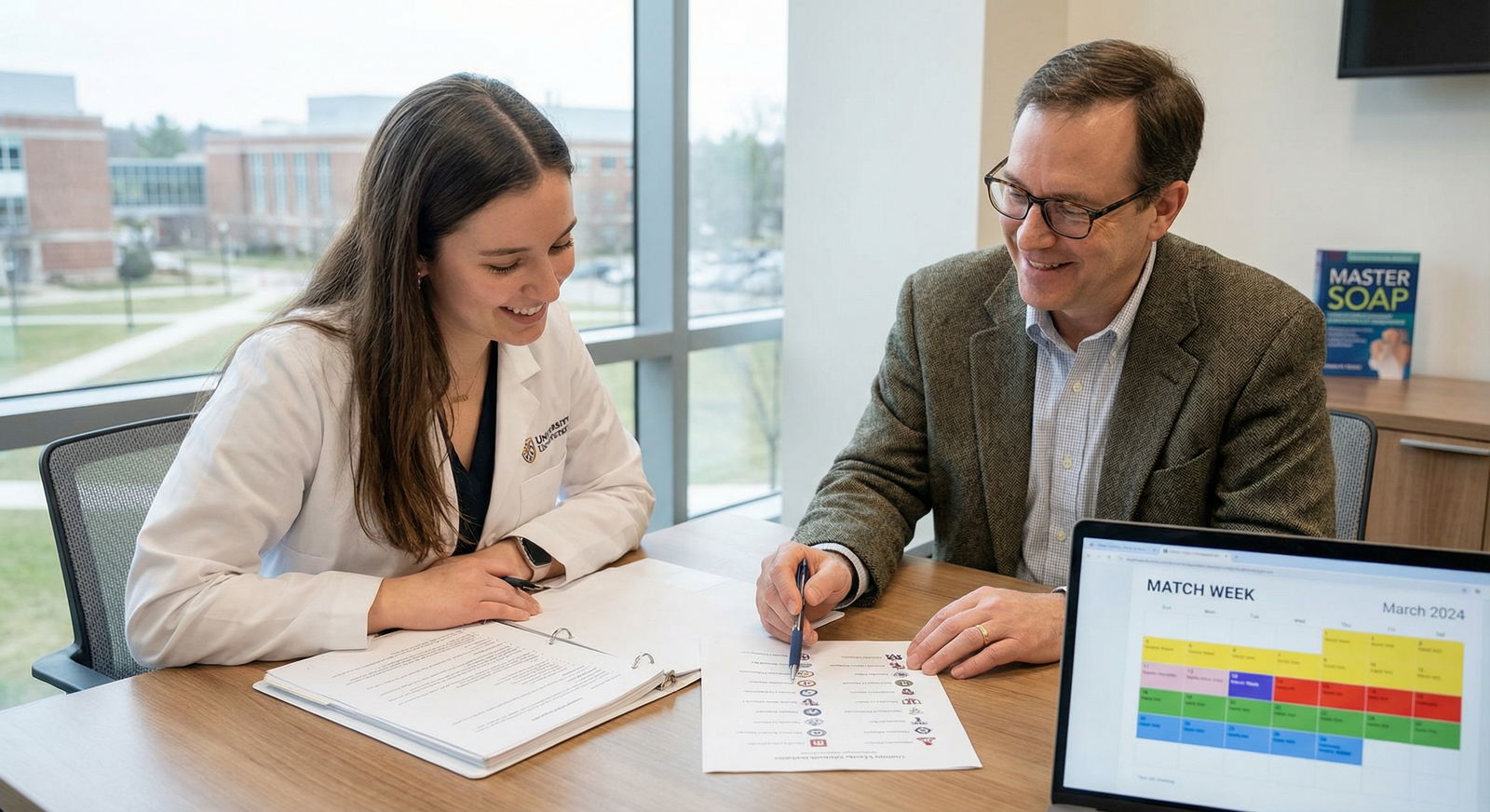
1. Self-Assessment and Honest Reflection
If you are at risk of not matching (few interviews, highly competitive specialty, major application gaps), begin reflecting early:
Ask yourself:
Application profile
- Did I apply to a realistic range of programs and specialties?
- Were my USMLE/COMLEX scores, clerkship grades, or clinical evaluations a limiting factor?
- Did my personal statement fully explain context (e.g., leaves of absence, failures, or red flags)?
Interview and communication
- Did I receive fewer interviews than peers with similar profiles?
- Did interviews feel awkward or repetitive?
- Did I practice answering common residency interview questions?
Specialty selection
- Was my specialty choice highly competitive relative to my metrics?
- Did I rank enough programs, including some “safer” options?
Use this reflection to prepare a clear narrative for SOAP interviews: what happened, what you learned, how you’ve grown, and why you will be a strong resident.
2. Identify Realistic SOAP Specialties and Pathways
SOAP is not the time to chase low-probability choices. Focus on realistic, attainable options that still align with your broader medical career goals.
Common SOAP-participating specialties include:
- Internal Medicine (categorical and preliminary)
- Family Medicine
- Pediatrics
- Psychiatry
- Transitional Year (TY) programs
- Some General Surgery prelim spots
- Occasionally OB/Gyn, Neurology, Pathology, and others
Ask yourself:
- Am I open to primary care or psychiatry as a long-term career?
- Would a preliminary or transitional year help me reapply to my original specialty?
- How flexible am I about location, hospital type, or community vs academic programs?
Discuss these questions with mentors or advisors familiar with residency match data and your situation.
3. Research Programs and Historical SOAP Trends
Well before Match Week, start researching:
Programs that historically have unfilled positions
- Use NRMP data reports and your medical school’s advising resources.
- Talk with deans or recent graduates about programs that frequently appear in SOAP.
Program characteristics
- Size (smaller programs may have fewer teaching resources; larger programs may have more structure)
- Community vs academic environment
- Patient population and case mix
- Fellowship opportunities and board pass rates
Create a draft list of programs and specialties that would be acceptable if you needed to SOAP. Having this scaffolding ready will save critical time when emotions are high.
4. Strengthen and Update Your Application Materials
Your ERAS application during SOAP can and should be updated thoughtfully.
Focus on:
Curriculum Vitae (CV) and ERAS entries
- Add any new rotations, research, leadership, and volunteer experiences.
- Refine descriptions to highlight clinical skills, teamwork, resilience, and professionalism.
Personal Statements
- Prepare at least two versions:
- One for your primary SOAP specialty (e.g., Internal Medicine, Family Medicine, Psychiatry)
- One for preliminary/TY positions if relevant
- Tailor your statement to:
- Explain your interest in the specialty clearly and positively
- Address any major red flags factually and briefly, emphasizing growth and accountability
- Show insight into what residency demands (stamina, humility, communication, adaptability)
- Prepare at least two versions:
Letters of Recommendation
- If possible, secure updated or specialty-specific letters ahead of Match Week:
- For example, an IM letter from a ward attending, or a Family Medicine letter from an outpatient preceptor.
- Ask letter writers to comment on:
- Clinical reasoning
- Work ethic
- Professionalism and collegiality
- Capacity to grow and respond to feedback
- If possible, secure updated or specialty-specific letters ahead of Match Week:
Having these components ready (or nearly ready) before Match results are released is one of the most impactful SOAP application strategies.
Executing During SOAP Week: Strategy Under Pressure
Once you learn on Monday that you are SOAP-eligible, emotions will be high. The key is to balance acknowledging those feelings with switching quickly into structured problem-solving mode.
1. Understand the Mechanics of SOAP Applications
During SOAP, you will work within two main systems:
NRMP (R3 system):
- Confirms SOAP eligibility
- Lists unfilled programs by specialty and state
- Manages offer rounds and acceptances
ERAS:
- Used to apply to programs (upload personal statements, assign letters, submit applications)
- Tracks which programs you’ve applied to
Important constraints:
- You have a cap on the total number of SOAP applications (e.g., historically 45; confirm the current year’s limit).
- You cannot directly contact programs outside of NRMP/ERAS rules (e.g., no cold emails to PDs asking for positions).
- Programs must initiate interviews and communication with you after reviewing your materials.
Familiarize yourself with the current-year SOAP handbook and rules from NRMP and ERAS before Match Week.
2. Strategic Application Planning
When the list of unfilled positions is released:
Sort by specialty:
Identify the realistic specialties you discussed with your advisor (e.g., IM, FM, Psych, TY).Filter by requirements: Consider:
- US vs IMG-friendly programs
- Visa sponsorship (if needed)
- USMLE/COMLEX score requirements
- State licensure nuances
Prioritize feasibility + fit Rank programs based on:
- Your competitiveness for that specialty
- Geographic and personal constraints (family, health, support system)
- Training environment (community vs academic, patient demographics, call schedule)
Allocate applications intentionally For example:
- 60–70% to your most realistic, acceptable specialty (e.g., Internal Medicine, Family Medicine, Psychiatry)
- 20–30% to transitional year or preliminary programs (if your long-term plan involves reapplying)
- The remainder to stretch or backup options that you can live with if matched there
Avoid using all your limited applications on highly competitive or geographically restricted programs.
3. Staying Organized in a Fast-Paced Week
The pace during SOAP is relentless. Good organization protects you from errors such as missing deadlines or double-accepting offers.
Use:
- A detailed calendar with:
- Application submission opening/closing times
- Each SOAP offer round’s start and end times
- Interview slots
- A spreadsheet or tracking document listing:
- Programs applied to, by specialty and state
- Interview invitations, contact information, and dates
- Impressions after interviews (pros/cons, red flags)
- Offer status across rounds
Keep all documents (CV, personal statements, LORs) easily accessible and clearly labeled.
4. Interviews and Communication During SOAP
SOAP interviews are often shorter and more focused than regular residency interviews, and they may occur by phone or video with little notice.
Prepare in advance to:
Tell your story concisely
- Why did you not match (or partially match)?
- Provide a brief, honest, non-defensive explanation.
- What have you learned and how have you grown?
- Why are you genuinely interested in this specialty and this program?
- Why did you not match (or partially match)?
Highlight strengths specifically
Emphasize:- Clinical performance (“I consistently received strong evaluations in inpatient rotations and was trusted to pre-round independently.”)
- Teamwork and reliability (“Residents and nurses have commented that I’m dependable and calm under pressure.”)
- Adaptability and resilience (especially important in the SOAP context)
Ask focused questions Time may be limited; ask questions that matter:
- How is mentorship structured?
- What are the main challenges residents face?
- How are struggling residents supported?
Professionalism and responsiveness
- Answer calls and emails promptly.
- Test your video setup (lighting, sound, background) ahead of time.
- Dress professionally, even if interviews are virtual.
Programs are not just determining if you have the knowledge—they’re evaluating if you are someone they can work with at 2 a.m. on a busy call night.
Navigating Offers, Acceptance, and Long-Term Strategy
If you receive SOAP offers, the decisions you make over a matter of minutes or hours can shape your early medical career trajectory.
1. Understanding SOAP Offer Rounds
During each SOAP round:
- You may receive zero, one, or multiple offers from programs where you applied.
- If you receive multiple offers in a round, you must:
- Choose one to accept, or
- Decline all and hope for a better offer in a later round (with the risk of receiving none).
Once you accept an offer:
- You are committed to that position.
- You are removed from further SOAP offer consideration for that training year.
Always verify current-year NRMP rules because timelines and round structures can change.
2. How to Evaluate Offers Rapidly and Rationally
When a SOAP offer appears, ask yourself:
Training quality and environment
- Is this an ACGME-accredited program with a reasonable board pass rate?
- Does the program seem supportive and structured?
Specialty and long-term alignment
- Can I see myself building a satisfying career in this specialty?
- If it’s a preliminary or transitional year, how will I leverage it to reapply or pivot?
Location and personal factors
- Can I reasonably live here for at least one year (or three+ for categorical spots)?
- What is the impact on my support system, cost of living, and wellbeing?
Career flexibility
- Does this specialty or program offer multiple paths later (e.g., IM → subspecialties; FM → sports medicine, geriatrics)?
It may help to create a predefined priority list with your advisor or support system before offers begin, ranking:
- Most preferred: categorical positions in realistic, acceptable specialties
- Next: transitional/preliminary roles at strong institutions with good support
- Last: positions that you would accept only if no other option exists
This reduces emotional decision fatigue when the clock is ticking.
3. Accepting Offers Professionally
Once you decide to accept:
- Confirm acceptance within the required time window via the NRMP system.
- Send a brief, professional thank-you email to:
- Program Director
- Program Coordinator
- Anyone who interviewed or advocated for you
Example:
Dear Dr. [Name],
Thank you for the opportunity to join [Program Name] as a [specialty] resident. I am excited and grateful to be part of your team and look forward to contributing to the program and caring for your patients.
Sincerely,
[Your Name]
Professionalism now contributes to your reputation before you even start residency.
4. If You Do Not Receive an Offer in SOAP
Not receiving a SOAP offer is painful, but it is not the end of a medical career.
If this happens:
Pause and process
Give yourself space to feel disappointed. This is a real loss and deserves acknowledgment.Meet with advisors quickly
- Review your full application honestly.
- Identify addressable issues:
- Exam failures or low scores
- Limited clinical experience
- Weak letters or personal statement
- Narrow specialty choice
Explore alternative pathways Options may include:
- Additional clinical or research year in the U.S.
- MPH, MBA, or research-focused degrees (if they strengthen your trajectory)
- Hospitalist scribe roles, clinical education, or quality improvement positions
- Reapplying next cycle with a more realistic specialty and a stronger application
Ask for frank feedback from program directors where possible. Many residents who eventually thrive in residency experienced at least one unmatched or SOAP cycle before succeeding.

Mindset, Wellness, and Professional Resilience During SOAP
SOAP happens at a time when you are already exhausted from residency preparation and emotionally invested in Match Day. Protecting your mental health is not optional—it is part of being able to think clearly and show up well.
Practical Tips for Staying Grounded
Designate support people
- Identify one or two trusted friends, partners, or family members who understand the process and can provide emotional support.
- If possible, connect with classmates going through SOAP so you don’t feel isolated.
Set information boundaries
- Limit social media and group chats on Match Day and during SOAP if they worsen stress.
- Focus on what you can control: your application, interviews, and decisions.
Maintain basic self-care
- Eat regular meals, hydrate, and sleep as much as is reasonably possible.
- Short walks or brief exercise can significantly reduce anxiety.
Use institutional resources
- Many medical schools and hospitals offer:
- Wellness counselors
- Peer support groups
- Emergency mental health services
Do not hesitate to use them.
- Many medical schools and hospitals offer:
Your response to adversity—how you adapt, communicate, and keep moving forward—is part of your professional identity as a future physician.
FAQs About SOAP and Residency Preparation
1. What is SOAP, and how is it different from the main Match?
SOAP (Supplemental Offer and Acceptance Program) is a structured process run by the NRMP during Match Week to fill unfilled residency positions. It is only for applicants who are unmatched or partially matched after the main Match algorithm. Unlike the main Match, which uses a ranking algorithm to pair applicants and programs, SOAP involves:
- A limited number of applications to unfilled programs
- Program-initiated interviews
- Several timed rounds of offers where you can accept one position
Both are part of the broader residency preparation and selection system, but SOAP is designed as a rapid, second-chance mechanism.
2. How long does SOAP last, and what are the key days?
SOAP usually runs for about four days during Match Week:
- Monday: You learn your match status and, if SOAP-eligible, see unfilled positions and start applying through ERAS.
- Tuesday–Thursday: Programs review applications, conduct interviews, and several rounds of offers occur via NRMP.
- Friday (Match Day): Final results (including SOAP placements) are released publicly.
Because the timeline is compressed, advanced preparation is critical.
3. How many programs can I apply to during SOAP, and should I use them all?
NRMP and ERAS set a cap on the total number of SOAP applications (historically up to 45). You should generally plan to use most or all of your allotted applications, but in a strategic way:
- Prioritize realistic specialties and programs where your profile is competitive.
- Avoid using a large proportion of your applications on aspirational or geographically restrictive programs that are unlikely to choose you.
- Work with an advisor to allocate applications across categorical, preliminary, and transitional positions based on your career goals.
4. How can I prepare for SOAP early, even if I hope to match?
You can prepare without assuming you’ll go unmatched by:
- Updating your ERAS application and CV regularly.
- Drafting at least one alternative-specialty personal statement (e.g., for Internal Medicine, Family Medicine, or Psychiatry).
- Meeting with an advisor to discuss a contingency plan if you receive few interviews or are at high risk of not matching.
- Familiarizing yourself with NRMP SOAP rules and the Match Week timeline.
Having a backup plan is part of mature residency preparation, not a sign of pessimism.
5. What if I don’t receive any offers during SOAP—do I still have a future in medicine?
Yes. Many physicians have taken non-linear paths into residency. If you do not receive a SOAP offer:
- Take time to process the disappointment.
- Meet with knowledgeable advisors to analyze your application honestly.
- Consider steps such as:
- Additional clinical experience or research
- Pursuing a graduate degree that aligns with your goals
- Reapplying with a more realistic specialty strategy and strengthened application materials
Your medical career is a marathon, not a sprint. SOAP is one intense and important phase, but it does not define your entire trajectory.
By understanding how SOAP works, preparing proactively, and responding thoughtfully under pressure, you can transform a setback on Match Day into a viable path forward. The process demands flexibility, humility, and resolve—qualities that will serve you throughout your medical career, far beyond residency applications and Match Day.