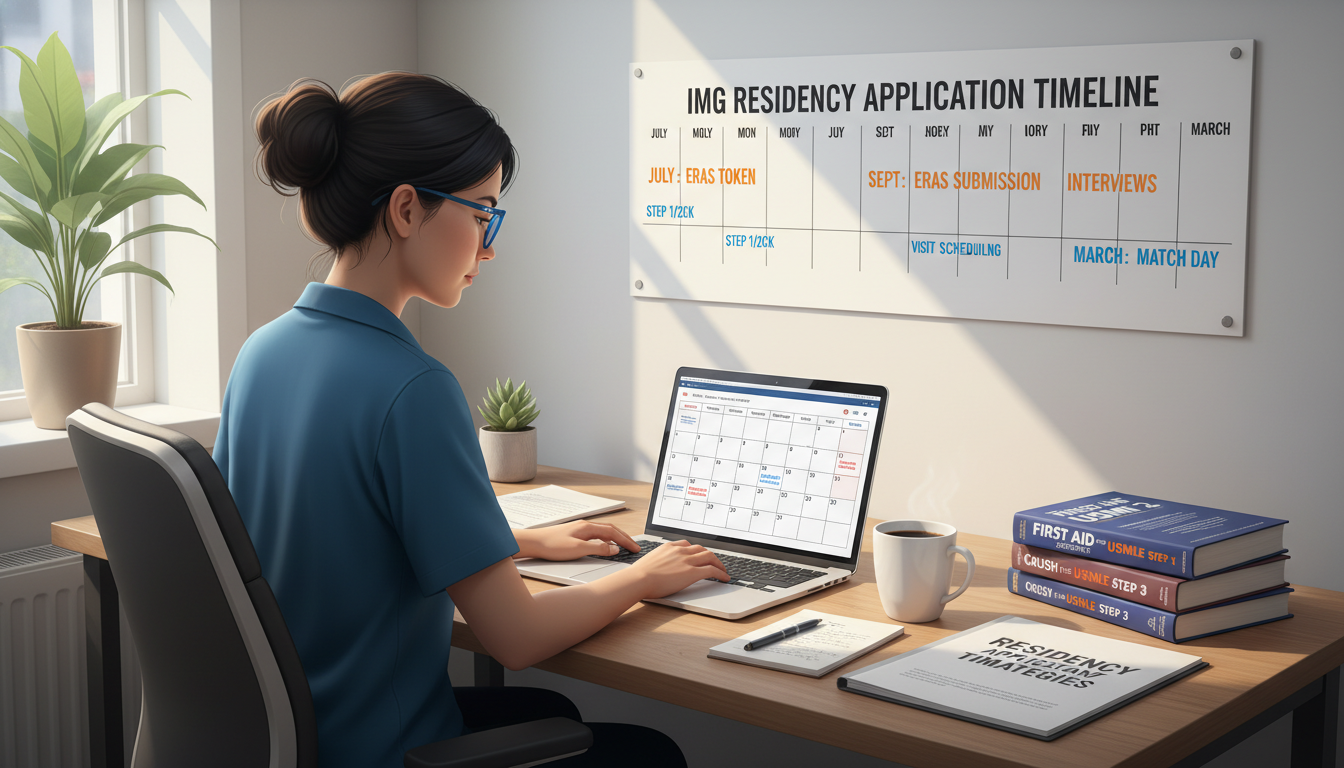
Understanding the Residency Application Timeline as an IMG
For an international medical graduate, the residency application timeline is more than just dates on a calendar—it’s a strategy that can make a real difference in your chances of matching. You face extra layers of complexity: visas, ECFMG certification, US clinical experience, and often being thousands of miles away from program events.
This IMG residency guide focuses entirely on timing: when to take exams, arrange letters, prepare ERAS, and—most importantly—when to submit ERAS so your application is seen at its strongest.
While exact dates change slightly each year, the overall residency application timeline stays similar. Always confirm current dates on:
- AAMC ERAS website
- NRMP (Match) website
- ECFMG | FAIMER website
Below, we’ll walk month-by-month through the process, then discuss strategic timing decisions specific to IMGs, followed by common scenarios and FAQs.
Big-Picture Timeline for IMGs: From 18 Months Before to Match Day
This section outlines a typical 18–24 month journey for an IMG targeting a July 1 residency start date.
18–24 Months Before Residency Start (Usually January–December, Two Years Prior)
Your main goals:
- Complete USMLEs (or at least Step 1 and Step 2 CK scheduled)
- Build US clinical experience (USCE)
- Start planning for letters of recommendation (LoRs)
Key Tasks:
USMLE Step 1 & Step 2 CK planning
- Aim to have:
- Step 1 done or near completion
- Step 2 CK scheduled so results are ready by late August or early September of your application year
- Many programs heavily weigh Step 2 CK for IMGs, even more so since Step 1 became pass/fail.
- Aim to have:
ECFMG Pathway & Certification Planning
- Review ECFMG requirements early (current pathway, English requirements, primary-source verification).
- Understand what you personally need to complete to become ECFMG certified (or at least on track) before ranking deadlines (typically February–March of the Match year).
US Clinical Experience (USCE)
- Plan observerships, externships, or electives 6–12 months before applying.
- Focus on specialty-aligned rotations (e.g., internal medicine for IM residency).
- Use these rotations to:
- Build relationships for strong U.S. LoRs
- Learn the U.S. healthcare system
- Improve your clinical communication and EMR familiarity
Preliminary Specialty & Location Planning
- Decide primary specialty (e.g., internal medicine, family medicine, pediatrics).
- Identify whether you might apply to a backup specialty.
- Start tracking:
- IMG-friendly programs
- Programs accepting visas (J-1, H-1B if you qualify)
- Programs with recent IMG residents
Actionable Tip:
Create a simple spreadsheet for programs you might target, with columns for “IMG status,” “visa,” “minimum scores,” “years since graduation,” and “USCE requirements.” Begin filling it as you research, even if your application cycle is still a year away.
12–9 Months Before ERAS Submission (October–December of the Year Before Applications Open)
Now you are entering the serious planning phase for your residency application timeline.
Typical Timeframe: October–December (year before ERAS opens)
Key Tasks:
Finalize Exam Strategy
- Ideally, Step 2 CK test date should allow score release by:
- Late August or early September of your application submission year.
- If you need Step 3 (for H-1B visa–friendly programs), start planning, but Step 3 is not required for all IMGs.
- Ideally, Step 2 CK test date should allow score release by:
Begin Personal Statement Drafting
- Create:
- A master personal statement
- Specialty-specific versions, if applying to more than one field
- Allow several rounds of revision:
- Peers
- Mentors
- U.S.-trained physicians (if possible)
- Create:
Gather CV Data
- Compile:
- Publications, posters, and presentations
- Leadership roles
- Volunteer activities
- Work and research experiences
- Convert your CV into U.S.-style bullet points (action-oriented, outcome-based).
- Compile:
Identify Letter Writers
- From your USCE and home-country experiences:
- Prioritize U.S. attendings in your target specialty.
- Choose those who actually know your work, not just big names.
- Ask them in advance:
- “Would you feel comfortable writing me a strong letter of recommendation for U.S. residency in [specialty]?”
- From your USCE and home-country experiences:
9–6 Months Before ERAS Application Opens (January–March of the Application Year)
This is the pre-ERAS preparation phase.
Key Tasks:
Confirm ERAS and NRMP Dates
- ERAS (AAMC) will post:
- Date ERAS opens for applicants
- First day programs can view applications
- NRMP will release:
- Registration open date
- Rank list deadlines
- For IMGs, missing application deadlines or submitting too late can be costly, so add all dates to your calendar.
- ERAS (AAMC) will post:
Strengthen Your Profile
- Complete ongoing research projects if possible.
- Seek leadership or teaching roles (e.g., tutoring, small group teaching).
- Improve English proficiency (formal courses or self-practice) if you’re not fully confident.
Draft ERAS Experiences Section
- Write concise, meaningful descriptions of:
- Clinical experiences
- Research
- Volunteer work
- Emphasize:
- Your role
- Impact on patients/teams
- Results or outcomes
- Write concise, meaningful descriptions of:
Clarify Your Program Target List
- Start with a broad list:
- 100–150+ programs for competitive specialties as an IMG international medical graduate
- More or less depending on your profile and specialty competitiveness
- Flag priority programs where you are a strong fit based on:
- Step scores
- Graduation year
- USCE
- Visa policies
- Historical IMG friendliness
- Start with a broad list:
6–3 Months Before ERAS Submission (April–June of the Application Year)
This is when ERAS typically opens for applicants to begin working on their applications (exact month varies slightly, but often June).
Key Tasks:
Set Up Your MyERAS Account
- Register when ERAS opens for your application season.
- Link your AAMC and ECFMG information.
- Familiarize yourself with each section of the application.
Finalize Letters of Recommendation
- Formally request letters from your chosen writers.
- Provide:
- Your CV
- Personal statement draft
- A summary of your work with them
- Encourage U.S. attendings to:
- Mention specifics: patient cases, work ethic, communication skills.
- Make sure letters are uploaded to ERAS via the LoR portal well before September.
Polish Personal Statement(s)
- Final edits:
- Remove clichés
- Emphasize specific experiences
- Clarify your reasons for the specialty and for training in the U.S.
- Check syntax, grammar, and tone with a native or fluent English speaker.
- Final edits:
Refine Program List and Strategy
- Group your programs:
- Reach programs: slightly above your stats
- Target programs: realistic based on your profile
- Safety programs: more IMG-friendly or community-based programs
- Make sure to include enough safety programs for a realistic chance of interviews.
- Group your programs:

When to Submit ERAS: Timing Strategy for IMGs
This is one of the most critical questions: when to submit ERAS to maximize your chances as an IMG.
Key ERAS Milestones
While exact dates change yearly, the typical pattern is:
- June: ERAS opens for applicants to begin entering information.
- Late September: ERAS opens for programs; they can begin viewing applications.
- September (specific date): First day applicants can submit their application and programs start to download them (called “opening day”).
Programs often begin filtering and reviewing applications within the first few days after they can see them. Many interview invitations go out in October and November, though some programs send earlier or later.
Ideal Timing for IMGs
Best practice:
Submit your ERAS application on or as close as possible to the first day programs can start downloading applications, with your application fully complete.
For an international medical graduate, this matters because:
- Many programs receive thousands of applications.
- They often batch review early submissions first.
- IMGs are frequently filtered by:
- Exam scores
- Years since graduation
- ECFMG certification status
- Earlier, complete applications may get more thorough consideration before interview slots begin to fill.
However, you should not submit an incomplete or significantly weak application early if waiting a short time would substantially improve it. The question becomes strategic:
Is it better to apply a few days or weeks later with stronger elements (e.g., Step 2 CK, more LoRs, ECFMG certification) than to submit on day 1 with serious gaps?
Common Timing Scenarios and Strategy
Scenario 1: You Have Step 1 and Step 2 CK Scores Ready by Early September
- Strategy:
- Prepare ERAS completely in June–August.
- Confirm all LoRs are uploaded or in progress.
- Submit as early as possible on opening day.
- Reasoning:
- You present as a complete, stable candidate when programs first review applicants.
Scenario 2: Step 2 CK Score Will Be Available Late September or October
- Example: You test in late July; scores release about 4 weeks later.
- Strategy:
- If your expected Step 2 CK release is before or very near the September ERAS program view date:
- You can still submit ERAS on opening day and update your application with the Step 2 CK score once available.
- If your Step 2 CK is delayed into October:
- For IMGs, it is often still worth submitting in late September with Step 1 + “pending Step 2 CK,” especially if Step 1 is strong.
- Programs can see that Step 2 CK is in progress and some may wait for it.
- If your expected Step 2 CK release is before or very near the September ERAS program view date:
- Key trade-off:
- Delaying too long for Step 2 CK can cause missed early review waves.
- But if Step 1 is weak and Step 2 CK is likely much stronger, waiting until you have Step 2 CK (even if a bit later) might improve your filter chances.
Scenario 3: ECFMG Certification Not Yet Final at Time of Submission
- Many IMGs submit ERAS and even interview while their ECFMG certification is still pending.
- What matters:
- You must be ECFMG certified by the rank order list certification deadline (usually in February) to fully participate in the Match.
- Strategy:
- You can and should still submit your ERAS on time in September while working towards ECFMG full certification.
- Make sure your documentation and communication with ECFMG are prompt to avoid delays.
Scenario 4: Letters of Recommendation Arriving Late
- Ideal: 3–4 LoRs uploaded by late September.
- If one or two letters are still pending:
- Submit on opening day with the letters you have.
- Additional letters can be uploaded and assigned to programs later.
- Do not delay overall submission for a single LoR, especially if you already have 3 solid letters.
How Late Is “Too Late” to Submit ERAS as an IMG?
- Submitting any time within the first 1–2 weeks after programs can download applications is generally still acceptable.
- Submissions after October begin to significantly reduce your odds, particularly if you are a non–U.S. IMG without strong connections.
- Many programs set internal application deadlines (not always explicit) and may stop reviewing new applications later in the season.
Guideline:
Aim to submit between opening day and the first 5–7 days thereafter, unless a short delay yields a major, concrete improvement (e.g., a much higher Step 2 CK score).
Month-by-Month Timeline: IMG Residency Guide to the Application Year
Let’s map this out specifically for the application year (assuming you start residency the following July).
January–March
- Finalize exam plans and clinical experiences.
- Begin building ERAS content offline:
- Experience descriptions
- Personal statement drafts
- CV polishing
April–June
- ERAS opens (usually June):
- Register and start completing application sections.
- Request LoRs formally and set target dates for upload.
- Gather transcripts and MSPE (dean’s letter) arrangements via your medical school and ECFMG.
July
- Continue refining:
- Experiences
- Personal statement(s)
- Program list
- Take Step 2 CK if not already completed (ensure you know how score release will align with applications).
August
- Final check:
- Confirm LoR uploads or at least confirm letter writers are on track.
- Verify ECFMG documents are correctly submitted.
- Finalize your program list, including a balance of reach/target/safety.
- Do a full review of your ERAS application for content and grammar.
September
- ERAS submission window opens for applicants (specific date each year).
- Programs receive and can start reviewing applications (late September).
- Your tasks:
- Submit ERAS as early as possible once submission opens.
- Ensure USMLE transcript release to ERAS.
- Track any late-arriving LoRs and assign them to programs.
- Watch for email invitations and interview communications.
October–January: Interview Season
- Most interview invitations go out in October and November.
- Some specialties and programs continue into December and January.
- As an IMG:
- Respond quickly to invitations—interview slots may fill within hours.
- Be prepared for:
- Virtual interviews
- Time zone issues
- Visa-related questions (if applicable)
- Keep updating your program notes after each interview.
February–March: Ranking and Match
- Register for NRMP (Match) if you haven’t already.
- Ensure ECFMG certification is completed by the NRMP rank certification deadline.
- Submit your Rank Order List (ROL) on NRMP before the deadline.
- Match Week (March):
- Monday: You learn whether you matched.
- If unmatched, you may participate in the Supplemental Offer and Acceptance Program (SOAP).
- Thursday: Main Match Day (if matched).

Practical Timing Tips & Common IMG Mistakes
Practical Timing Tips
Work Backwards from Key Dates
- Start with:
- ERAS opening day
- Program view date
- Step score release dates
- Then schedule:
- Test days
- Letter requests
- Application drafting deadlines
- Start with:
Use a Visual Timeline
- Create a Gantt-style chart or calendar with:
- Exam deadlines
- ERAS milestones
- NRMP deadlines
- ECFMG tasks
- Create a Gantt-style chart or calendar with:
Time Zone Awareness
- ERAS and NRMP deadlines are often based on U.S. Eastern Time.
- If you’re abroad, double-check conversion to avoid missing cut-offs by hours.
Batch Your Tasks
- Avoid leaving all ERAS entry to the final weeks.
- Set internal deadlines:
- “Finish experiences section by July 15”
- “Finalize personal statement by August 1”
- “Confirm all LoRs by August 15”
Maintain Flexibility
- Build buffer time for:
- Unexpected exam delays
- ECFMG document issues
- Late-arriving letters
- Build buffer time for:
Common IMG Timing Mistakes
Taking Step 2 CK Too Late
- Testing in September or October of the application year can mean scores arrive after many interview invitations have already gone out.
Waiting to Be “Perfect” Before Submitting
- Holding your ERAS until late October in hopes of adding one more certificate or minor experience can hurt more than help.
Ignoring Program-Specific Application Deadlines
- Some programs stop accepting or start reviewing applications early.
- Always check each program’s website and ERAS entry.
Underestimating Letter of Recommendation Timing
- Asking for letters in late August or early September can be risky.
- Some attendings may need several weeks; build this into your timeline.
Not Planning for ECFMG Processing Time
- Delays in document submission or verification can push your certification past key NRMP deadlines if not handled early.
Frequently Asked Questions (FAQ)
1. As an IMG, when is the absolute best time to submit ERAS?
For most international medical graduates, the optimal time is on the first day ERAS allows application submission, or within the first few days after that. Your application should be as complete as possible—USMLE transcript released, personal statement finalized, and at least 3 letters of recommendation uploaded or confirmed. Submitting in this early window helps ensure your application is in the first batch programs review.
2. Is it better to wait for my Step 2 CK score or submit ERAS early without it?
It depends on your situation:
- If your Step 1 is strong and Step 2 CK is only slightly delayed (e.g., score available by late September or early October), it is usually better to submit early and update later.
- If your Step 1 is weak and Step 2 CK is likely to be significantly higher, a short delay to include Step 2 CK might improve your chances of passing initial filters, even if you submit slightly after opening day.
Always avoid delaying beyond early October unless absolutely necessary, as many programs will have started filling interview slots.
3. Do I need to be ECFMG certified before I submit ERAS?
No. You do not need full ECFMG certification to submit ERAS or even to attend interviews. However, you must be ECFMG certified by the time programs submit their rank lists (NRMP rank certification deadline, typically in February). Start your ECFMG process early in your residency application timeline to avoid any last-minute delays.
4. I’m more than 5 years since graduation. Does timing still matter as much for me?
Yes—perhaps even more so. Programs that accept older graduates often have large volumes of applicants fitting similar profiles. Submitting early and presenting a complete, polished application gives you a better chance to stand out. Additionally, you may need extra time within the cycle to arrange:
- Updated US clinical experience
- Recent letters
- Additional documentation explaining any gaps in clinical work
By understanding the full residency application timeline, planning your exam and document preparation carefully, and making strategic decisions about when to submit ERAS, you can significantly improve your competitiveness as an international medical graduate. Treat timing as a central part of your overall application strategy, not an afterthought, and build a clear, realistic plan starting 12–18 months before your target Match.