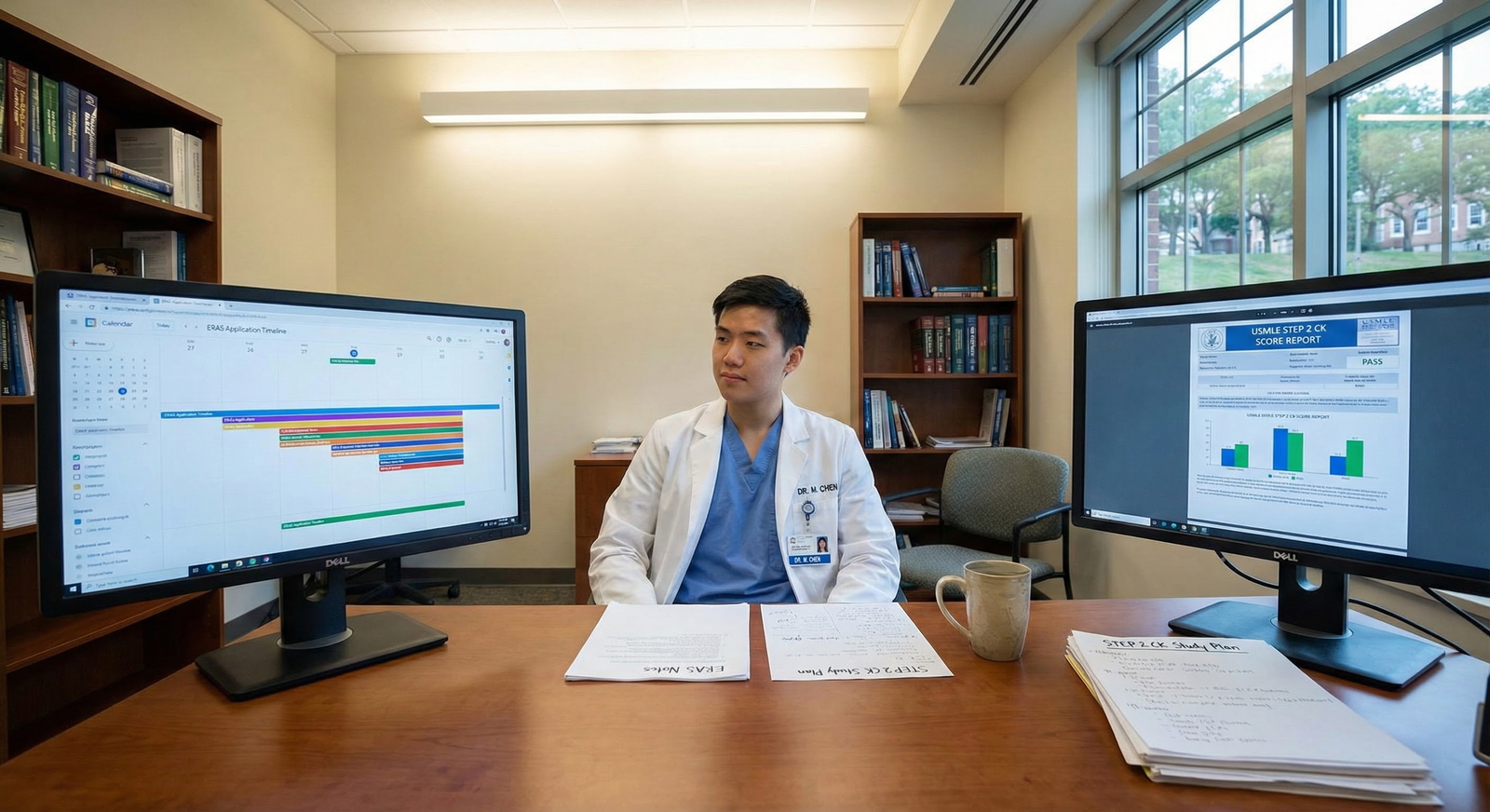
Introduction: Why ERAS Timing Can Make or Break Your Match
For most medical students, the ERAS Application is the single most important gateway to medical residency in the United States. The content of your application matters enormously—but when you submit it can be almost as important as what you submit.
Residency programs operate under intense time pressure. Many begin reviewing applications the moment they’re released and send out a large portion of their interview invitations in the first weeks of the season. If your ERAS is incomplete or submitted late, you may never be seen by programs that would otherwise have been a good fit.
This guide lays out a clear, practical Residency Timeline for preparing and submitting your ERAS Application, from 12+ months before submission all the way through interview season. You’ll find:
- A month‑by‑month ERAS preparation roadmap
- Specific Application Tips for each phase
- Guidance on the best time to submit ERAS for maximum visibility
- Interview Preparation strategies once your application is in
- Examples of what makes an application truly competitive
By the end, you’ll know not just when to apply, but how to use each stage of the year to build a strong, well‑timed application that maximizes your chances in the Residency Match.
Understanding ERAS and Why Timing Is Strategic
Before planning your timeline, it helps to understand how the ERAS system and residency programs interact.
What Exactly Is ERAS?
The Electronic Residency Application Service (ERAS), run by the AAMC, is the centralized platform used by almost all U.S. residency programs. Through ERAS, you submit:
- Biographic and demographic information
- Medical school transcript
- USMLE/COMLEX scores
- Medical education history and experiences
- Letters of Recommendation (LoRs)
- Personal Statement(s)
- MSPE (Dean’s Letter; uploaded later by your school)
- Program list and specialty preferences
Programs then review your application through the ERAS Program Director’s Workstation (PDWS) and decide whom to invite for interviews.
Because nearly every applicant and program uses the same system, ERAS creates a high‑stakes, heavily front‑loaded application environment—programs receive a flood of applications on the same day. That’s why timing is critical.
Why ERAS Timing Matters So Much
Most programs cannot thoroughly review every application they receive. Many use filters (e.g., minimum score thresholds, graduation year, visa requirements) and then conduct detailed review on only a subset of applicants.
Timing influences your odds in several ways:
- Early visibility: When applications first become available to programs, faculty and PDs are eager to identify strong candidates and start offering interview spots.
- Interview slot scarcity: Some programs send a majority of their interview invitations in the first 1–3 weeks of reviewing applications.
- Impression of organization: Submitting a complete, polished ERAS on or near the opening review date signals preparedness and professionalism.
- Late submissions = missed opportunities: While you can technically apply later, many interview spots will already be taken, especially at competitive programs.
In short: being early and complete is advantageous. Being late, even with strong metrics, can limit your options.
Long‑Range Planning: 12+ Months Before ERAS Submission
This phase typically spans the latter half of your third year of medical school (or earlier if you’re planning ahead).
Clarify Your Specialty Interests
A thoughtful specialty decision is foundational to your ERAS strategy.
- Reflect on clinical rotations: Which rotations energized you? Where did attendings see you as a “natural fit”?
- Consider competitiveness: Match rates, required scores, and research expectations vary widely (e.g., dermatology vs. family medicine).
- Explore with mentors: Talk to residents and attendings in potential specialties about lifestyle, training paths, and fellowship options.
Early clarity about your specialty helps you choose rotations, research, and mentors that will support a coherent application.
Begin Targeted Program and Region Research
Start building familiarity with programs at a high level:
- Identify geographic preferences: Regions where you have ties, want to live, or might have visa or family considerations.
- Browse program websites and FREIDA: Note program size, call schedules, fellowship match lists, and educational style.
- Flag key programs: Dream, realistic, and safety programs; community vs. academic; university‑affiliated vs. independent.
Create a simple spreadsheet (program name, location, type, key features, notes) to organize your thoughts. This will later guide how many programs you apply to and where.
Cultivate Strong Relationships for Letters of Recommendation
Letters of Recommendation carry major weight in the ERAS Application. Start early:
- Be intentional on rotations: Show up prepared, read around your patients, and ask for feedback.
- Identify potential letter writers: Attendings who know you clinically, research mentors, or department leaders in your chosen specialty.
- Ask early: Near the end of a successful rotation, say, “I’m planning to apply to [specialty]. Would you feel comfortable writing me a strong letter of recommendation?”
Early relationship‑building gives your letter writers time to see you at your best and later craft detailed, personalized letters.

Mid‑Range Planning: 6–12 Months Before Submission
This period usually spans late third year to the start of fourth year, when your Residency Timeline starts to take clearer shape.
Get Familiar with ERAS Mechanics
Between September and December of the year before you submit:
- Create or update your AAMC account.
- Browse ERAS resources: Watch official AAMC videos and read the ERAS Applicant User Guide.
- Understand fees and budget: Estimate total application costs (ERAS fees, USMLE transcripts, NRMP registration, interview travel or tech needs).
Understanding the system early reduces stress when the application opens.
Narrow Specialty Focus and Build a Strategy
By December–January:
- Confirm your primary specialty. If you’re undecided between two (e.g., IM vs. neurology), talk to your dean’s office and specialty advisors early.
- Consider dual or backup applications if your primary specialty is highly competitive (e.g., ENT, plastic surgery, dermatology).
- Plan away rotations strategically: Especially in specialties where visiting electives matter (orthopedics, EM, neurosurgery, etc.).
This is also the time to think about how many programs you may need to apply to based on your competitiveness and specialty norms.
Start Drafting Application Content
Between January and February (about 6–8 months before submission):
- Personal Statement brainstorming:
- Reflect on meaningful patient encounters, turning points, or challenges you’ve overcome.
- Outline themes that explain why this specialty and why you specifically will succeed in it.
- Update your CV:
- Add all clinical experiences, research, leadership, teaching, and volunteer work.
- Record dates, descriptions, and supervisors so you won’t scramble later.
- Clarify your Letters of Recommendation plan:
- Most applicants submit 3–4 LoRs per program.
- Confirm which attendings or mentors you’ll ask and in which specialty (e.g., 3 IM letters + 1 research letter for internal medicine).
Laying this groundwork early makes the final ERAS entry much smoother.
Intensive Preparation: 3–6 Months Before ERAS Opens
This is the heart of application prep, typically March through July before your application is submitted.
March–April: Deep Work on Narrative and Experiences
Use this time to refine the “story” of your application.
Crafting a Compelling Personal Statement
Your personal statement should:
- Explain your motivation: Why this specialty, and how did your path lead you here?
- Demonstrate insight: What have you learned from your experiences? How have they shaped your approach to patient care?
- Highlight your strengths: Clinical skills, resilience, communication, leadership, or unique perspectives.
- Show, don’t just tell: Use 1–2 brief, specific anecdotes rather than generic claims.
Ask at least 2–3 people for feedback: a mentor in your specialty, a trusted resident, and ideally someone with strong writing skills.
Structuring ERAS Experience Entries
The ERAS Application allows detailed entries for work, volunteer, research, and leadership experiences. Make them count:
- Be specific: Describe your role (not just the project). What did you actually do?
- Quantify when possible: “Interviewed 15 patients per clinic half-day,” “Led a team of 10 volunteers.”
- Highlight outcomes: Presentations, posters, quality improvement results, policy changes, or patient impact.
- Select “most meaningful” carefully: Use this flag for experiences that truly shaped your growth and career goals.
Thoughtful experience descriptions help program directors understand your trajectory and potential.
May–June: Assemble Documentation and Confirm LoRs
By May and June, your focus should shift to completing the concrete items programs will see.
Secure and Track Letters of Recommendation
- Ask formally and clearly: Provide your CV, a draft of your personal statement, and a brief summary of your goals in the specialty.
- Use ERAS LoR portal early:
- Generate Letter Request Forms in ERAS once available.
- Give each letter writer clear deadlines (ideally 4–6 weeks before submission date).
- Track submissions: Use a simple spreadsheet with “Requested / Confirmed / Uploaded” columns.
Strong, timely LoRs are crucial for a competitive Medical Residency application, and missing letters can delay when programs consider you.
Verify Exam Scores and Transcript
- Ensure all USMLE/COMLEX scores are released and correct.
- Plan for Step 2 CK/Level 2:
- If you haven’t taken it yet, discuss timing with your dean’s office and mentors.
- Many programs expect a Step 2/Level 2 score by the time they rank applicants, and some by the time they send interviews.
- Confirm medical school transcript procedures: Know when and how your school will upload it to ERAS.
July: Finalizing Content and Preparing for ERAS Opening
ERAS typically opens for applicants to start entering data in mid-June to July, even though you can’t submit to programs until later.
During July:
- Complete all ERAS sections:
- Biographic details
- Medical education
- Experiences, publications, presentations
- Personal statement(s)
- Program list draft
- Proofread meticulously: Typos and inconsistencies can send the wrong message.
- Meet with your dean’s office or advisor: Many schools offer a final application review; take advantage of it.
By the end of this period, your ERAS should be essentially complete and ready for submission once the system allows you to send to programs.
The Critical Window: Submitting Your ERAS Application
The “best time to submit ERAS” is closely tied to when programs first gain access to applications. Exact dates can shift slightly each year, but the pattern is consistent.
Understanding Key ERAS and NRMP Dates
Typical structure (verify specific dates on the AAMC website for your cycle):
- Mid-June/July: ERAS opens for applicants to begin working on their applications.
- Late September (formerly mid-September): Applicants can begin submitting applications to programs.
- Shortly after (Program Release Date): Residency programs can begin downloading and reviewing applications.
- October–February: Interview season.
- Late February/early March: Rank order lists due and Match Week.
Programs do not see your work while you are still editing in July and August. They only see what you have submitted once their access date opens.
When Should You Actually Submit?
For most applicants, the ideal target is:
- Submit a complete ERAS application on or as close as possible to the very first day you can apply to programs (often a late-September date set by ERAS).
Reasons:
- Your application will be included in the first wave that programs download.
- You maximize your chances of being reviewed before interview spots start filling.
- You avoid technical or last-minute issues that can happen if you cut deadlines too close.
If you’re debating waiting for an updated item (e.g., Step 2 score), weigh the trade‑off:
- If you’re comfortable with your current profile: Submit on day 1; updated scores can be transmitted later.
- If your Step 2 is critical to offset low Step 1: A short delay to include a strong Step 2 may be worth it, but discuss with an advisor for your specific situation.
Ensuring Your Application Is “Complete” on Submission
A “complete” ERAS typically includes:
- Personal statement(s)
- LoRs (at least 3 in most cases, some specialties prefer 4)
- Transcript
- Available exam scores
- MSPE (which is uploaded later by your school but doesn’t delay initial submission)
Programs may start reviewing your application even if one element (like a late LoR) comes in shortly after submission, but earlier completeness is always better.
After Submission: Staying Organized Through Interview Season
Submitting your ERAS Application is a major milestone—but your Residency Timeline doesn’t stop there.
Early Interview Season: September–November
Once programs begin reviewing applications:
- Monitor your email and ERAS frequently: Many interview invitations fill within hours. Set up reliable notifications.
- Use a dedicated calendar system: Block off days as soon as interviews are scheduled; avoid double‑booking.
- Be flexible and courteous: Programs may offer a limited set of dates. Prompt, professional responses reflect well on you.
This is also where Interview Preparation becomes critical.
Structured Interview Preparation
- Know your application cold: Programs often ask about any activity, gap, or research you listed.
- Practice common questions:
- “Tell me about yourself.”
- “Why this specialty?”
- “Why our program?”
- “Describe a challenge or failure in clinical training.”
- Plan thoughtful questions for programs: Ask about curriculum, mentorship, wellness initiatives, and fellowship placements.
If interviews are virtual:
- Test your internet, camera, and microphone.
- Choose a quiet, neutral background.
- Practice maintaining eye contact by looking at the camera, not the screen.
Mid–Late Interview Season: December–February
As the season progresses:
- Track impressions after each interview: Jot down notes on program culture, people you met, caseload, location, and gut feeling. These will be invaluable when creating your rank list.
- Respond professionally to waitlists and schedule changes: Some programs offer later interviews as cancellations occur.
- Avoid excessive post‑interview communication: Most programs follow NRMP guidelines discouraging pressure or “commitment” language.
Maintaining organization and professionalism through this phase can leave a lasting positive impression.
Final Steps: Pre‑Match Wrap‑Up and Communication
In the last months before rank lists lock:
- Thank letter writers and mentors: Update them on your interview progress and express genuine appreciation.
- Stay updated on NRMP rules: Review policies regarding communication, ranking, and match obligations.
- Construct your rank list thoughtfully:
- Rank programs in true order of preference, not where you think you are “more likely” to match.
- Consider training quality, geographic fit, personal support systems, and long‑term goals.
This is also the time to manage stress and burnout—maintaining perspective and self‑care is essential.
What Makes a Competitive ERAS Application?
Submitting at the perfect time is only an advantage if your application itself is solid. Core elements of a competitive Medical Residency application include:
Strong Academic and Clinical Performance
- Consistent grades and clerkship evaluations that show reliability and growth.
- Honors or above‑average performance in rotations relevant to your chosen specialty carry particular weight.
Appropriate Exam Performance
- USMLE/COMLEX scores that meet or exceed typical benchmarks for your specialty.
- For competitive specialties, strong Step 2/Level 2 performance can be especially important in the era of Step 1 pass/fail.
Meaningful Clinical, Research, and Leadership Experience
- Clinical depth: Sub‑internships, acting internships, and away rotations where you functioned at an intern‑like level.
- Research (when relevant): Particularly important in academic and highly competitive specialties.
- Leadership and service: Roles that demonstrate initiative, teaching, advocacy, or quality improvement involvement.
Persuasive Narrative: Personal Statement and Experiences
Your narrative should:
- Tell a coherent story about your path to medicine and your specialty.
- Connect experiences to skills and values (e.g., teamwork, resilience, empathy).
- Align with the strengths and focus of the programs to which you are applying.
Strong, Specific Letters of Recommendation
The best LoRs:
- Come from faculty who know you well clinically or academically.
- Provide concrete examples of your performance and growth.
- Compare you favorably to peers at your level.

Frequently Asked Questions About ERAS Timing and the Residency Timeline
1. What is the ideal date to submit my ERAS Application?
Aim to submit your ERAS Application on the first day applications can be sent to programs for your cycle (often late September—verify with AAMC each year). Being part of the initial wave of applications increases your chance of early review and interview offers. Submitting within the first few days is usually acceptable, but avoid waiting weeks unless there is a compelling strategy reason and you’ve discussed it with an advisor.
2. Can I still match if I submit my ERAS late?
Yes, it is still possible to match with a late ERAS submission, especially in less competitive specialties or programs with later review timelines. However:
- Many programs fill the majority of their interview slots early.
- A late application may substantially reduce the number of interviews you receive.
If you anticipate a late submission (e.g., due to exam timing or personal issues), discuss it with your dean’s office and adjust your program list strategy accordingly (e.g., apply more broadly, include a range of competitiveness levels).
3. How important is it that all my Letters of Recommendation are uploaded before I submit?
Ideally, you should have 3–4 LoRs uploaded at the time you submit to programs. Many programs will begin reviewing once they see a complete application. If one letter is delayed but the rest of your application is strong, most programs can still review you, and the late letter can be added when available. However, chronically missing or late LoRs can negatively impact your competitiveness, especially early in the season.
4. Should I wait to submit ERAS until I have my Step 2 CK / Level 2 score?
It depends on your situation:
- If your Step 1/Level 1 performance is average or strong and you’re not heavily relying on Step 2 to compensate, it’s generally better to submit on time and let Step 2 scores be transmitted later.
- If your Step 1 is borderline or concerning and advisors believe a strong Step 2 could significantly improve your outlook, a brief delay to include that score might be reasonable—but delaying too long risks missing early interview offers.
This decision is nuanced; review it with your specialty advisor or dean’s office.
5. How many programs should I apply to, and does timing change that?
The number of programs to apply to depends on specialty competitiveness, your academic profile, and geographic flexibility. General norms:
- Highly competitive specialties: often 60+ programs.
- Moderately competitive: often 30–50.
- Less competitive: sometimes 20–30 may suffice, depending on your metrics and region.
Submitting early does not mean you can under‑apply, and applying to a large number of programs late will not fully offset the disadvantage of timing. The best approach is a broad but targeted list submitted early.
Mastering the ERAS Application timeline is about more than just a single deadline. It’s a year‑long process of strategic preparation—aligning your experiences, relationships, and narrative so that when submission day arrives, your application is not only on time, but truly ready.
By starting early, following a structured Residency Timeline, and combining timely submission with a compelling and authentic application, you significantly increase your chances of landing interviews and ultimately matching into a residency program where you can thrive.