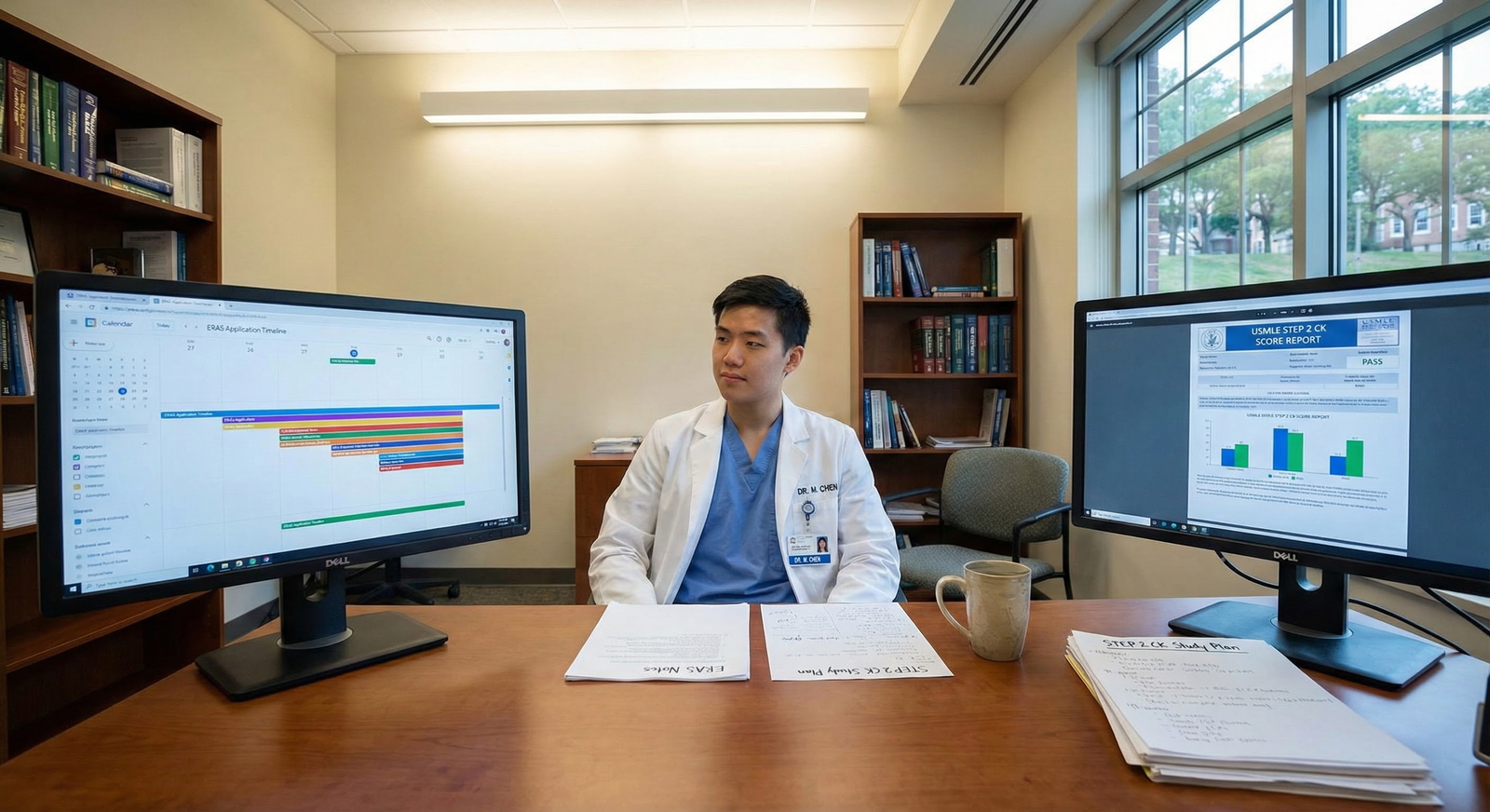
The Right Moment: How to Choose the Best Time to Submit Your ERAS
Choosing when to submit your ERAS application is one of the most strategic decisions in the residency application process. The content of your application matters tremendously—but so does when programs actually see it in their inbox.
Understanding ERAS timing, your own readiness, and the competitive dynamics of Residency Application season can help you avoid common pitfalls and maximize your chances of securing interviews and matching successfully.
This guide walks you through how to think about the best time to submit ERAS, step by step, with practical timelines, examples, and strategies you can actually use.
Understanding ERAS Timing and Why It Matters
What ERAS Is and How Programs Use It
The Electronic Residency Application Service (ERAS), run by the AAMC, is the centralized system through which most U.S. residency programs receive and review applications. Through ERAS, you submit:
- Your MyERAS application (experience entries, demographics, education)
- Personal statements
- Letters of Recommendation (LoRs)
- Medical School Performance Evaluation (MSPE or “Dean’s Letter”)
- USMLE/COMLEX scores
- Medical school transcript
- Program-specific documents
For you, ERAS is the portal where you build and submit your Residency Application. For programs, it is the database they use to:
- Filter applicants (e.g., by test scores, visa status, graduation year)
- Review applications
- Select candidates for interview offers
- Track communications and ranking decisions
Why timing matters: Programs receive a huge volume of applications as soon as they can start reviewing. Many screen and invite applicants in waves. If your application is late, you may be competing for fewer remaining interview spots—even if your application is strong.
Key Elements of the ERAS Calendar
While exact dates vary slightly each year, the general ERAS cycle follows a predictable pattern for most specialties:
ERAS Opens for Applicants (late spring / early summer)
- You can register, start entering information, request LoRs, and work on your personal statement and experiences.
- This is not the time when programs see applications—it’s just when you can start building your file.
Application Submission Opens (usually early September)
- You can officially submit and assign your application to programs.
- Submitted applications are held in the system until…
Programs Can Begin Reviewing Applications (mid to late September)
- On this date, all applications that have been submitted and certified are released to programs at once.
- From this point on, any additional submissions or updates appear as they come in.
Interview Invitation Season (typically October–January)
- Many specialties send a large proportion of interview invitations in the first 2–4 weeks after programs start reviewing applications.
- Some continue to send invites later to fill cancellations or newly available spots.
Rank Order List Deadline (February)
- This is NRMP territory, but your ERAS timing should account for you having enough time for interviews before you create your rank list.
The takeaway: You aren’t just aiming to beat a deadline—you’re aiming to be fully ready by the time programs first see applications.
Key Factors to Consider Before You Click “Submit”

1. Understanding the ERAS Timeline and “Early Enough”
What does “early” actually mean in ERAS?
For SEO and clarity: when applicants search for the best time to submit ERAS, they’re usually wondering how early is early enough without sacrificing quality.
- Ideal window: Submit your application on or before the date applications are first released to programs (mid–late September), with all key components in place.
- Practical target: Aim to have your application certified and submitted several days before that release date to avoid last-minute technical issues and stress.
- Acceptable but not ideal: Submitting within the first week after programs start reviewing is often still fine, especially in less competitive specialties.
- Potentially harmful: Submitting more than 2–3 weeks after programs begin reviewing can lower your chances at some programs, particularly more competitive ones.
Why applying right at the opening can help
- Programs are fresher and actively building their interview lists.
- Some programs review in the order applications were received.
- Early submissions often get included in the first screening pass, when most interview slots remain open.
But remember: early and weak is worse than slightly later and strong. The goal is earliest date at which your application is truly polished.
2. Assessing Your Personal Readiness
Your calendar isn’t the only factor. You also need to ask: Is my application as strong as it can reasonably be by the time programs start reviewing?
A. Completeness and Quality of Your Materials
Before submitting ERAS, ideally have:
- A polished and proofread personal statement, tailored to your specialty
- A completed, consistent, and error-free Experience section
- A finalized CV that matches your ERAS entries
- All or most of your Letters of Recommendation uploaded
- Your USMLE/COMLEX scores already reported, if possible
- An accurate and up-to-date academic record
Actionable tip: Plan to finish the content of your application 2–3 weeks before the submission date you are targeting. Use that buffer for:
- Final proofreading
- Faculty/mentor review
- Polishing phrasing and structure
- Confirming all LoRs and documents are in progress or uploaded
B. Are Your Letters of Recommendation Ready?
Letters of Recommendation are often the main bottleneck. Waiting for a strong letter can be worth a short delay; waiting indefinitely can cost you interview opportunities.
Ask yourself:
- Do I have at least three solid letters uploaded or clearly guaranteed by closely trusted faculty?
- Is there a critical “golden letter” (e.g., from a chair or away rotation) that would significantly strengthen my application?
- Have I clearly communicated deadlines and sent reminders to letter writers?
Strategy:
- For most applicants, it’s reasonable to submit as long as you have three strong letters uploaded, even if one additional letter might arrive a bit later. You can assign late-arriving letters to programs after initial submission.
- Avoid delaying submission by weeks just to wait for a non-essential letter, especially once programs have started reviewing files.
C. Near-Graduation and Academic Factors
Your readiness may also hinge on:
- Recent USMLE/COMLEX scores pending
- Remediation of a failed exam
- Completion of a key sub-internship or away rotation
You will need to weigh:
- Benefit of waiting for improved metrics or better narrative in your MSPE vs.
- Cost in terms of fewer remaining interview spots if you submit late
Discuss these trade-offs with your dean’s office or a trusted advisor who understands your specialty’s competitiveness.
D. Life Events and Mental Bandwidth
Residency applications are demanding. You need the bandwidth to:
- Attend interviews (often with short notice)
- Prepare for and perform in those interviews
- Continue rotations and responsibilities
If you are dealing with major life stressors (family illness, personal health, relocation), it may affect how early you can realistically be ready. Build your personal reality into your Application Timing strategy, not just the idealized timeline.
3. The Competitive Landscape and Specialty Differences
Not all specialties move at the same speed or with the same intensity. Knowing the dynamics of your target specialty can help you better judge the best time to submit ERAS.
A. Why Early Submission Is Especially Valuable
Programs are flooded with applications. Some data and anecdotal reports suggest:
- A large portion of interview invitations are sent to applicants whose files are complete and visible when programs first review applications.
- Screening often happens in batches, and early batches may set the tone for most interview slots.
- Certain programs explicitly or implicitly favor early, complete applications.
Example:
A highly competitive Internal Medicine program might receive over 4,000 applications for 20–30 spots. Their faculty committee may only deeply review a subset. If your file arrives weeks late, you may never enter the first pass of serious consideration.
B. Specialty-Specific Timing Nuances
While you should always check your specialty’s specific guidelines and recent trends, as a general guide:
Highly competitive specialties (e.g., Dermatology, Orthopedic Surgery, Plastic Surgery, ENT, Neurosurgery):
- Aim to be complete by the date programs begin reviewing applications.
- Late submission (more than a few days after that date) can significantly hurt your chances.
Moderately competitive specialties (e.g., Internal Medicine, General Surgery, Emergency Medicine, OB/GYN, Pediatrics, Anesthesiology):
- Still aim for completion at or near the program review start date.
- A few days’ delay is often acceptable, but more than 1–2 weeks can be a disadvantage.
Less competitive specialties or smaller applicant pools:
- There may be slightly more flexibility, but early is still better.
- Some smaller community programs review more slowly and offer interviews over a longer period.
C. Program-Specific Practices
Programs vary in how they conduct their reviews:
- First-come, first-reviewed: Some programs screen applications in the order they arrive.
- Batch review: Others wait until they have a large number of applications, then review them as a group.
- Rolling vs. non-rolling interview offers: Many programs issue interview offers on a rolling basis; a smaller number review all applications first, then send offers.
To fine-tune your approach:
- Attend virtual open houses, program information sessions, and residency fairs.
- Ask current residents (especially alumni from your medical school) how “early” matters at specific programs.
- Check program websites and social media; some share information about their review and interview timelines.
Strategizing Your Application Cycle and Submission Date
1. Coordinating Letters, Scores, and Your Timeline
Think of your Residency Application as a three-part alignment problem: Letters, Scores, and ERAS Content must align with the ERAS calendar.
A. Letters of Recommendation
- Request LoRs early—ideally at the start or mid-point of the clerkship or rotation where you impressed an attending.
- Give letter writers:
- A clear deadline (e.g., “By August 15”)
- Your CV
- A draft personal statement
- Your ERAS ID and submission instructions
- Gently follow up 2–3 weeks before your target ERAS submission date.
If a critical letter is slightly delayed:
- It may still be better to submit your application on time and assign the letter as soon as it’s uploaded, rather than delaying your entire submission by weeks.
B. USMLE/COMLEX Scores
If you are waiting on a Step 2 CK or COMLEX Level 2-CE score:
- For many specialties, having a solid, already-posted Step 1/Level 1 or Step 2/Level 2 may be sufficient to submit.
- If your Step 1 was borderline and Step 2 is likely to be a significant improvement, there may be value in waiting a short period until the score is available—but be cautious about delaying beyond the first couple of weeks of program review.
Discuss with your dean’s office or advisor if your testing timeline is atypical or if you have a fail/re-take on record.
C. The “Early Bird” Advantage vs. Rushed Submissions
Data and program testimonials often suggest:
- Applicants submitting within the first few days after programs can begin reviewing are more likely to receive early interview offers.
- However, typos, inconsistencies, and rushed personal statements can harm impressions.
Balance by:
- Setting an internal deadline to have your ERAS content fully drafted at least two weeks before the official ERAS submission date.
- Using that time for:
- Proofreading and fine-tuning
- Supervisor or mentor feedback
- Ensuring consistency across ERAS, CV, and personal statement
2. Tracking and Managing Your ERAS Application After Submission
Submitting ERAS is not the end of your strategy—it’s the beginning of the interview phase.
A. Use ERAS Tools Proactively
Within ERAS, you can:
- Monitor whether documents (LoRs, MSPE, transcript) have been uploaded.
- Confirm that each program has received all materials.
- Assign newly uploaded letters to programs even after initial submission.
Check your dashboard regularly—particularly in the first 2–3 weeks after submission—to ensure your application is complete everywhere you applied.
B. Responding to Interview Invitations
Interview Preparation connects directly to your timing strategy:
- Many competitive programs send invitations that fill quickly.
- Some invitations include scheduling links that can be full in hours.
To handle this:
- Check your email (and ERAS messages) at least daily during peak interview season.
- Set up filters so that ERAS and residency-related emails never go to spam.
- Have your calendar organized in advance so you can quickly accept or select dates.
Best Practices for ERAS Submission Timing

1. Build a Backward Timeline From the ERAS Release Date
Start by identifying the day when programs can first see your application. Then work backward:
8–10 weeks before:
- Draft personal statement(s)
- Outline and begin entering ERAS experiences
- Request updated CV review
6–8 weeks before:
- Request Letters of Recommendation
- Plan or complete any critical rotations relevant to your specialty
- Begin Interview Preparation basics (common questions, behavioral questions, “tell me about yourself”)
3–4 weeks before:
- Finalize first draft of ERAS content
- Get feedback from mentors or your dean’s office
- Confirm with letter writers
2 weeks before:
- Polish and proofread
- Double-check entries for accuracy and consistency
- Confirm that at least three letters are expected or already uploaded
1 week before:
- Final checks, preview, and completion
- Certify and submit your application (you cannot un-certify once submitted)
This approach helps you avoid the chaos of last-minute scrambling.
2. Set Personal Deadlines and Checkpoints
Don’t rely only on the ERAS platform deadlines. Create:
Personal soft deadlines for:
- Completing a first draft of your personal statement
- Entering and polishing all Experience entries
- Having all letters requested and confirmed
Weekly checkpoints:
- “By Friday, the personal statement is ready for mentor review.”
- “By next Wednesday, all experiences are entered in ERAS.”
- “By the end of the month, I will have met with my advisor.”
Use a digital calendar or project management tool (e.g., Trello, Notion, or a simple spreadsheet) to track progress.
3. Plan for Contingencies
Unexpected challenges happen:
- A letter writer becomes unavailable
- A personal statement needs major revision
- You realize an error in your experience dates or descriptions
- You need to re-take an exam or handle a health issue
To protect your timeline:
- Build at least 1–2 weeks of buffer time into your plan.
- Identify “backup” letter writers early.
- Regularly communicate with your student affairs or dean’s office for support.
4. Align Submission Timing With Program-Specific Cycles
Research your target programs’ patterns:
- Some programs prominently state:
- “We strongly encourage early applications.”
- “We review applications holistically after the ERAS release date.”
- Use residency forums, your school’s match data, and resident mentors to learn:
- When they typically send first interview waves
- Whether they tend to hold a second wave of invites later in the season
If a program is known to:
- Use rolling interview offers: earlier complete submission is more critical.
- Perform one or two major review batches: ensure your file is complete by their known decision dates, if available.
Frequently Asked Questions About ERAS Submission Timing
1. What is the official ERAS application deadline, and when should I actually submit?
There is no single universal “ERAS application deadline” for all programs. ERAS itself provides a timeline window, but each residency program and specialty may have its own final date for accepting applications.
In practice:
- Aim to submit your application by the date programs begin reviewing applications, with all key components in place.
- Submitting within a few days of that date is usually fine.
- Avoid waiting until the last week or two of October for most specialties, as many interviews may already have been given.
Always double-check program websites for any explicit deadlines.
2. Can I change my ERAS application after I submit it?
Once you certify and submit your MyERAS application:
- You cannot change certain core sections (e.g., some demographics, experiences already locked, and key form fields).
- You can:
- Add or assign new Letters of Recommendation
- Add or update personal statements and assign them to programs
- Apply to additional programs
- Upload some additional documents if your school releases them later (e.g., MSPE on its official date)
Because of this, make sure your experiences, dates, and personal details are correct before certification.
3. Is it always better to submit as early as possible, even if my application feels unfinished?
Submitting a weak or error-filled application very early is not in your best interest. The goal is the earliest possible submission date at which your application is polished and complete enough to represent you well.
Early submission is beneficial when:
- Your personal statement is coherent and proofread.
- Experience entries are accurate and reflect your true involvement.
- You have at least three solid Letters of Recommendation in progress or uploaded.
- Your test scores do not require immediate explanation or re-take.
If you would dramatically improve your application with one extra week of focused revision, that short delay is often worthwhile—especially if it keeps you within the first wave of reviewed applications.
4. How can I track whether programs have received my full ERAS application?
Use your ERAS dashboard to:
- Verify that all documents (LoRs, MSPE, transcript) have been uploaded.
- Check that you have correctly assigned each document to each program.
- Confirm application submission status for each program.
If a program indicates they have not received something they require (for example, a Chair’s letter in some specialties), contact:
- Your medical school’s ERAS coordinator, or
- The program’s residency coordinator (politely, and only after checking ERAS carefully)
5. Should I apply to all programs as soon as ERAS opens, or can I stagger my applications?
Most applicants benefit from applying to their full initial list of programs early in the cycle rather than staggering over weeks. Reasons:
- Programs may fill many interview spots from early batches of applications.
- Staggering applications too slowly could mean you miss earlier review cycles at some programs.
However, you can:
- Start with a carefully chosen core list aligned with your competitiveness and goals.
- Add more programs later if:
- You receive fewer interview invitations than expected.
- Your advisor recommends broadening your list based on early responses.
In all cases, prioritize quality fit over sheer quantity.
By understanding the ERAS calendar, assessing your personal readiness honestly, researching your specialty’s competitive landscape, and building a structured plan, you can choose the right moment to submit your ERAS application—maximizing your visibility to programs and giving yourself the best chance at a successful match.