
The faculty-to-resident ratio is the most abused “quality metric” in residency marketing. Programs flash a nice number; applicants treat it as gospel. The data says that is a mistake.
You are trying to answer two very different questions:
- How much real teaching will I get?
- How much raw service work will I be forced to carry?
The faculty-to-resident ratio is only a proxy. And often a noisy one. Let’s dissect how to read it the way a statistically literate applicant should.
1. What the Faculty-to-Resident Ratio Actually Measures (On Paper)
Start with the basic definition most programs use:
Faculty-to-resident ratio = total core faculty ÷ total residents in the program
Example: 60 core faculty and 45 residents (15 per year) gives 60 ÷ 45 ≈ 1.33:1.
Looks comforting, right? More than one faculty per resident. But that topline figure hides more than it reveals.
You need to break it down along three axes:
- Full-time vs part-time faculty
- Teaching time vs clinical/service time
- On-service availability vs office-only presence
A faculty member who is 0.3 FTE teaching, 0.7 FTE research and mostly in another building from 8–5 is not the same as a hospitalist on the ward with you all day.
Programs rarely tell you that split directly. You have to infer it.
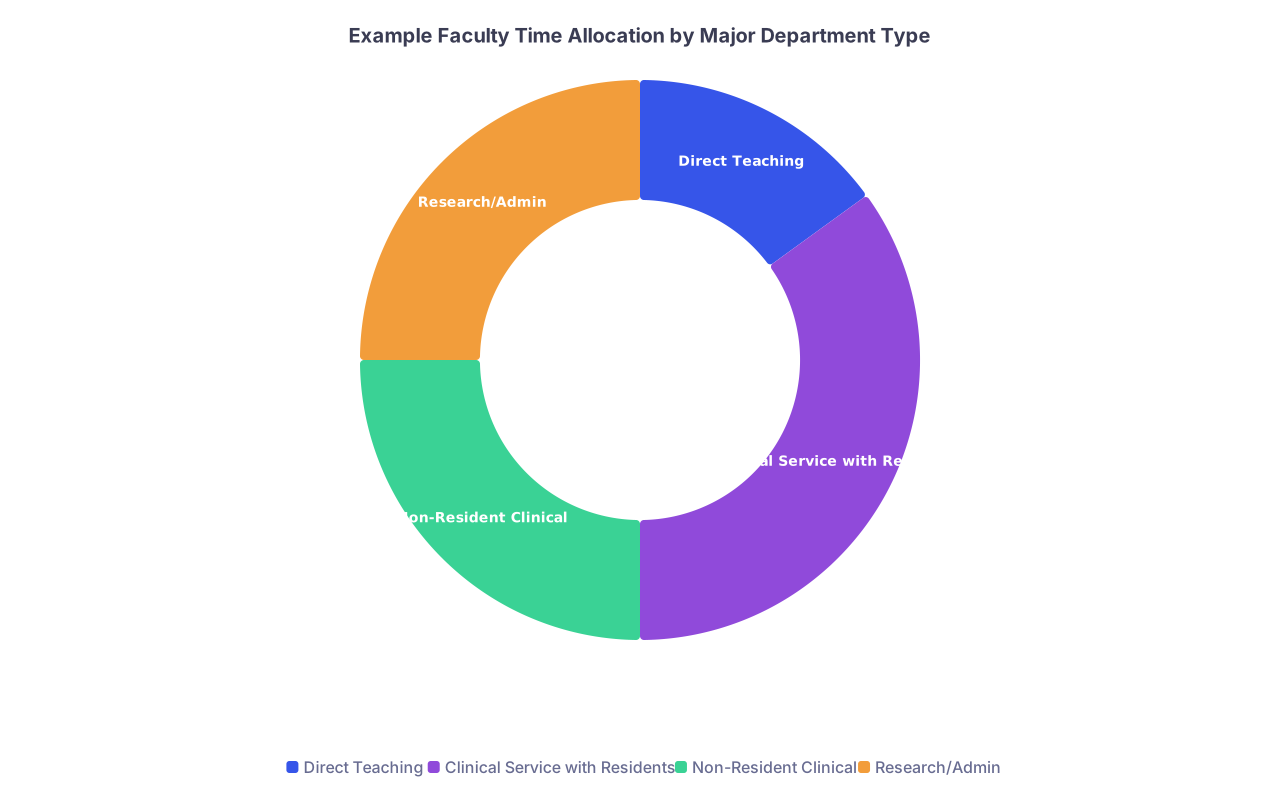
| Category | Value |
|---|---|
| Direct Teaching | 15 |
| Clinical Service with Residents | 35 |
| Non-Resident Clinical | 25 |
| Research/Admin | 25 |
In many departments, only about 15–20% of total faculty time is truly “direct teaching” (structured didactics, supervision with feedback, resident coaching). The rest is clinically productive time, and only a slice of that overlaps with residents.
So a “2:1” faculty-to-resident ratio on a brochure can shrink to a “0.3–0.4 FTE of real teaching per resident” when you factor in time.
2. Teaching Load vs Service Load: Competing Forces
Teaching load and service load do not move independently. They trade off.
- Teaching load = hours of structured and unstructured instruction, feedback, and supervision that actually help you learn.
- Service load = hours of scut, notes, logistics, cross-cover, and throughput work that keep the system running, but add marginal educational value.
You want a program where the marginal service work per incremental patient decreases as you advance, but the teaching load per hour on duty stays stable or improves.
In practice, programs fall roughly into three patterns:
- High service, low teaching (the “workhorse” model)
- Moderate service, moderate teaching (balanced but busy)
- Lower service, high teaching (often smaller or more resourced programs)

What applicants often miss: the same headline faculty-to-resident ratio can exist in all three patterns. The deciding factor is how the program chooses to deploy residents versus advanced practice providers (APPs), hospitalists, and fellows.
3. Turning Ratios into Actual Teaching Time
Let’s do the math the way you should be thinking about it.
Assume a program reports:
- 50 core faculty
- 40 residents (13–14 per year)
- 3-year program
Headline ratio = 50 ÷ 40 = 1.25 faculty per resident.
Now apply realistic adjustments:
- Only 60% of those faculty routinely work with residents on clinical services.
- Among those, an average of 30% of their FTE is on resident-involved services.
- Of that clinical resident time, maybe half is “true teaching” (explicit feedback, bedside, didactics, not just “staffing”).
Estimate of effective teaching FTE:
50 faculty × 0.60 × 0.30 × 0.50 = 4.5 FTE of concentrated teaching time
Spread across 40 residents, that is 4.5 ÷ 40 = 0.1125 FTE “pure teaching” per resident.
At a crude 40-hour workweek equivalent, that is:
0.1125 × 40 ≈ 4.5 hours per week of high-quality teaching exposure per resident.
That number is far more meaningful than “1.25:1 faculty:resident.”
Your job on interview day is to extract data that lets you approximate those multipliers.
4. How to Interrogate a Program’s Ratio Like a Data Analyst
Forget “Is your faculty-to-resident ratio good?” That is a useless question. Instead, you want quantifiable, decomposable information. Ask questions that produce numbers.
Examples you can actually use:
Teaching exposure per week
- “On a typical ward month, how many hours per week are scheduled for teaching (table rounds, chalk talks, case conference) with the attending physically present?”
- “How often do attendings do bedside teaching rounds — daily, weekly, or rarely?”
Attending workload and availability
- “How many patients, on average, does a ward attending carry on a teaching service? What is the cap?”
- “How many residents and students share that attending?”
Resident workload and caps
- “What is the resident’s patient cap on ward and ICU? And how often do you hit that cap?”
- “At night, how many patients is one cross-covering resident responsible for?”
This is where faculty-to-resident ratio should intersect with service: high ratios should, in theory, support lower caps and more real teaching. When the numbers do not line up, you are looking at a marketing metric, not a structural advantage.
| Metric | Program A | Program B |
|---|---|---|
| Faculty-to-Resident Ratio | 2.0:1 | 1.2:1 |
| Ward Attending Patient Cap | 12 | 18 |
| Resident Patient Cap (PGY-2/3) | 10 | 14 |
| Avg Scheduled Teaching Hrs/Week | 8 | 4 |
| Night Cross-Cover Patients/Resident | 50 | 80 |
Program A has both a better ratio and better deployment of it. If a program claims “excellent ratio” but lives in the Program B column on other metrics, you know where the faculty time is really going.
5. The Hidden Variable: How Programs Use Non-Resident Clinicians
The single biggest factor that separates teaching vs service heavy programs is not the faculty-to-resident ratio. It is how aggressively the program uses non-resident clinicians to offload pure service:
- Hospitalists on non-teaching services
- APPs (NPs/PA-Cs) on co-managed services
- Nocturnists handling admissions independently
- Scribes or documentation support
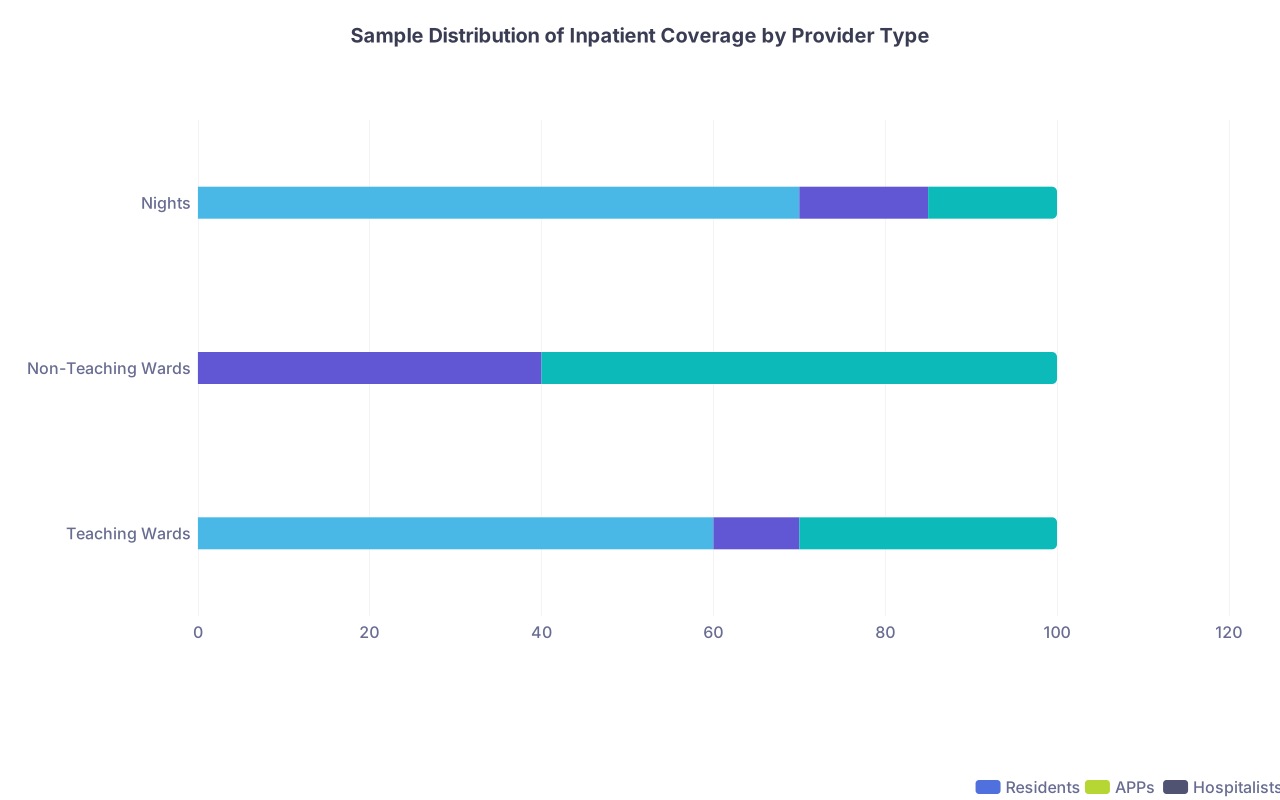
| Category | Residents | APPs | Hospitalists |
|---|---|---|---|
| Teaching Wards | 60 | 10 | 30 |
| Non-Teaching Wards | 0 | 40 | 60 |
| Nights | 70 | 15 | 15 |
Two programs can both claim “strong faculty presence”:
- Program X: 6 inpatient teams, 4 are resident teams, 2 are pure hospitalist teams
- Program Y: 6 inpatient teams, all 6 are resident teams
Both might have similar numbers of faculty on the roster. Program X will usually have lower resident service load per patient-day because some work is absorbed by non-resident teams. Program Y often pushes residents to 14–18 patients each, “for autonomy.”
This is where your questions should get very concrete. Ask residents, not just leadership:
- “On your worst ward month in the last year, what was the highest number of patients you personally carried?”
- “How often do non-teaching hospitalist teams pick up overflow when you are capped?”
If the answers are “20+ patients” and “almost never,” that high faculty-to-resident ratio is not protecting you from service drag.
6. Specialty-Specific Norms: Do Not Compare Apples to Neurosurgery
Different specialties live in different universes of intensity and faculty deployment. Internal Medicine ward ratios do not translate to Surgery call pools.
Very rough expectations, based on available ACGME data and what you will hear on the interview trail:
- Internal Medicine: faculty-to-resident ratios often advertised at 1.2–2.0:1. True teaching exposure is more sensitive to how many hospitalists are non-teaching and how heavy the ICU rotations are.
- General Surgery: more attendings listed, but many are OR-based and not on your floor rounds regularly. The real educational constraint is OR case competition among residents and fellows, not the ratio itself.
- Pediatrics: often somewhat higher apparent ratios, but lower evening/night coverage from faculty in community programs can push resident service work up.
- EM: chaotic but simple — one attending per shift, multiple residents and APPs. Your primary metrics are patients per hour per resident and presence of off-service rotators.
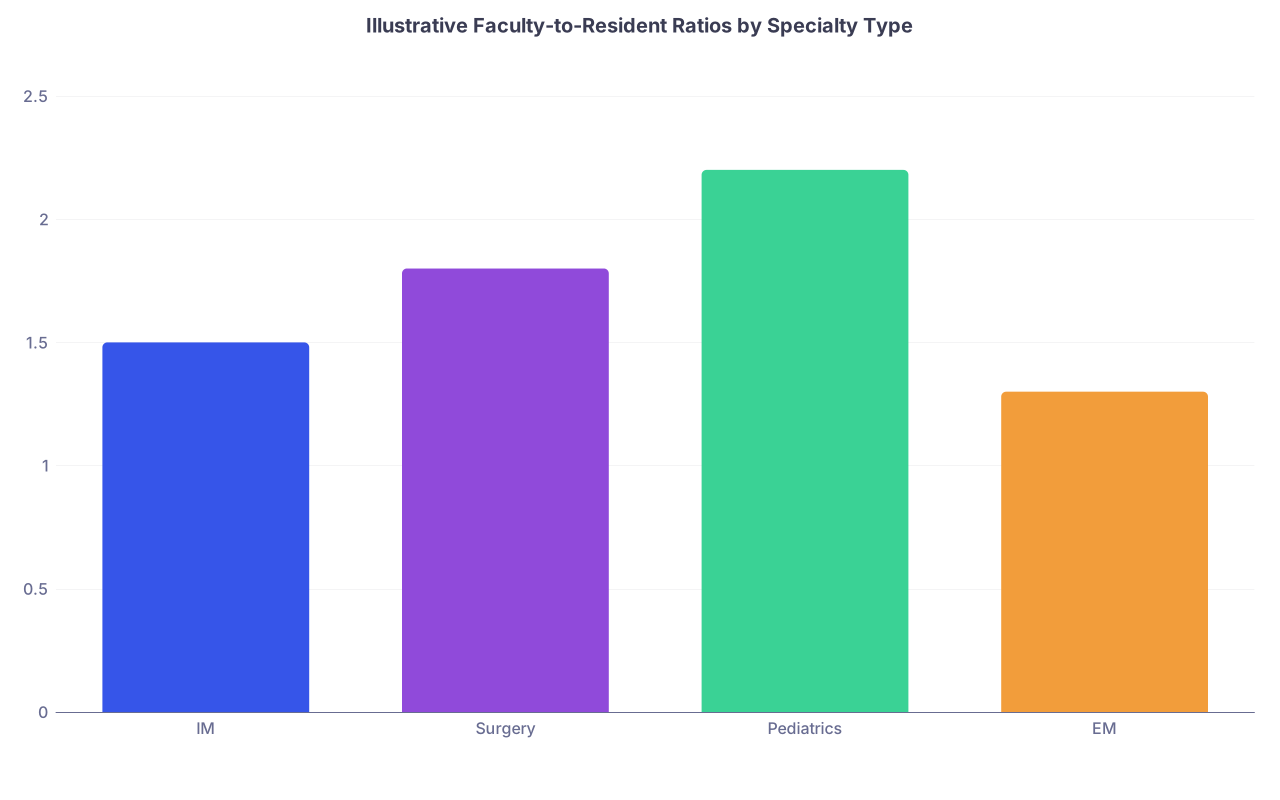
| Category | Value |
|---|---|
| IM | 1.5 |
| Surgery | 1.8 |
| Pediatrics | 2.2 |
| EM | 1.3 |
Higher ratio does not automatically mean more teaching. Surgery with a 1.8:1 ratio can still feel like a service grind if 80% of those faculty are tied up in elective cases you barely see.
So you must ask specialty-specific questions:
- For Surgery: “How many cases per resident per day, and how often do attendings scrub with juniors vs seniors?”
- For EM: “What is the average patients-per-hour by PGY year, and how many attendings supervise per shift?”
- For IM: “What portion of your inpatient census is on non-teaching services?”
7. Structural Red Flags and Positive Signals
You will not get perfect data. But certain patterns consistently correlate with either good or bad teaching-to-service balance.
Red flags, even if the brochure ratio looks great:
- Large number of “core faculty” whose main FTE is research or clinic in a separate building
- Heavy reliance on residents to staff all overnight coverage with minimal attending presence
- No explicit patient caps, or culturally ignored caps
- Residents telling you, “You learn by working. There is not much time for formal teaching.”
- ACGME citations related to duty hours or supervision in the last several years
Positive signals:
- Clear patient caps with documented patterns of hitting them and then diverting to non-teaching teams
- Explicit protected half-days for didactics, with genuine coverage by attendings or hospitalists
- Night float systems with attendings regularly present or readily available on-site, not just “phone coverage”
- Residents able to quote approximate weekly teaching hours without laughing or rolling their eyes
- Fellows present but not monopolizing all complex cases or procedures

When the qualitative signals match the quantitative story (reasonable caps, visible faculty, protected teaching time), the faculty-to-resident ratio you saw on paper is more likely to be real.
8. Converting Interview-Day Information into a Personal “Score”
You are not going to build a full regression model on every program. But you can use a simple scoring framework that forces you to quantify what you see.
Here is a rough method I have seen applicants use effectively.
For each program, assign 1–5 scores on the following:
Effective Faculty Presence
- 1 = attendings mostly off-site, minimal bedside, residents do everything
- 5 = frequent bedside rounds, clear supervision, easy attending access
Service Intensity
- 1 = caps routinely exceeded, 70–80 patients at night per resident
- 5 = reasonable caps, good non-teaching services or APP support
Formal Teaching Time
- 1 = “We have noon conference when we are not too busy”
- 5 = protected didactics, real coverage, residents actually attend
Autonomy with Backup
- 1 = either micromanaged or dangerously unsupervised
- 5 = graded autonomy with visible safety net
Faculty-to-Resident Ratio Credibility
- 1 = number looks good on paper but does not match what residents describe
- 5 = ratio, coverage patterns, and resident stories all align
| Dimension | Weight | Program X | Program Y |
|---|---|---|---|
| Effective Faculty Presence | 0.25 | 4 | 3 |
| Service Intensity | 0.25 | 3 | 2 |
| Formal Teaching Time | 0.20 | 4 | 3 |
| Autonomy with Backup | 0.15 | 4 | 4 |
| Ratio Credibility | 0.15 | 5 | 2 |
Weighted score = Σ(score × weight). You will quickly see that a glossy 2.0:1 ratio does not rescue a program that is a “2” on service intensity and a “2” on credible use of faculty.
9. How to Read Between the Lines on Websites and Brochures
You are not on-site yet. You are trying to make sense of marketing copy with insufficient data. There are a few simple heuristics.
If a program:
- Plasters “2:1 Faculty-to-Resident Ratio!” on the front page but provides zero detail on caps, non-teaching services, or didactics → assume the ratio is padding the truth.
- Lists 100+ faculty for a 30-resident program, but half are “adjunct,” “voluntary,” or clinic-only → adjust your mental ratio downward sharply.
- Has a daily noon conference and a weekly grand rounds but nothing else in the listed curriculum → expect teaching to be mostly incidental.
On the flip side, when programs show hard numbers, that usually signals they have thought seriously about design:
- Specified inpatient caps by PGY year
- Explicit list of protected education blocks (e.g., “4 hours every Wednesday morning”)
- Clear breakdown of services: “4 teaching teams, 3 non-teaching hospitalist teams, 1 APP-only team”
That last bullet is one of the most underrated pieces of data you can find. It directly tells you how residents are being used as labor, regardless of faculty count.

| Stage | Activity | Score |
|---|---|---|
| Interview Day | Faculty visibility | 3 |
| Interview Day | Transparency of caps | 4 |
| PGY1 Reality | Service load | 2 |
| PGY1 Reality | Teaching time | 3 |
| PGY3 Perspective | Preparedness for fellowship | 4 |
| PGY3 Perspective | Overall balance | 3 |
Residents three years in tend to be brutally honest about whether the advertised balance matched reality.
10. Application Strategy: How Much Weight Should You Give the Ratio?
Final point: do not overfit to a single metric. Your career will not be determined by whether your program’s faculty-to-resident ratio was 1.4:1 or 1.9:1.
What the data and real-world outcomes consistently suggest:
- Extremely low ratios combined with visible faculty presence and reasonable caps usually correlate with better resident satisfaction and stronger board pass rates.
- Extremely high service loads, regardless of faculty count, correlate with burnout, duty hour violations, and weaker exam performance.
- Mid-range ratios (1.2:1–1.8:1) can be either excellent or miserable, depending on how the department allocates service vs teaching.
So when ranking programs:
- Use faculty-to-resident ratio as a screening variable, not a deciding one.
- Punish programs hard on your rank list if resident-reported service load is crushing and supervision is thin, even if the ratio “looks good.”
- Reward programs where faculty are tangibly present on the wards, teaching is protected, and you will not be buried under unfiltered service work.

You are choosing the environment that will shape your clinical habits for life. Do not let a single glossy ratio number hijack that decision.
FAQs
1. Is there an “ideal” faculty-to-resident ratio I should target?
There is no magic cutoff, but ratios below 1:1 usually indicate either heavy service burden or extensive use of non-faculty clinicians for supervision. Ratios between about 1.3:1 and 2:1 are common in strong academic programs. Above that, the key question is whether those extra faculty are truly present on resident services or mostly doing research and clinic.
2. What if residents say the workload is intense but “great for learning”?
You should separate intensity from educational value. A busy program can be excellent if there is strong supervision, protected teaching, and reasonable caps. When residents say “you learn a ton” but then admit they rarely attend didactics and routinely exceed caps, what they usually mean is “you learn by surviving.” That teaches stamina, not necessarily good medicine.
3. How much do ACGME citations or board pass rates matter compared to the ratio?
They matter more. A program with recent citations around supervision or duty hours and marginal board pass rates has structural problems that a high faculty-to-resident ratio number will not fix. Use those hard outcomes as a sanity check. If the program looks great on paper but struggles on those metrics, assume the teaching vs service balance is off, regardless of what the marketing materials say.