
You are here
It is the week after Match Day. Your email has stopped buzzing, the group texts have calmed down, and the adrenaline is gone. You know where you are going July 1. The question echoing now is different:
“Did I do this right? And what does this mean for my next big decision?”
Whether you matched at your top choice, somewhere in the middle, scrambled to SOAP, or did not match at all, this is the same critical moment:
Post‑match reflection.
This is where you dissect your process while the memories are still sharp, so you are not guessing the next time you have to pick a path—fellowship, job search, maybe re‑applying. You are not just evaluating outcomes (“I matched!”). You are evaluating your decision‑making system.
I will walk you through this as a timeline. What you should do this week, this month, and over the next several months to convert a chaotic application season into a usable playbook for future choices.
Week 1–2 After Match Day: Capture Everything Before You Forget
At this point you should not be “processing feelings” in the abstract. You should be writing things down while details are still vivid.
Day 1–3: Emotional debrief (short, but honest)
Block 30–60 minutes. No phone, no inbox, no group chat.
Answer these in a notebook or document. Full sentences, not bullet fragments.
Where did I match and how do I actually feel about it?
- Relieved, disappointed, surprised, neutral?
- Example: “Matched #3. I am 80% relieved, 20% annoyed I did not get #1, but honestly #1 was more about prestige than fit.”
What did I expect to happen vs what happened?
- Did you think you were a lock at a certain program? Thought you would not match at all?
- Write what you told your closest friend the night before Match.
What hurts and what feels like a win?
- Be specific: “No interview at my home program still stings.” / “SOAP worked and I am grateful. But scared.”
This is not therapy notes. It is context. Later, when you evaluate your rankings logically, you will want to see where emotion was driving the bus.
Day 4–7: Data dump of your whole cycle
Now you switch to hard data. At this point you should get everything into one place.
Create a simple spreadsheet or document and collect:
- Scores and metrics:
- Step 1 (P/F), Step 2 CK, class rank, AΩA, research output, leadership roles.
- Application list:
- Every program you applied to, with:
- Specialty and track (categorical, prelim, advanced).
- Location and setting (urban, suburban, rural; academic vs community).
- Every program you applied to, with:
- Outcomes:
- Who offered you:
- No reply
- Rejection
- Interview
- Post‑interview contact (if allowed; informal signals, etc.)
- Who offered you:
- Rank list:
- Final rank order with:
- Your own pre‑interview expectations (if you took notes).
- Any last‑minute changes you made.
- Final rank order with:
Put this into something like:
| Category | Count |
|---|---|
| Programs applied | 80 |
| Interviews offered | 14 |
| Interviews attended | 12 |
| Programs ranked | 12 |
Change the numbers to your actual data, obviously.
Then, add a column:
- “Why I ranked them where I did (at the time)”
Not a novel. One line:
- “#1: Strong research, close to partner, loved program culture meeting with PD.”
- “#5: Great operative volume, but location was a poor fit.”
You are reconstructing your decision logic. I have watched too many residents hit PGY‑2 and have no idea why they ranked a place highly. Do not be that person.
Weeks 3–4: Autopsy of Your Process, Step by Step
Now that you have the facts in one place, you start dissecting.
At this point you should walk backward through the season:
- Program choice → Interview behavior → Application strategy → Self‑assessment at the start.
Step 1: Did you apply to the right type and range of programs?
Look at your list by competitiveness tier, not just name recognition.
Rough buckets (slightly cynical but real):
| Tier | Typical Profile |
|---|---|
| Reach | Top 10–20 name brands, heavy research |
| Target | Solid academic or strong community |
| Safety | Less desired locations or newer programs |
Now ask:
- What proportion were reach / target / safety?
- Where did your interviews come from?
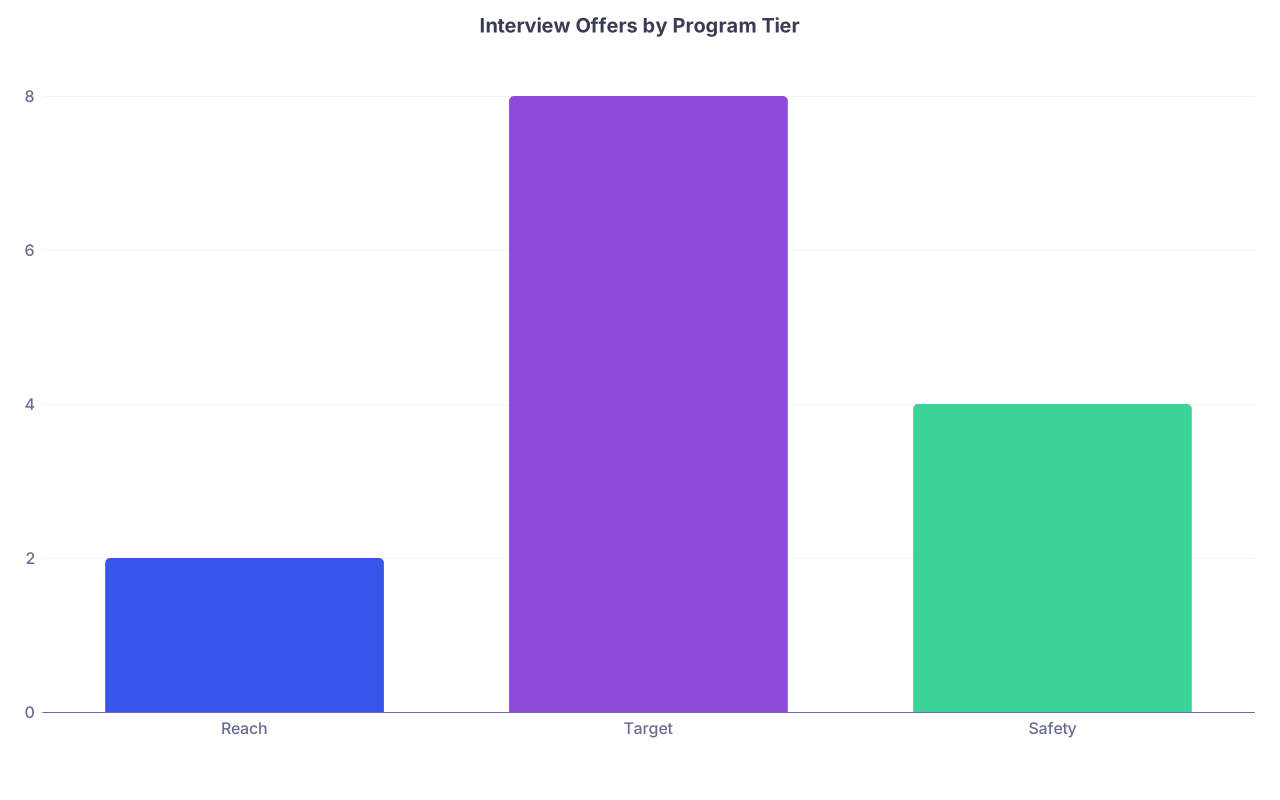
| Category | Value |
|---|---|
| Reach | 2 |
| Target | 8 |
| Safety | 4 |
Replace the numbers with your reality.
If 80% of your applications went to “big‑name” academic centers and 90% of your interviews came from mid‑tier community programs, the market is telling you something. Your self‑assessment was off.
Write a short paragraph for yourself:
- “My interview yield came mainly from X type of program, not Y.”
- “I under‑applied to safety programs.”
- “I ignored geography reality—Northeast saturated, Midwest more receptive.”
This becomes crucial when you later choose fellowship programs or jobs. The pattern often repeats.
Step 2: Was your filter for choosing programs actually aligned with what matters to you?
Look at your top 5 ranked programs and your bottom 5 ranked ones. For each, list:
- Location
- Call schedule
- Operative / patient volume
- Fellowship match or job placement
- Culture (from your sense)
- Support for residents (wellness, backup, remediation)
- Anything personally critical (partner job, visa, kids’ schools, etc.)
You do not need a biopsychosocial assessment. Just a quick grid.
Now ask:
- Did I rank higher the programs that aligned best with my values, or the ones everyone else talked about?
- Did prestige override red flags?
- Did fear override opportunity?
I have seen students place a program with toxic vibes at #1 because “their fellowship match is insane,” then dread coming to work 6 months into intern year.
Circle where your priorities in action did not match your stated priorities.
Example realizations:
- “I say I value location, but I ranked a city I hate as #2 purely for name brand.”
- “I down‑weighted family proximity but now, seeing I matched far away, that hurts more than I expected.”
This is how you learn what actually matters for your next big choice.
Step 3: Interview performance—signal vs noise
At this point you should evaluate how you came across, not just how you felt.
Pull your memory from each interview:
For each program where you interviewed, rate (1–5):
- Pre‑interview prep (did you actually research them?)
- Rapport in interviews (attending, PD, residents)
- Your answers clarity (why this specialty, why this program, red flag questions)
- Post‑interview follow‑up (thank‑you emails, updates when appropriate)
Then compare:
- Programs where you felt you did well but got no traction.
- Programs where you felt off but still did well outcome‑wise.
Pattern you might see:
- “My best conversations happened where I had specific talking points about their program.”
- “I rambled on ‘tell me about yourself’ and did not refine it until halfway through season.”
- “Zoom fatigue killed my energy on later interviews.”
This is not about self‑loathing. It is about pattern recognition. Your next high‑stakes interviews—fellowship, jobs, academic positions—will hit the same weak spots if you do nothing.
Month 2–3: Evaluate the Match Outcome in Light of Fit
Now you have lived with the result for a few weeks. The sting (or euphoria) has faded slightly. At this point you should do a cold‑eyed review of the actual match.
If you matched at or near your top choices
Do not assume that means your process was flawless. Sometimes you hit the target with a shaky aim.
Ask:
Was this outcome due to a strong, coherent strategy or luck plus over‑applying?
- Did you shotgun 120 applications because you were terrified?
- Did you have a clear narrative across your personal statement, letters, and experiences?
Where was your margin of safety?
- If you only had 6 interviews and matched #2, the process worked, but barely.
- If you had 18 interviews and matched #6, your rank list strategy may need re‑thinking.
Would you repeat this approach for fellowship or jobs?
- Over‑application may be unsustainable later.
- You may want to refine your filters rather than just repeat what “worked.”
Write a 5–10 line reflection:
- “I matched #1, but my interview distribution was top‑heavy and risky. Next time I want a more balanced list.”
- “My story (non‑trad, lots of work experience) clearly resonated. I should keep leaning into that narrative.”
If you matched, but not where you hoped
This is where most people get stuck in unproductive regret. Skip that. Be clinical.
Three questions:
Did my rank list reflect reality or fantasy?
- Did you rank places higher that clearly showed less interest?
- Did you ignore significant red flags because “it is a name brand”?
Was I honest with myself about competitiveness?
- You rank 5 ultra‑competitive academic programs first with modest scores and research, then act shocked when you slide to a mid‑tier community program that actually loved you.
Given what I know now, how would I reorder my rank list?
- This is the key exercise. Not to berate yourself. To learn your own decision biases.
Write out a hypothetical:
That gap between past you and current you is where the learning is.
If you SOAPed or did not match
At this point you should separate two things:
- The process you used.
- The profile you brought into the market.
First pass: brutally factual.
- Number of interviews before Match.
- Where interviews came from (tier, geography).
- Any obvious red flags: failed Step, gap year, visa status, specialty switch, discipline issues.
Second pass: misalignment review.
Common patterns I see:
- Over‑reaching in a hyper‑competitive specialty (e.g., Derm, Ortho, ENT) without a realistic parallel plan.
- Late pivot to a new specialty without convincing narrative or letters.
- Ignoring advisor feedback about safety programs or broadening geography.
Document, in a paragraph or two:
- “I applied to X specialty with Y interviews. I did / did not have a viable backup specialty.”
- “Where I misjudged: ___.”
- “If I re‑apply, I need to change: ___ (specialty? application strategy? exam scores? research? all of the above).”
This is not theoretical. If you re‑apply, you will be making those decisions in a few months.
Month 3–6: Align What You Think You Want With What Actually Works for You
Now you zoom out. The point of post‑match reflection is not just, “How do I match better next time?” It is “How do I make smarter future career choices? Fellowship. Jobs. Leadership roles.”
At this point you should start noticing recurring themes.
Step 1: Identify your actual decision drivers
Look across your notes:
- Reasons you ranked programs high.
- How you felt when you saw your result.
- What you now wish you had prioritized.
Pull out 4–6 recurring drivers. Typical ones:
- Geographic preference (coasts vs Midwest vs Southeast)
- Proximity to family / support system
- Prestige / reputation
- Procedural volume or case mix
- Lifestyle (call, hours, night float)
- Mentorship, culture, psychological safety
- Academic vs community environment
- Compensation / cost of living (more for job search later)
Now be honest. Which ones actually dominate for you?
I have seen plenty of people swear “prestige does not matter to me,” then agonize for months that they are not at a top‑10 name. That dissonance will bite you again if you do not call it out.
Create a simple ranking for yourself:
- 1–2: Non‑negotiable
- 3–4: Strong preference
- 5–6: Nice to have
If “supportive culture” is truly non‑negotiable for you, that should change how aggressively you chase certain prestigious but malignant environments for fellowship or jobs.
Step 2: Convert lessons into a reusable decision framework
At this point you should be building a template you can reuse.
Make a one‑page “Future Decisions Checklist” with sections like:
Self‑assessment
- Objective profile vs target environments.
- Known weaknesses to address before next application (exam scores, research, interviewing).
Program / job filters
- Hard filters (will not compromise): geography, visa, specific schedule constraints.
- Soft filters: prestige level, size, subspecialty exposure.
Interview priorities
- 3 questions you will always ask residents.
- 3 red flags that are now automatic deal‑breakers.
- 3 green flags that predict you will thrive.
Rank / offer list rules
- “I will not rank a place higher solely for prestige if I have serious cultural concerns.”
- “I will give more weight to proximity to support system if I am already stretched thin.”
You can formalize this visually if you like.

| Step | Description |
|---|---|
| Step 1 | Start Decision |
| Step 2 | Self assessment |
| Step 3 | Adjust expectations or improve CV |
| Step 4 | Apply using filters |
| Step 5 | Interview and collect data |
| Step 6 | Score programs on key drivers |
| Step 7 | Build rank or offer list |
| Step 8 | Check against rules and values |
| Step 9 | Submit final decision |
| Step 10 | Profile matches target tier |
Print this, save it, whatever. But have something you can look at when you are exhausted and tempted to make a brand‑name, impulsive decision.
Between Match and Residency Start: Reality‑check with Other Humans
By now you have your own narrative. Time to see how it holds up against outside eyes.
At this point you should have at least two conversations:
Advisor / faculty who knows you and the specialty
- Bring:
- Your application snapshot.
- Your interpretation of what went right / wrong.
- Concrete questions: “For future fellowship apps, am I overestimating my competitiveness for top‑tier places?” “Which parts of my profile should I shore up now?”
If they disagree with you, good. That tension helps refine your model.
- Bring:
Current residents at your matched program (and, if possible, a place you ranked highly but did not match)
- Ask:
- “Now that you are here, what surprised you about this program?”
- “Knowing what you know now, would you rank it the same?”
- “What do people who hate this place usually cite as reasons?”
- Ask:
This gives you a sense of how accurate your pre‑match impressions were. Sometimes you will learn that you dodged a bullet without knowing it. That is useful for quieting regret and recalibrating your “fit radar” for next time.
Year 1 of Residency: Ongoing Reflection (But Not Obsession)
Once you start residency, the reflection does not stop. It just becomes slower, more grounded in lived experience.
At this point you should be doing small, periodic check‑ins, not constant spiraling.
3‑Month Check‑in
Ask:
- What do I like about this program that I did not fully appreciate during interviews?
- What is harder than I expected?
- Do my original priorities still make sense?
Example: You thought you needed big‑name research. But in reality, the day‑to‑day kindness of your senior residents matters more than the CV line.
Write a one‑page “3‑month reality check” for yourself.
6–12‑Month Check‑in
Now you can start thinking forward:
- Am I leaning toward fellowship or general practice?
- Which parts of this environment help me thrive? Which parts deplete me?
- Would I choose a very similar environment for fellowship / first job, or something very different?
Your next big decisions are coming faster than you think. For competitive fellowships, groundwork often starts PGY‑1/2.
Use these questions to update your “Future Decisions Checklist”. Cross out what you were wrong about. Add new non‑negotiables.
Putting it all together: What this means for how to choose next time
Let me be blunt. Most people choose residency and later jobs using a messy mix of:
- Hearsay.
- Prestige.
- Gut feeling from a 1‑day visit.
- Fear of not matching.
Your advantage, if you actually do this reflection, is that you will be one of the few who has:
- A documented track record of how you decide.
- Concrete evidence of where your process failed or succeeded.
- A personal hierarchy of values that is reality‑tested, not aspirational.
When you next stand at a fork—fellowship vs no fellowship, academic vs community job, big city vs small town—you will not be starting from scratch. You will be running a refined algorithm that has already gone through a real‑world stress test: your Match.
To make that even more concrete, sketch out a simple “next decision” scoring grid for yourself:
| Factor | Weight (1–5) | Program A Score | Program B Score |
|---|---|---|---|
| Culture / support | 5 | 4 | 2 |
| Location | 4 | 3 | 5 |
| Training quality | 4 | 5 | 4 |
| Prestige | 3 | 4 | 3 |
| Lifestyle / schedule | 4 | 3 | 4 |
You are not pretending this is math. You are forcing yourself to be explicit about trade‑offs.
And over time, as you look back at your choices, you can ask: “Did my scoring system predict how happy / effective I would be?” Then tune it again.

Your next step today
Do not try to “process” the entire year in your head. That is how you forget the specifics that actually matter.
Today, do one concrete thing:
Open a blank document and title it:
“Post‑Match Reflection – [Your Name], [Year]”
Then write three headings:
- What I expected to happen.
- What actually happened.
- Why I think there was a gap.
Spend 20–30 minutes filling those in while this cycle is still sharp in your mind. That becomes the anchor you will build everything else on—spreadsheets, checklists, scoring grids.
This is how you stop Match Day from being just a story, and turn it into data you can actually use the next time you have to choose where your life goes next.