
The obsession with program size is misplaced. Most of what you have heard about small vs large residencies is either half-true or flat-out wrong.
People talk about size like it’s a personality test: “I’m a small-program person,” or “I need the resources of a big place.” Then they build their rank list around vibes and anecdotes instead of outcomes and structure. That’s how you end up at a program that matches your “energy” but does not actually train you well for the career you want.
Let’s cut through the mythology and talk about what size really changes, what it doesn’t, and where the data and real-world experience do not line up with the usual advice.
Myth #1: Big Programs Always Have Better Training
The prestige trap is real. Applicants see a big-name 30-resident-per-year academic program and assume: more residents = more volume = better training.
Reality is less flattering.
High volume alone does not guarantee good training. I’ve watched residents at very large programs spend entire months as glorified triage clerks: move patients, click boxes, sign notes someone else wrote. Yes, the hospital did 40 of that procedure last month. They saw three. Scrubbed once.
Program size affects how the clinical work is distributed. That’s the real variable.
At a large program, patient volume is shared among more learners: residents, fellows, off-service rotators, medical students, sometimes advanced practice providers. If the structure is bad, you can easily be buried under systems tasks while someone else gets the “interesting” procedures.
At a smaller program, the absolute volume is lower, but resident-per-patient ratio can be much better. I’ve seen 4-resident-per-class community programs where PGY-2s are already comfortable placing central lines, doing bread-and-butter procedures, and running codes—because there’s no one else to do it. The work has to get done, and you’re the one there.
Here’s the comparison you should be making, and almost no one does:
| Factor | Large Program (e.g., 24+ total residents) | Small Program (e.g., 12 or fewer total residents) |
|---|---|---|
| Patients per resident on wards | Lower to moderate | Moderate to high |
| Procedures per resident | Highly variable, can be diluted | Often higher per resident |
| Fellow competition | Usually more fellows | Fewer or no fellows |
| Autonomy in codes/procedures | Dependent on fellows/attendings | Often resident-run |
So no, bigger does not automatically mean “better clinical training.” It means more moving parts and more potential for dilution if they do not protect resident cases and procedures.
The metric that matters is not program size. It’s your hands-on volume. Ask for real numbers on procedures per resident and where fellows sit in the workflow.
Myth #2: Small Programs = Weak Academics and Fellowship Outcomes
This one is persistent and lazy: “If you want competitive fellowships, you need a big, academic powerhouse.”
The data do not cleanly support this.
What we know from NRMP and subspecialty match reports is that things like board scores, letters, research output, and perceived program quality matter. But none of those are strictly determined by size. I’ve seen 6-resident-per-class community programs send people to GI, Heme/Onc, Cards, or competitive surgical fellowships every single year. Why? Because:
- They had attendings with national networks willing to pick up the phone
- They protected 3–4 months of research time across residency
- Residents got leadership roles (chiefs actually doing things, QI projects with teeth)
Fellowship directors aren’t sitting with a spreadsheet filtering out “small programs.” They’re asking: Do I know this PD? Have I trusted residents from there before? Is the applicant’s portfolio strong?
Here’s what the bigger vs smaller programs typically do differ on, academically:
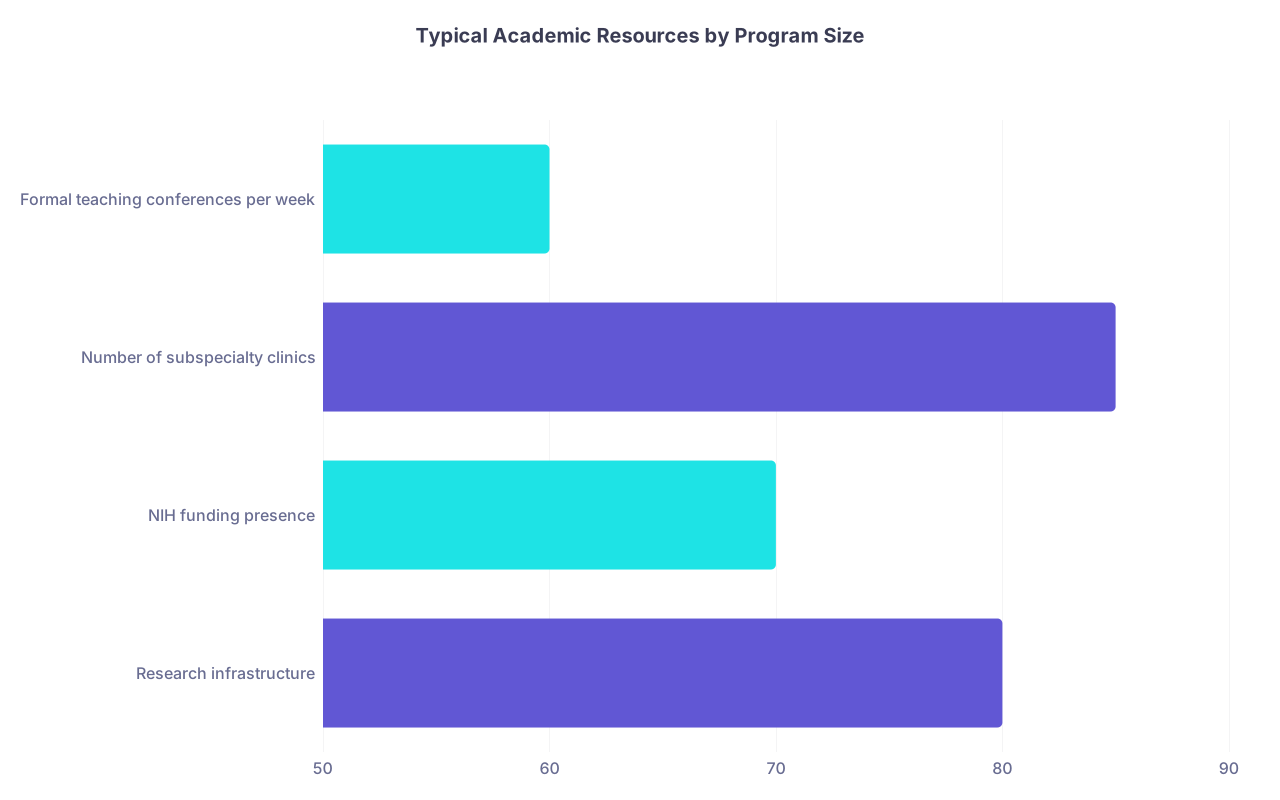
| Category | Value |
|---|---|
| Research infrastructure | 80 |
| NIH funding presence | 70 |
| Number of subspecialty clinics | 85 |
| Formal teaching conferences per week | 60 |
(Think of 100 as “highly resourced at a top academic center” and 0 as “none.” Larger programs often sit higher on the first three metrics. Teaching conferences are more variable and not strictly size-linked.)
Large programs usually have:
- More funded labs
- More subspecialty clinics
- More faculty doing research
But residents are often so busy staffing those clinics and covering floor work that meaningful research time gets squeezed into golden weekends and post-call haze. You get your name in the middle of a 12-author paper, but you did not actually own a project.
Small and mid-sized programs with one or two research-minded faculty can give you something arguably more valuable: a project that is yours, from IRB to data to manuscript. When that attending calls a fellowship PD and says, “This resident drove the entire project,” that carries more weight than “They were author #9 on our lab’s standard output.”
So if you care about academics and fellowship, stop asking “Is this a big academic center?” and start asking very specific questions:
- How many residents per year go into fellowship? Which ones?
- How many get their top 1–2 choices?
- Are there actual blocks of research time, or is it ‘protected’ in name only?
- Who, specifically, would mentor me if I’m interested in X field?
Large or small, some programs are powerhouses for a given subspecialty. Others are wastelands. Size doesn’t decide that; people do.
Myth #3: Big Programs Are Less Malignant / More Supportive
Applicants often treat size as a proxy for culture. Big = more wellness resources, resident support, backup. Small = “everyone knows my business and I’m one bad eval away from disaster.”
This one’s emotionally understandable and empirically wrong.
I’ve seen extremely supportive, tight-knit small programs where the PD knows you well enough to recognize you’re burning out and quietly rearranges your rotation schedule. I’ve also seen massive, name-brand programs where residents are so interchangeable that a struggling trainee can sink for a year before anyone notices.
Size can cut both ways for culture:
In a large program, you may have:
- More co-residents to share call and talk to
- More structured wellness initiatives (retreats, counseling access, workshops)
- But also more anonymity, more cliques, easier for toxic behavior to hide
In a small program, you may have:
- Very clear visibility: everyone knows who’s overworked, who’s struggling
- Stronger sense of identity as “our residents”
- But if the PD or key faculty are dysfunctional, there is nowhere to hide
The hidden variable is leadership quality, not size. Culture flows from the PD, APDs, and senior residents. If they’re healthy, the program tends to be healthy. If they’re toxic, size won’t save you.
Watch for these during interview day:
- Do residents speak candidly, or like they’re reading a brochure?
- Ask a simple question: “When a resident is struggling clinically or personally, what actually happens?” Listen for specific structures, not generic “we’re very supportive.”
- How do they talk about “weak” residents? With contempt or with a plan?
A small program with decent leadership beats a giant machine with beautiful wellness slides and terrible accountability. Every time.
Myth #4: Small Programs = Crippling Call / Terrible Workload
This one has enough truth in it to be dangerous.
In a very small program, the math is brutal. If there are 3–4 residents per class and you need 24/7 coverage of ICU, wards, night float, consults, someone is often doubling up or staying late. If the hospital volume is high and there are no fellows, you can absolutely be crushed.
But large programs aren’t inherently better here. I’ve seen 20-resident programs where the call felt worse than at a 6-resident shop, because the big place was a regional referral center with endless transfers, more services to cover, more bureaucracy, and zero interest from administration in adding FTEs.
So again, size is a lousy surrogate. The real question is staffing vs workload.
This is where you need to ask for hard numbers, not vibes:
| Domain | Questions to Ask Programs |
|---|---|
| Call | How often are 24h calls or night float blocks? |
| Coverage | How many residents cover each service at night? |
| Caps | What are the patient caps per resident on wards/ICU? |
| Backup | How often is jeopardy activated? For what reasons? |
| APP support | Are there NPs/PA for nights, admissions, or only days? |
If a small program tells you, “We cap at 10–12 patients per resident on wards and have night float instead of q4 28‑hour call,” that can easily be more humane than a larger program with higher caps and worse nights.
Look at structure and caps, not just N per class.
Myth #5: Large Programs Give You More Flexibility and “Options”
Applicants often treat big program size as insurance: “If I change my mind, there will be more mentors, more tracks, more everything.”
Sometimes. Sometimes not.
Yes, large programs usually have more subspecialty services. More clinic types. More faculty in niche fields. But that doesn’t automatically translate into flexibility for you. Complex bureaucracy can make schedule changes and electives harder, not easier.
I’ve watched residents at giant programs spend months fighting for a single away elective or an out-of-track rotation because the block schedule is a rigid puzzle. At a mid-size or small program with a halfway competent chief and PD, they just…changed it. Two emails, done.
Where size actually helps with flexibility is redundancy. If one attending leaves, you may still have three others in that subspecialty. At a small program, a single retirement can blow up an entire niche rotation.
So it’s a trade:
- Large programs: broader menu, more redundancy, but more bureaucracy
- Small programs: narrower menu, but sometimes much more nimble for individual requests
When you’re there on interview day, you should be asking residents:
- “Have you changed your career plans since intern year? How hard was it to adjust your rotations/electives to match that?”
- “How easy is it to get away rotations or research electives approved?”
If they stare at each other and start with, “Well, it depends…,” you have your answer.
What Actually Correlates With Outcomes (Instead of Size)
Here’s the blunt truth: program size is a proxy people use because it’s easy. It’s a number. It looks objective. But it’s only loosely connected to the stuff that shapes your training and career.
Better predictors:
- Case and procedure volume per resident, not per hospital
- Leadership quality: PD/APDs who are present, responsive, and respected
- Culture of teaching: Do attendings actually teach on rounds, or dump?
- Fellow presence: Can help or hurt your hands-on exposure depending on dynamics
- Residents’ real outcomes: Board pass rates, fellowship matches, job placement
- Resident satisfaction and turnover: Are people leaving early or switching programs?
If you force me to generalize, program size matters most at the extremes.
- Ultra-small programs (1–2 residents per year) can be fragile. One bad hire or faculty departure can destabilize them. They can also be incredible for autonomy, but risky if leadership is weak.
- Mega-programs (15+ per year) can be fantastic if well-run, or soul-crushing factories if not. It’s harder to change culture in a huge system. Momentum (good or bad) is strong.
For the middle (4–12 residents per year), size itself is not destiny. The internal structure is.
How To Actually Use Size in Your Rank List
So how should you think about small vs large?
Use size as a flag, not a decision rule.
At a small program, dig hard into:
- Backup systems (jeopardy, cross-coverage, wellness resources)
- Volume per resident, especially for key rotations
- Stability of faculty and leadership over the last 5–10 years
At a large program, push on:
- How they prevent resident dilution for procedures and cases
- How they keep track of struggling residents and support them
- How accessible mentorship is in your areas of interest (not just “we have 15 cardiologists”)
And then weight size against your personality and needs honestly. Some people thrive as one of four in a class, where everyone knows them. Others need the anonymity and variety of a big cohort.
But do not kid yourself that size alone protects you from bad training, poor fellowship outcomes, or burnout. It does not.
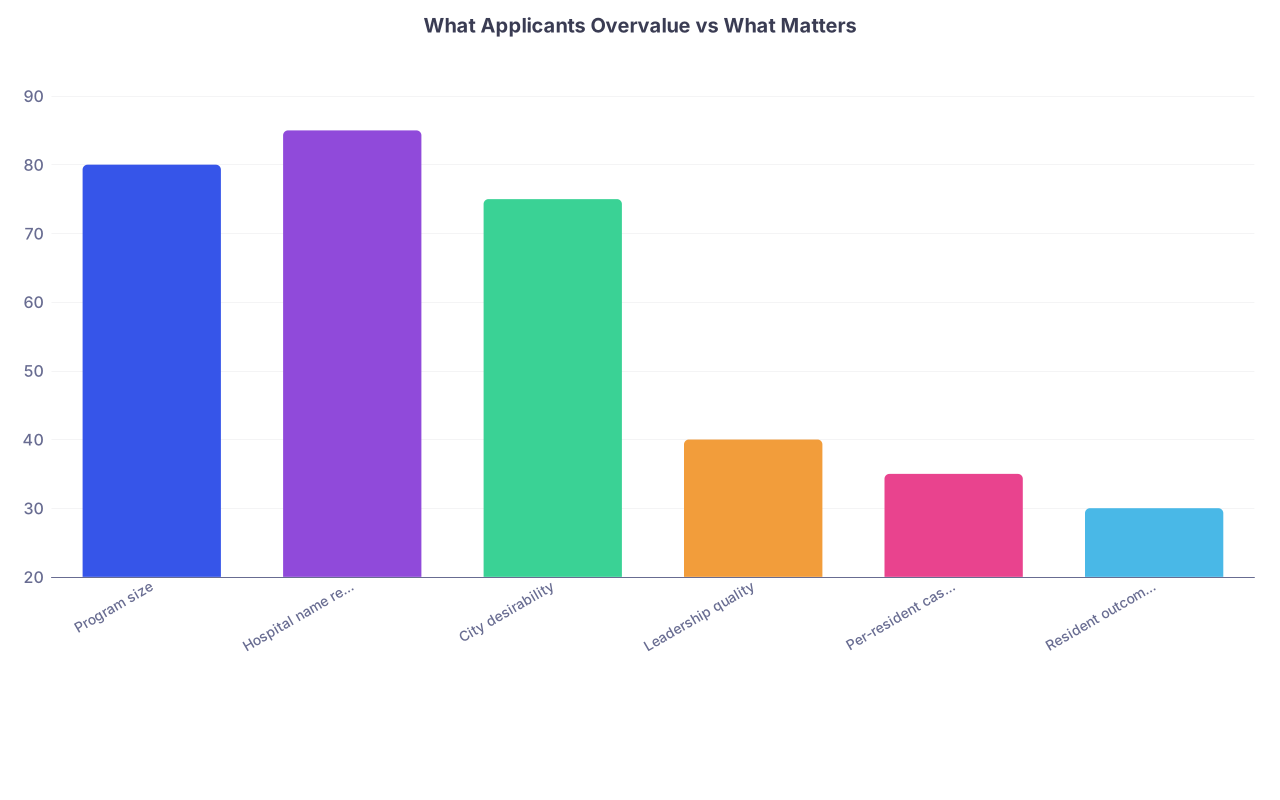
| Category | Value |
|---|---|
| Program size | 80 |
| Hospital name recognition | 85 |
| City desirability | 75 |
| Leadership quality | 40 |
| Per-resident case volume | 35 |
| Resident outcomes | 30 |
The taller bars are what applicants obsess over. The shorter ones are what actually drive your day-to-day experience and future options. Those should be flipped.
Final Takeaways
Program size is not the magic variable people think it is. Three points to remember:
- Big vs small does not determine training quality; per-resident exposure and leadership do.
- Fellowship and academic success come from mentorship, outcomes, and your CV—not raw program size.
- Use size as a cue for what questions to ask, then rank based on structure, culture, and real resident outcomes, not class numbers on a website.
If you stop treating “small vs large” as a personality quiz and start interrogating how the work, teaching, and support are actually structured, your rank list will get a lot smarter.