Clinical informatics sits at the intersection of medicine, data, and technology—so your CV has to speak fluently in all three languages. Whether you’re a medical student planning early, a resident targeting a clinical informatics fellowship, or a practicing clinician pivoting into health IT training, a focused, strategically written CV is critical.
Below is a comprehensive guide on how to build a CV for residency and beyond specifically oriented toward clinical informatics. You’ll find residency CV tips, informatics-specific examples, and practical steps for strengthening your profile over time.
Understanding the Clinical Informatics Landscape
Clinical informatics is different from traditional specialties in how candidates are evaluated. Programs and employers still care about clinical performance, but they also look for:
- Evidence of technical literacy (EHRs, data, analytics, tools)
- Demonstrated systems thinking and workflow optimization
- Experience with quality improvement and implementation projects
- Ability to function as a bridge between clinicians, IT, and administration
What Clinical Informatics Programs Look For
When clinical informatics fellowship directors or health IT hiring managers scan a CV, they are often seeking:
- Strong clinical foundation (completion of or progress through an ACGME-accredited residency)
- Prior exposure to:
- EHR optimization or build
- Clinical decision support (CDS) work
- Data analytics, dashboards, or reporting
- Quality, safety, or process improvement projects
- Academic or scholarly work related to:
- Informatics
- Digital health
- Health services research
- Evidence of collaboration with:
- IT teams
- Data scientists
- Quality or operations departments
Understanding this lens will help you decide what to emphasize, what to de-emphasize, and how to frame your experiences in your medical student CV or residency CV.
Core Structure: How to Build a CV for Residency in Clinical Informatics
The underlying structure of a clinical informatics–oriented CV is similar to a general residency CV, but with deliberate emphasis on informatics-relevant experiences.
Below is a recommended order and key content for each section.
1. Contact Information & Professional Summary (Optional, but Helpful)
Contact information should be simple and clean:
- Name, degree(s)
- Professional email
- Phone number
- LinkedIn profile (if professional and up to date)
- Optional: Personal website or GitHub (if you have informatics or code-related work)
Professional summary (2–4 lines)
Not mandatory for every medical CV, but very useful for clinical informatics. It allows you to quickly position yourself.
Example:
Internal medicine resident with a strong interest in clinical informatics, focusing on EHR optimization and data-driven quality improvement. Experienced in leading multidisciplinary workflow redesign projects and developing clinical decision support tools to improve medication safety.
This kind of summary immediately tells the reader who you are and what they should look for in the rest of your CV.
2. Education & Training
List degrees in reverse chronological order:
- Fellowship (if applicable)
- Residency
- Medical school
- Prior graduate degrees (e.g., MPH, MS in Biomedical Informatics, MBA)
- Undergraduate
For each entry, include:
- Institution, city, state/country
- Degree and specialty (e.g., MD, Internal Medicine)
- Dates (month/year or year–year)
- Honors or distinctions (e.g., AOA, Gold Humanism, Dean’s List)
Informatics-specific tips:
- Explicitly list any informatics-related concentrations, tracks, or certificates (e.g., “Biomedical Informatics Scholarly Concentration”).
- Highlight coursework relevant to health IT training:
- Clinical decision support
- Data science
- Biostatistics
- Programming or database courses
- Health systems or quality improvement
This section anchors you as a credible clinician in training while making it clear you have formal exposure to informatics concepts.
3. Clinical Experience: Highlighting Systems Thinking
For residency or fellowship applications, clinical competence is non-negotiable. However, for clinical informatics, your clinical section can also showcase your systems-level perspective.
Residency Experience
- List your residency program, role (e.g., PGY-2 Internal Medicine Resident), and dates.
- You may include subsections such as:
- Leadership roles (e.g., Chief Resident, QI champion)
- Committee work (e.g., EHR steering committee, Medication Safety committee)
- Informatics-relevant responsibilities, such as:
- Super-user for a new EHR implementation
- Pilot tester for new order sets or CDS tools
- Liaison between clinical teams and IT for a workflow redesign
Clinical Rotation Highlights (Especially for Students)
If building a medical student CV:
- List sub-internships, electives, or away rotations, especially:
- Clinical informatics electives
- Quality improvement or patient safety rotations
- Digital health/telemedicine electives
Example bullet points:
- “Served as resident super-user for Epic upgrade, providing front-line feedback on redesigned sepsis alert pathways and collaborating with informatics team to refine alert thresholds.”
- “Participated in pilot tele-ICU program, documenting user experience issues and proposing workflow modifications that reduced average response time by 18%.”
These bullets demonstrate not just participation but impact—crucial for informatics roles.

Informatics-Relevant Experience: The Heart of Your CV
This is the section that most differentiates a standard residency CV from an informatics-focused CV. It can have several subheadings depending on your background.
4. Projects & Quality Improvement (QI)
This is often the most important section for proving you understand informatics principles in a real-world context—especially if you are early in training.
Organize each project as follows:
- Project title or concise descriptor
- Institution/department
- Dates
- 2–4 bullet points focused on:
- Problem addressed
- Your specific role
- Tools/technologies used
- Measurable outcomes when available
Strong vs weak bullets:
- Weak: “Participated in EHR optimization project.”
- Strong: “Led resident working group to streamline inpatient discharge order sets in Epic, reducing average order entry time by 3 minutes per discharge and improving user-reported satisfaction scores from 2.8 to 4.1 (on a 5-point scale).”
Example QI/informatics projects:
- Implementing a new sepsis alert algorithm
- Redesigning documentation templates to reduce note bloat
- Developing an ED triage dashboard
- Building or piloting clinical decision support (e.g., drug–drug interaction alerts, dose calculators)
- Improving data capture quality for a registry or research database
If you lack direct informatics projects, lean on:
- Standard QI initiatives (e.g., reducing readmissions, antimicrobial stewardship) and frame them in terms of:
- Data collection and analysis
- Workflow mapping
- Process redesign
- Use of dashboards or reports
5. Technical Skills & Tools
Unlike many other specialties, listing technical skills is valuable and expected in a clinical informatics fellowship or health IT training–oriented CV.
Organize by categories, such as:
- EHR Systems:
- “Epic (inpatient and ambulatory), Cerner, Athenahealth – advanced user; participated in order set build and testing.”
- Data & Analytics:
- “SQL (basic querying), Excel (pivot tables, VLOOKUP), R or Python (beginner/intermediate), Tableau or Power BI dashboards.”
- Programming & Scripting (if applicable):
- “Python (pandas, matplotlib), R (tidyverse), basic JavaScript/HTML.”
- Data Standards & Health IT Concepts (awareness level is fine):
- “Basic familiarity with HL7, FHIR, SNOMED, LOINC, ICD-10, CPT.”
- Project & Collaboration Tools:
- “JIRA, Confluence, Trello, Microsoft Teams, Slack.”
Be honest about your proficiency levels. Overstating your skills can backfire quickly when you’re asked to describe a project in detail.
6. Research, Publications, and Presentations
Academic productivity is not mandatory for all clinical informatics fellows, but it’s a strong differentiator—especially if your work is informatics-focused.
How to Organize This Section
Use standard academic formatting, grouped by type:
- Peer-reviewed publications
- Conference abstracts/posters
- Oral presentations
- Book chapters or invited talks
Within each category, list in reverse chronological order.
Emphasize informatics-related work, such as:
- EHR interventions and outcomes
- Decision support tools
- Telemedicine or digital health research
- Data science or predictive modeling applied to clinical problems
- Implementation science projects
Example entries:
- Doe J, Smith A, You R, et al. “Implementation and Evaluation of a Clinical Decision Support Tool for Opioid Prescribing in a Resident Clinic.” Journal of Clinical Informatics. 2024;XX(X):XX–XX.
- You R. “Improving Provider Adoption of a Sepsis Alert: Lessons from a Resident-Led Workflow Redesign.” Oral presentation at AMIA Clinical Informatics Conference; 2023; Chicago, IL.
If you don’t yet have formal publications, list:
- Posters at institutional research days
- Regional conferences
- Grand rounds or invited talks about QI or EHR projects
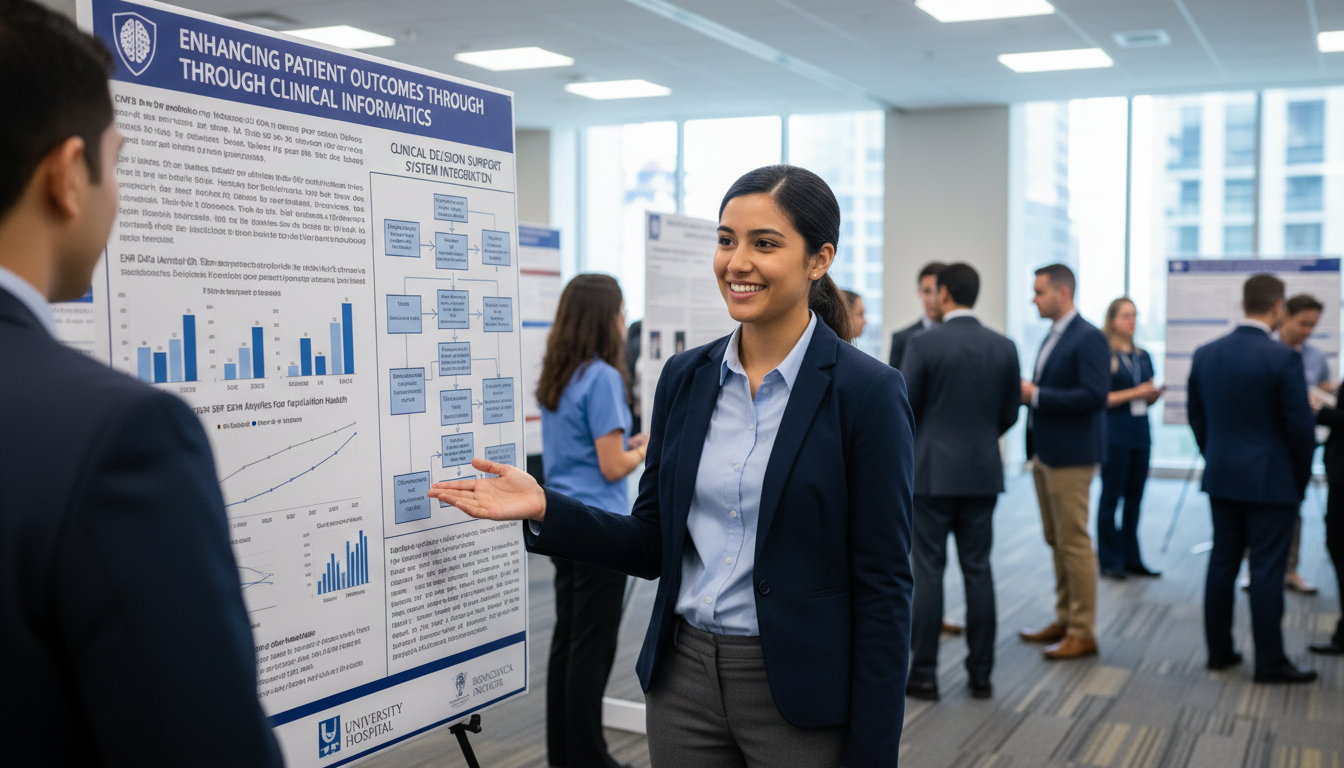
Enhancing Your CV: Strategic Steps Before You Apply
If you’re still early in training, you have time to deliberately build experiences that will strengthen your clinical informatics fellowship application. Here are concrete strategies.
7. Targeted Experiences to Seek Out
A. Clinical Informatics Electives or Rotations
- Ask your program director if there is a local clinical informatics rotation.
- If not, inquire about creating a custom elective with:
- CMIO or associate CMIO
- EHR/IT department
- Quality or analytics team
On your CV, this might appear as:
- “Clinical Informatics Elective, 4 weeks, Department of Clinical Informatics, [Institution]. Focus: EHR optimization, clinical decision support, data analytics for quality improvement.”
B. Governance and Committee Work
Volunteer for roles that expose you to system-level operations:
- EHR optimization committees
- Quality improvement councils
- Sepsis or antimicrobial stewardship committees
- Safety/incident review committees
Demonstrate in your CV that you contributed more than passive attendance:
- “Reviewed monthly safety event data and helped develop and pilot a standardized order set for high-risk anticoagulation, reducing error rates from 3.2 to 1.5 per 1,000 patient-days.”
C. Collaboration with IT and Data Teams
Proactively reach out to:
- CMIO/CHIO (Chief Health Informatics Officer)
- Data analysts or clinical data scientists
- Quality improvement leaders
Offer to:
- Help define clinically relevant metrics
- Interpret analytics outputs
- Co-lead projects that involve both clinical workflow and data
These collaborations often lead to:
- Co-authored abstracts
- Co-presentations
- Strong letters of recommendation from informatics leaders
8. Academic and Extracurricular Signals of Fit
Beyond direct informatics work, certain activities on your medical student CV or residency CV can still send a strong “informatics-friendly” signal.
Teaching & Curriculum Development
If you’ve:
- Designed educational sessions on EHR efficiency
- Taught peers about data interpretation, QI methods, or basic coding
- Developed curriculum on digital health literacy
…these are excellent to include under Teaching Experience or Educational Activities.
Leadership in Tech-Adjacent Organizations
List leadership roles in:
- Medical school or residency technology committees
- Student-run free clinic EHR implementation team
- National organizations’ informatics or digital health sections (e.g., AMIA student working groups)
Certifications and Courses
Highlight any of the following:
- AMIA or professional society informatics courses
- Coursera/edX/online courses in:
- Data science
- Machine learning
- Health informatics
- SQL or Python
- Lean Six Sigma Green Belt or similar QI training
Place these under Certifications & Additional Training, clearly dated, with issuing organization.
Formatting, Style, and Presentation: Residency CV Tips that Still Matter
Substance will always matter more than formatting, but poor presentation can distract from strong content. A clean, professional structure communicates that you’re detail-oriented—an essential trait in informatics.
9. General Formatting Principles
- Length:
- Medical student CV: often 2–4 pages
- Resident/fellow CV: 3–6+ pages is reasonable, especially with publications and projects.
- Font:
- Readable, professional fonts (e.g., Calibri, Arial, Garamond, Times New Roman).
- 10–12 pt for main text; consistent throughout.
- Layout:
- Clear section headings in bold or small caps.
- Consistent date alignment (all right-aligned or all left-aligned).
- Use bullet points, not paragraphs, for experiences.
10. Writing Strong, Informatics-Oriented Bullet Points
Each bullet should generally:
- Start with an action verb (led, designed, implemented, analyzed)
- Identify what you did and with whom (multidisciplinary team, IT, pharmacy)
- Describe tools or methods used (Epic, Tableau, SQL, PDSA cycles)
- Whenever possible, include a result or impact (improved efficiency, reduced errors, increased adoption)
Examples:
- “Co-designed and tested a new EHR order set for outpatient hypertension management in collaboration with IT and pharmacy, resulting in a 20% increase in guideline-concordant prescribing over 6 months.”
- “Analyzed ED throughput metrics using SQL and Excel; developed a daily dashboard that helped reduce average door-to-provider time by 7 minutes.”
These bullets explicitly connect clinical, technical, and systems-oriented thinking—the core of clinical informatics.
11. Customizing Your CV for Different Audiences
The same base CV can be tailored slightly depending on your target:
For Clinical Informatics Fellowship
- Move Informatics Projects, Technical Skills, and Research closer to the top.
- Ensure informatics-related keywords are present:
- “clinical informatics fellowship”
- “EHR optimization”
- “clinical decision support”
- “health IT training”
- Highlight collaborations with informatics leaders and any exposure to governance or policy.
For General Residency (If You’re a Medical Student)
- Maintain a standard residency CV structure but subtly foreground informatics:
- Short professional summary mentioning your interest.
- QI projects framed around data and system design.
- Use headings like Research and Quality Improvement or Informatics & QI Projects to signal your combined interests.
For Health IT or Industry Roles
- Emphasize:
- Technical tools
- Project management
- Cross-functional collaboration
- Consider adding a Skills Summary box on page one with tools, methods, and domains.
Common Pitfalls to Avoid
Even strong candidates can weaken their case with a few missteps. Watch out for:
12. Overstuffed, Unfocused CVs
- Including every minor role or short-lived club membership can dilute your message.
- Ask: “Does this help demonstrate my readiness for clinical informatics or high-quality clinical training?” If not, consider omitting or condensing.
13. Overclaiming Technical Expertise
- Listing “Python, R, SQL, machine learning, FHIR, cloud computing” without substantive projects will raise eyebrows.
- It’s better to list fewer skills and clearly show where you used them.
14. Vague or Generic Descriptions
- Bullets like “Involved in several QI projects” or “Worked with EHR team” don’t tell evaluators anything meaningful.
- Convert vague descriptions into concrete statements with actions, tools, and outcomes.
15. Inconsistencies and Errors
- Typos, inconsistent dates, or misaligned sections signal lack of attention to detail.
- Ask a mentor or informatics faculty member to review your CV; they may also suggest better framing and highlight patterns you didn’t see.
Putting It All Together: A Strategic Approach
Building a strong CV for clinical informatics is a multi-step process:
Clarify your narrative
- Are you a data-driven clinician improving systems?
- A budding informatics researcher?
- A bridge-builder between IT and frontline care?
Curate and organize experiences to support that narrative:
- Education and clinical training as your foundation
- Informatics projects, QI, and technical skills as your differentiating features
Actively seek experiences that fill gaps:
- No informatics projects? Volunteer with EHR committees.
- Limited technical skills? Take structured courses and apply them in real projects.
- Few academic outputs? Turn a robust QI project into a poster or abstract.
Refine presentation and language:
- Strong, impact-focused bullet points
- Clear formatting
- Thoughtful ordering of sections
Over time, your CV should read like a coherent story: a clinician who not only delivers excellent patient care but also understands how to design, implement, and evaluate the digital tools and systems that support that care.
Frequently Asked Questions (FAQ)
1. How early should I start building an informatics-focused CV?
Start as early as medical school if you already have interest. Begin with:
- A QI project that uses EHR data
- An elective related to health systems or digital health
- Basic analytics or programming coursework
For many residents, PGY-1 or early PGY-2 is an ideal time to intentionally seek out clinical informatics experiences, so they are mature enough by the time you apply for a clinical informatics fellowship or related health IT training.
2. I don’t have programming experience. Can I still be competitive for clinical informatics?
Yes. Programming is helpful but not mandatory. Fellowship directors primarily want:
- Strong clinical foundation
- Demonstrated ability to work on systems-level problems
- Experience with QI, CDS, or EHR optimization
You can strengthen your residency CV by:
- Taking introductory courses in data analytics or programming
- Learning how to use Excel, basic SQL, or dashboard tools
- Clearly framing projects where you used data to drive decisions
3. How much research do I need for a clinical informatics fellowship?
There is no minimum requirement. Many successful applicants:
- Have a few posters or presentations
- May or may not have peer-reviewed publications
More important than quantity is relevance: informatics, QI, implementation science, or health services research is more valuable than unrelated bench research. If you have non-informatics research, still include it—but consider adding at least one informatics-related project before applying.
4. Should I separate QI and informatics projects on my CV?
This depends on how much content you have:
- If you have extensive experience, separate sections like Clinical Informatics Projects and Quality Improvement Projects can be helpful.
- If your QI work is tightly linked to EHR or data use, you can combine under a single heading such as Informatics & Quality Improvement Projects.
The key is clarity: make it easy for readers to quickly identify which projects best demonstrate your suitability for clinical informatics.
By crafting a targeted, well-organized CV and deliberately building experiences that showcase your systems thinking, data literacy, and collaborative skills, you’ll position yourself strongly for clinical informatics fellowships, informatics-focused residencies, and health IT training opportunities throughout your career.