Understanding the Role of Your CV in a Medical Genetics Residency Application
For a DO graduate targeting a medical genetics residency, your CV is more than a list of experiences—it is your narrative in structured form. Program directors scan it in seconds to decide whether to read your personal statement, invite you for an interview, or move on.
Unlike some procedure-heavy specialties, medical genetics programs care intensely about:
- Intellectual curiosity and commitment to lifelong learning
- Comfort with complexity and uncertainty
- Attention to detail and data
- Communication skills with patients and families
- Interest in rare diseases, genomics, and research
Your CV is where you demonstrate those qualities clearly and efficiently.
For DO graduates, there are additional considerations:
- Showing you understand and can navigate the MD-dominant environment
- Demonstrating that your osteopathic background is a strength (holistic care, strong physical diagnosis skills, systems thinking)
- Clearly presenting your exam profile (COMLEX and, if taken, USMLE)
- Distinguishing yourself in a relatively small field where every experience can stand out
This article will walk you through how to build a CV for residency in medical genetics, with detailed residency CV tips tailored to a DO graduate seeking a medical genetics residency or combined programs (e.g., pediatrics–genetics, internal medicine–genetics).
Core Structure: What a Strong Medical Genetics Residency CV Must Include
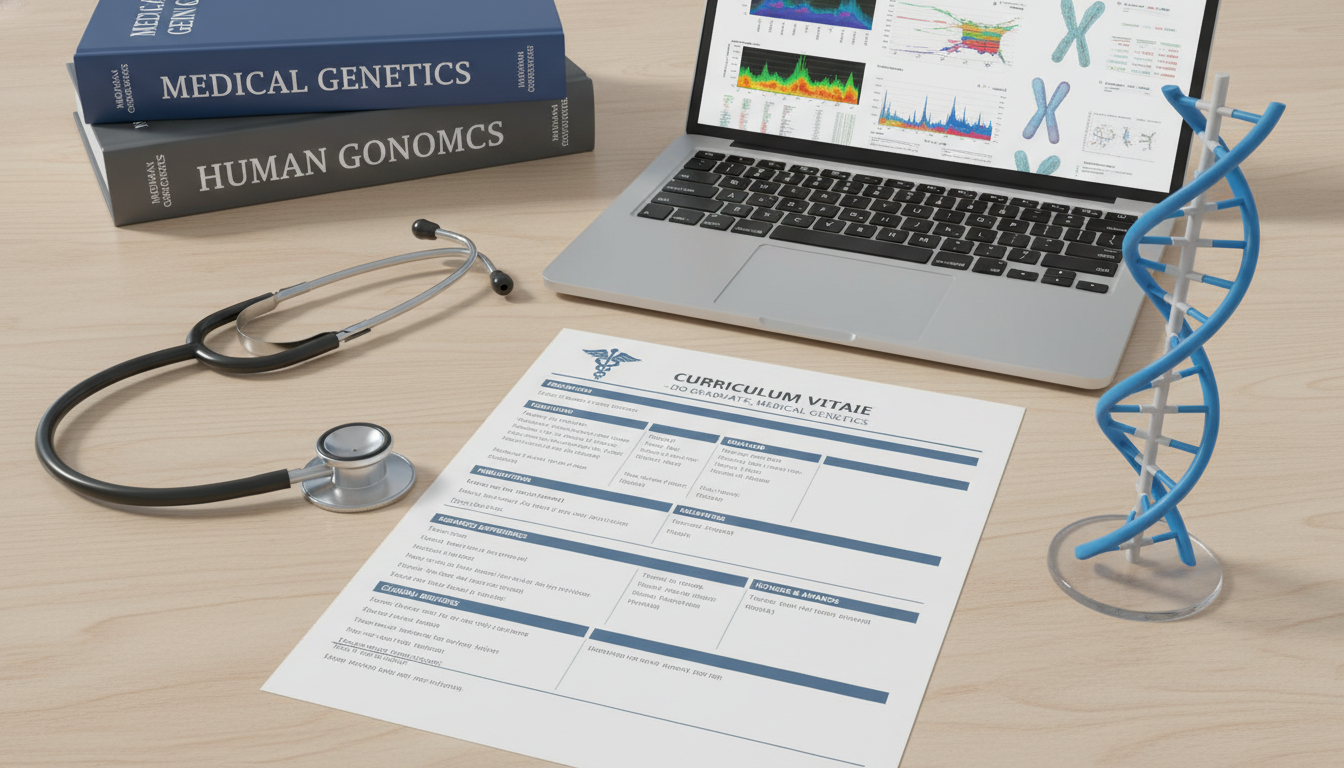
Before polishing details, you need a clear structure. A well-organized medical student CV (or early graduate CV) for the osteopathic residency match in genetics usually includes:
- Contact Information
- Education
- Exams & Certifications (COMLEX / USMLE, BLS/ACLS, etc.)
- Clinical Experience
- Rotations (core and elective), with emphasis on genetics-related experiences
- Sub-internships / acting internships
- Research & Scholarly Activity
- Presentations, Publications & Posters
- Leadership & Professional Involvement
- Teaching & Mentoring
- Volunteer & Community Service
- Honors & Awards
- Skills & Additional Information
Each section should be:
- Chronological (most recent first)
- Consistent in format
- Free of spelling/grammar errors
- Easy to skim (clear headings, bullet points, no dense blocks of text)
Contact Information
Keep this compact and professional:
- Full name, DO
- Phone number
- Professional email (e.g., firstname.lastname@domain.com)
- City/State
- Optional: LinkedIn or professional website if they’re updated and well done
Avoid including:
- Photo (unless required by a specific system/region)
- Personal details like age, marital status, religion
Education
List all post-secondary education:
- Doctor of Osteopathic Medicine (DO) – Include school name, location, graduation date (or expected), and any advanced tracks (e.g., Research Track, Primary Care Track, Honors Pathway).
- Undergraduate degree(s) – Include major, minor, and any genetics-related coursework or honors.
Example (stronger for genetics match):
Kansas City University, College of Osteopathic Medicine, Kansas City, MO
Doctor of Osteopathic Medicine, May 2025
Research track in Molecular Medicine; Genetics Elective Concentration
Highlight anything relevant to genetics: molecular biology major, genetics minor, bioinformatics coursework, etc.
Exams & Certifications
For DO graduates, this section is especially important.
Include:
- COMLEX Levels 1/2/3 (scores or “Pass” depending on institution/program norms)
- USMLE Step 1/2 (if taken)
- BLS, ACLS, PALS (if applicable)
- Any genetic counseling, genomics, or research certifications (e.g., online genomics courses with certificates)
Example:
COMLEX Level 2-CE – Score: XXX; Date: MM/YYYY
COMLEX Level 1 – Pass; Date: MM/YYYY
USMLE Step 2 CK – Score: XXX; Date: MM/YYYY
BLS and ACLS certified, current through 2027
If your scores are not as strong, your CV’s academic and research sections become even more critical to demonstrate fit and capability for a genetics match.
Clinical Experiences: Showcasing a Genetics-Oriented Clinical Trajectory
Medical genetics programs know that most students don’t have extensive direct genetics rotations—but you can still demonstrate a strong fit through how you frame your clinical experience.
Core Rotations
List:
- Rotation title (e.g., Pediatrics, Internal Medicine, OB/GYN)
- Institution and location
- Dates (by month/year, not exact days)
- Optional: 1–2 bullet points if you did anything specifically relevant to genetics
For example, under Pediatrics:
Pediatrics – Children’s Hospital of Philadelphia, Philadelphia, PA
08/2023 – 10/2023
- Evaluated children with developmental delay and congenital anomalies, frequently collaborating with genetics for diagnostic workup
- Participated in multidisciplinary case conferences that included genetics, neurology, and cardiology
Those bullets subtly show familiarity with genetics in a real-world setting.
Electives and Sub-Internships
This is your chance to make your interest in genetics unmistakable.
Prioritize and detail:
- Clinical genetics electives
- Maternal-fetal medicine (MFM), neonatology, oncology, neurology, rheumatology—especially if genetic thinking was prominent
- Sub-internships in pediatrics, internal medicine, or combined tracks at institutions with strong genetics departments
For a genetics elective:
Medical Genetics Elective – University Hospital, Department of Medical Genetics, City, State
02/2024 – 03/2024
- Participated in outpatient dysmorphology, cancer genetics, and adult-onset genetic disease clinics
- Assisted in collecting three-generation pedigrees and counseling patients on genetic testing (exome sequencing, microarray, targeted panels)
- Observed variant interpretation discussions with genetic counselors, emphasizing ACMG classification and returning incidental findings
Even a short elective, described like this, powerfully signals commitment to the field.
Osteopathic Clinical Identity in Genetics
As a DO graduate, leverage your philosophy:
- Emphasize holistic, systems-based approach in complex, multi-organ genetic diseases
- Highlight experiences managing chronic, multi-system conditions (e.g., connective tissue disorders, metabolic conditions, neurologic conditions)
- Mention hands-on skills when relevant (e.g., musculoskeletal assessments in suspected connective tissue disorders like Ehlers–Danlos syndrome)
Example bullet:
- Applied osteopathic principles of holistic, systems-based assessment when evaluating adults with suspected hereditary connective tissue disorders, integrating musculoskeletal and cardiovascular findings
This bridges osteopathic training with medical genetics thinking.
Research and Scholarly Activity: Standing Out in a Data-Driven Specialty
Medical genetics is deeply intertwined with research, even in clinically focused programs. Your CV should reflect curiosity and comfort with scientific thinking, regardless of whether you have formal bench research.
Types of Research That Matter
Any of these strengthen your medical genetics residency application:
- Basic science in genetics, molecular biology, or cell biology
- Clinical genetics or genomics projects
- Case reports or case series of rare diseases
- Quality improvement projects involving genetic testing workflows or counseling
- Bioinformatics or data-analysis projects
- Research with genetic counselors or lab teams (e.g., variant reclassification, lab utilization studies)
If you don’t have genetics-specific research, general clinical research still helps—especially if you can highlight transferable skills: data analysis, critical thinking, and scientific writing.
How to Present Research on Your CV
Use a consistent format:
- Project title
- Role
- Institution and mentor
- Dates
- Brief description (1–3 bullet points)
- Outcome (poster, publication, abstract, ongoing)
Example:
Research Assistant – Genotype–Phenotype Correlations in Familial Cardiomyopathies
Department of Cardiology and Medical Genetics, XYZ University
Mentor: Jane Smith, MD, PhD
06/2022 – 08/2023
- Performed chart review and data abstraction for 150 patients with suspected inherited cardiomyopathy
- Helped construct three-generation pedigrees using electronic medical records and patient interviews
- Co-authored an abstract accepted for presentation at the American College of Medical Genetics (ACMG) Annual Meeting 2023
Case Reports and Rare Disease Work
Case reports are especially valued in genetics because the field often advances through recognition of unusual phenotypes and new syndromes.
On your CV:
Case Report – “A Novel Presentation of X-Linked Intellectual Disability with Epilepsy in a DO Clinic”
- First author; manuscript under review at Journal of Medical Genetics
- Recognized and documented unique constellation of clinical features prompting exome sequencing and variant identification
Even if your case report isn’t yet published, labeling it clearly as “In preparation,” “Under review,” or “Accepted” is key.
If You Lack Research Experience
If you’re late in your DO training and don’t yet have research:
- Seek a short-term, well-defined project (chart review, case report, QI project involving genetic testing) with a clear endpoint.
- Include it as “Ongoing” on your CV, with a concrete description.
- Make sure your role is obvious (not just a passive “research assistant”).
Programs understand not every student had access to high-level laboratories; they care more about your initiative and follow-through.

Leadership, Teaching, and Service: Proving You’re a Future Genetics Colleague
Medical genetics is collaborative and multidisciplinary. Programs actively look for residents who will communicate with teams, teach, and lead.
Leadership & Professional Involvement
Include:
- Positions in student organizations (e.g., Genetics Interest Group, AMSA, SOMA, specialty clubs)
- Roles in ethics committees, rare disease clubs, genomics initiatives
- Representation on curriculum or research committees
Format example:
President, Genetics and Genomics Interest Group
Kansas City University, 2023–2024
- Organized five faculty-led sessions on topics including cancer genetics, pharmacogenomics, and microarray interpretation
- Launched a peer-led workshop on constructing three-generation pedigrees for pre-clinical students
This directly conveys your investment in genetics and your ability to mobilize others.
Teaching & Mentoring
Genetics requires clear, empathetic explanation of complex concepts. Teaching experience is highly valued.
Include:
- Peer tutoring in genetics, molecular biology, or related subjects
- Teaching assistant roles for anatomy, biochemistry, genetics
- Community education on genetic conditions, newborn screening, or carrier testing
- Mentoring pre-meds or junior medical students
Example:
Peer Tutor – Medical Genetics
08/2022 – 05/2023
- Led weekly small-group review sessions for first-year DO students on inheritance patterns, chromosomal abnormalities, and genetic testing interpretation
- Developed question sets emphasizing clinical application of genetics to pediatrics and internal medicine
This makes you look like a future resident who can teach students, colleagues, and families.
Volunteer & Community Service
Service can also underscore your commitment to patient-centered, holistic care—central to both osteopathic medicine and genetics.
Especially relevant:
- Work with special needs populations
- Rare disease advocacy events (e.g., Rare Disease Day, disease-specific fundraisers)
- Health fairs involving family history collection or education about hereditary risk
- Work with underserved communities where access to genetic testing is limited
Example:
Volunteer – Rare Disease Day Clinic Outreach
State Children’s Hospital
02/2023
- Assisted in organizing and staffing an information booth on rare genetic disorders and available clinical trials
- Helped families access educational resources and referral information for genetic counseling
Honors & Awards
Don’t bury your achievements:
- Dean’s list, research awards, poster prizes
- Specialty-specific recognitions (e.g., “Outstanding Performance in Genetics,” “Excellence in Pediatrics”)
- Osteopathic philosophy awards (reflecting your holistic approach)
Order them by prestige and relevance; call out any directly related to genetics.
Fine-Tuning: Formatting, Content Strategy, and Common DO Pitfalls
You may already have the content—but how you present it strongly influences how program directors perceive you.
Length and Level of Detail
For a DO graduate applying to a medical genetics residency, a CV is typically:
- 2–4 pages (shorter if limited experiences, longer is acceptable if genuinely content-rich)
- Dense with concrete action verbs and specifics (e.g., “co-authored,” “designed,” “coordinated,” “implemented”)
- Focused on depth, not just lists
Avoid:
- Overly long descriptions of non-medical work unless directly relevant
- Redundant bullets (e.g., every entry saying “rounded daily on patients”)
Language and Tone
Use:
- Active verbs: “led,” “developed,” “analyzed,” “counseled,” “organized,” “implemented”
- Clinically relevant detail without being overly technical
- Clear explanation of acronyms at first use
Avoid:
- Jargon-heavy descriptions that obscure your actual role
- Overstating your contributions (programs can spot inflated claims)
Tailoring for the Genetics Match
To optimize your residency CV for the genetics match:
Prioritize genetics-relevant content
- Move genetics electives, research, and leadership higher within sections.
- Use section subtitles if helpful (e.g., “Selected Genetics-Related Activities”).
Integrate genetics language naturally
- Mention “genetic counseling,” “variant interpretation,” “exome/genome sequencing,” “familial risk,” “pedigree construction” when appropriate.
- Highlight experience interpreting or communicating test results, even at a student level.
Show longitudinal interest
- If interest dates back to undergrad (e.g., genetics major, lab work), tie that thread through your CV.
- Make sure dates show continuity—not a last-minute specialty choice.
DO-Specific Considerations and Pitfalls
For DO graduates, some specific residency CV tips:
COMLEX vs USMLE clarity:
- Present both clearly if you have them.
- If only COMLEX, consider a brief note (if allowed in the system, more often in your personal statement) explaining familiarity with USMLE-like content.
Osteopathic manipulative medicine (OMM/OMT):
- Include OMM experiences if they show hands-on assessment of multi-system disease or patient-centered care.
- Avoid overselling OMM as central to genetics; instead, frame it as complementary holistic care for complex, chronically ill patients.
Non-traditional paths:
- If you started in another specialty interest (e.g., pediatrics) and shifted toward genetics, structure your CV to show how that evolved logically, not as a last-minute pivot.
Alignment with ERAS and Application Systems
Your CV should be easily transferable into ERAS or other residency application systems:
- Headings on your CV should generally mirror ERAS categories, making copy/paste straightforward.
- Keep dates, titles, and descriptions consistent between your standalone CV and ERAS entries.
- Use the CV as your “master document” and trim or reorganize slightly for each specific program’s needs if you send it separately (some programs still request an attached CV beyond ERAS).
Putting It All Together: Action Plan to Build and Improve Your CV
If you’re a DO graduate either preparing to apply or planning ahead for a future osteopathic residency match in genetics, here is a step-by-step plan:
6–18 Months Before Applying
Audit your current experiences
- List everything you’ve done: clinical, research, leadership, teaching, volunteer work.
- Highlight what already aligns with genetics or can be framed to do so.
Add at least one genetics-focused clinical experience
- Aim for a medical genetics elective or combined rotation (e.g., MFM with emphasis on prenatal diagnosis).
- Seek out shadowing in a genetics clinic if formal electives are limited.
Secure a focused research or scholarly project
- Talk to a genetics faculty member or clinical mentor about:
- A case report
- Small chart review
- Quality improvement project involving genetic testing or counseling workflows
- Talk to a genetics faculty member or clinical mentor about:
Engage in at least one leadership or teaching role
- Start or join a Genetics Interest Group.
- Tutor underclassmen in genetics, biochemistry, or related subjects.
3–6 Months Before Applying
Draft your CV using the structure above
- Stick to consistent formatting and font.
- Use bullet points with action verbs and concrete outcomes.
Seek feedback from three perspectives
- A genetics faculty member (for content and specialty relevance)
- A DO mentor or advisor (for DO-specific positioning)
- A peer or professional proofreader (for clarity and errors)
Align your CV with your personal statement
- The CV shows the facts; the personal statement provides the story.
- Ensure that major themes in your personal statement (e.g., interest in rare diseases, experiences with affected families) have corresponding entries on your CV.
Final Weeks Before Submission
Polish and proofread
- Eliminate typos, inconsistent dates, repeated wording.
- Double-check institution names and mentor titles.
Update any new achievements
- Recently accepted poster? Add it.
- New leadership position? Include it.
Prepare a “program-facing” PDF version
- Even if ERAS is the main platform, some programs ask for a separate CV via email or at interview time.
By following this roadmap and intentionally highlighting your fit for genetics, you’ll transform your medical student CV into a powerful, targeted document that significantly strengthens your application for a medical genetics residency as a DO graduate.
FAQ: CV Building for DO Graduates in Medical Genetics
1. How is a CV for medical genetics different from other residency CVs?
A genetics-focused CV places more emphasis on research/scholarly work, complex case exposure, and teaching/communication experiences. While clinical rotations matter in all specialties, genetics programs especially value evidence of comfort with rare diseases, longitudinal care, and data-driven decision-making. Even your leadership and volunteering should—when possible—reflect interest in rare diseases, special needs populations, or genomics.
2. I’m a DO graduate with limited genetics exposure. How can I still build a competitive CV for the genetics match?
You can still be competitive if you:
- Secure at least one genetics-oriented elective or shadowing experience, even late in medical school.
- Pursue a concrete scholarly project (case report, chart review, or QI project involving genetic testing).
- Highlight rotations where you collaborated with genetics services (e.g., pediatrics, oncology, MFM).
- Emphasize your strengths in communication, holistic care, and managing complex multi-system conditions—core to medical genetics practice.
3. Does my CV need to show published research to match into medical genetics?
Publication helps, but it’s not mandatory. Programs value:
- Ongoing projects with clear roles and goals
- Accepted abstracts and posters
- Well-described case reports, even if “in preparation” or “under review”
- Demonstrated initiative and consistent scholarly interest
Focus your CV on contributions you actually made—data collection, analysis, writing—rather than chasing a long but thin publication list.
4. How should I handle COMLEX and USMLE on my CV as a DO applying to genetics?
List both clearly if you have them. If you only took COMLEX, that is acceptable for many programs, including some in medical genetics. On your CV, present exam information in a standard format (exam name, score or “Pass,” and date). The key is transparency and consistency. If needed, address exam strategy or context in your personal statement or in advising conversations, not by omitting major exams from your CV.
By strategically constructing your CV around your strengths, osteopathic identity, and genuine interest in genetics, you can present yourself as a compelling future colleague in this rapidly evolving, intellectually rich specialty.