Understanding the Unique CV Needs of a DO Applying to Pediatrics-Psychiatry
Building an outstanding medical student CV as a DO graduate targeting a Pediatrics-Psychiatry (Peds-Psych) or Triple Board residency is not just about listing accomplishments. It’s about telling a clear, cohesive story:
- You are a DO graduate with a holistic, patient-centered philosophy
- You are genuinely committed to both pediatrics and psychiatry
- You understand what makes peds psych residency and triple board programs unique
- You can function at the level of any candidate in the osteopathic residency match or NRMP match
Your CV is the backbone of your application: it shapes how program directors interpret your ERAS entries, personal statement, letters, and interview performance. For combined pediatrics-psychiatry tracks (including Triple Board), your residency CV tips must be more targeted and deliberate than for a single-specialty application.
This guide will walk you through how to build a CV for residency as a DO graduate focused on Pediatrics-Psychiatry, including structure, content, strategy, and practical examples.
Core Principles for a Strong Peds-Psych CV as a DO Graduate
Before diving into sections, keep these foundational principles in mind.
1. Tell a Clear Combined-Specialty Story
Pediatrics-Psychiatry programs want to see evidence that:
- You like working with children and families
- You are comfortable with mental health, development, and behavioral issues
- You understand systems of care (schools, social services, community mental health)
- You can handle longitudinal, complex care across multiple domains
On your CV, almost every major entry should ideally support at least one of these themes. When you choose what to include, ask: Does this experience demonstrate something relevant to pediatrics, psychiatry, or both?
2. Leverage Your Osteopathic Identity
As a DO graduate, you bring specific strengths:
- Training in osteopathic principles and holistic care
- Often strong experience in primary care and continuity
- Comfort with biopsychosocial models that match psychiatry’s framework
Your CV should highlight:
- Any rotations or projects where osteopathic manipulative treatment (OMT) intersected with pediatrics, pain, or mental health
- Integrative care, wellness, or whole-child/whole-family approaches
- Community engagement and prevention-oriented projects
These are critical differentiators in the osteopathic residency match for combined programs.
3. Show Trajectory, Not Just Checkboxes
Programs do not simply count the number of items on your CV; they look for:
- Progression of responsibility (member → leader, participant → organizer)
- Depth of involvement (multi-year roles, follow-through on projects)
- Coherence (activities that fit together into a clear narrative)
You want your medical student CV to read like a focused journey into caring for children with complex emotional, behavioral, and developmental needs, not like a random list.
4. Optimize for ERAS and Traditional CV Formats
You’ll ultimately input most details into ERAS, but you should also maintain a well-formatted stand-alone CV (PDF) for:
- Emailing to mentors and letter writers
- Supplemental applications or scholarship opportunities
- Interview days where faculty may print or review it
The content overlap is about 90%. Learning how to build a CV for residency that works in both formats saves time and improves consistency.
Step-by-Step Structure: Essential Sections of a Peds-Psych Residency CV
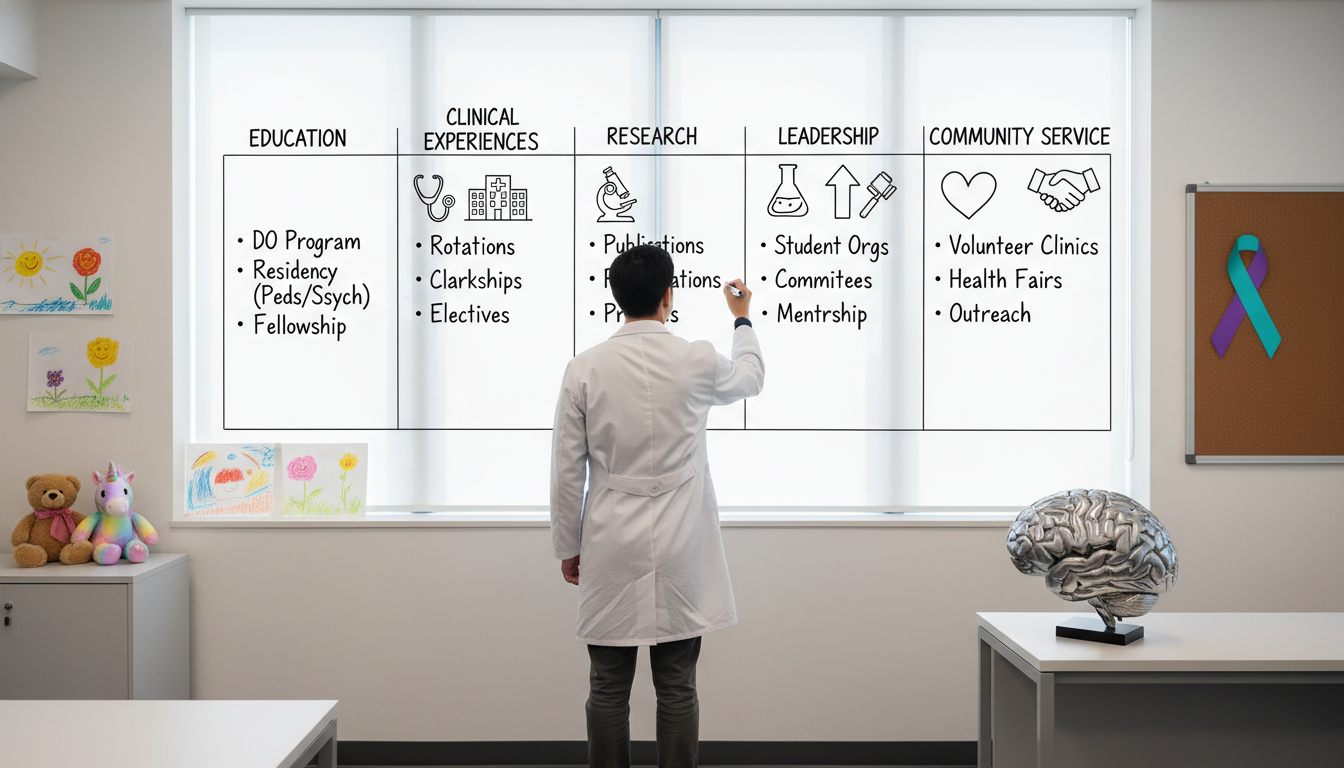
Below is a recommended structure specifically tailored to a DO graduate applying to pediatrics-psychiatry or triple board programs. This assumes you are a recent graduate (0–3 years out of school). For mid-career applicants, you would expand work experience sections.
1. Contact Information & Professional Heading
At the top of your CV:
- Full Name, DO
- Professional email (firstname.lastname@…)
- Phone number
- City, State (you can omit full street address)
- Optional: LinkedIn or professional website if polished and up to date
Example:
Jordan M. Patel, DO
Email: jordan.patel@medmail.com | Phone: (555) 123-4567
Philadelphia, PA | LinkedIn: linkedin.com/in/jordanpateldo
Avoid adding date of birth, photo, or marital status; these are not recommended in US residency applications.
2. Education
List in reverse chronological order:
- Residency (if applying as a re-applicant or switching specialties)
- Medical School (with DO degree, dates)
- Undergraduate (degree, major, institution, graduation year)
Include:
- Honors (e.g., cum laude, Phi Beta Kappa)
- Thesis titles if relevant to child development, psychology, or public health
- For DO graduates: note if you were in a pediatric or psychiatry track, scholarly concentration, or leadership program.
Example entry:
Philadelphia College of Osteopathic Medicine, Philadelphia, PA
Doctor of Osteopathic Medicine (DO), May 2025
Pediatric-Psychiatry Scholarly Track; Student Government Representative
3. Examination Scores and Licensure (Optional on CV, Required in ERAS)
On a standalone CV, you may include:
- COMLEX Level 1/2/3 scores
- USMLE Step 1/2 scores (if taken)
- State licenses (if applicable for graduates with clinical work)
For DO graduates, including both COMLEX and USMLE can be beneficial if your USMLE scores are strong and competitive; many DO graduate residency applicants use this to signal readiness for ACGME programs, including combined tracks. If scores are borderline, consider omitting them from the CV while still honestly reporting in ERAS.
4. Clinical Experience: Highlighting Pediatrics, Psychiatry, and Integration
This is one of the most important sections for a peds psych residency CV. Separate into:
- Core Clinical Rotations (summarized)
- Sub-internships / Acting Internships (AIs)
- Electives (especially in child psychiatry, developmental pediatrics, behavioral pediatrics, school-based health, adolescent medicine, consultation-liaison)
- Additional Clinical Work (e.g., pre-residency jobs, telepsychiatry scribe, clinic assistant)
You don’t need to list every core clerkship in detailed bullets, but you should spotlight:
- Pediatrics rotations where you worked with complex psychosocial needs
- Psychiatry rotations with children, adolescents, or family systems
- Any consult-liaison or integrated behavioral health experiences
Example format:
Sub-Internship in Pediatrics, Children’s Hospital of Atlanta, GA
July–August 2024
- Managed 6–8 inpatients daily under supervision, including children with chronic medical conditions and co-occurring anxiety, ADHD, and adjustment disorders.
- Collaborated with pediatric psychiatry consultants to develop behavioral management plans and family counseling strategies.
- Led family-centered rounds, incorporating biopsychosocial assessments learned in osteopathic training.
Elective in Child and Adolescent Psychiatry, Community Mental Health Center, PA
March 2024
- Conducted initial psychiatric interviews under supervision for children and adolescents with mood, anxiety, and neurodevelopmental disorders.
- Participated in school meetings and multidisciplinary case conferences with social workers and pediatricians.
- Observed parent management training and trauma-focused therapy sessions.
Explicitly describing cross-disciplinary interactions reinforces your fit for Triple Board and Peds-Psych programs.
5. Research and Scholarly Work: Signal Your Curiosity and Commitment
You do not need to be a first-author in a major journal to impress peds-psych faculty. Programs look for evidence of scholarly thinking and follow-through.
Subheadings can include:
- Peer-Reviewed Publications
- Abstracts and Posters
- Oral Presentations
- Quality Improvement (QI) and Projects
For Pediatrics-Psychiatry and Triple Board, ideal topics include:
- ADHD, autism spectrum disorder, learning disorders
- Pediatric mood and anxiety disorders
- Behavioral issues in chronic medical illness
- Suicidality and self-harm in youth
- Social determinants of health in children
- Family and caregiver stress, trauma, ACEs (adverse childhood experiences)
- Integrated care models and collaborative care
Example entry:
Lopez A, Chen M, Patel JM (2024). Screening for Depression and Anxiety in Adolescents with Type 1 Diabetes in a Pediatric Endocrinology Clinic. Poster presented at the American Academy of Pediatrics National Conference, Chicago, IL.
- Led data collection and analysis for 200+ patients; identified under-utilization of standardized screening tools.
- Proposed implementation of PHQ-9/A and GAD-7 screening at routine visits, integrating behavioral health referrals.
If your research is not directly in pediatrics or psychiatry, you can still frame it thoughtfully. For example, an internal medicine QI project on medication adherence can be tied to your interest in longitudinal care and behavior change.

Experience That Sets You Apart: Leadership, Advocacy, and Community Work
Combined pediatrics-psychiatry and Triple Board programs are drawn to applicants who engage beyond the exam room. This is where your DO training in holistic, community-centered care can shine.
1. Leadership and Organizational Roles
Programs look for evidence that you can help shape clinical teams, curricula, and systems. On your medical student CV, highlight leadership that aligns with children’s health, mental health, or advocacy:
- Pediatric interest group president or event organizer
- Psychiatry or Child & Adolescent Psychiatry interest group leader
- Student government positions with wellness, diversity, or curriculum roles
- Organizing a mental health awareness week, suicide prevention event, or ACEs lecture
- Leading initiatives in osteopathic schools focused on integrated care
Example:
Co-President, Pediatric Interest Group, PCOM
2022–2023
- Organized 8 events featuring pediatricians, child psychiatrists, and triple board physicians to educate students about careers in pediatric mental health.
- Developed a mentorship program pairing 40 pre-clinical students with residents and fellows in pediatrics and child psychiatry.
This shows both commitment to pediatrics and proactive exploration of psychiatry.
2. Community Service and Advocacy
Peds-Psych programs place high value on:
- Work with vulnerable children and families
- Involvement with foster care, juvenile justice, or school-based programs
- Advocacy around mental health access, stigma reduction, and family support
Examples of CV entries:
Volunteer, School-Based Mental Health Screening Program, Philadelphia, PA
2021–2023
- Assisted in school-wide screening for anxiety, depression, and behavioral concerns in middle school students.
- Provided psychoeducation handouts to parents; coordinated referrals with community mental health clinics.
Advocacy Day Participant, State Capitol Pediatric Mental Health Initiative
April 2023
- Met with state legislators to advocate for increased funding for child and adolescent mental health services.
- Shared clinical experiences about wait times and barriers for pediatric psychiatric consultation.
These experiences help your CV stand out in the osteopathic residency match pool for combined programs, demonstrating that you see children not just as patients, but as part of families and communities.
3. Teaching and Mentoring
Child psychiatry and pediatrics both demand strong teaching skills—for families, patients, students, and interprofessional teams.
Include:
- Peer tutoring, step exam prep teaching
- Mentoring pre-med or early medical students
- Teaching assistant roles in psychology, neuroanatomy, pediatrics, or OPP/OMM
- Health education sessions for parents or youth
Example:
Small-Group Facilitator, “Mental Health in Primary Care” Workshop, PCOM
February 2024
- Co-facilitated sessions for second-year students on recognizing early signs of depression, anxiety, and ADHD in children.
- Used simulated cases to practice communication with children and caregivers.
This signals to programs that you will likely become a strong educator and advocate—traits they want in a Triple Board resident.
Crafting and Polishing: Practical Residency CV Tips for DO Peds-Psych Applicants
Once your content is assembled, attention to detail and strategy will elevate your CV from acceptable to impressive.
1. Use Clear, Consistent Formatting
- Keep 1-inch margins and a professional, easy-to-read font (11–12 pt).
- Use bold for headings, italics for roles or institutions if desired, but keep styles consistent.
- Keep dates right-aligned and visible: Month Year–Month Year or Year–Year.
- Typical CV length for a recent graduate: 2–4 pages (quality over quantity).
2. Write Impact-Oriented Bullet Points
Avoid vague descriptions. When describing experiences, aim for bullets that include:
- Action (what you did)
- Context (in what setting, with whom)
- Outcome/Impact (what changed, what you learned, or skills gained)
Weak:
Helped with pediatric clinic visits.
Stronger for a Peds-Psych CV:
Conducted preliminary histories and developmentally appropriate screenings for anxiety and depression in children aged 8–16 in a community pediatrics clinic, facilitating timely referral to integrated behavioral health services.
This level of specificity shows direct relevance to your targeted specialty track.
3. Emphasize DO-Specific Strengths Strategically
In each relevant section, think: How does my osteopathic training uniquely prepare me for Pediatrics-Psychiatry?
Examples:
In a pediatric rotation:
Applied osteopathic structural exams (OSE) to evaluate headaches and somatic complaints in anxious adolescents, integrating findings into biopsychosocial formulations.
In an OMM/OPP teaching role:
Taught first-year students how to approach somatic symptoms in children and adolescents with a trauma-informed lens, emphasizing mind-body connections.
This integrates your DO identity without overemphasizing OMT in ways that feel unrelated to mental health or pediatrics.
4. Be Honest and Avoid Overinflating Roles
Program directors can detect inflated titles or vague descriptions. Avoid:
- Calling a small contribution “Director” or “Executive” without justification
- Listing routine student tasks as if you independently managed high-risk psychiatric patients
- Claiming “designed the curriculum” when you facilitated a single session
Instead, be accurate and concrete. If you assisted or participated, say so. You can still highlight initiative and insights gained.
5. Explain Any Gaps or Non-Traditional Paths
If you have:
- Time off between medical school and application
- A prior residency or career
- Personal or health-related leaves
Include entries that clarify and frame these periods positively. For example:
Clinical Research Coordinator, Pediatric Anxiety Program, Boston, MA
July 2023–June 2024 (Post-graduation research year)
- Coordinated longitudinal study of youth with anxiety disorders, strengthening my interest in evidence-based pediatric mental healthcare while preparing for Pediatrics-Psychiatry residency.
Use your personal statement or ERAS “experiences” text to elaborate further.
6. Tailor the CV for Peds-Psych and Triple Board
If you’re applying to both categorical pediatrics, categorical psychiatry, and combined programs, consider:
- One master CV, then minor adjustments:
- For Triple Board: emphasize integration and systems of care
- For Categorical Pediatrics: emphasize continuity, general child health, advocacy
- For Categorical Psychiatry: highlight psychiatric rotations, psychotherapy exposure, and adult psych as well as child psych
The core data stays the same; you simply reorder or selectively expand sections depending on the program type.
Putting It All Together: A Sample Narrative Through Your CV
Imagine you’re a DO graduate, 2025, applying primarily to Pediatrics-Psychiatry and Triple Board residency programs. If your CV is well-constructed, a program director should see a narrative like this:
- Education Section: DO degree, maybe a pediatric or behavioral health track, strong performance in core clinical years.
- Clinical Experience: Robust pediatric rotations with explicit mention of behavior and development; elective in child psychiatry; perhaps a consult-liaison or adolescent medicine experience.
- Research & Scholarship: A poster on pediatric depression or ADHD; or a QI project on screening and referrals.
- Leadership & Service: Roles in pediatric and/or psychiatry interest groups, community volunteering with youth, perhaps advocacy around mental health.
- Teaching & Mentoring: Peer teaching about mental health topics or developmental milestones.
- Additional Skills: Language skills, work with diverse populations, experience in trauma-informed care or motivational interviewing.
When all of these are clearly described and formatted, your CV alone strongly suggests that you are an ideal fit for Peds-Psych and Triple Board—well before anyone reads your personal statement.
Frequently Asked Questions (FAQ)
1. How many pages should my residency CV be as a new DO graduate?
For most DO graduates applying directly from medical school, a 2–4 page CV is appropriate. If you’ve done a prior degree, significant research, or a preliminary residency year, 3–5 pages may be acceptable. Focus on clarity and relevance; remove outdated or tangential experiences (e.g., unrelated high school activities).
2. Do I need publications to match into a Peds-Psych or Triple Board program?
Publications help, but they are not mandatory. Programs value quality and relevance over sheer volume. Strong clinical experiences, meaningful community work, and thoughtful QI projects can be just as compelling. If you lack formal research, consider including robust presentations, QI work, or a scholarly capstone with pediatric or psychiatric relevance.
3. How can I make my CV stand out as a DO in the osteopathic residency match?
To stand out:
- Emphasize holistic, biopsychosocial care and how it informs your approach to children and families.
- Showcase experiences that integrate primary care and mental health, aligning perfectly with peds-psych and triple board’s multidisciplinary nature.
- Clearly articulate DO-related strengths (communication, whole-person assessment, OMT when relevant) without overclaiming.
- Demonstrate longitudinal commitment to children’s mental health through sustained leadership, service, or research.
4. Should I include non-medical jobs and activities on my residency CV?
Yes, if they demonstrate valuable, transferable skills (leadership, resilience, communication) or help explain your path. For example, work as a camp counselor, teacher, social worker, or mental health tech is highly relevant to pediatrics-psychiatry. Briefly describe responsibilities and skills gained, but keep the majority of space focused on medical school and clinical experiences.
By intentionally designing your CV to highlight your osteopathic background, your commitment to both pediatrics and psychiatry, and your engagement with children’s mental health in real-world settings, you give Peds-Psych and Triple Board programs exactly what they are looking for: a focused, reflective, and well-prepared DO candidate ready to thrive in a uniquely demanding and rewarding combined residency.