
Understanding the EM-IM Combined Pathway and What Programs Look For
Building a strong CV for Emergency Medicine-Internal Medicine (EM IM combined) programs requires more than just listing your experiences. These dual residency programs are highly selective and seek applicants who can thrive in both the fast-paced, high-acuity environment of emergency medicine and the longitudinal, complex management style of internal medicine.
What Makes EM-IM Combined Programs Different?
Emergency medicine internal medicine combined programs train residents to be fully board-eligible in both specialties. This means:
- Broad clinical scope: From undifferentiated emergencies to chronic disease management and complex inpatient care.
- High cognitive and procedural demands: You must handle resuscitations, critical care, and nuanced diagnostic reasoning.
- Interdisciplinary leadership: Graduates often lead ED observation units, hospital medicine services, or critical care teams, and work at the interface between ED and inpatient care.
Programs therefore look for applicants who demonstrate:
- Ability to think quickly and systematically
- Interest in acute care and longitudinal follow-up
- Evidence of resilience, adaptability, and teamwork
- Commitment to lifelong learning and systems-based practice
- Potential for leadership and teaching
Your medical student CV is one of the main tools to demonstrate these attributes. It should tell a clear, coherent story: why EM-IM combined, and how your experiences back that up.
Core Principles of a Strong EM-IM Residency CV
Before diving into sections and formatting, it helps to understand the core principles that should guide how to build your CV for residency, especially in EM-IM combined programs.
1. Clarity and Professionalism
Program directors skim dozens (sometimes hundreds) of applications in a sitting. Your CV must be:
- Easy to scan: Clear headings, consistent formatting, logical section order.
- Free of errors: No typos, spelling mistakes, or inconsistent dates.
- Professional in tone: Neutral, factual, and polished.
Think of your CV as your professional snapshot—if it looks disorganized, reviewers may infer the same about your clinical work.
2. EM-IM-Relevant Storytelling
Your CV should support a consistent narrative:
- Experiences that show interest in acute care: ED shifts, resuscitations, trauma, EMS, point-of-care ultrasound.
- Experiences that show internal medicine depth: continuity clinic, inpatient medicine, subspecialty interests, quality improvement projects.
- Experiences that bridge the two, such as:
- Observation medicine
- Critical care
- Sepsis workflows
- ED–inpatient transitions of care
- Hospital throughput and flow projects
You are not just listing what you did; you are curating what best aligns with emergency medicine internal medicine training.
3. Depth Over Breadth
Residency CV tips often emphasize that “more is not always better.” For EM-IM combined, this is particularly true:
- A handful of meaningful, longitudinal commitments (e.g., three years in a free clinic, multiple academic projects) generally carry more weight than many short, unrelated, one-off activities.
- Highlight leadership roles, concrete outcomes, and impact instead of listing numerous superficial experiences.
4. Quantify and Specify
Whenever possible, use specifics:
- “Co-led a weekly student-run clinic serving ~40 patients per month.”
- “Completed 12-week ED research project; screened 300+ charts.”
- “Coordinated a simulation workshop attended by 60 students.”
Specific details help reviewers understand the scope and seriousness of your involvement.
Structuring Your EM-IM Residency CV: Section by Section
Below is a recommended structure tailored for applicants to EM-IM combined programs. You may adapt order and section titles slightly depending on your background and institutional norms, but maintain clarity and consistency.
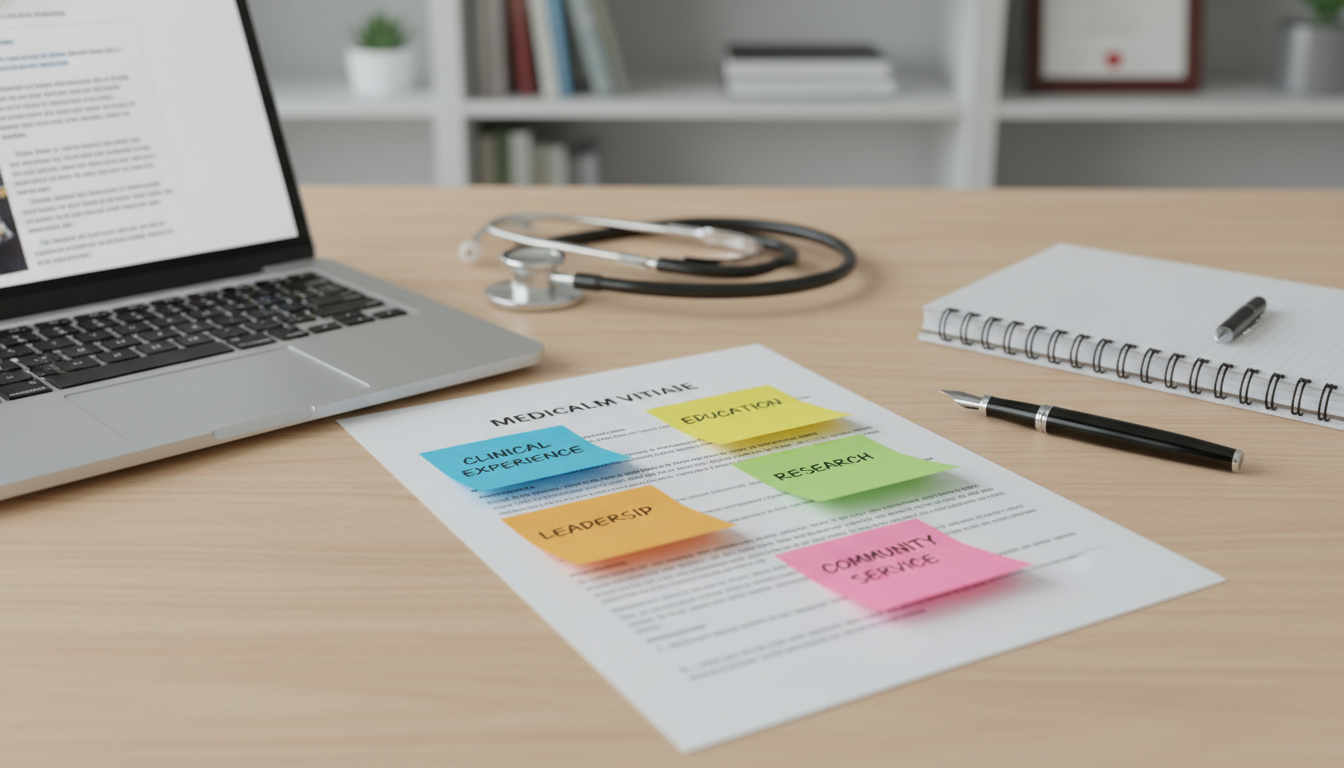
1. Header and Contact Information
This section should be simple and professional:
- Full name (as used in official documents)
- Current address (optional but customary)
- Professional email (e.g., [email protected])
- Phone number
- ERAS AAMC ID or NRMP ID (if available and appropriate)
- Optional: LinkedIn or professional website (only if up-to-date and polished)
Avoid:
- Personal photos on the CV (ERAS handles photos separately, depending on region/program norms)
- Casual email addresses (e.g., gamer handles, nicknames)
2. Education
List in reverse chronological order:
- Medical school: name, city/state, years attended, expected graduation date.
- Any previous degrees (BS/BA, MS, MPH, etc.) with:
- Major(s)/minor(s)
- Honors (cum laude, departmental honors) if applicable.
- Thesis titles or capstone projects can be added briefly, especially if relevant to EM-IM combined interests (e.g., critical care, health systems, EMS, public health).
Example entry:
Doctor of Medicine (M.D.)
XYZ School of Medicine, City, State
Expected May 2026
Bachelor of Science in Biochemistry, magna cum laude
ABC University, City, State
2016–2020
3. Honors, Awards, and Distinctions
Programs want to see academic excellence, professionalism, and leadership. Include:
- Alpha Omega Alpha (AOA), Gold Humanism Honor Society (GHHS)
- Academic scholarships or merit awards
- Clerkship honors (especially in EM, IM, ICU, cardiology, pulmonary/critical care)
- Leadership awards, teaching awards, or service recognition
Structure:
- Name of award
- Granting organization or institution
- Month/Year
- One brief line of context if not self-explanatory
EM-IM angle: If you have separate honors in both EM and IM rotations, make sure they are clearly visible—they strongly support your fit for dual training.
4. USMLE/COMLEX and Licensing (If Applicable)
Some institutions prefer scores left off the CV, as they are already in ERAS. Follow your school’s guidance. If you do include them, keep it minimal:
- USMLE Step 1: Pass (or score, if you choose to list it where allowed)
- USMLE Step 2 CK: [score or Pass]
- COMLEX equivalents if applicable
Do not attempt to “explain” scores on your CV; that belongs, if anywhere, in other parts of the application and ideally with advisor guidance.
5. Clinical Experience and Sub-Internships
For EM-IM, your clinical experiences are central to your medical student CV.
This includes:
- EM rotations (home, away/sub-I, electives)
- IM rotations (ward months, subspecialties, sub-internships)
- Critical care rotations (MICU, CCU, SICU)
- Observation medicine or ED–hospitalist bridging experiences
- Longitudinal clinics (especially those focused on complex, high-risk patients)
How to list:
- Rotation name
- Institution and location
- Dates (month/year)
- Brief bullet points emphasizing:
- Patient volume or type (e.g., high-acuity, tertiary care)
- Specific responsibilities (e.g., procedures, sign-outs, managing cross-cover pages)
- Any particular achievements (e.g., selected to present case at morning report)
Example:
Sub-Internship, Internal Medicine
XYZ University Hospital, City, State | July–August 2025
- Managed a census of 6–8 inpatients under resident supervision, including complex multi-morbidity cases.
- Performed daily rounds, wrote orders and notes, and participated in multidisciplinary care planning.
- Led two case-based teaching sessions for third-year students.
6. Research and Scholarly Activity
EM-IM programs value applicants who are curious, analytical, and able to contribute to systems-level or evidence-based improvements. Research does not have to be EM- or IM-specific to be valuable, but it’s ideal if at least some projects intersect acute care, health systems, or chronic disease management.
Include:
- Original research projects
- Quality improvement (QI) initiatives
- Educational scholarship (curriculum design, evaluation)
- Case reports and case series
- Presentations (poster, oral, local/regional/national)
- Publications (published, accepted, in press)
How to structure entries:
For projects:
- Project title
- Role (e.g., Student Investigator, Co-investigator)
- Institution
- Mentor(s)
- Dates
- 1–2 bullet points emphasizing:
- Research question or goal
- Methodology in broad strokes
- Outcome (poster, manuscript, protocol changes, etc.)
For publications:
- Standard citation format (authors, title, journal, year, volume:pages).
- Indicate your author position (e.g., first author, second author).
- Indicate status (e.g., “In press,” “Under review”).
EM-IM-specific examples:
- QI project on reducing 30-day readmissions for heart failure patients discharged from the ED.
- Retrospective study on outcomes of patients admitted to observation vs. inpatient status.
- Implementation of a sepsis bundle spanning ED and internal medicine floors.
These demonstrate that you are thinking at the interface of emergency medicine internal medicine—a major asset for dual training.
7. Teaching and Leadership Experience
EM-IM residents are often future leaders: in academic departments, ED–hospitalist interfaces, or quality improvement teams. Your CV should show that you can teach, organize, and lead.
Teaching roles:
- Peer tutoring (USMLE, physiology, clinical skills)
- Teaching assistant for pre-clinical courses
- Small-group facilitator (e.g., problem-based learning)
- Simulation teaching for junior students
- Ultrasound workshops, procedure labs
Leadership roles:
- Positions in student organizations (e.g., EMIG, IMIG, combined EM-IM interest groups)
- Roles in community organizations or clinics
- Class representative, curriculum committee member
- EMS or disaster response teams
When listing, highlight:
- Title/role
- Organization
- Dates
- 1–2 bullet points focusing on:
- Scope of responsibility (e.g., supervised X members, managed Y budget).
- New initiatives started or improved processes.
- Evidence of sustained commitment (multi-year involvement).
Example:
Co-President, Emergency Medicine Interest Group (EMIG)
XYZ School of Medicine | 2023–2024
- Organized 8 skills workshops (airway management, ultrasound, EKG interpretation) with >100 cumulative student attendees.
- Coordinated resident and faculty panel highlighting EM-IM combined career pathways.
8. Service, Volunteering, and Community Engagement
EM-IM physicians often serve vulnerable populations, manage social determinants of health, and function in safety-net hospitals. Programs value applicants who have engaged with communities meaningfully.
Include:
- Free clinics
- Homeless outreach
- Community health education
- Disaster relief or EMS support
- Global health work (if applicable)
Focus on longitudinal efforts and roles with increasing responsibility. Clarify:
- Patient population served
- Frequency of involvement
- Your role (not just “volunteered,” but “coordinated scheduling,” “developed educational materials,” etc.)
EM-IM relevance highlights:
- Work with frequent ED utilizers
- Transitional care or hospital follow-up clinics
- Chronic disease management in resource-limited settings
9. Professional Memberships and Certifications
List:
- Memberships: SAEM, ACEP, AAEM, ACP, EMRA, etc.
- Roles within these organizations, if any (committee work, trainee sections).
- Certifications: BLS, ACLS, PALS, ATLS (if obtained as a student), ultrasound certificates, EMS or EMT certification.
Though some certifications may be renewed during residency, listing them shows early commitment to acute care excellence.
10. Skills, Procedures, and Languages
This section should be truthful and not overstated.
Clinical skills/procedures:
You can list common student-level procedures relevant to EM-IM, such as:
- Peripheral IV insertion
- Arterial blood gas sampling
- Basic airway management (e.g., bag-valve-mask, oral/nasal airways)
- Basic ultrasound applications (FAST, cardiac, aorta) if trained
- Bedside procedures performed under supervision (paracentesis, thoracentesis, lumbar puncture)
Only list procedures for which you have direct, supervised experience and some degree of comfort; don’t inflate your skillset.
Languages:
Indicate proficiency accurately:
- Native
- Fluent
- Conversational
- Medical proficiency (if applicable)
Language skills are especially valuable in EM and IM, where communication with diverse populations is critical.
11. Personal Interests (Optional but Recommended)
A brief interests section humanizes your application and may create interview connections. EM-IM attendings are often multi-dimensional: many are involved in global health, outdoor activities, or teaching.
Examples:
- Long-distance running; completed three half-marathons.
- Wilderness medicine and backcountry hiking.
- Culinary medicine; developed simple recipes for patients with limited resources.
- Simulation-based education and debriefing.
Keep it short (3–5 items) and genuine.
Tailoring Your CV Specifically for EM-IM Combined Programs
Now that we’ve outlined structure, consider how to specifically optimize your medical student CV for EM-IM combined programs.

Align Your Experiences With Dual Training
Ask yourself for each major entry: How does this show that I’m prepared for and interested in both EM and IM?
Examples of how to frame experiences:
- ED Research: Emphasize aspects related to follow-up care, readmissions, or chronic disease exacerbations.
- Ward QI Project: Highlight how interventions impacted ED boarding times, admission criteria, or early warning systems.
- Community Clinic: Note how you managed both acute complaints and chronic conditions, mirroring EM-IM’s bridge role.
Demonstrate Breadth Across Settings
EM-IM programs want to see that you:
- Enjoy resuscitations and acute decision-making (EM side).
- Appreciate complex, longitudinal, diagnostic and therapeutic puzzles (IM side).
- Are comfortable in multiple environments: ED, wards, ICU, clinic.
Your CV should therefore include experiences from:
- Emergency department (adult, possibly pediatric if available)
- Inpatient medicine
- Critical care
- Outpatient/continuity settings
- System-level or transitional care projects
Highlight Systems Thinking and Transitions of Care
One of the unique strengths of EM-IM physicians is their ability to improve patient flow and outcomes across the continuum:
- ED triage and risk stratification
- Admission vs. observation vs. discharge decision-making
- Early post-discharge follow-up
- Preventing bounce-backs and avoidable hospitalizations
If you have any involvement in projects around throughput, readmissions, sepsis bundles, or discharge planning, showcase them clearly. These signal that you already think like a future EM-IM physician.
Indicate Specific EM-IM Mentorship or Exposure
If you’ve:
- Worked with EM-IM combined trained faculty
- Participated in EM-IM interest group events
- Attended EM-IM combined program information sessions
- Shadowed dual-trained physicians in unique roles (ED observation units, hospitalist-ED liaison, etc.)
Include these where appropriate (under clinical experiences, mentoring, or leadership). It shows informed interest rather than a generic EM or IM application.
Common Pitfalls and How to Avoid Them
Even a strong candidate can weaken their application with an unfocused or poorly executed CV. Here are key residency CV tips to avoid common issues.
Pitfall 1: Disorganized or Overly Dense Formatting
Avoid:
- Tiny fonts and minimal spacing
- Multiple different bullet styles
- Excessive bolding or underlining
Instead:
- Use a clear, professional font (e.g., 11–12 pt).
- Maintain consistent date and location formatting.
- Use bullet points judiciously—2–4 bullets per entry is usually enough.
Pitfall 2: Listing Without Explaining Significance
Example of weak entry:
- “Volunteered at free clinic.”
Stronger version:
- “Volunteer Clinician, Student-Run Free Clinic
– Conducted history and physical exams for uninsured adult patients under supervision, addressing both acute concerns and chronic disease management.
– Coordinated referral and follow-up plans with local primary care practices.”
The second version helps EM-IM reviewers see skills relevant to both specialties.
Pitfall 3: Overstating Responsibilities or Skills
Your CV must be accurate and honest. Programs value integrity more than any single accomplishment.
- Do not claim independent practice when you were supervised.
- Don’t list advanced procedures you’ve only observed.
- Avoid inflated titles (“co-PI” when you functioned as a student contributor).
If a reviewer asks for details during an interview and you cannot comfortably discuss them, the credibility of your entire application may suffer.
Pitfall 4: Not Updating or Customizing
Your CV is not static. Update it:
- After each new presentation, publication, or major rotation.
- Before sending to letter writers or mentors for review.
For EM-IM applications, consider creating a slightly tailored version that emphasizes:
- ED- and IM-related projects
- Systems and transitional care work
- Dual mentorship experiences
While ERAS has standardized fields, your uploaded CV (often used for away rotations or networking) can still be strategically oriented.
Pitfall 5: Neglecting Feedback
Before finalizing:
- Ask a faculty mentor in EM, IM, or (ideally) EM-IM to review your CV.
- Seek feedback from a dean’s office advisor or career counseling.
- Have a grammar-conscious friend or colleague proofread for typos and clarity.
Fresh eyes often catch inconsistencies you’ll miss after working on the document for weeks.
Frequently Asked Questions (FAQ)
1. How long should my residency CV be for EM-IM combined applications?
For most medical students, 2–4 pages is typical and acceptable. Length depends on:
- Amount of research and scholarly work
- Prior degrees or careers
- Leadership and service involvement
Do not artificially compress your CV to a single page if it compromises clarity; EM-IM programs are accustomed to multi-page CVs. However, avoid filler—every entry should add value or context to your candidacy.
2. Do I need EM-specific and IM-specific research to be competitive for EM-IM combined programs?
No. While EM- or IM-focused research can be helpful, programs primarily look for evidence of intellectual curiosity, follow-through, and basic research literacy. High-yield projects include:
- Quality improvement (e.g., sepsis bundles, throughput, readmissions).
- Systems-based projects linking ED and inpatient or outpatient care.
- Clinical or educational research demonstrating teamwork and scholarly output.
A strong, well-executed project in any medically relevant area is better than multiple superficial EM/IM projects.
3. Should I list every activity from the start of medical school on my CV?
You should list meaningful, relevant, and sustained experiences. It’s appropriate to exclude:
- Very short-term activities (e.g., single-day events) unless highly significant.
- Unrelated pre-medical jobs that don’t inform your current professional story.
Focus on activities that demonstrate the skills, values, and experiences EM-IM programs seek: clinical competence, leadership, systems thinking, resilience, and service.
4. How do I show my specific interest in EM-IM combined and not just EM or IM?
Use your CV (along with your personal statement and experiences) to highlight:
- Rotations that span both acute and longitudinal care.
- Projects on transitions of care, observation units, or ED–inpatient interfaces.
- Leadership in combined interest groups or EM and IM organizations.
- Mentorship or shadowing with EM-IM trained physicians.
When combined, these elements signal to programs that you understand what EM-IM training entails and are genuinely committed to that unique pathway.
By applying these strategies, you can transform your medical student CV from a basic list of experiences into a powerful, coherent narrative that aligns closely with what emergency medicine internal medicine combined programs seek. Your CV, together with your personal statement, letters, and performance, will help demonstrate that you are ready to thrive in the dual world of EM-IM—and to build a career at the critical intersection of acute and longitudinal care.