Understanding the Radiology Residency CV as a Non-US Citizen IMG
For a non-US citizen IMG or foreign national medical graduate, the residency CV is more than a formality—it is your primary tool to bridge geographic, educational, and cultural gaps. Program directors will often skim your medical student CV for less than a minute on first pass. In that short window, your document must clearly answer three questions:
- Can this person handle the academic demands of a US diagnostic radiology residency?
- Do they truly understand radiology and show sustained interest in the field?
- Are there red flags in training, professionalism, or communication?
A strong residency CV, tailored to diagnostic radiology, signals that you are serious, organized, and ready for the US training environment—even if your entire education occurred abroad.
CV vs. ERAS Application: What Matters for You
For the diagnostic radiology match, most US programs primarily review your ERAS application, which functions like a structured CV. However, many programs still request or appreciate a standalone PDF CV:
- As an email attachment when you communicate with faculty or program coordinators
- For away electives, observerships, or research positions
- When networking at conferences or cold-emailing faculty for research
- For institutions or fellowships outside ERAS or in later career steps
Because you are a non-US citizen IMG, faculty will frequently ask for your “CV” when they consider you for:
- US clinical experience (USCE)
- Research roles
- Letters of recommendation (LORs)
- Institutional visa sponsorship discussions
So you need both:
- A polished ERAS profile
- A well-formatted, US-style academic CV that aligns with it
This article focuses on how to build CV for residency in diagnostic radiology as an IMG, with emphasis on what programs and radiology faculty actually look for.
Core Structure of a Strong Radiology Residency CV
Your CV must be easy to skim, logically structured, and aligned with US expectations. Length is typically 2–4 pages for most non-US citizen IMG applicants who graduated recently.
Recommended Section Order
Use a standard, conservative order that program directors recognize:
- Contact Information & Personal Details
- Education
- Examinations & Certifications (USMLE, etc.)
- Clinical and Radiology-Relevant Experience
- Research & Publications
- Presentations & Posters
- Honors, Awards & Scholarships
- Teaching & Leadership
- Professional Memberships
- Skills (Focused on radiology and residency readiness)
- Languages
- Interests (brief, curated)
This structure also serves as a roadmap for how to build CV for residency step by step. Let’s break it down.
1. Contact Information & Personal Details
Include at the top:
- Full name (matching passport/ERAS)
- Current address (US address if you have one; if not, home-country address)
- Professional email (e.g., firstname.lastname@domain.com)
- Phone number with country code
- LinkedIn profile (optional but helpful if well-maintained)
Avoid photos, date of birth, marital status, or national ID numbers—these are not expected in US-style residency CVs and can raise concerns about bias.
Visa Status: You do not need a separate “Visa” line on the CV. Your ERAS application will cover this. If you have permanent residency or US citizenship, it’s acceptable to mention “US permanent resident” under your name, but do not overemphasize it.
Highlighting Education and Exams as a Foreign National Medical Graduate
Program directors know that training structures differ worldwide. Your goal is clarity and equivalence.

2. Education: Make Your Training Easy to Understand
List in reverse chronological order:
Medical School
- Name of university, city, country
- Degree (e.g., M.B.B.S., M.D., etc., with equivalent if commonly misunderstood)
- Dates attended (month/year – month/year)
- Class rank or GPA if strong and understandable (e.g., “Top 5% of graduating class”)
Postgraduate Training (if any)
- Internship, residency, or fellowship in your home country
- This is especially relevant if you have radiology training already
Undergraduate / Pre-med (if relevant or if it demonstrates academic excellence)
Example entry:
M.B.B.S. (Bachelor of Medicine, Bachelor of Surgery)
All India Institute of Medical Sciences, New Delhi, India
08/2016 – 06/2022
Graduated with Distinction; Top 10% of class
3. Examinations & Certifications: Demonstrate US Readiness
For a diagnostic radiology residency, program directors are highly score-conscious. Make this section clear and prominent:
- USMLE Step 1: Score, attempt(s), month/year
- USMLE Step 2 CK: Score, attempt(s), month/year
- USMLE Step 3: If completed, especially helpful for visa-sponsoring programs
- ECFMG Certification: “ECFMG Certified, month/year” or “ECFMG Certification in progress”
- English certification (if relevant): IELTS/TOEFL scores for some institutional roles
Example layout:
Licensing Examinations & Certifications
- USMLE Step 2 CK: 252, First Attempt, 06/2024
- USMLE Step 1: Pass (3-digit 235), First Attempt, 02/2023
- ECFMG Certification: Anticipated 02/2025 (all exams passed; awaiting document verification)
For a non-US citizen IMG, having Step 3 before the radiology residency match can slightly strengthen your appeal for visa sponsorship, especially at H-1B–friendly institutions.
Radiology-Relevant Experiences: Show Depth, Not Just Interest
Diagnostic radiology programs want to see more than “I like imaging.” They look for trajectory: consistent exposure, increasing responsibilities, and real insight into radiology practice.
4. Clinical and Radiology-Related Experience
This is one of the most important sections for a radiology residency match.
Create subsections if needed:
- US Clinical Experience (USCE)
- Radiology Rotations (Home Country and US)
- Other Clinical Experience
For each entry:
- Title (e.g., “Visiting Medical Student – Diagnostic Radiology Elective”)
- Institution, city, state/country
- Dates (month/year – month/year)
- 2–4 bullet points focusing on what you did and what you learned, especially radiology-relevant tasks
Good bullet examples for radiology CV:
- “Interpreted plain radiographs and CT scans under supervision, presenting findings to attending radiologists during read-outs.”
- “Assisted in performing ultrasound-guided procedures, including paracentesis and thoracentesis, gaining familiarity with sonographic anatomy.”
- “Participated in daily multidisciplinary tumor boards, presenting imaging findings and discussing radiologic-pathologic correlation.”
Avoid vague bullets like “Observed radiology workflow” or “Assisted radiologist with daily tasks.”
US Clinical and Observership Experience for the Non-US Citizen IMG
If your US experience is limited to observerships or shadowing:
- Be transparent (label as “Observer” or “Shadowing”)
- Focus bullets on learning outcomes and clinical radiology insight
- Highlight any mini-projects, case presentations, or Q/A sessions you engaged in
Example:
Diagnostic Radiology Observer
Department of Radiology, XYZ University Hospital, Boston, MA
04/2024 – 06/2024
- Observed interpretation of cross-sectional imaging (CT, MRI, PET-CT) in a tertiary academic center.
- Attended daily case conferences and neuroradiology teaching sessions.
- Prepared and delivered two brief case presentations on interesting neuroradiology cases to residents and fellows.
5. Research & Publications: Tailoring to Radiology
Radiology is a research-heavy specialty; many program directors prefer applicants with at least some scholarly output, even for international candidates.
Prioritize Radiology-Related Work
On your residency CV, prioritize radiology or imaging-related research:
- Peer-reviewed journal articles
- Abstracts & posters at conferences (especially RSNA, ACR, local radiology societies)
- Case reports involving imaging
- Quality improvement (QI) projects in radiology (e.g., radiation dose optimization, workflow improvement)
Format publications in standard academic style. Separate into:
- Peer-Reviewed Publications
- Abstracts & Posters
- Manuscripts in Preparation or Under Review (clearly labeled)
Example:
Peer-Reviewed Publications
- Ahmed R, Patel S, et al. “Diagnostic performance of low-dose CT in suspected pulmonary embolism in a resource-limited setting.” Journal of Thoracic Imaging. 2023;38(2):123–130.
- Ahmed R, et al. “Utility of point-of-care ultrasound in emergency trauma triage: A prospective study.” Emergency Radiology. 2022;29(4):211–218.
If your research is not radiology-related, still include it, but be selective and concise. Emphasize:
- Quantitative skills (statistics, data analysis)
- Experience with large datasets or imaging-adjacent topics
- Evidence of perseverance and completion of projects
For a non-US citizen IMG, any research done in the US (even small QI projects) shows your ability to function in the local academic environment—highlight clearly where US institutions are involved.
Building Radiology-Relevant Content When You Have Limited Experience
Many foreign national medical graduates ask: “What if I don’t have radiology research or US radiology electives?” You can still strategically optimize your residency CV.
6. How to Build CV for Residency When You’re Just Starting
If you’re early in medical school or just deciding on diagnostic radiology, use residency CV tips like these to build targeted experiences:
a. Start Radiology-Focused Projects Locally
Even in non-US settings, you can:
- Join your department’s audit or QI projects (e.g., reducing report turnaround time, improving contrast safety protocols)
- Initiate case series on common radiological findings in your hospital
- Collaborate with surgical or oncology departments on radiologic-pathologic correlation studies
These projects become excellent CV entries and show initiative.
b. Seek Remote or Virtual Radiology Opportunities
- Online research collaborations with US or international radiologists
- Remote participation in imaging-based AI or teleradiology projects
- Online radiology electives or structured teaching programs that provide certificates
Include them under “Additional Radiology Education” or “Remote Electives” with concrete outcomes (presentations, projects, exams completed).
c. Use Conferences Strategically
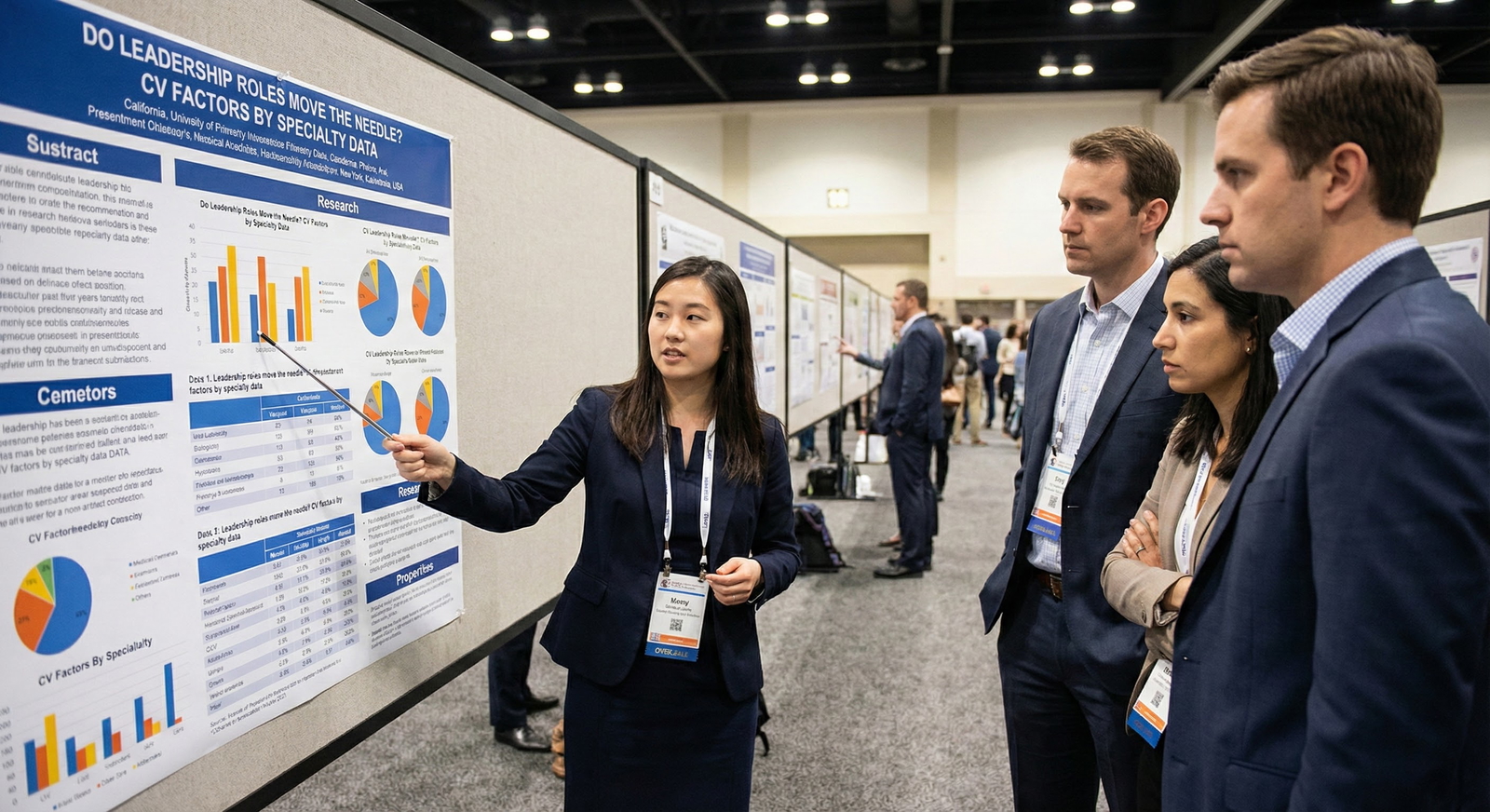
For the diagnostic radiology match, poster presentations at reputable radiology meetings are powerful:
- RSNA, ARRS, ACR, ECR, regional radiology societies
- Submit case reports or small retrospective studies
- Take screenshots of accepted poster confirmation emails and keep details for your CV
Your entry might look like:
Poster Presentation
Ahmed R, et al. “Spectrum of MRI findings in tuberculous spondylitis in a tertiary care center in India.” RSNA Annual Meeting, Chicago, IL, 2024.
Strengthening the “Generalist” Parts of Your Radiology Residency CV
Program directors also care about whether you will be a good resident overall, not just a future radiologist. Your CV should showcase teaching, leadership, communication, and professionalism.
7. Honors, Awards & Scholarships
Include:
- National or institutional merit scholarships
- Dean’s list or “Top X% of class” awards
- Radiology society prizes (e.g., best poster, quiz winners)
- Any exam distinctions (e.g., “Highest score in Radiology rotation OSCE”)
Detail briefly what the award was for, especially if it’s specific to radiology or academic performance.
8. Teaching & Leadership
Teaching is crucial in US residency culture, including diagnostic radiology:
- Peer tutoring in anatomy, imaging, or clinical medicine
- Small-group teaching for junior students
- Radiology interest group leadership
- Organizing journal clubs or case conferences
Use 1–3 bullets to clarify scope and outcomes:
- Organized monthly radiology case discussions for 25 medical students, focusing on chest imaging fundamentals.
- Developed a 6-session ultrasound basics curriculum for interns in the emergency department.
Leadership roles outside radiology (student council, committee work) still matter—they signal maturity, reliability, and organizational skills.
9. Professional Memberships
For a non-US citizen IMG, US-based memberships can show commitment to US radiology:
- Radiological Society of North America (RSNA) – “International Trainee Member”
- American College of Radiology (ACR)
- Specialty societies (e.g., Society of Thoracic Radiology, Society of NeuroRadiology, etc.)
- Home-country radiology or medical associations
List them with membership type and year joined.
10. Skills: Focus on What Radiologists Care About
Avoid generic skills lists (“time management,” “teamwork”) unless truly demonstrated. Instead, emphasize:
- Imaging-related competencies:
- “Basic proficiency in point-of-care ultrasound (FAST, basic echocardiography)”
- “Familiarity with DICOM viewers and PACS systems (e.g., RadiAnt, OsiriX)”
- Research/Data skills:
- “Intermediate proficiency in SPSS and R for statistical analysis”
- “Experience handling imaging datasets for AI research (e.g., labeling CT scans)”
- Technical/IT skills:
- LaTeX, reference managers (EndNote, Zotero), basic Python or MATLAB use in research
These speak directly to the technical and analytical nature of diagnostic radiology.
11. Languages and Interests
Languages are often an asset in diverse US hospitals—list fluency levels realistically.
Interests should be:
- Specific (e.g., “Marathon running; completed 3 half-marathons”)
- Demonstrate perseverance, teamwork, or creativity
- Avoid controversial topics or vague hobbies
They can provide interview talking points and humanize your profile.
Formatting and Presentation: Making Your CV Look US-Standard
Even excellent content can be overlooked if the format is cluttered or unfamiliar to US reviewers.
Length and Font
- Target 2–4 pages for a typical non-US citizen IMG applying to diagnostic radiology
- Use simple, readable fonts: Calibri, Arial, Times New Roman (size 10–11)
- 1-inch margins, consistent spacing, no colored text
Style and Consistency
- Use consistent date format: MM/YYYY – MM/YYYY
- Bold section headings and job titles, not every keyword
- Avoid tables for the main body; simple bullet lists are easier to parse in PDFs
- Save as PDF with a professional filename:
Lastname_Firstname_CV_2025.pdf
Alignment with ERAS
Your CV and ERAS application must match on critical facts:
- Dates of education and experiences
- Publication titles and authors
- Positions and institutions
Minor wording differences in descriptions are fine; major discrepancies look like dishonesty or disorganization.
Strategic CV Tips for the Diagnostic Radiology Match as a Non-US Citizen IMG
To summarize key residency CV tips tailored to diagnostic radiology:
Show radiology trajectory
- Multiple radiology rotations (home and US if possible)
- Radiology-focused research or QI projects
- Membership in radiology societies and attendance at imaging conferences
Demonstrate academic rigor
- Strong USMLEs clearly displayed
- Solid research track record (even outside radiology)
- Awards or distinctions during medical school
Highlight adaptability to US systems
- US-based observerships or electives
- Participation in US-based research or remote collaborations
- Evidence of English communication and teaching roles
Avoid clutter
- Remove high school achievements unless extraordinary
- Minimize irrelevant or very old activities
- Keep bullets focused on impact and relevance to residency
Tailor when needed
- For research-heavy academic radiology programs, emphasize publications and projects
- For community-based programs, highlight clinical exposure, communication, and reliability
FAQs: CV Building for Non-US Citizen IMGs in Diagnostic Radiology
1. How is a radiology residency CV different for a non-US citizen IMG vs. a US graduate?
The core structure is the same, but as a foreign national medical graduate you must work harder to:
- Explain your education system and class rank clearly
- Prove US readiness (USMLEs, USCE, ECFMG status)
- Show genuine radiology commitment despite geographic barriers
- Reassure programs about visa sponsorship feasibility through clear status and Step completions
Your CV must close the information gap that program directors might have about your home institution and training.
2. Can I include home-country radiology residency or postgraduate training on my CV?
Yes—in fact, radiology or other postgraduate training can be an asset:
- List it under Education or a separate Postgraduate Training section
- Clarify the role: “Radiology Resident (PGY-1),” “House Officer,” etc.
- Highlight skills transferable to US diagnostic radiology: imaging interpretation, procedures, multidisciplinary work
Just be ready to discuss why you are pursuing US diagnostic radiology residency after previous training—this will come up in interviews, not just on the CV.
3. Is it a problem if I have no radiology research for my diagnostic radiology match?
It’s not an automatic rejection, especially at less research-focused programs, but you are more competitive if you have some scholarly work. If you lack radiology-specific research:
- Include any clinical or epidemiological research you have
- Seek short-term radiology projects (case reports, small audits) to add before application season
- Emphasize any imaging-heavy clinical roles, like ultrasound in emergency or ICU settings
Programs care more about evidence of curiosity, follow-through, and analytic skills than about the sheer number of radiology papers.
4. Should I tailor my CV for each program I apply to?
Your core CV should stay the same for all programs to avoid confusion. However, you can:
- Adjust your email body or cover letter when sending it to specific faculty
- Emphasize certain sections when presenting verbally (e.g., in interviews for research-heavy vs. community programs)
- Have slightly different versions for research inquiries vs. clinical observership requests (e.g., moving research higher on the page for research-focused outreach)
The PDF you upload as your main CV for the diagnostic radiology match should be consistent, polished, and broadly applicable.
By crafting a clear, radiology-focused, US-style CV and aligning it closely with your ERAS application, you give program directors confidence that you—as a non-US citizen IMG—understand the expectations of diagnostic radiology residency and are prepared to thrive in their program.