As a US citizen IMG (American studying abroad), your CV is more than a document—it’s your strategic tool to turn “IMG” from a perceived disadvantage into a clear asset. For family medicine residency programs, where fit, communication, and continuity of care matter as much as board scores, a strong CV can significantly improve your FM match prospects.
Below is a detailed, step‑by‑step guide on how to build a CV for residency in family medicine, tailored specifically for US citizen IMGs.
Understanding the Role of the CV in the Family Medicine Match
Your CV (and the ERAS application that mirrors it) serves three key functions for family medicine residency programs:
Snapshot of readiness
- Shows that you’ve completed core rotations, passed key exams, and are ready for residency training.
- Programs quickly scan to see: Is this person safe to have in clinic and on call?
Narrative of fit for family medicine
- Helps programs see: Why family medicine? Why this applicant?
- Your experiences, leadership, volunteer work, and research should all flow toward a coherent “family medicine” narrative: primary care, continuity, community, prevention, broad-spectrum skills.
Risk assessment for US citizen IMGs
Programs use your CV to assess whether you:- Understand the US healthcare system.
- Have US clinical experience.
- Are committed and reliable (no long unexplained gaps, evidence of perseverance).
- Will likely pass board exams and complete training.
For an American studying abroad, the CV is where you prove that:
- You’re academically solid.
- You’ve actively sought US clinical exposure.
- You’re already functioning at the level of a solid US senior medical student in family medicine and primary care settings.
Core Structure: What a Strong FM Residency CV Should Include
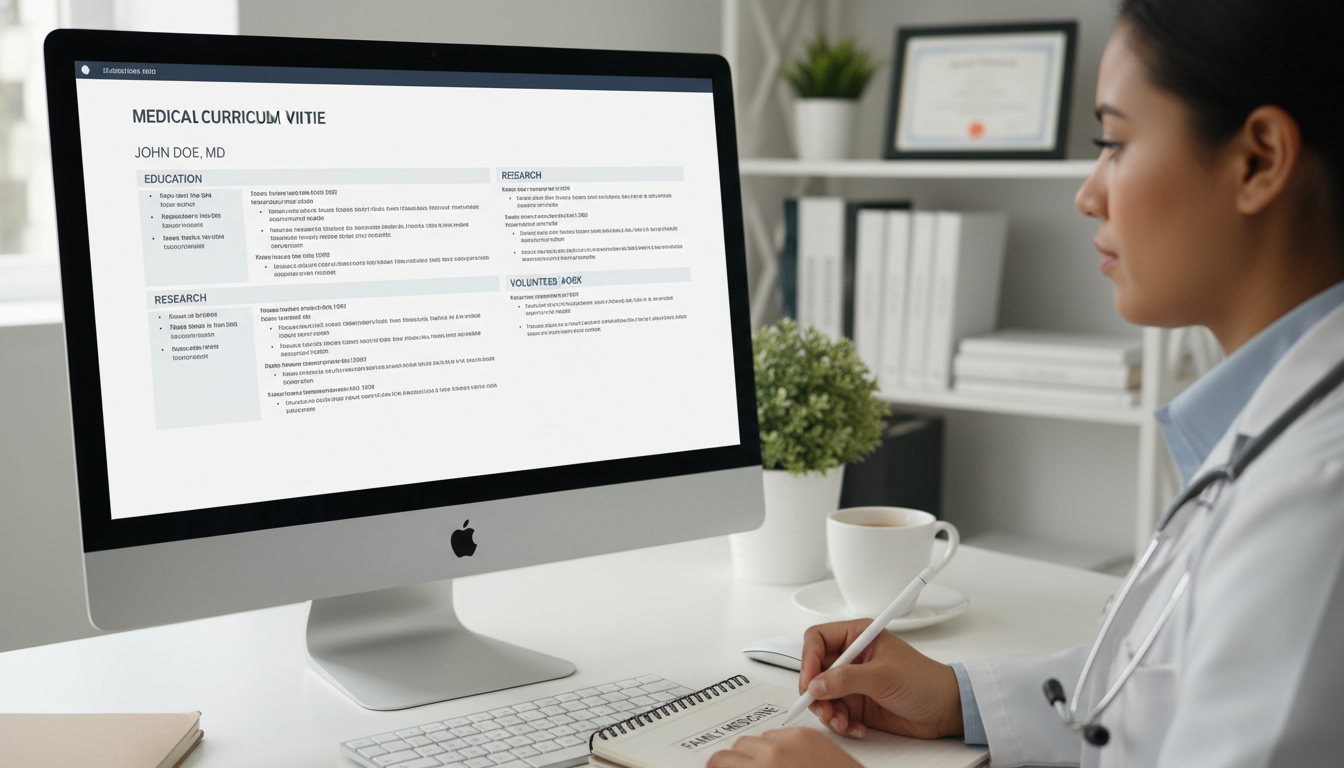
Your CV should be clean, structured, and easy to skim in under 30 seconds. While ERAS has its own fields, you should maintain a standalone medical student CV that aligns with what you enter in ERAS. This serves as your master document and helps with networking, emails to program directors, and away rotations.
Recommended Sections (in order)
- Contact Information
- Education
- Exams & Certifications
- Clinical Experience
- Research & Scholarly Activity
- Leadership & Professional Involvement
- Volunteer & Community Service
- Awards & Honors
- Skills & Languages
- Personal Interests
You do not need all of these sections to be full, but you should:
- Avoid obvious empty sections (e.g., a “Research” section with no entries).
- Combine or omit minor categories if they’re very light (e.g., “Awards & Honors” can merge with “Leadership”).
Below are residency CV tips to make each section serve your FM story.
Section-by-Section Guide: How to Build Your Residency CV as a US Citizen IMG
1. Contact Information
Keep this simple and professional:
- Name: As it appears on official documents.
- Email: Use a professional email (e.g., firstname.lastname@…); avoid nicknames.
- Phone: US phone number, voicemail set up with professional greeting.
- Current Address: US address if you have one during application season.
- LinkedIn (optional): Only include if it’s fully up to date and consistent with your CV.
Common IMG mistake: Leaving only foreign contact info or a non-functional phone/voicemail during interview season.
2. Education
As an American studying abroad, this section is crucial. It orients programs immediately.
Format example:
Doctor of Medicine (MD) or MBBS equivalent
Name of Medical School, City, Country
Month Year – Expected Month Year- US citizen IMG; completed core clinical rotations with emphasis in primary care and family medicine.
Undergraduate Degree
Bachelor of Science in Biology, University Name, City, State, USA
Month Year – Month Year- GPA (optional, if strong and recent).
Tips specific for US citizen IMGs:
- Explicitly note that you are a US citizen in your ERAS personal statement and other materials; the CV can mention it in a brief bullet under medical school if helpful.
- If your medical school is less known, you can add one clarifying bullet (e.g., “WHO-listed, English-language instruction, affiliated with [hospital name].”).
- If you did a post-bacc or master’s to strengthen your application, highlight performance.
3. Exams & Certifications
Family medicine programs care deeply about your ability to pass boards and practice safely.
Include:
- USMLE/COMLEX scores and dates (if you choose to list them; some applicants prefer not to list scores directly on the CV and rely on ERAS, which is acceptable).
- BLS/ACLS certification with expiration dates.
- Any certificates relevant to primary care (e.g., smoking cessation counseling, cultural competency).
Advice:
- If you have strong Step 2 CK but weaker Step 1, you can note Step 2 and leave Step 1 off the CV and let ERAS speak for both.
- Do not list exams as “scheduled” on your CV. That belongs in application communications, not in the formal CV.
4. Clinical Experience: The Heart of Your FM CV
For family medicine, this is often the most important section, especially for IMGs.
Break it into:
- US Clinical Experience (USCE) – highlight this separately.
- International/Medical School Rotations
US Clinical Experience
Label clearly. Example:
US Clinical Experience – Family Medicine & Primary Care
Sub-Intern, Family Medicine
XYZ Family Medicine Residency Clinic, City, State, USA
Month Year – Month Year- Managed panel of continuity patients under supervision, including chronic disease management (diabetes, hypertension, COPD).
- Performed focused physical exams and presented patients to attending and senior residents.
- Documented notes in EMR (Epic), including assessment and plan, medication reconciliation, and preventive care measures.
- Participated in interdisciplinary team meetings with social work and pharmacy.
Outpatient Clinical Observer, Family Medicine
ABC Community Health Center, City, State, USA
Month Year – Month Year- Observed patient care in a federally qualified health center serving underserved populations.
- Developed familiarity with US healthcare system, insurance issues, and social determinants of health.
- Assisted with patient education materials on diabetes management and smoking cessation.
Key residency CV tips for this section:
- Maximize any USCE you have and make it obvious.
- Use active, competency-focused bullets: patient volume, level of responsibility, EMR experience, types of conditions managed, procedures observed/performed.
- Tailor bullets to family medicine themes:
- Chronic disease management
- Preventive care and screening
- Behavioral health and motivational interviewing
- Continuity and longitudinal follow-up
- Do not inflate your role. Misrepresenting observer roles as hands-on can backfire if your letters or interviews contradict it.
Core and Elective Rotations (International)
List major clinical rotations, emphasizing those relevant to FM:
Clinical Rotations – Medical School
XYZ International Medical University, CountryFamily Medicine / General Practice – 8 weeks (Month Year – Month Year)
- Managed common outpatient presentations (URIs, back pain, headaches, minor trauma) under supervision.
- Conducted preventive health visits and counseling on diet, exercise, and vaccinations.
Internal Medicine – 12 weeks
- Admitted and followed inpatients with heart failure, diabetes complications, COPD, and infections.
- Participated in daily rounds and case presentations.
Pediatrics – 8 weeks
Obstetrics & Gynecology – 8 weeks
Psychiatry – 6 weeks
For family medicine, highlight rotations that reflect broad-spectrum training: IM, peds, OB, psych, geriatrics, emergency.
5. Research & Scholarly Activity: Tailored for FM
You do not need a PhD or dozens of publications for family medicine. Programs value applied, clinically meaningful work, especially in:
- Population health
- Quality improvement (QI)
- Health disparities
- Chronic disease outcomes
- Behavioral health in primary care
- Community-based research
Example entries:
Quality Improvement Project – Improving Hypertension Control in Clinic Patients
XYZ Community Clinic, City, Country | Month Year – Month Year- Collected baseline data on hypertension control among adult patients.
- Implemented a patient reminder system for follow-up blood pressure checks.
- Increased proportion of controlled BP patients from 55% to 70% over 6 months.
Poster Presentation – “Barriers to Diabetes Self-Management in Low-Income Urban Populations”
Regional Primary Care Conference, City, State | Month Year- Conducted structured interviews with 30 patients in a family medicine clinic.
- Presented findings on transportation, health literacy, and cost barriers.
If you have limited research:
- Emphasize small QI projects or case reports from family medicine or internal medicine rotations.
- Use bullet points to show impact: What changed? What did you learn?
6. Leadership & Professional Involvement
Programs want to see that you can:
- Work on teams.
- Take initiative.
- Communicate effectively.
For a US citizen IMG, leadership also demonstrates commitment and resilience while training abroad.
Examples:
President, Family Medicine Interest Group (FMIG)
XYZ International Medical University | Month Year – Month Year- Organized monthly talks on primary care topics and virtual panels with US family medicine residents.
- Developed a mentorship program pairing pre-clinical students with senior students pursuing family medicine.
Coordinator, USMLE Study Group
- Led weekly group sessions, created shared study schedules and resource lists.
Student Representative, Curriculum Committee
- Provided feedback on clinical skills teaching and primary care exposure.
Whenever possible, tie leadership to family medicine: FMIG roles, primary care outreach projects, interprofessional education.
7. Volunteer & Community Service: A Major Asset in Family Medicine
Family medicine values service, continuity, and community engagement. As a US citizen IMG, your community involvement can strongly reinforce your fit.
Examples to highlight:
- Free clinics
- Health fairs
- School-based health education
- Work with immigrant, refugee, or underserved populations
- Crisis hotlines, mental health advocacy
- Long-term, consistent commitments (even non-medical)
Sample entry:
Volunteer, Community Free Clinic
City, State, USA | Month Year – Month Year- Assisted with patient intake, vital signs, and health education under supervision.
- Helped coordinate follow-up appointments and referrals to community resources.
Health Educator, School-Based Program
- Delivered interactive sessions on nutrition, physical activity, and mental health to middle school students.
Actionable tip:
If your volunteer work is primarily outside the US, try to add at least one US-based community experience (even short-term) before applying. It shows engagement with the population you intend to serve.
8. Awards & Honors
List anything that reflects academic excellence, professionalism, service, or leadership:
- Dean’s List, distinction awards, scholarships.
- Awards for teaching, mentorship, or community work.
- Recognition from clinics or hospitals (e.g., “Outstanding Student in Family Medicine Rotation”).
If you don’t have formal awards, don’t invent them. Instead, double down on strong descriptions in other sections.
9. Skills & Languages
For family medicine, certain skills are particularly attractive:
Languages: Be honest about proficiency. Use categories like:
- Native / Fluent
- Professional working proficiency
- Conversational
Family medicine programs in diverse communities value bilingual applicants (Spanish, Arabic, Mandarin, etc.).
Technical/Clinical Skills:
- EMR experience (Epic, Cerner, etc.)
- Point-of-care ultrasound (POCUS) exposure
- Office-based procedures observed/performed (pap smears, joint injections, simple suturing, etc.)—describe in clinical experience or skills, but don’t overstate competence.
Other:
- Data analysis tools (if you did research/QI).
- Teaching/tutoring experience.
10. Personal Interests
This is not fluff. Family medicine programs often value well-rounded, personable physicians with sustainable interests.
Examples:
- Long-distance running, yoga, team sports.
- Music or art, especially if tied to community performances.
- Cooking, gardening, travel, especially with a global or cultural perspective.
Aim for 3–5 concise items. Avoid controversial topics (politics, polarizing activities). Be prepared to talk about any interest in detail during interviews.
Strategic Considerations for US Citizen IMGs in Family Medicine

1. Aligning Your CV with a Family Medicine Narrative
Your whole CV should answer: Why should a family medicine program invest in this applicant?
Ways to build that narrative:
- At least one strong US family medicine rotation (sub-I, externship, or robust observership).
- Consistent community service or primary care engagement.
- Leadership or memberships in FMIG or primary care groups.
- Scholarly activity in primary care, health disparities, or community health.
When deciding what to include or emphasize, ask:
“Does this help a PD see me as a future family medicine physician?”
If not, either shorten it or omit it.
2. Addressing Common IMG Concerns on the CV
Gaps in training:
- Do not leave unexplained calendar gaps.
- Briefly indicate what you did (e.g., “USMLE preparation and part-time clinical observership,” “Family responsibilities while maintaining volunteer work at X clinic”).
Multiple attempts on exams:
- Do not highlight attempts on the CV.
- Focus on later success: strong Step 2, solid clinical performance, QI projects.
- Use your personal statement or advisor discussions to frame growth if needed.
Limited research:
- Emphasize QI, case reports, teaching, and community engagement—highly valued in FM.
- One or two well-described projects are sufficient.
3. Formatting and Style Essentials
Residency directors may only glance at your CV for 30–60 seconds initially.
Follow these formatting rules:
- Length: 1–3 pages is typical for a medical student CV.
- Font: Simple, professional (e.g., 11–12 pt Calibri, Arial, or Times).
- Consistency: Same date format, same bullet style, same verb tense for similar items.
- Order: Reverse chronological (most recent first) within each section.
- Grammar: Use past tense for completed experiences, present tense for ongoing ones.
- Avoid dense paragraphs; use bullets for clarity.
Don’t:
- Use photos, borders, or colorful fonts on the CV (ERAS doesn’t allow photos in the main app either).
- Overuse jargon or abbreviations that a PD outside your country won’t recognize.
4. Turning Your CV Into a Story for Interviews
Your CV is the script for your interview. Everything on it must be:
- Truthful
- Comfortably discussable
- Connected to your FM interest
Actionable steps:
Go line by line and create a 1–2 sentence story for each major experience:
- What you did
- What you learned
- How it prepared you for family medicine
Identify 3–5 “anchor experiences” on your CV that strongly show your FM fit:
- A US family medicine sub-I
- A community clinic volunteer role
- A QI project in primary care
- A leadership role in FMIG
Practice answering:
- “Tell me about this experience in your CV.”
- “How did working at [clinic/rotation] influence your decision to pursue family medicine?”
Putting It All Together: A One-Year CV-Building Plan (If You’re Early)
If you are 1–2 years away from applying and wondering how to build a CV for residency strategically:
Months 1–3
- Secure at least one US family medicine rotation (sub-I or externship).
- Start or continue regular community service, ideally in a US setting if possible.
- Organize your existing experiences into a basic medical student CV.
Months 4–6
- During USCE, actively seek small QI or case-based projects.
- Ask attendings for feedback and potential letters; work toward strong FM letters.
- Join or lead family medicine interest or primary care groups (even remotely if abroad).
Months 7–9
- Finalize at least one poster, case report, or small project.
- Fill any gaps with additional outpatient or primary care exposure.
- Refine your CV formatting, ensuring clarity and strong FM-oriented bullets.
Months 10–12
- Cross-check your CV against your ERAS application entries for consistency.
- Have mentors (especially US-based) review your CV specifically from the lens of a family medicine PD.
- Prepare your interview stories based on your CV content.
FAQs: CV Building for US Citizen IMGs in Family Medicine
1. Should I label myself as a “US citizen IMG” on my CV?
You don’t need to literally write “US citizen IMG” on the CV, but it’s fine to mention in a bullet under education (e.g., “US citizen studying medicine abroad”). Programs will see your citizenship status in ERAS; the key is making it clear that you understand the US system and have US clinical experience. Emphasize your US background and USCE throughout the CV rather than the label itself.
2. Is research mandatory for a family medicine residency CV?
No. Family medicine does not require heavy research. However, at least some scholarly activity—especially QI projects, case reports, or community health projects—strengthens your application. Focus less on high-impact journals and more on practical, primary care–relevant work that you can describe intelligently and enthusiastically.
3. How important is US clinical experience for a US citizen IMG applying to family medicine?
Very important. Even as a US citizen, programs need evidence that you can function in the US healthcare environment. Aim for at least one substantial US family medicine rotation and, if possible, additional primary care or internal medicine experiences. On your CV, clearly separate a “US Clinical Experience” subsection with detailed, responsibility-focused bullets.
4. Can non-medical jobs or experiences be included on a residency CV?
Yes, if they demonstrate skills valued in family medicine (communication, teamwork, leadership, service, resilience). Examples: teaching, customer service roles, community organizing, military service. Place them under a section like “Employment & Other Experience” and use bullets to connect them to competencies relevant for residency (e.g., conflict resolution, working with diverse populations, time management).
By treating your CV as a strategic, family medicine–focused narrative rather than a simple list, you—especially as a US citizen IMG—can show programs that you’re not just eligible for training, but uniquely prepared to serve as a compassionate, competent, community‑oriented family physician in the US.