Understanding the Purpose of Your CV in Diagnostic Radiology
Your residency CV is more than a list of activities—it’s a strategic document that tells program directors, “I understand what a radiologist does, I’ve started building the right skills, and I will be a low-risk, high-yield resident.”
For an MD graduate applying to diagnostic radiology residency, your CV needs to do three things:
Show readiness for the rigors of radiology training
Evidence: strong academic performance, USMLE scores (if listed), solid clinical foundation, and professionalism.Demonstrate a clear and sustained interest in diagnostic radiology
Evidence: radiology electives, research, shadowing, radiology-related QI projects, imaging-focused presentations, radiology organizations.Highlight potential as an academic contributor and team member
Evidence: research and publications, teaching, leadership, systems-based projects, and interprofessional collaboration.
Unlike some other fields, diagnostic radiology places a premium on:
- Analytical thinking and pattern recognition
- Comfort with technology and imaging informatics
- Attention to detail and accuracy
- Reliability and efficiency
- Communication skills (written and verbal reports; interactions with referrers)
Your CV should be curated to foreground these strengths.
Key mindset:
Your CV is not a data dump. It’s a selectively edited, well-organized professional narrative tailored to the diagnostic radiology match—and specifically to residency programs that value clinically strong, data-driven, collaborative physicians.
Core Structure: How to Organize a Radiology-Focused Residency CV
Programs quickly screen many applications, and your CV is often reviewed in under a minute on first pass. Structure and clarity matter as much as content.
A clean structure for an MD graduate residency applicant aiming at radiology might be:
- Contact Information & Professional Summary (optional, short)
- Education
- Examination Scores & Certifications (optional section depending on ERAS; can be omitted if redundant)
- Clinical Experience
- Radiology-Specific Experiences (Electives, Observerships, Sub-internships)
- Research & Scholarly Activity
- Presentations & Posters
- Teaching & Mentorship
- Leadership & Professional Involvement
- Quality Improvement, Informatics, and Projects
- Skills (Technical, Language, and Relevant Software)
- Honors & Awards
- Volunteer and Community Service
- Interests (1–2 succinct lines)
Contact Information
Keep it clean and professional at the very top:
- Full name, MD (or equivalent)
- Professional email (e.g., firstname.lastname@…)
- Mobile phone
- City/State (full address is optional)
- LinkedIn or professional website (optional but helpful if well-maintained)
Avoid:
- Personal photos
- Nicknames
- Excessive social media links
Professional Summary (Optional but Useful for Radiology)
A 2–3 line summary can help frame your application quickly, especially if your path is non-traditional or you’re a reapplicant.
Example:
MD graduate from an allopathic medical school with strong academic performance, multiple imaging-based research projects, and extensive experience in diagnostic radiology electives. Particularly interested in oncologic imaging and quality improvement in radiology workflows.
This is not required—but if done, it must be concise and aligned with your radiology residency goals.
Education and Clinical Experience: Building a Strong Foundation
Education Section: Show Strength and Progression
List in reverse chronological order:
Medical School (Allopathic / Osteopathic or international)
- Institution, city, country
- Degree (MD), graduation month/year
- Honors (e.g., AOA, Gold Humanism, Dean’s List if applicable)
- Thesis or scholarly concentration (if substantial)
Undergraduate (if relevant)
- Institution, degree, major, graduation year
- Significant honors or distinctions
Example entry:
Doctor of Medicine (MD)
XYZ Allopathic Medical School, City, State
Graduated: May 2025
- AOA Honor Society (2024)
- Scholarly Concentration in Imaging and Informatics
For the allopathic medical school match, clearly stating your medical school and degree assures programs of your training background and builds trust in your academic preparation.
Clinical Experience: Connect to Radiology
For your residency CV, list clinical rotations that matter most. ERAS will also capture this, but on your CV you can strategically highlight aspects relevant to imaging.
You can organize clinical experience in two possible ways:
- Standard Clinical Clerkships + Radiology Section (common for US MDs)
- Clinical Experience (US + Home Country) + Radiology Subsection (common for IMGs or those with varied experience)
Example (brief):
Core Clinical Clerkships, XYZ Allopathic Medical School
Jul 2023 – May 2024
- Internal Medicine (8 weeks): Managed inpatient teams; frequently collaborated with radiology for CT and MRI interpretations and interdisciplinary rounds.
- Surgery (8 weeks): Assisted in pre-op and post-op imaging review, including trauma CTs and abdominal imaging.
- Pediatrics (6 weeks), Obstetrics & Gynecology (6 weeks), Psychiatry (4 weeks), Family Medicine (4 weeks).
You don’t need to describe every rotation in detail; emphasize points where you worked closely with imaging or developed skills relevant to radiology—analytical decision-making, interdisciplinary communication, and case presentations.
Building and Showcasing Radiology-Specific Experience
This is where your CV can truly stand out in the diagnostic radiology match. Programs want to see evidence that you know what radiologists actually do and have sought meaningful exposure.
Radiology Electives and Sub-Internships
Create a distinct section, such as:
Diagnostic Radiology Clinical Experiences
Example:
Sub-internship in Diagnostic Radiology
ABC University Hospital, City, State
Aug 2024
- Participated in daily readouts in neuroradiology and body imaging.
- Independently reviewed plain films and CT studies prior to attending readout.
- Presented two interesting imaging cases at weekly radiology case conference.
Elective in Emergency Radiology
DEF Medical Center, City, State
Jun 2024
- Observed a high volume of trauma and emergent CT/MRI studies.
- Developed preliminary impressions on urgent studies under supervision, improving speed and accuracy in pattern recognition.
Tips:
- Highlight subspecialties you experienced (MSK, neuro, body, chest, emergency).
- Emphasize readout participation, case presentations, and any structured teaching you received or provided.
Shadowing and Observerships (Especially Important for IMGs)
If you’re an MD graduate from outside the US or from a school with limited radiology exposure, observerships are crucial.
Radiology Observerships
Diagnostic Radiology Observer
GHI Teaching Hospital, City, State
Jan – Mar 2024
- Observed workflow in general radiology, interventional radiology, and neuroradiology.
- Participated in multidisciplinary tumor boards, seeing how imaging guided management decisions.
- Completed a small retrospective project on CT pulmonary angiography utilization.
Make sure each entry shows:
- Setting (teaching hospital/community)
- Scope (which modalities and subspecialties)
- Active learning (tumor boards, conferences, mini-projects)
Radiology-Related Projects and Roles
Any non-research projects that show initiative in a radiology context belong here or under a “Projects” section.
Examples:
- Helped optimize a radiology teaching file database.
- Assisted with PACS workflow evaluation or protocol standardization.
- Created radiology teaching sessions for junior students.
Document as:
Radiology Teaching File Development Project
XYZ Medical School, Department of Radiology
Feb – May 2024
- Curated and anonymized 80+ imaging cases with teaching points for use in resident education.
- Standardized case templates to improve searchability and educational value.
These demonstrate that you understand workflow, education, and systems improvement—attributes valued in radiology.
Research, Scholarly Work, and Academic Potential in Radiology
For many diagnostic radiology residency programs, research is a major differentiator, especially in academic centers. However, lack of radiology research does not disqualify you; you just need to present your scholarly work thoughtfully.
Research Section: Structure and Order
Use a structure like:
- Peer-reviewed Publications
- Manuscripts Under Review / In Preparation (clearly labeled)
- Abstracts
- Posters and Oral Presentations
- Book Chapters or Educational Content
Order within each subcategory should be reverse chronological. Use standard citation style and bold your name.
Peer-reviewed Publications
Doe J, Smith A, Lee R. “Optimizing CT Protocols for Trauma Imaging in a Community Hospital.” Journal of Emergency Radiology. 2024; 31(2):123–129.
If your research is not in radiology, that’s acceptable—still list it, but highlight:
- Quantitative/analytic methods
- Use of imaging as an outcome or supporting tool
- Data management or programming skills relevant to radiology (R, Python, SQL, etc.)
Radiology-Focused Research Examples
Retrospective Study on MRI Utilization in Low Back Pain
Department of Radiology, ABC University Hospital
Jul 2023 – Dec 2023
- Reviewed 300+ MRI lumbar spine studies to evaluate appropriateness per ACR guidelines.
- Found overutilization in 20% of cases; work presented as a poster at the State Radiological Society Meeting.
AI and Imaging Analytics Projects
- Assisted in labeling imaging datasets for machine learning models.
- Analyzed inter-reader variability between residents and attendings.
This strengthens your positioning in a field where AI, informatics, and image-based analytics are rapidly evolving.
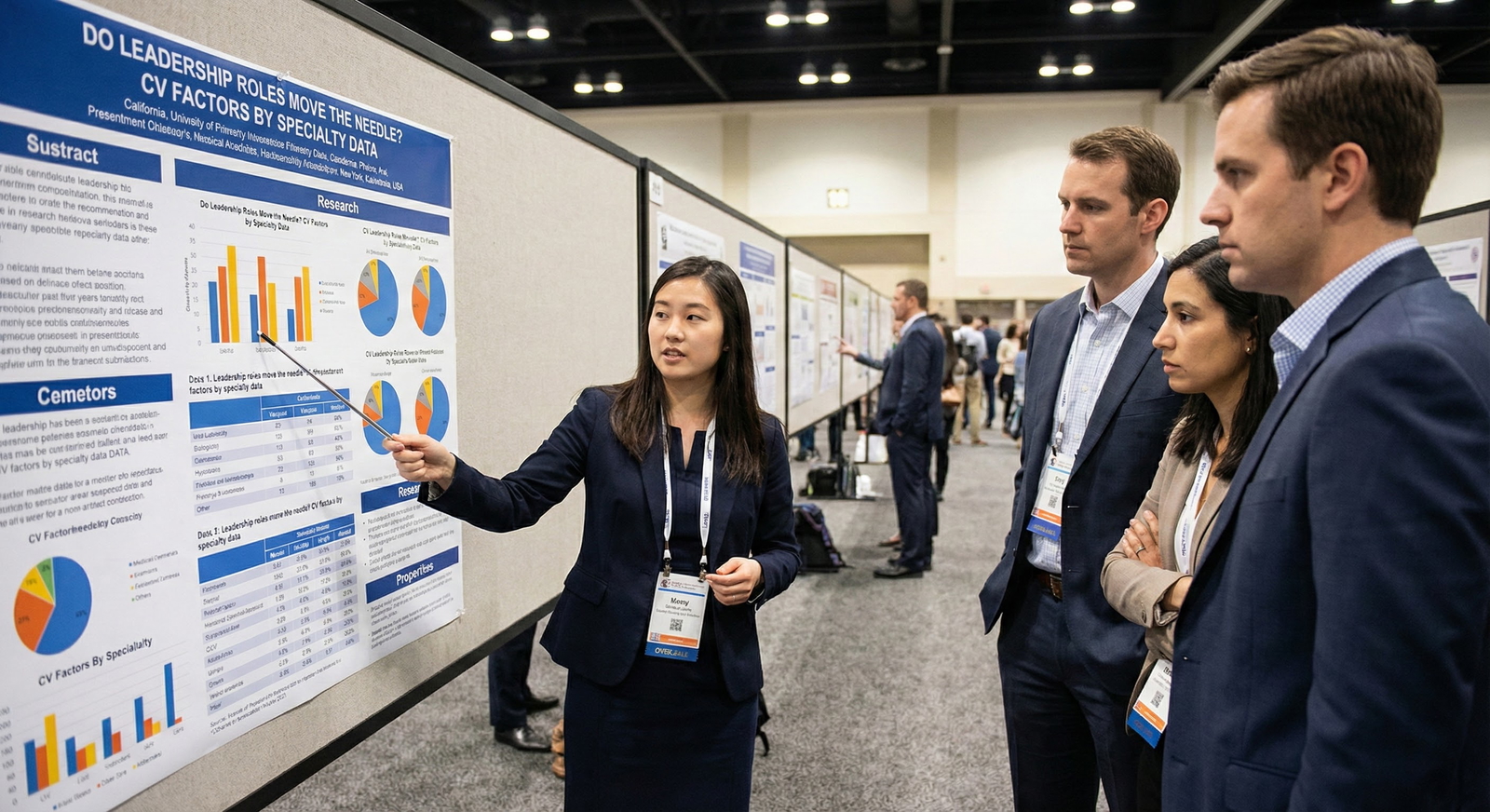
Presentations and Posters: Don’t Underestimate Their Value
Programs look favorably on applicants who present work, even locally.
Conference Presentations
Smith A, Doe J. “Patterns of Incidental Pulmonary Nodules on Trauma CT: Implications for Follow-up.” Oral presentation, Citywide Radiology Research Day, May 2024.
Clearly label poster vs oral and local, regional, national, or international.

Crafting a Competitive Medical Student CV for Radiology: Practical Tips and Examples
This section focuses on residency CV tips and explicitly addresses how to build CV for residency with diagnostic radiology in mind.
1. Tailor, Don’t Generalize
For a medical student CV aimed at radiology, every major section should answer: “What does this show about how I’d perform as a radiology resident?”
For example:
Under “Clinical Experience,” don’t just say:
Managed inpatient medical patients.
Instead, add a radiology-relevant dimension:
Coordinated imaging workup for complex inpatient cases, frequently synthesizing CT and ultrasound findings into management plans during rounds.
Under “Research,” highlight imaging aspects or analytical methodologies.
2. Use Action Verbs That Reflect Radiology Skills
Favor verbs that suggest:
- Interpretation: “reviewed,” “analyzed,” “interpreted under supervision”
- Systems thinking: “optimized,” “streamlined,” “standardized”
- Communication: “presented,” “collaborated,” “created teaching materials”
Example bullet conversions:
- Weak: “Worked on radiology project with residents.”
- Strong: “Analyzed CT utilization patterns with radiology residents, identifying protocol changes that reduced non-indicated scans by 12%.”
3. Quantify Whenever Possible
Radiology is data-heavy. Quantifying gives credibility and resonates with the specialty’s analytic culture:
- “Reviewed over 150 imaging studies under attending supervision.”
- “Curated 80+ teaching cases in musculoskeletal radiology.”
- “Co-authored 2 radiology conference abstracts and 1 peer-reviewed article.”
4. Highlight Technical and Informatics Skills
A dedicated “Skills” section should be concise but strategic:
Technical & Informatics Skills
- PACS and RIS familiarity (Cerner, Epic, or specific system if relevant)
- Basic DICOM understanding
- Data analysis: R / Python / SPSS / Excel (if truly used)
- Basic coding or scripting (Python, MATLAB, etc.), especially for image analysis or AI
- LaTeX or reference managers (EndNote, Zotero, Mendeley) for academic work
Radiology is at the interface of medicine and technology; these competencies are valued.
5. Include Teaching and Leadership—Radiology Is a Team Sport
Radiologists teach trainees, communicate with clinicians, and often lead service lines. Use CV sections to show:
- Small-group teaching for junior students (e.g., “Intro to Reading Chest X-rays” workshop)
- Leadership roles in radiology interest groups or student organizations
- Coordination of radiology case conferences or journal clubs
Example:
Co-leader, Radiology Interest Group
XYZ Medical School
Sep 2023 – Apr 2024
- Organized monthly imaging case discussions led by residents and faculty.
- Developed introductory chest radiograph interpretation sessions attended by 40+ preclinical students.
This shows alignment with a collaborative, academic culture.
6. Don’t Overstuff; Curate for Impact
Programs will skim. For each section, ask:
- Does this entry add something new about my capabilities?
- Is it relevant to how I will function in radiology training or medicine broadly?
It’s acceptable to omit:
- Minor, short-term activities without sustained engagement
- Very old pre-medical activities that don’t add value
- Overly detailed job descriptions from non-medical work (unless they show critical transferable skills)
Polishing and Presenting Your Radiology Residency CV
Formatting Essentials
- Length: For an MD graduate residency applicant, usually 2–4 pages is reasonable, depending on research volume.
- Font: Professional and readable (e.g., 11–12 pt Calibri, Times New Roman, or Arial).
- Margins: Standard 1-inch or slightly reduced if needed (but keep it clean).
- Consistency: Uniform date formats, bullet styles, and heading levels.
Avoid:
- Dense blocks of text; use concise bullets.
- Overly decorative layouts or graphics—your audience is highly analytical and time-limited.
- Typos or grammatical errors—attention to detail is crucial in radiology.
Alignment with ERAS and the Allopathic Medical School Match
You will duplicate much content from your CV into ERAS, but your standalone CV is still important for:
- Away rotations
- Mentors and letter writers
- Networking at conferences
- Some program websites or supplemental applications that request a PDF CV
Ensure:
- No discrepancies between your CV and ERAS entries.
- Titles, dates, and authorship consistent across documents.
- Your narrative (personal statement, experiences, and CV) tells a coherent story about your journey to the diagnostic radiology match.
Getting Feedback from Radiology Mentors
Before finalizing, ask:
A radiology resident or faculty member to review your CV with the question:
“If you saw this in a stack of diagnostic radiology residency applications, what would stand out, and what feels generic or confusing?”
A non-radiologist mentor to check clarity and structure—they should still understand your strengths easily.
Incorporate feedback on:
- Redundant or low-yield entries
- Clarity of radiology interest
- Balance between academic, clinical, and personal elements
Common Pitfalls to Avoid
- Over-claiming involvement: Radiology attendings are very sensitive to accuracy. Do not inflate roles in research or clinical activities.
- Listing unsubmitted or conceptual projects as ‘in progress’: Only include manuscripts “in preparation” if there is a real draft and ongoing work; never misrepresent review or acceptance status.
- Overloading with abbreviations: Spell out terms on first use, especially for non-standard local abbreviations.
- Inconsistent authorship order: Match your CV to formal citations and conference abstracts.
FAQs: CV Building for MD Graduates in Diagnostic Radiology
1. How important is radiology-specific research for a diagnostic radiology match?
Radiology-specific research is helpful but not mandatory. Academic radiology residency programs value it more, but strong general research in outcomes, AI, quality improvement, or clinical medicine still demonstrates analytic skills and academic interest. If you lack radiology research, focus on:
- Clinical excellence and strong letters from radiologists
- Radiology electives and observerships
- Involvement in imaging-related QI or case reports
Your CV should still show a clear, consistent interest in imaging.
2. Should I include USMLE scores on my CV if ERAS already has them?
For most applicants, it’s optional. Many MD graduates omit detailed scores from the CV because ERAS handles that centrally. You may include a small “Examinations & Certifications” section if:
- A program or mentor specifically requests it, or
- You are sending the CV outside of ERAS (e.g., to a research PI, away rotation coordinator).
If you do list them, be accurate and concise, e.g., “USMLE Step 2 CK: 248 (2024).”
3. How far back should I go with experiences on my residency CV?
Focus primarily on medical school and late undergraduate years. Include pre-medical experiences only if they:
- Show significant leadership or long-term commitment,
- Are directly relevant to radiology (e.g., engineering, signal processing, data science), or
- Represent a major achievement (e.g., national-level scholarship).
Avoid cluttering your CV with short, minor, or unrelated high school activities.
4. How can I strengthen my CV if I’m a late convert to radiology?
If you decided on radiology late, you can still present a compelling profile:
- Add at least one or two radiology electives or observerships before applications, if possible.
- Seek out a small but real radiology project (case report, QI project, teaching file work).
- Ask for at least one strong letter from a radiologist.
- Use bullets in clinical sections to highlight your frequent interaction with imaging and multidisciplinary decision-making.
Your CV should reflect a clear, intentional pivot—connected by your analytic strengths, interest in imaging, and consistent professionalism.
By approaching your medical student CV as a strategic document—not just a list of activities—you can effectively communicate your readiness for the demands of diagnostic radiology residency. Thoughtful structure, precise language, radiology-focused experiences, and clear evidence of academic and clinical potential will make your application stand out in the competitive allopathic medical school match.