Understanding the CV for a Preliminary Medicine Residency
For an MD graduate targeting a Preliminary Medicine (Prelim IM) year, your CV is more than a list of experiences—it is a strategic document that tells program directors you are ready to function as a capable, reliable intern in internal medicine while still preparing for your advanced specialty.
Unlike categorical internal medicine applicants, you are often applying to both:
- Preliminary Medicine programs, and
- Advanced programs (e.g., Neurology, Radiology, Anesthesiology, Dermatology, Ophthalmology, PM&R, etc.)
This means your medical student CV has to do two things simultaneously:
- Demonstrate you will be a strong medicine intern: reliable, clinically competent, team-oriented.
- Align with your long-term specialty goals while still looking attractive to internal medicine departments.
In this guide, you’ll learn how to build a CV for residency specifically optimized for:
- MD graduate residency applicants
- Allopathic medical school match pathways
- Preliminary medicine year positions (Prelim IM)
We will cover structure, content, strategy, and detailed residency CV tips you can apply immediately.
Core Principles of a Strong Prelim Medicine CV
Before diving into sections and formatting, anchor your approach around these core principles.
1. Clinical Readiness Is Your Central Message
For a preliminary medicine year, programs want to see that you can:
- Handle high patient volumes
- Work efficiently on wards, ICU, and night float
- Communicate clearly with multidisciplinary teams
- Take ownership, follow up, and be dependable
Your CV should therefore highlight:
- Core medicine rotations with strong performance
- Any sub-internships (Sub-Is) or acting internships in internal medicine
- Night float, ICU, or step-down unit exposure
- Evidence of professionalism and work ethic
2. Stability and Reliability Matter
Prelim positions are one-year commitments; programs don’t want to worry about attrition, lack of motivation, or poor fit. Use your CV to subtly convey:
- Continuity: Long-standing roles (e.g., multi-year leadership, longitudinal clinics)
- Follow-through: Completed quality improvement (QI) projects, research from idea to publication, etc.
- Professional conduct: Peer-reviewed recognition, teaching, or committee work
3. Align With Both Medicine and Your Advanced Specialty
If you are, for example, applying advanced Radiology and Prelim Medicine:
- Your CV should not look like it ignores internal medicine.
- Emphasize medicine-relevant skills (clinical reasoning, patient care) and also include advanced-specialty-aligned research or electives.
This dual alignment is key for MD graduates in the allopathic medical school match who must secure both an advanced spot and a preliminary medicine year.
4. Clarity and Professionalism Over Flash
Your CV is not a design portfolio. For residency:
- Avoid graphics, colors, or multi-column layouts.
- Use simple, clean, consistent formatting.
- Be precise, avoid exaggeration, and ensure everything is verifiable.
Ideal CV Structure for a Prelim IM Applicant
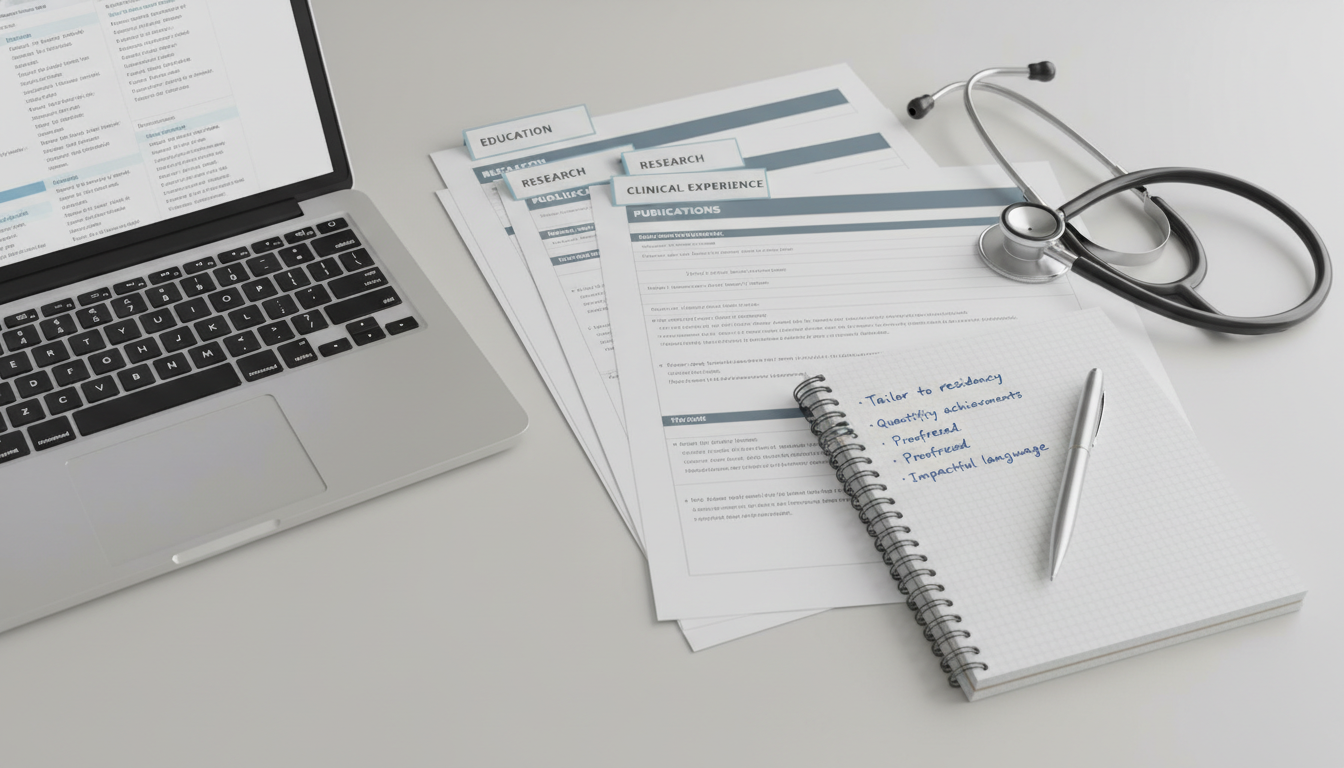
A strong MD graduate residency CV targeting Preliminary Medicine should generally follow this order:
- Contact Information & Personal Details
- Education
- USMLE/COMLEX Scores (or Board Exams)
- Clinical Experience (Medical School Rotations, Sub-Internships)
- Research Experience
- Publications, Presentations, and Posters
- Leadership & Professional Involvement
- Teaching & Mentoring Experience
- Quality Improvement and Patient Safety Projects
- Awards and Honors
- Volunteer and Community Service
- Skills (Clinical, Language, Technical)
- Interests (Optional but recommended)
You can adjust slightly based on your strengths—for example, if research is a major asset, it can move higher—but clinical experience and education should always come early.
Section-by-Section Guide: How to Build Your Prelim Medicine CV
1. Contact Information & Personal Details
Keep this simple at the top of page 1:
- Full Name (as on your ERAS application)
- MD degree (e.g., “John A. Smith, MD”)
- Professional email (avoid nicknames)
- Mobile phone number
- City, State (optional but acceptable)
- LinkedIn (optional, only if it is polished and up to date)
Do not include:
- Photo (ERAS handles photos separately if applicable)
- Date of birth, marital status, or visa status (only indicate visa needs in ERAS or personal statement if appropriate)
2. Education
List in reverse chronological order:
Example:
MD, Allopathic Medical School, City, State
Expected Graduation: May 2026- Class Rank (if top tier and reported; e.g., Top 15%)
- Notable distinctions (e.g., AOA, Gold Humanism Honor Society)
BS in Biology, University Name, City, State
Graduated: May 2022, Magna Cum Laude
For an MD graduate, this section is usually straightforward. Highlight:
- Honors track (if applicable)
- Dual degrees (e.g., MPH, MBA, MS) – particularly helpful for QI, leadership, or health systems roles
3. Board Examinations (USMLE/COMLEX)
Although ERAS captures scores, many program directors expect to see a concise summary on your CV.
Example:
- USMLE Step 1 – Pass (Month Year)
- USMLE Step 2 CK – 24X (Month Year)
You do not need to list failed attempts on the CV; those will be visible in ERAS if present. Keep this section short and factual.
4. Clinical Experience: The Heart of a Prelim IM CV
This is one of the most critical segments for Preliminary Medicine programs evaluating your readiness to be an intern.
4.1 Core Clerkships
Include at least:
- Internal Medicine
- Surgery
- Pediatrics
- OB/Gyn
- Psychiatry
- Family Medicine
- Any medicine subspecialty electives
Format:
- Internal Medicine Core Clerkship, University Hospital, City, State
Dates: June–August 2024- Evaluations: Honors (or High Pass/Pass; use your school’s grading language)
- 8-week inpatient rotation, general medicine wards and step-down unit
- Managed 4–6 patients per day under supervision; presented on rounds; wrote daily progress notes and admission H&Ps
If your school permits, briefly mention:
- Honors or high performance
- Senior roles (e.g., “Chief student on team,” if formalized)
- Specific exposures (ICU, CCU, subspecialty consults)
4.2 Sub-Internships / Acting Internships (AI)
These are especially powerful for a prelim IM CV. If you have more than one, place them above core clerkships.
Example:
- Internal Medicine Sub-Internship, University Hospital
Dates: August–September 2025- Functioned with intern-level responsibilities under supervision: daily notes, admissions, order entry, care coordination
- Participated in night float; cross-covered 30–40 patients with senior supervision
- Led family discussions for goals of care under attending oversight
This directly addresses the question: “Can this MD graduate handle an intern workload in a busy Preliminary Medicine year?”
4.3 Electives Relevant to Medicine or Your Advanced Specialty
If you are applying Radiology + Prelim IM, relevant electives might include:
- Cardiology
- Pulmonology
- Nephrology
- Emergency Medicine
- Radiology electives showing imaging interest but also clinical relevance
Add 1–2 bullets indicating what you did—not a full job description, but concise, responsibility-focused points.
5. Research Experience
Even if you are not targeting a research-heavy advanced specialty, research signals curiosity, follow-through, and academic engagement.
5.1 Organize by Position
Example format:
- Research Assistant, Department of Cardiology, Allopathic Medical School, City, State
Dates: January 2024 – Present
Mentor: Jane Doe, MD- Retrospective chart review on outcomes in patients with heart failure readmissions
- Extracted and cleaned data for 400+ patients; performed basic statistical analyses (SPSS)
- Contributed to abstract accepted for presentation at ACC 2025 (see Publications/Presentations)
Prioritize:
- Internal medicine–related work
- QI and patient safety projects
- Outcomes or hospital-based research
5.2 For Strong Research Backgrounds
If you have significant research (e.g., a research year or multiple first-author publications):
- Keep descriptions short but impactful.
- Highlight your role: study design, data collection, analysis, manuscript writing.
6. Publications, Presentations, and Posters
This is where you demonstrate scholarly productivity. Program directors look here to assess your ability to take projects to completion.
6.1 Formatting Tips
Divide into subsections if you have more than a few entries:
- Peer-Reviewed Publications
- Abstracts & Posters
- Oral Presentations
Use a consistent citation style (e.g., AMA). Clearly distinguish published, accepted, and submitted (avoid listing “in preparation”).
Example:
Doe J, Smith J, et al. Hospital Readmission Rates in Heart Failure Patients After Implementation of a Transitional Care Clinic. J Hosp Med. 2025;10(3):123–130.
Smith J, Lee R, Doe J. Early Predictors of ICU Transfer in COVID-19 Patients. Poster presented at: Society of General Internal Medicine Annual Meeting; April 2024; San Diego, CA.
Be honest; program directors are experienced at spotting inflated or vague entries.
7. Leadership & Professional Involvement
Prelim IM programs value residents who will help teams run smoothly and support a positive culture.
Include:
- Class leadership (e.g., class officer, student government)
- National organizations (e.g., ACP, AMA, specialty societies)
- Committee roles (curriculum committees, wellness committees, diversity councils)
Example:
- Co-President, Internal Medicine Interest Group
Allopathic Medical School
Dates: 2023–2024- Organized monthly case conferences with IM faculty; average attendance 40+ students
- Coordinated a mentorship program pairing 60 students with 25 IM residents and faculty
This shows initiative, organizational skills, and interest in internal medicine.
8. Teaching and Mentoring Experience
Residency is both a learning and a teaching role. Prelim IM residents often supervise students on wards; highlighting teaching ability is a plus.
Examples:
- Peer tutor for pre-clinical courses (e.g., anatomy, physiology)
- Clinical skills preceptor assistant (OSCEs, physical exam teaching)
- Near-peer teaching on wards or in small-group settings
Example:
- Teaching Assistant, Physical Diagnosis Course
Dates: 2023–2024- Taught weekly small-group sessions for 10 first-year medical students
- Evaluated history-taking and physical exam techniques; provided written and verbal feedback
Teaching entries enhance your medical student CV and are valued across all specialties.
9. Quality Improvement (QI) and Patient Safety Projects
For a preliminary medicine year, QI involvement is especially attractive because:
- IM services often drive hospital QI initiatives.
- It shows readiness to engage in systems-based practice.
Example:
- Project Lead, “Improving Medication Reconciliation Accuracy on Hospital Discharge”
University Hospital, Internal Medicine Service
Dates: March–November 2024- Implemented a discharge checklist and pharmacist-student reconciliation protocol
- Reduced discharge medication discrepancies from 22% to 9% over 6 months
- Presented outcomes at the hospital QI symposium (see Presentations)
If possible, quantify outcomes (percent changes, time saved, error reductions).
10. Awards and Honors
Place this section higher if you have major achievements (AOA, GHHS, competitive research awards). Otherwise, mid-to-late in the CV is fine.
Examples:
- Alpha Omega Alpha (AOA), Inducted 2025
- Gold Humanism Honor Society, Inducted 2024
- Best Student Presentation, Department of Medicine Research Day, 2023
- Dean’s List (Undergraduate), 2018–2021
Awards reinforce your overall narrative of excellence and reliability.
11. Volunteer and Community Service
Programs look favorably on sustained service, especially if it reflects:
- Commitment to underserved populations
- Longitudinal involvement
- Alignment with patient-centered care
Example:
- Volunteer Physician Assistant (Student Role), Free Urban Health Clinic
Dates: 2023–2025, 3–4 hrs/week- Conducted intake interviews and vitals for uninsured patients
- Assisted with patient education on diabetes management and blood pressure monitoring
This section also helps you stand out as more than a test score and transcript.
12. Skills: Clinical, Language, and Technical
Be purposeful and honest. Avoid generic or unverifiable claims.
12.1 Clinical Skills
You don’t need to list basic competencies (e.g., “can perform physical exam”), but you can mention:
- Procedures: paracentesis, thoracentesis, central line insertion (if you have had substantial supervised exposure)
- Diagnostic skills: point-of-care ultrasound (POCUS) basics
Only include if:
- You’ve performed them on patients under supervision
- You can answer questions confidently during interviews
12.2 Language Skills
Specify proficiency level:
- Native, Fluent, Professional Proficiency, Conversational
This is particularly relevant if you serve a diverse population.
12.3 Technical/Research Skills
Include:
- Statistical software (R, SPSS, Stata)
- Basic coding (Python, if used in research)
- Database tools (REDCap experience)
- Advanced Excel for data analysis
These skills support your research/QI narrative and can be useful in residency projects.
13. Interests
This section seems minor, but it can humanize your CV and serve as a great interview icebreaker.
Be specific:
- “Long-distance running; completed two half-marathons”
- “Classical piano; performed in community recitals”
- “Photography with focus on urban street scenes”
Avoid generic, vague lists (“reading, travel, music”). Include 3–5 well-chosen interests.
Formatting & Style: Residency CV Tips That Matter

1. Length and Layout
For an MD graduate residency applicant:
- 2–3 pages is standard and acceptable.
- Avoid shrinking fonts or margins to squeeze everything in; prioritize readability.
Formatting guidelines:
- Font: 10–12 pt (e.g., Times New Roman, Calibri, Arial)
- Margins: ~1 inch
- Use bold for headings, italics for roles/dates if desired, but keep consistency.
2. Bullet Point Crafting
Every bullet should emphasize:
- Action: What you did
- Context: Where/how you did it
- Impact: Outcome, scale, or learning
Weak bullet:
- “Participated in patient care.”
Stronger bullet:
- “Managed daily care of 4–6 hospitalized patients under supervision, presenting on rounds and updating families on clinical plans.”
When possible, quantify:
- Number of patients
- Time periods
- Percent improvements
- Attendance or scale of programs
3. Tailoring for Prelim Medicine vs Advanced Specialty
You do not need separate CVs for each specialty if using ERAS, but you can emphasize different points in bullets if:
- One version is more medicine-heavy (for Prelim IM)
- One is more subspecialty-focused (for your advanced specialty, if requested outside ERAS)
For Prelim IM:
- Place Internal Medicine Sub-I and medicine-related QI up high.
- Use language that emphasizes teamwork, patient volume, and inpatient care.
For a Radiology or Anesthesia CV:
- Highlight imaging or perioperative-related research and electives more prominently.
4. Avoiding Common Pitfalls
Typical mistakes in how to build CV for residency:
Overcrowding: Too many small, low-impact activities with long descriptions.
- Solution: Prioritize depth over breadth; consolidate minor roles.
Exaggeration: Inflated titles (e.g., “Lead Investigator” when you were an assistant).
- Solution: Be specific and honest; program directors will spot inconsistencies.
Inconsistency: Dates, formatting, bullet style not uniform.
- Solution: Review your CV line-by-line; use a master template.
Jargon Overload: Using acronyms or terms that are not standard.
- Solution: Use clear, concise language; explain unusual terms if needed.
Strategic Advice for MD Graduates Targeting a Preliminary Medicine Year
Beyond structure, think strategically about how your CV fits into the allopathic medical school match ecosystem.
1. Show Genuine Interest in Internal Medicine
Even if you’re ultimately aiming at another specialty, your preliminary medicine year is real work that matters. Show:
- IM-related research or QI
- Involvement in internal medicine interest groups
- Preference for IM electives and Sub-I
Programs are wary of applicants clearly “using” Prelim IM with zero genuine interest. Your CV can counter that perception.
2. Emphasize Your Readiness for a Busy Intern Schedule
Preliminary medicine spots can be intense:
- Night float, ICU, procedure-heavy rotations
- High census wards
- Cross-cover responsibilities
On your CV, highlight:
- Night shifts or call experiences
- High-volume inpatient services
- Any leadership on teams or in crises (rapid responses, codes under supervision)
3. Manage Gaps or Weaknesses Transparently
If there are:
- Gaps between graduation and application
- Remediation or extended leaves
- Lower board scores
Your CV can’t “hide” them, but it can:
- Show continuous, productive engagement (research, clinical observerships, additional degrees)
- Reinforce strengths (clinical evaluations, QI success, strong letters referenced via roles)
Address explanations more fully in your personal statement or interviews, but ensure your CV demonstrates ongoing professional growth.
4. Coordinate CV and ERAS Application
Your CV, ERAS application, and personal statement must be consistent:
- Dates must match exactly.
- Titles of roles and projects should be identical or clearly related.
- Activities listed in ERAS should appear on your CV if they are significant.
Your CV is often used as a quick-glance summary during interviews; make it easy to navigate, and ensure it echoes the narrative in your ERAS experiences.
Putting It All Together: A Mini Example Layout
Here’s a brief skeleton of how a Prelim IM–focused MD graduate residency CV might flow:
- Name, MD | Contact Info
- Education
- USMLE Scores
- Clinical Experience
- Internal Medicine Sub-Internship (Honors)
- Medicine Core Clerkship (High Pass)
- ICU Elective
- Emergency Medicine Elective
- Research Experience
- HF readmission project (with IM faculty)
- Publications & Presentations
- Leadership & Involvement
- IM Interest Group Co-President
- ACP Student Member
- Teaching
- Physical Diagnosis TA
- QI Projects
- Medication reconciliation improvement project
- Awards & Honors
- Volunteer & Community Service
- Skills (Languages, Research Tools, Procedures)
- Interests
From that foundation, you customize the specific content and bullet points to your own history and the programs you’re applying to.
Frequently Asked Questions (FAQ)
1. How long should my CV be as an MD graduate applying for a preliminary medicine residency?
Most MD graduate residency CVs for Prelim IM are 2–3 pages. A one-page CV is often too short to cover clinical rotations, research, QI, leadership, and service. Don’t cut substantive experiences just to fit on one page; instead, be concise and prioritize high-impact content.
2. Should my CV differ from what I list in ERAS?
The content should be consistent, but the CV:
- Is a formatted document you may upload or send to programs.
- Offers a more traditional academic layout. ERAS sections (Experiences, Publications) are structured fields. Your CV should not contradict ERAS but can emphasize certain elements (like Internal Medicine Sub-I and QI projects) more clearly for preliminary medicine year programs.
3. Do I need separate CVs for Preliminary Medicine and my advanced specialty?
Usually, one well-structured CV is enough, especially if you’re applying via ERAS. However, if:
- An advanced specialty program asks you for a separate CV outside ERAS,
- Or you’re applying to a very research-heavy advanced field,
you can create a slightly tailored version: one emphasizing IM-relevant clinical and QI experiences (for Prelim IM) and one emphasizing specialty-specific research and electives. Be sure all versions remain honest and consistent on key dates and major activities.
4. How can I strengthen my CV late in medical school if I’m worried it’s not competitive?
Focus on short, high-yield additions:
- Do a strong Internal Medicine Sub-Internship and list clear, responsibility-focused bullets.
- Join or lead a small but well-defined QI project that can be completed in months (e.g., handoff documentation quality, discharge instructions clarity).
- Present a case report or poster at a local or regional meeting.
- Take on a meaningful teaching role for juniors (tutoring, OSCE coaching).
These targeted steps can quickly improve the impact and depth of your medical student CV and demonstrate readiness for a busy preliminary medicine residency year.
By building a clear, honest, and strategically structured CV, you present yourself as a capable, motivated MD graduate—someone who will thrive in the demands of a Preliminary Medicine year and carry those skills into your advanced specialty and beyond.