Understanding the CV Landscape for a Non‑US Citizen IMG in Preliminary Medicine
Non‑US citizen IMGs applying for a Preliminary Medicine year (prelim IM) face a very specific challenge: you need a tight, achievement‑focused, residency‑ready CV that competes with US graduates and visa‑independent applicants.
For a foreign national medical graduate, your CV is more than a list of experiences. It’s your primary tool to quickly answer three questions every program director has:
- Can this applicant safely and effectively function as an intern in July?
- Is there evidence of genuine interest and fit for internal medicine, even if they ultimately match into another specialty (e.g., Neurology, Anesthesiology, Radiology)?
- Will this applicant be worth the administrative work of sponsoring a visa?
This article focuses on how to build a CV for residency as a non‑US citizen IMG applying to Preliminary Medicine, with detailed residency CV tips, structure, content strategy, and examples tailored to your situation.
Section 1: Core Principles of an Effective Residency CV for Non‑US Citizen IMGs
Before you start formatting your medical student CV, you need a strategy. Program directors often scan a CV in 30–60 seconds before deciding whether to read your application more deeply. Your job is to make that quick scan work in your favor.
1.1 The “3-Second Impressions” Your CV Must Convey
Your CV should instantly communicate:
- Professionalism – clean structure, consistent formatting, no spelling/grammar errors.
- Clinical readiness – recent, relevant clinical activity (ideally US clinical experience).
- Motivation and direction – a coherent story showing interest in internal medicine/preliminary year needs.
- Reliability – evidence of follow‑through (longitudinal activities, promotions, leadership roles).
- Adaptability to US system – familiarity with US standards through observerships, electives, research or QI projects in US settings.
If you are a non‑US citizen IMG, one extra layer:
- Visa reality – You won’t write “I require visa sponsorship” on the CV, but your foreign medical school, lack of US citizenship, and possibly non‑US experience suggest it. Programs will consider this, so your CV must be strong enough to justify visa sponsorship.
1.2 Differences Between a CV and an ERAS Application
Most US residencies use ERAS, which has its own structured “CV.” Still, you will often be asked for a separate CV:
- For emailing program coordinators or faculty.
- For research positions, observerships, or externships.
- For networking (e.g., when a mentor forwards your CV).
- For pre‑match inquiries or after interviews.
Therefore, you should:
- Build a master CV (comprehensive, detailed).
- Create an ERAS‑optimized version (aligned with how programs view your application).
- Keep a 1–2 page polished version you can quickly send to faculty or program staff.
Section 2: Essential Sections and Structure of a Strong Preliminary Medicine CV
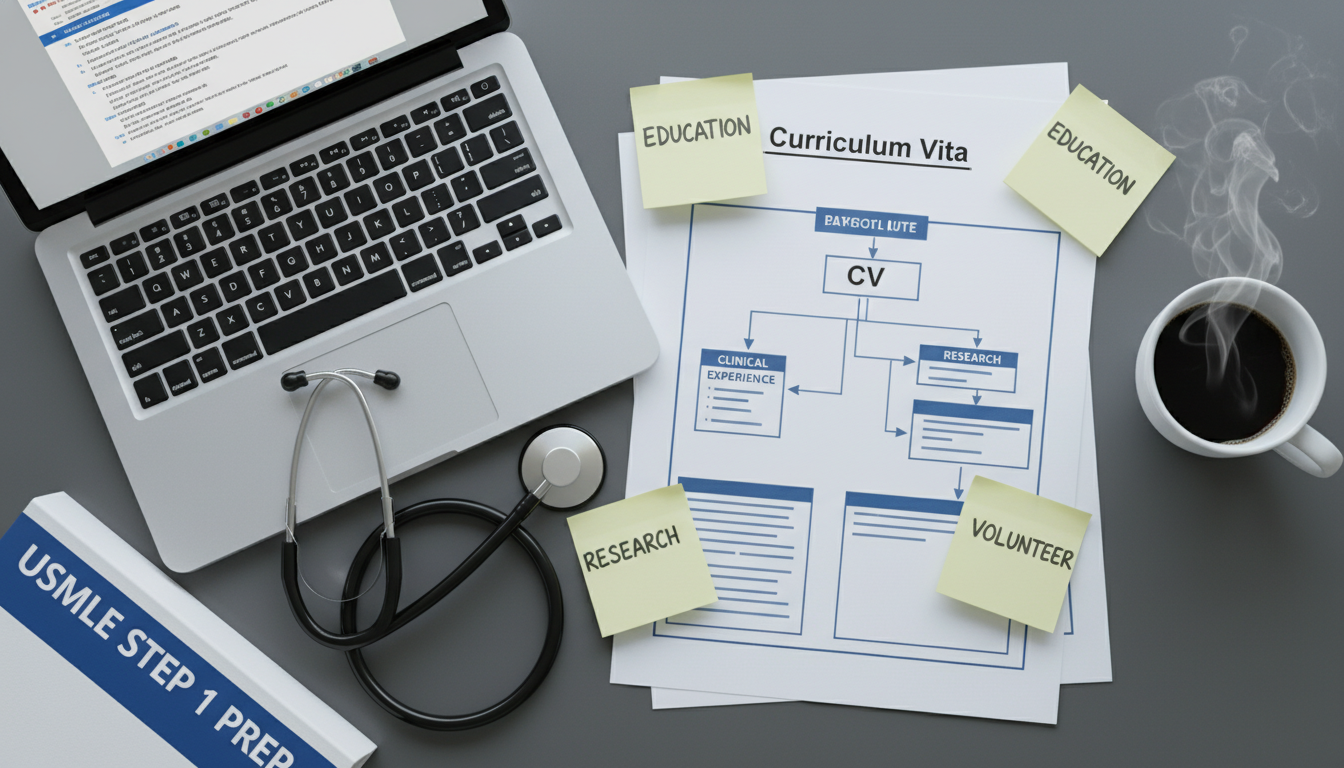
Below is a recommended structure for a Preliminary Medicine residency CV tailored to a non‑US citizen IMG.
Suggested order:
- Contact & Identity
- Education
- Examination & Certification (if you include it)
- Clinical Experience (US and home country)
- Research / Scholarly Activity
- Teaching & Leadership
- Quality Improvement and Audit
- Honors & Awards
- Volunteer Experience
- Professional Memberships
- Skills & Interests
You do not need to use these exact titles, but the order should highlight your best assets first.
2.1 Header: Contact & Identity
Include:
- Full name (consistent on all documents and USMLE registration).
- Current address (US address if you’re in the US; permanent address optionally).
- Professional email (e.g., firstname.lastname.md@gmail.com).
- Phone number with country code if foreign.
- LinkedIn profile (optional but helpful if professional).
Avoid:
- Photo (unless required by a specific institution outside ERAS).
- Date of birth, marital status, or religion.
- National ID, passport number.
2.2 Education
List in reverse chronological order:
- Medical school, city, country, dates (month/year – month/year).
- Degree (e.g., MBBS, MD, MBChB).
- Class rank or GPA (if strong and understandable).
- Graduation status (e.g., “Expected June 2026” or “Graduated December 2023”).
Optionally add:
- Relevant thesis, honors, or distinction.
- If you had a gap (e.g., extended graduation), don’t hide it. Plan to explain briefly in your personal statement or interviews, and make sure your CV shows constructive activity during that time.
If you have prior degrees:
- Bachelor’s, Master’s, or PhD – include them with major, institution, country, and dates.
2.3 Exams & Certifications (Optional Section on the CV)
ERAS already captures USMLE scores, but on a separate CV you may:
- List USMLE Step 1, Step 2 CK (score only if strong or requested; write “Passed” otherwise).
- Step 3 (if taken) is a huge plus for a non‑US citizen IMG, especially for a preliminary medicine year and visa sponsorship.
- English proficiency exams (IELTS/TOEFL) if needed for visas or institutional requirements.
- Basic certifications:
- BLS, ACLS, PALS (if applicable), with expiration dates.
Example format:
- USMLE Step 2 CK – Passed (MM/YYYY)
- USMLE Step 1 – Passed (MM/YYYY)
- BLS (American Heart Association), valid through MM/YYYY
Section 3: Clinical Experience – The Core of a Prelim IM CV
For a preliminary medicine year, clinical readiness is critical. For a foreign national medical graduate, this section may decide if your CV gets a deeper review.
Subdivide if possible:
- US Clinical Experience (USCE)
- Home Country Clinical Experience
3.1 US Clinical Experience (USCE)
This is the most scrutinized area for non‑US citizen IMGs.
Types of experience (strongest to weakest):
- Hands‑on electives / sub‑internships in US hospitals (direct patient care, order writing under supervision).
- Externships with some clinical responsibility.
- Inpatient observerships in internal medicine or subspecialties (rounding with team, note exposure).
- Outpatient observerships or shadowing.
How to list USCE:
Each entry should include:
- Role (Clinical Elective, Sub‑Internship, Extern, Observer).
- Department / service (Internal Medicine, Hospitalist Service, Cardiology, etc.).
- Institution, city, state.
- Dates (MM/YYYY – MM/YYYY).
- 2–4 bullet points emphasizing:
- Exposure to US health system workflows.
- Communication with multidisciplinary teams.
- Any presentations, mini‑projects, or QI involvement.
- Evidence that attending physicians can speak about your performance in letters.
Example:
Clinical Elective, Internal Medicine – Inpatient
Department of Medicine, XYZ University Hospital, Boston, MA, USA
07/2024 – 08/2024
- Participated in daily ward rounds with attending, residents, and medical students on a 20–25 patient internal medicine service.
- Performed focused histories and physical examinations, presented new admissions, and formulated management plans under supervision.
- Prepared a 15‑minute case presentation on new onset atrial fibrillation in sepsis for the team’s educational conference.
3.2 Home Country Clinical Experience
Do not underestimate this. For a preliminary medicine year, strong home‑country experience can still show clinical maturity.
Include:
- Internship / House job rotations (if completed).
- Postgraduate medical officer positions.
- Rotations particularly relevant to internal medicine:
- General medicine, ICU, emergency, geriatrics, cardiology, nephrology, etc.
For each:
- Role (Intern, House Officer, Medical Officer).
- Institution, city, country.
- Dates.
- Bullet points highlighting:
- Patient volume and acuity.
- Responsibilities (e.g., admissions, call duties, procedures).
- Any early leadership (e.g., supervising junior interns, organizing teaching).
Example:
Medical Officer, Internal Medicine
ABC Teaching Hospital, Lahore, Pakistan
01/2023 – 12/2023
- Managed 15–20 inpatients per day under consultant supervision, including diabetic emergencies, decompensated heart failure, and sepsis.
- Took overnight call 1–2 times per week, performing initial assessments and stabilization for acutely ill admissions.
- Coordinated discharge planning with nursing staff and social workers, focusing on medication reconciliation and follow‑up arrangements.
3.3 Aligning Clinical Experience with a Preliminary Medicine Narrative
Even if your ultimate specialty is anesthesiology, neurology, dermatology, or radiology, your CV should show why you will be an excellent intern in internal medicine:
Highlight:
- Exposure to acutely ill patients.
- Management of chronic diseases.
- Team‑based inpatient care.
- Comfort with systems‑based practice (discharge planning, documentation).
Downplay or integrate:
- Overly niche experiences that don’t speak to intern‑level readiness.
Section 4: Research, QI, Teaching, and Leadership – Making Your CV Competitive
Preliminary medicine positions can still be competitive, especially at academic centers. A non‑US citizen IMG with a strong scholarly profile stands out.

4.1 Research and Scholarly Activity
For a foreign national medical graduate, research can compensate for:
- Limited USCE.
- Time since graduation.
- Moderate board scores.
Your Research section can include:
- Original research projects.
- Case reports/series.
- Review articles.
- QI projects.
- Conference abstracts and posters.
- Book chapters (if any).
How to list:
- Use a standard citation format (e.g., AMA) if possible.
- Separate:
- Published / In Press
- Submitted / In Preparation (clearly labelled; do not misrepresent status).
Example (published abstract):
Khan A, Patel R, Smith J. Impact of early sepsis bundles on 30‑day mortality in a tertiary care hospital in Pakistan. Abstract presented at: Society of Hospital Medicine Annual Meeting; April 2023; Austin, Texas.
If you lack formal research, emphasize:
- Audit projects (e.g., chart reviews of diabetic control).
- QI initiatives (e.g., hand hygiene compliance).
For a prelim IM CV, clinical‑oriented projects (hospitalist medicine, inpatient care, outcomes) are particularly relevant.
4.2 Quality Improvement (QI) and Audit
US training programs value QI highly. Many non‑US citizen IMGs overlook this.
You can create a section: Quality Improvement and Audit or include QI under Research.
Example:
Quality Improvement Project – Reducing 30‑Day Readmissions for Heart Failure
Internal Medicine Department, XYZ Hospital, Mumbai, India
06/2022 – 12/2022
- Led a multidisciplinary team to develop a discharge checklist for heart failure patients, incorporating medication review and patient education.
- Implemented standardized follow‑up calls at 7 and 14 days post‑discharge.
- Achieved a reduction in 30‑day readmission rates from 22% to 17% over 6 months.
This directly illustrates skills useful as a preliminary medicine intern.
4.3 Teaching and Leadership
Program directors look for future chief residents and academic leaders, even in prelim interns. For a non‑US citizen IMG, teaching and leadership show:
- Adaptability.
- Communication skills.
- Initiative.
Possible entries:
- Teaching medical students or junior residents.
- Organizing journal clubs.
- Leading simulation sessions.
- Being a class representative, student council member, or organizer of health camps.
Example (teaching):
Clinical Tutor, Internal Medicine Bedside Teaching
DEF Medical College, Cairo, Egypt
09/2021 – 06/2022
- Conducted weekly bedside teaching sessions for 3rd‑year medical students, focusing on cardiovascular and respiratory system examination.
- Developed short case‑based quizzes to reinforce clinical reasoning skills.
Example (leadership):
Vice President, International Students’ Medical Association
GHI University, Warsaw, Poland
09/2019 – 08/2020
- Coordinated a team of 15 volunteers to organize community health screenings for 500+ local residents annually.
- Managed budgeting, sponsor relations, and event logistics.
These experiences reassure programs that you can function within teams and systems, not just as an isolated clinician.
Section 5: Tailoring Your CV Specifically for Preliminary Medicine and US Expectations
Many non‑US citizen IMGs make the mistake of using a generic CV for all specialties and positions. For a preliminary medicine year, you should tailor both content and emphasis.
5.1 Show a Clear Understanding of the Preliminary Year Role
A preliminary medicine intern is expected to:
- Care for a high volume of general medicine patients.
- Cover nights, weekends, and cross‑cover multiple specialties.
- Communicate effectively with surgeons, anesthesiologists, neurologists, etc.
- Manage common floor emergencies (chest pain, shortness of breath, delirium, arrhythmias).
Reflect this in your CV bullets:
- Emphasize acute care: ER, ICU, high‑dependency units.
- Mention cross‑disciplinary collaboration.
- Include any night‑shift experience.
Weak bullet:
“Worked with internal medicine patients.”
Stronger bullet:
“Managed initial stabilization and admission orders for 5–7 acute internal medicine admissions per night under supervision, including cases of sepsis, acute coronary syndrome, and diabetic ketoacidosis.”
5.2 Align CV with Your Target Advanced Specialty (If Applicable) Without Confusing Programs
Many applicants use a Prelim IM year as a bridge to:
- Neurology
- Anesthesiology
- Radiology
- PM&R
- Ophthalmology
- Dermatology
That is acceptable, but your CV should:
- Clearly show you can thrive as an internal medicine intern.
- Avoid making internal medicine seem like an afterthought or “backup” only.
Practical advice:
- If applying advanced and prelim simultaneously:
- Keep your core clinical sections identical.
- Slightly adjust Research and Interests emphasis depending on what you send to whom.
- In Internal Medicine‑focused CVs, make sure at least half of your scholarly activities relate to medicine‑adjacent content (hospital medicine, chronic disease, acute care, etc.).
5.3 Addressing Common IMG Challenges on the CV
1. Gaps after graduation
Use your CV to show constructive activity:
- Research assistant roles.
- Step exam preparation plus part‑time clinical work.
- Language courses or exam preparation (if relevant).
2. Older year of graduation
Compensate with:
- Recent USCE.
- Step 3 (if possible).
- Ongoing clinical work (not just research for several years without patient contact).
3. Limited or no USCE
Maximize:
- Tele‑rotations supervised by US physicians (if legitimate and structured).
- Home‑country clinical experience with strong responsibilities.
- Research/QI with US collaborators.
Section 6: Practical Formatting, Style, and Common Mistakes to Avoid
Even the strongest experiences can be undermined by poor presentation. The following residency CV tips focus on clarity and professionalism.
6.1 Formatting Essentials
- Length:
- Early medical students: 1–2 pages.
- Graduates/older IMGs: 2–3 pages is acceptable if content is strong and relevant.
- Font:
- Use a professional font (Arial, Calibri, Times New Roman, 11–12 pt).
- Consistency:
- Align dates on the right or left, but be consistent.
- Use the same bullet style and indentation throughout.
- File type:
- Save as PDF when emailing to maintain formatting.
6.2 Writing Strong Bullet Points
Use the Action – Context – Outcome model.
Weak:
“Did research in sepsis.”
Strong:
“Analyzed outcomes of 120 patients with septic shock in a tertiary care ICU to identify predictors of mortality; findings formed the basis of an abstract presented at the National Critical Care Conference (2023).”
Try to quantify:
- Number of patients.
- Frequency of tasks (“5–10 admissions per shift,” “weekly journal club,” “organized 3 health fairs”).
- Impact (“reduced waiting times by 15%,” “increased screening rates by 20%”).
6.3 Adapting International CV Styles to US Norms
Many foreign national medical graduates use CV templates common in their home countries that do not translate well to US residency expectations. Avoid:
- Including a photograph (except where explicitly required).
- Listing primary school or high school education in detail.
- Adding non‑relevant details like national ID, marital status, or parents’ occupations.
- Overly decorative designs, graphics, or columns that make scanning difficult.
Instead, prioritize:
- Simple, clean layout.
- Clear sections with bold headings.
- Readable bullets (2–5 per experience).
6.4 Final Quality Checks Before Submission
- Spellcheck in US English.
- Ask at least one US‑trained physician or mentor to review your CV.
- Verify dates for consistency (no overlaps or impossible timelines).
- Ensure your CV matches:
- ERAS entries.
- Personal statement narrative.
- What is said in letters of recommendation.
Contradictions create doubt; coherence builds trust.
Frequently Asked Questions (FAQ)
1. How should a non‑US citizen IMG prioritize experiences on a CV for a preliminary medicine year?
Prioritize in this order:
- Recent clinical experience, especially USCE in internal medicine or hospital‑based specialties.
- Home country internal medicine / acute care experience, including internship or medical officer roles.
- Research and QI related to internal medicine, hospital medicine, or acute care.
- Teaching and leadership roles that demonstrate communication and teamwork skills.
- Volunteer and community work that reflects professionalism and service.
Place your strongest sections (USCE, clinical work) near the top so program directors see them first.
2. Should I include USMLE scores directly on my residency CV?
It depends on context:
- For ERAS, your scores are already visible, so they don’t need to dominate the CV.
- For external CVs (email to faculty, research PI, or potential mentor):
- Include exam status (Passed Step 1, Step 2 CK) and optionally scores if they are competitive for your target programs.
- If scores are borderline, you can simply note “Passed” and let ERAS show the details when required.
Always be truthful and consistent with ERAS.
3. I am a foreign national medical graduate with no publications. Can my CV still be competitive?
Yes, especially for preliminary medicine, as long as you strengthen other areas:
- Focus on high‑quality clinical experience (preferably some USCE).
- Highlight case presentations, journal clubs, or small audit projects even if not formally published.
- Emphasize teaching, leadership, and relevant volunteer work.
- Consider starting a small QI project or case report now; even “in progress” activities show initiative.
Programs do not expect every prelim IM applicant to be heavily published, but they do expect evidence of engagement and initiative.
4. How can I make my CV support visa sponsorship concerns as a non‑US citizen IMG?
You cannot change your visa status on a CV, but you can strengthen the risk‑benefit calculation in the program’s mind by:
- Showing reliable, consistent clinical work in recent years (no large unexplained gaps).
- Demonstrating familiarity with US clinical practice through USCE and/or collaboration with US mentors.
- Including Step 3 if possible, which can simplify certain visa pathways and signals commitment.
- Showcasing professionalism, leadership, and long‑term goals that indicate you will be a valuable team member.
A strong, coherent, and US‑tailored CV helps justify the effort of sponsoring you.
By approaching your CV as a strategic document—not just a chronological list—you can significantly increase your competitiveness as a non‑US citizen IMG applying for a preliminary medicine year. Focus on demonstrating clinical readiness, internal medicine relevance, adaptability to the US system, and reliability. With careful structure, strong bullet points, and honest but strategic presentation, your CV can open doors to interviews and, ultimately, a successful match.