Understanding the Role of the CV in the Residency Match
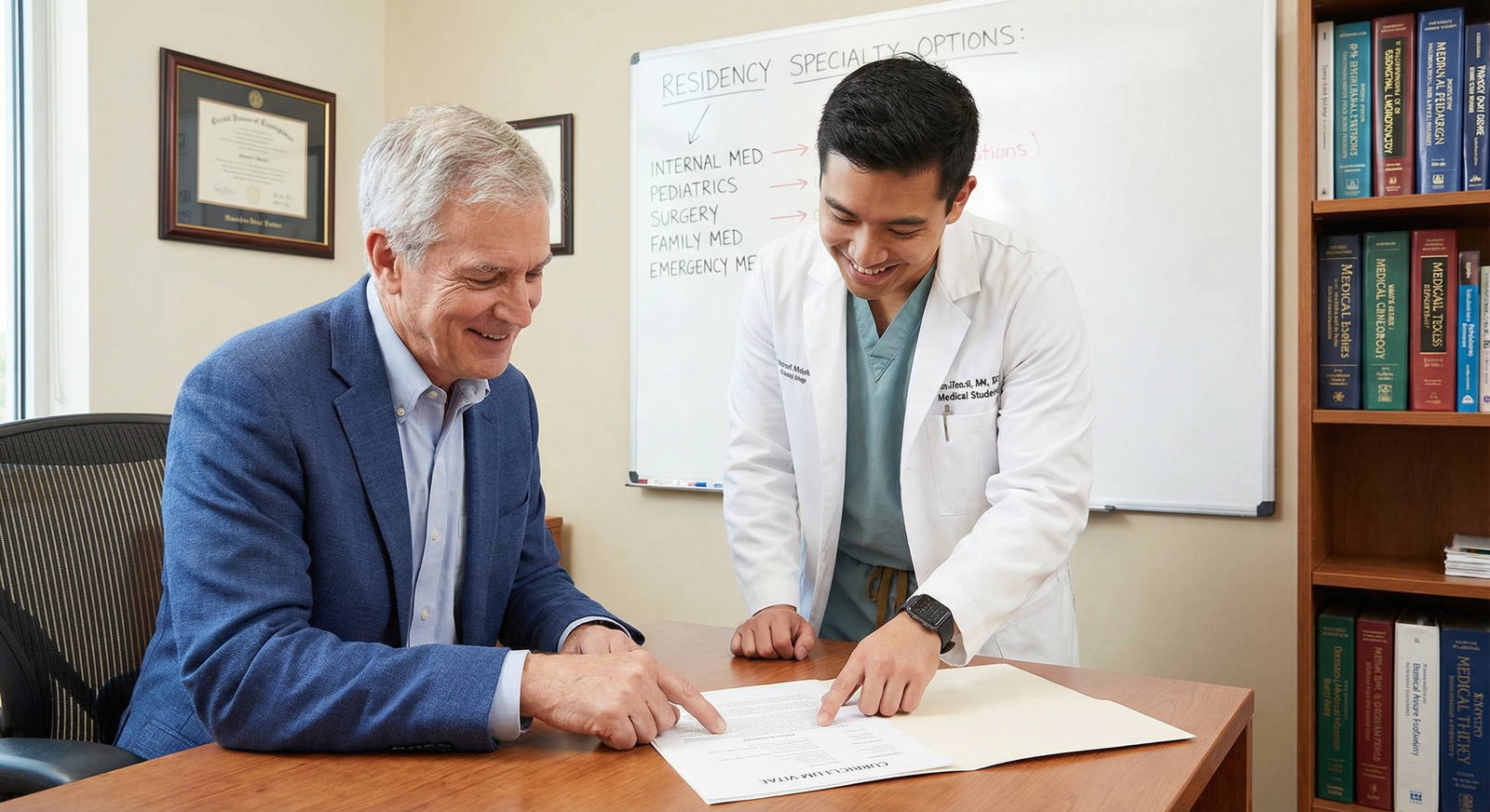
For an international medical graduate, your curriculum vitae (CV) is more than just a list of experiences. It is your professional story, translated into a format that U.S. program directors understand and trust. While exam scores, clinical performance, and interviews are all crucial, a strong CV often determines whether your application is read carefully—or skimmed and set aside.
Residency programs receive thousands of applications. In that volume, your CV becomes:
- A screening tool to quickly assess your background
- A contextual document that explains your journey as an IMG
- A conversation guide for your interview
- A credibility check—does your story feel coherent and verifiable?
For IMGs, this is especially important because program directors may be less familiar with your medical school, clinical settings, or local systems. A well-structured, focused residency CV helps them clearly see your strengths and how you fit into their program.
This IMG residency guide will walk you through how to build a CV for residency that is:
- Clear, structured, and aligned with U.S. expectations
- Focused on what residency programs actually value
- Honest, verifiable, and easy to read quickly
Core Principles of an Effective IMG Residency CV
Before discussing individual sections, it helps to understand the core principles that guide strong residency CV tips for international medical graduates.
1. Clarity and Structure Over Decoration
Program directors and faculty often review CVs quickly—sometimes in under a minute on the first pass. Your goal is to make information:
- Easy to find (titles, headings, consistent formatting)
- Easy to skim (bullet points, short phrases)
- Easy to interpret (clear dates, locations, concise descriptions)
Avoid:
- Fancy fonts or colors
- Tables that don’t convert well to PDF
- Overly long paragraphs
- Small font sizes (10–12 pt is standard)
2. Consistency and Accuracy
Every date, title, and accomplishment must be accurate and consistent across:
- Your CV
- ERAS application
- Personal statement
- Letters of recommendation (as much as you can ensure)
Red flags for program directors:
- Overlapping dates not explained
- Gaps in training without explanation
- Inflated or vague titles (e.g., calling a 2-week shadowing “clinical fellowship”)
- “Research” that turns out to be just literature review without supervision
When in doubt, understate rather than overstate. Credibility is more valuable than impressive-sounding wording.
3. U.S.-Friendly Translation of Your Experiences
Many IMGs come from systems where:
- Grades use different scales
- Titles (e.g., “House Officer,” “Demonstrator,” “Honorary Assistant”) may be unclear to U.S. readers
- Clinical roles may not map exactly to U.S. equivalents
Your job is to translate, not embellish. For example:
- “House Officer (equivalent to rotating intern)”
- “Demonstrator in Anatomy (teaching assistant for preclinical medical students, 2nd year)”
This kind of clarity instantly reduces confusion and builds trust.
4. Alignment With Your Target Specialty
Your residency CV should reflect a coherent interest in your chosen specialty, especially for competitive fields. Even if your background is diverse, highlight:
- Clinical experiences related to your specialty
- Research or quality improvement projects in that field
- Presentations, conferences, and leadership relevant to your chosen area
This doesn’t mean deleting everything else—it means prioritizing what’s most relevant.

Essential Sections of a Strong IMG Residency CV
A typical medical student CV for residency follows a fairly standard structure. For IMGs, including the right sections and labeling them clearly is critical.
1. Contact Information and Professional Header
At the top of your CV, include:
- Full name (consistent with ERAS)
- Professional email (e.g., firstname.lastname@gmail.com)
- Phone number with country code (for IMGs applying from abroad)
- Current address (and U.S. address if you have one)
- Optional: LinkedIn profile or personal academic website (only if professional and updated)
Do not include:
- Date of birth
- Marital status
- Photo (unless a specific non-U.S. system requests it; U.S. residency CVs do not use photos)
- National ID numbers
2. Education
List in reverse chronological order:
- Medical school (full name, city, country)
- Degree (e.g., M.B.B.S., M.D., or equivalent)
- Start and graduation month/year
- Honors or distinctions (e.g., “Graduated with Distinction in Internal Medicine”)
- Prior degrees (bachelor’s, master’s, PhD)
- Notable academic achievements (e.g., class rank if very strong)
For IMGs, it can help to provide brief clarification when needed:
- “M.B.B.S. (equivalent to U.S. MD)”
- “Graduated top 5% of class (15/300 students)”
Avoid overloading this section with all course grades. Only highlight if they are truly exceptional or relevant (e.g., “Distinction in Surgery and Pediatrics”).
3. Medical Licensure and Exams (Optional Separate Section)
You can incorporate this either under education or as its own section:
- USMLE Step 1 (Pass, first attempt, month/year)
- USMLE Step 2 CK (Score, first attempt, month/year) – if programs will see the score anyway in ERAS, keep wording consistent.
- OET/IELTS/TOEFL (if relevant for language requirements)
- ECFMG certification status (e.g., “ECFMG Certified, June 2025” or “ECFMG certification in progress”)
Be precise and honest about:
- Attempts
- Completion dates
- Pending results
4. Clinical Experience
This is one of the most important sections for IMGs and a focus of any IMG residency guide.
Break into subheadings if you have multiple types:
- U.S. Clinical Experience (USCE)
- International Clinical Experience
- Observerships / Externships / Electives
For each entry:
- Position title (accurate and clear: “Clinical Observer,” “Extern,” “Rotating Intern,” “Junior Resident,” “House Officer”)
- Institution name, city, country
- Dates (month/year – month/year)
- Specialty/service (e.g., “Internal Medicine – General Wards,” “Cardiology Outpatient Clinic”)
- 2–4 bullet points with action-oriented descriptions
Example (Strong):
Clinical Extern, Internal Medicine
ABC University Hospital, New York, NY, USA — 07/2023–09/2023
- Participated in daily inpatient rounds, presenting 1–2 new admissions per week under direct supervision
- Performed focused histories and physical exams; documented progress notes in EMR (template notes co-signed by attending)
- Assisted with care coordination and discharge planning, including medication reconciliation and follow-up appointments
- Observed and assisted with bedside procedures (paracentesis, thoracentesis) through pre- and post-procedure patient counseling
Avoid vague or exaggerated statements like “Managed all inpatient care” or “Independently performed complex procedures” unless that is realistically true for your role and training level.
5. Research Experience
For IMGs, research can significantly strengthen your profile, especially for academic or competitive programs. In this section:
Include for each entry:
- Position title (e.g., “Research Assistant,” “Research Fellow,” “Volunteer Researcher”)
- Department, institution, city, country
- Supervisor’s name and title (optional but helpful)
- Dates (month/year – month/year)
- 2–4 bullets describing your role and contributions
Example:
Research Assistant, Department of Neurology
XYZ University Medical Center, Boston, MA, USA — 01/2023–present
- Conducted chart reviews for a retrospective cohort study on stroke outcomes in patients with atrial fibrillation (n=450)
- Extracted and entered clinical data into REDCap database with 99% accuracy based on random checks
- Assisted with data cleaning and preliminary statistical analysis using SPSS
- Contributed to abstract writing for presentation at a national neurology conference
If your research led to posters, presentations, or publications, list those separately under Publications and Presentations for clarity.
6. Teaching and Leadership Experience
Residency programs value applicants who can teach, lead, and work in teams. For IMGs, this can help demonstrate communication skills and initiative.
Possible entries:
- Small group teaching for junior medical students
- Teaching assistant roles
- Course organizer or coordinator
- Leadership roles in student organizations, societies, or committees
Describe these with concrete outcomes:
- “Organized monthly ECG interpretation workshops for 3rd-year medical students (average attendance 40 students per session).”
- “Led a student-run clinic team of 8 volunteers, coordinating weekly schedules and patient follow-up.”
7. Publications, Presentations, and Posters
This section signals scholarly engagement and productivity. Divide if you have many items:
- Peer-reviewed publications
- Manuscripts under review (clearly labeled)
- Abstracts and posters
- Oral presentations
Follow a consistent citation style (e.g., AMA). For example:
- Ahmed R, Lee S, Kumar P. Outcomes of early versus delayed cholecystectomy in acute cholecystitis: a retrospective cohort study. J Surg Res. 2023;XXX:XXX–XXX.
For posters/presentations:
- “Kumar P, Ahmed R. Early cholecystectomy improves length of stay in acute cholecystitis. Poster presented at: American College of Surgeons Clinical Congress; October 2023; Boston, MA.”
Do not list a manuscript as “published” if it is only submitted or in preparation. Use accurate labels: “In preparation,” “Submitted,” “Under review.”
8. Volunteer and Community Service
This section demonstrates professionalism, empathy, and commitment beyond pure academics.
Examples:
- Health fairs and screening camps
- Free clinics
- Community education programs
- Leadership in non-medical charities or service organizations
Provide brief, outcome-oriented bullet points:
- “Coordinated a community hypertension screening project that screened 200+ adults over 3 weekends, identifying 60 patients with previously undiagnosed elevated blood pressure.”
9. Awards, Honors, and Scholarships
This section can strengthen your profile, especially if you come from a lesser-known medical school.
Examples:
- “Best Graduating Student in Medicine (1/200 students)”
- “Dean’s List for Academic Excellence (2019, 2020, 2021)”
- “Recipient, National Scholarship for Academic Merit (top 1% nationwide)”
Be selective—list awards with clear significance or competitiveness. If the award name is not self-explanatory, briefly clarify in parentheses.
10. Certifications, Skills, and Other Relevant Sections
You may also include:
- Certifications: BLS, ACLS, PALS, ATLS (with dates)
- Technical skills: EMR systems (e.g., Epic, Cerner), basic statistics software (SPSS, R, Stata), REDCap
- Languages: List languages and proficiency (native/fluent/proficient/basic)
- Professional memberships: e.g., American College of Physicians (ACP) Member, American Medical Association (AMA) International Member
Keep this focused and avoid overloading with minor or unrelated certificates.

Tailoring and Strengthening Your CV as an IMG
Knowing how to build a CV for residency is not just about structure—it is about strategy. IMGs often face unique challenges: perceived unfamiliarity, visa issues, or limited U.S. clinical experience. Strategic CV-building can help address these.
1. Prioritize U.S. Clinical Experience (USCE) Where Possible
Program directors often look first for:
- Sub-internships (“sub-Is”) or acting internships in the U.S.
- Hands-on externships with patient contact
- Inpatient rotations in your chosen specialty
On your CV, place U.S. experiences prominently, especially if they are limited in number. Consider:
- Creating a separate subheading: “U.S. Clinical Experience”
- Putting it near the top of your clinical experience section
When describing USCE, highlight:
- Direct patient interaction
- Documentation responsibilities
- EMR use
- Participation in team-based care (rounds, sign-outs, case discussions)
2. Address Gaps and Transitions Thoughtfully
Many IMGs have:
- Gaps during exam preparation
- Time spent working in other fields
- Delays in graduation or training
Gaps themselves are not automatically disqualifying—but unexplained gaps raise questions. On your CV and ERAS application:
- Use clear date ranges with no large unexplained blank areas
- Briefly label major periods: “USMLE Step Preparation,” “Family responsibilities,” “Non-clinical employment”
You do not need long explanations on the CV; simply avoid leaving months or years unaccounted for.
3. Align Your CV With Your Specialty Choice
Your CV should make your specialty choice feel natural and logical. For example:
For Internal Medicine:
- Emphasize internal medicine rotations, outpatient clinics, chronic disease management
- Highlight related research (cardiology, nephrology, endocrinology, etc.)
- Include relevant QI or audit projects (e.g., diabetes control, readmissions)
For Surgery:
- Highlight operative exposure, case presentations, surgical skills labs
- Include trauma or emergency surgery experiences
- Emphasize manual dexterity-related activities if relevant (e.g., surgical skills workshops, simulation labs)
For Psychiatry:
- Emphasize psychiatry rotations, mental health clinic work, counseling experiences
- Include psychological or neuropsychiatric research
If your earlier history is non-aligned, you can still build a coherent narrative by giving more space and detail to experiences that support your chosen specialty.
4. Use Strong, Honest Action Verbs and Quantification
Residency CV tips frequently emphasize using action verbs. For IMGs, this also helps translate your roles clearly into U.S. expectations. Use verbs like:
- “Collaborated,” “Assisted,” “Conducted,” “Presented”
- “Led,” “Organized,” “Coordinated,” “Implemented”
- “Reviewed,” “Analyzed,” “Documented,” “Educated”
Whenever possible, quantify your experience:
- “Presented 10+ cases during morning report”
- “Screened 150 patients over 3 months in a community clinic”
- “Tutored 12 second-year medical students in anatomy over one semester”
Avoid subjective adjectives (“very dedicated,” “highly skilled”)—instead, show this through concrete evidence.
5. Maintain a Clean, U.S.-Compatible Format
For a medical student CV aimed at U.S. residency:
- Use a simple, clean layout in Word or Google Docs
- Export as PDF for submission
- Use uniform bullet style and consistent date format (e.g., “MM/YYYY–MM/YYYY”)
- Keep margins standard (0.75–1 inch) and font professional (e.g., Calibri, Times New Roman, Arial)
Remove:
- Local formatting styles that may not transfer well
- Excessive bolding/underlining
- Decorative or graphic elements
Your CV should reflect professional judgment and attention to detail.
Common Mistakes IMGs Make on Residency CVs (and How to Fix Them)
Even strong candidates sometimes weaken their application through avoidable CV errors. Here are frequent issues and how to correct them.
1. Overcrowded or Unfocused CV
Problem: Trying to include everything you have ever done, resulting in a 6–8 page CV that is difficult to navigate.
Fix:
- Aim for about 2–4 pages for most IMG residency CVs, depending on your experience.
- Prioritize recent (last 5–7 years) and residency-relevant activities.
- Remove or condense:
- High school achievements
- Very minor or short non-medical activities
- Repetitive or overlapping descriptions
2. Inconsistent Titles and Dates
Problem: The same role has different titles or dates on different documents, or overlapping periods are unclear.
Fix:
- Create a master timeline of your activities and cross-check:
- CV
- ERAS entries
- Personal statement
- LinkedIn (if used)
- Ensure titles reflect reality and are consistent. If in doubt between two terms, pick the clearer one and explain in the description.
3. Exaggerating Roles or Responsibilities
Problem: Calling shadowing “clinical practice,” or describing limited participation as “managing all patient care.”
Fix:
- Use role-appropriate verbs:
- Shadowing: “Observed,” “Attended,” “Learned from”
- Student: “Assisted,” “Participated in,” “Presented”
- Intern/house officer: “Managed under supervision,” “Performed”
- Remember that programs often contact supervisors; credibility matters more than impressive phrasing.
4. Poor English Language and Formatting
Problem: Grammatical errors or awkward phrasing that weakens impression of communication skills.
Fix:
- Have a trusted mentor or U.S.-trained colleague review your CV.
- Use spell-check and grammar tools, but also get human feedback.
- Write in clear, simple sentences rather than complex or overly formal phrasing.
5. Mixing CV With Personal Statement Content
Problem: Including motivations and emotional narratives in the CV.
Fix:
- Keep CV factual, concise, and objective.
- Save your story—why you chose your specialty, why the U.S., your long-term goals—for the personal statement and interviews.
Practical Steps to Build and Maintain a Strong IMG Residency CV
To turn these residency CV tips into action, follow a structured approach:
Step 1: Start Early—Even as a Student
If you are still an international medical graduate in training:
- Begin a “living CV” in your first clinical years.
- Record each activity as it happens:
- Dates, supervisor, key responsibilities
- Any measurable outcomes
- This will save you from scrambling later and forgetting details.
Step 2: Use a Standard Template and Customize
- Start with a clean, standard medical CV template.
- Adapt the headings to your situation:
- “U.S. Clinical Experience”
- “International Clinical Experience”
- “Research Experience”
- “Teaching and Leadership”
- Reorder sections based on your strengths (e.g., if research-heavy, place research higher).
Step 3: Get Specialty-Specific Feedback
- Ask mentors in your target specialty (ideally in the U.S.) to review your CV.
- Ask specifically:
- “Does this CV clearly support my interest in [specialty]?”
- “Are there any red flags or confusing points?”
- “What would you move higher or lower?”
Step 4: Update Regularly and Version-Control
- Update your CV every 3–6 months, even outside of application season.
- Maintain:
- A full academic CV (for research or academic roles)
- A focused residency CV (slightly shorter and more clinically oriented)
Name files with date and purpose (e.g., “CV_Residency_IM_2025_06.pdf”).
Step 5: Align CV With ERAS and Personal Statement
Before submitting your application:
- Check that every major activity on your CV:
- Appears in ERAS with matching dates/titles
- Is consistent with what you might discuss in your personal statement
- Identify a few “anchor experiences” (key clinical/research roles) that appear in all documents and become central to your story.
Frequently Asked Questions (FAQ)
1. How long should a residency CV be for an IMG?
For most international medical graduates, a residency-focused CV of about 2–4 pages is appropriate. If you have extensive research and publications, it may run longer, but clarity and relevance are more important than length. Avoid padding with unrelated or very old content just to increase page count.
2. Should I include my USMLE scores on my CV?
You may list your USMLE exams and scores in a brief “Licensure and Examinations” section, but it is not mandatory, since programs will see your scores in ERAS. If you choose to include them, be precise and honest, and use the same information as in ERAS. If you prefer not to highlight a borderline score, you can simply write “USMLE Step 1: Pass (first attempt, 06/2023).”
3. How can I make up for limited U.S. clinical experience on my CV?
If your USCE is limited:
- Emphasize any U.S.-based observerships, externships, or virtual electives you do have.
- Highlight strong, responsible roles in your home country (internship, junior residency).
- Strengthen research, teaching, and volunteer sections to show initiative and engagement.
- Use your personal statement and letters of recommendation to provide context and evidence of adaptability to U.S. systems.
4. Do I need different CVs for different specialties or programs?
You can maintain one core CV but slightly adjust emphasis for different specialties:
- Reorder sections (e.g., moving psychiatry-related experiences higher if applying to psychiatry).
- Expand bullets for the most specialty-relevant roles.
- Consider minor wording changes to highlight skills valued in that field.
However, the core facts—dates, roles, institutions—must stay consistent across all versions and your ERAS application.
By approaching your CV strategically—as both a factual record and a clear translation of your journey as an international medical graduate—you can significantly strengthen your residency application. Structure, honesty, and specialty alignment will help decision-makers see not only where you’ve been, but why you are ready to thrive in their program.