Understanding the Role of Your CV in the Residency Match
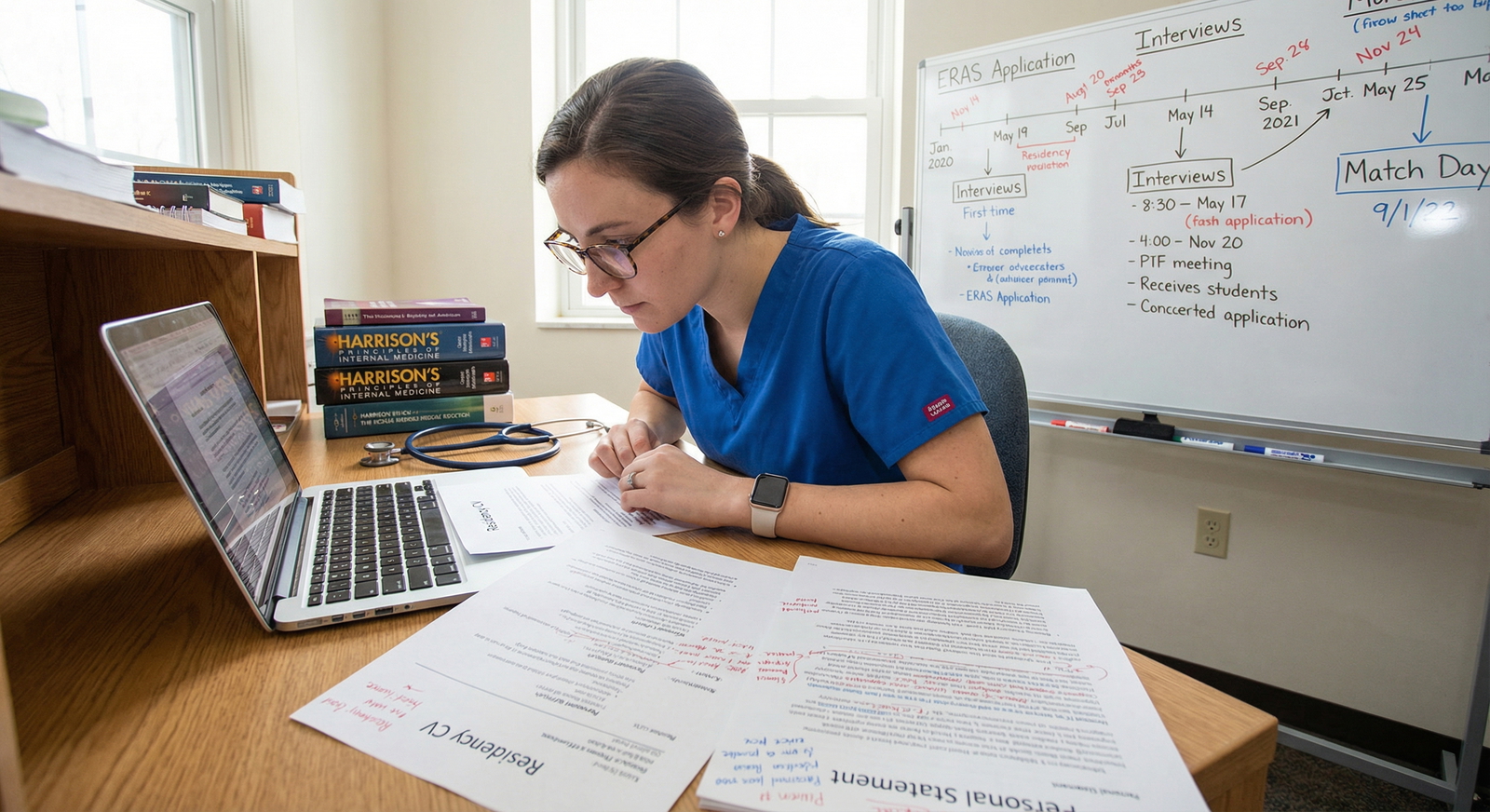
Your residency CV is more than a list of achievements—it is a strategic document that tells a clear, credible story about who you are as a physician in training. For an MD graduate residency applicant, a strong CV can:
- Clarify your career interests and trajectory
- Highlight the depth and continuity of your experiences
- Support your application narrative and personal statement
- Help program directors quickly assess “fit”
- Serve as the primary reference document for interviewers
Even if you are coming from an allopathic medical school match pathway where you feel your school reputation and USMLE performance are strong, a weak or disorganized CV can blunt your impact. Conversely, a well-structured, targeted CV can help compensate for modest scores or a non-linear path.
Think of your CV as the foundation of your entire application package. Your ERAS application, personal statement, letters of recommendation, and interview responses should all be consistent with—and reinforced by—what appears on your CV.
CV vs. Resume: Know the Difference
For residency, you are building a Curriculum Vitae (CV), not a one-page corporate resume. Key differences:
- Length: A residency CV is typically 2–4 pages for an MD graduate, depending on experience.
- Scope: CVs are comprehensive, including education, research, presentations, publications, teaching, leadership, and service.
- Detail: CVs include citations for research, clear role descriptions, and often dates down to month/year.
- Audience: Your reader is an academic physician or program coordinator, not a corporate recruiter.
Your CV should still be highly concise and selective, but you are not constrained to one page. The art lies in organizing and curating rather than simply compressing.
Core Structure: What Every MD Graduate Residency CV Should Include
While formats vary slightly by institution, a strong MD graduate residency CV typically follows this order:
- Contact Information
- Education
- Medical Training & Clinical Experience
- Licensure & Certifications
- Research Experience
- Publications & Presentations
- Teaching & Mentoring
- Leadership & Extracurricular Involvement
- Honors & Awards
- Professional Memberships
- Skills (optional but recommended)
- Personal Interests (brief, optional)
Below, we’ll walk through each section with residency CV tips and examples.
1. Contact Information
This should be clean, professional, and easy to find at the top of the first page:
- Full name (as used in medical school records)
- MD credential
- Current city/state (full address optional)
- Phone number (with voicemail set up and professional greeting)
- Professional email (avoid nicknames; use a simple format like firstname.lastname@...)
- LinkedIn URL (optional but increasingly common, if well-maintained)
Avoid: Photos, date of birth, marital status, or other personal identifiers not relevant to selection (and potentially problematic in some jurisdictions).
2. Education
This section anchors you as an MD graduate:
Order: Reverse chronological (most recent first).
Include for each entry:
- Degree and major (e.g., Doctor of Medicine)
- Institution name and location
- Dates (month/year – month/year or “Expected”)
- Honors (e.g., AOA, Gold Humanism, Dean’s List)
- Thesis title (if applicable)
Example Format
Doctor of Medicine (MD), Allopathic Medical School, City, State
Aug 2020 – May 2024- Honors: Alpha Omega Alpha (AOA), Gold Humanism Honor Society
Bachelor of Science in Biochemistry (Summa Cum Laude), University Name, City, State
Aug 2016 – May 2020- Honors: Dean’s List (all semesters), Honors College Scholar
If you completed a post-baccalaureate program or a master’s degree, list them as separate entries with clear degree type.
3. Medical Training & Clinical Experience
This is where you show your evolution from student to physician. For an MD graduate residency applicant, your clinical background is central to how programs assess readiness.
Core Clinical Experiences (Clerkships)
Most of your core rotations will be captured in ERAS automatically, but it can still help to highlight:
- Sub-internships or acting internships
- Away rotations (audition electives)
- Longitudinal clinical experiences
- Any non-standard or gap-closing clinical roles after graduation
You don’t need to list every clerkship, but spotlight the ones most relevant to your chosen specialty.
Example (for Internal Medicine applicant)
Sub-Internship in Internal Medicine
University Hospital, Department of Medicine, City, State
Aug 2023 – Sep 2023
- Managed a panel of 5–8 inpatients under supervision, including admission H&Ps, daily progress notes, and discharge summaries.
- Led daily presentations on diagnostic reasoning and management plans.
- Participated in night-float coverage and cross-coverage responsibilities.
If you have a gap between graduation and application, use this section to document post-graduate clinical roles, such as:
- Clinical research fellow with patient contact
- Physician observer or extern (if permissible where you trained)
- Transitional clinical roles in your home country (for dual-system graduates)
Be explicit about your role (hands-on vs. observational) to maintain credibility.
How to Build Clinical Depth on Your CV
If you feel your core clerkships are average, emphasize:
- Continuity: longitudinal clinics, multi-year volunteer work
- Responsibility: independent tasks performed under supervision
- Complexity: subspecialty experiences, ICU, ER, procedural clinics
- Progression: show increased responsibility in later rotations
Avoid listing routine responsibilities that every medical student has (“took histories and performed physical exams”) without adding what distinguished your performance.

Research, Academic Output, and Scholarly Activity
For MD graduate residency applicants—especially those targeting competitive specialties—your research and scholarship can significantly influence your allopathic medical school match prospects.
4. Research Experience
Organize research entries clearly and consistently. For each project:
- Project title or topic
- Institution and department
- Mentor’s name and degree
- Dates (month/year – month/year)
- Role (e.g., Research Assistant, Sub-Investigator, Student Researcher)
- 2–4 bullet points describing your specific contributions
Example
Clinical Research Assistant, Heart Failure Outcomes Study
Department of Cardiology, Allopathic Medical School, City, State
PI: Jane Smith, MD
Jun 2021 – May 2023
- Screened and enrolled eligible patients for a prospective observational study (n = 220).
- Extracted and entered clinical data into REDCap, maintaining >99% data accuracy.
- Performed preliminary statistical analyses using SPSS under supervision.
- Co-authored abstract accepted to regional cardiology conference.
Be honest about your level of involvement. Overstating your role is easy to spot when letter writers or interviewers describe your contribution differently.
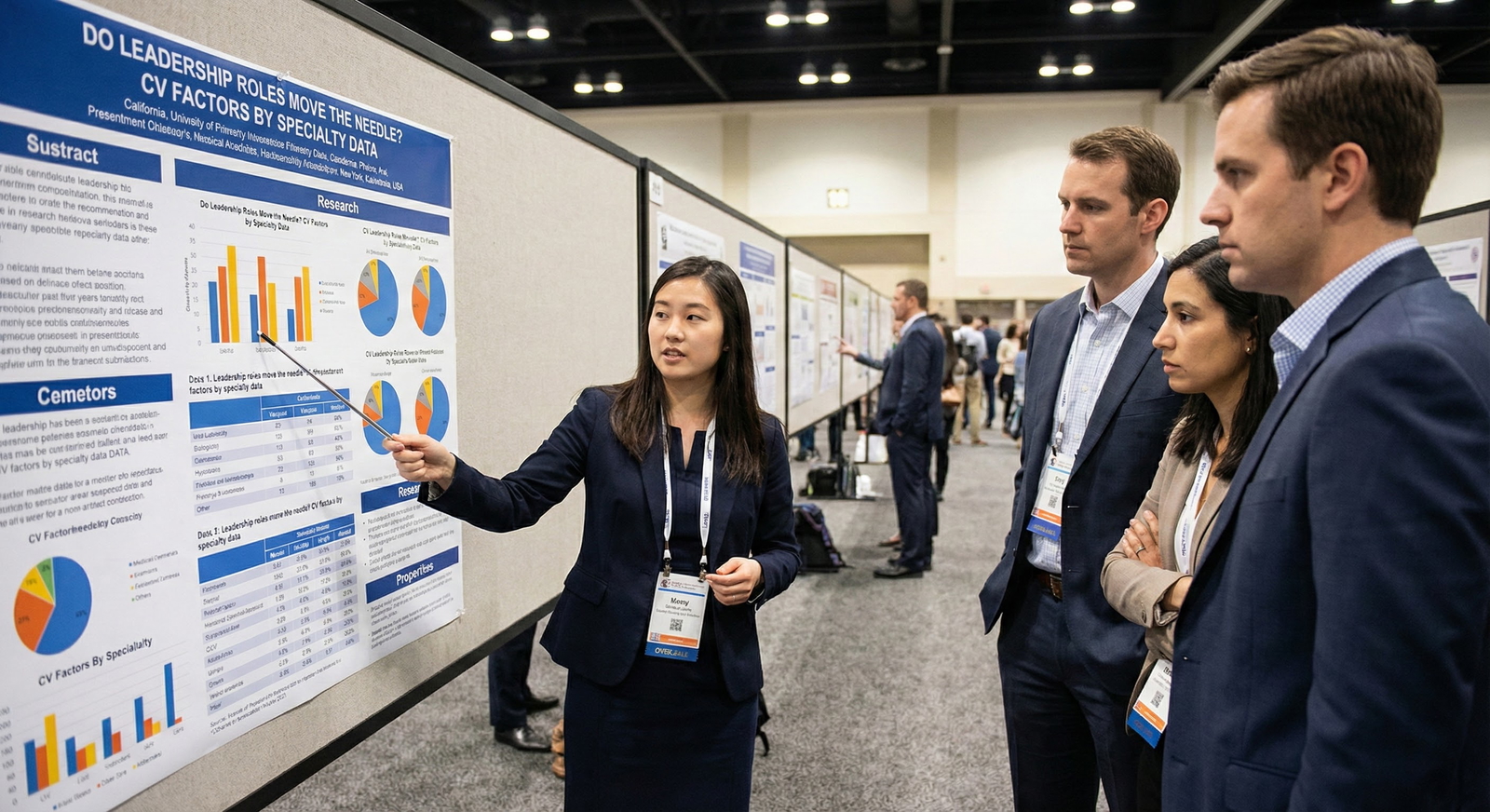
5. Publications, Abstracts, and Presentations
Program directors look for patterns of follow-through: did you turn research into tangible output? This is where many applicants struggle in how to build a CV for residency that showcases both effort and results.
Divide this section logically, such as:
- Peer-Reviewed Publications
- Manuscripts Under Review / In Preparation (optional; use cautiously)
- Abstracts and Poster Presentations
- Oral Presentations or Invited Talks
Use a consistent citation format (e.g., AMA). Bold your name to highlight your position in the author list.
Example – Peer-Reviewed Publication
- Doe J, Smith J, Patel A. Readmission rates in patients with acute decompensated heart failure after implementation of a transitional care program. J Hosp Med. 2023;18(2):123-130.
Example – Poster Presentation
- Doe J, Nguyen L, Chen R. Impact of telemedicine follow-up on readmissions in heart failure patients. Poster presented at: American College of Cardiology Annual Scientific Session; March 2023; New Orleans, LA.
Be cautious with a “Manuscripts in Preparation” subheading. Only include manuscripts that:
- Have a complete draft, and
- You are reasonably certain will be submitted to a journal.
Avoid listing “working titles” that may never materialize; they weaken your credibility.
Leadership, Teaching, and Service: Demonstrating Professional Identity
Residency programs want more than test-takers; they want future colleagues who will contribute to their departments and institutions. This is where your CV can powerfully differentiate you from other MD graduate residency applicants.
6. Teaching and Mentoring
Even small teaching roles matter if they demonstrate communication skills, professionalism, and initiative.
Examples to include:
- Small-group facilitator for pre-clinical courses
- Peer tutor or standardized patient instructor
- OSCE coach for junior students
- Anatomy TA or lab facilitator
- Community health education workshops
Example
Peer Tutor, Physiology and Pathology
Allopathic Medical School, City, State
Aug 2021 – May 2023
- Provided weekly one-on-one and group tutoring for 8–10 first-year medical students.
- Developed review materials and practice questions aligned with course objectives.
- Received average evaluation score of 4.9/5 from tutees.
Quantify your impact where possible (number of sessions, students, evaluations).
7. Leadership and Extracurricular Roles
Use this section to show sustained engagement and growth. Roles can include:
- Student organization leadership (e.g., Internal Medicine Interest Group president)
- Committee service (curriculum, wellness, diversity and inclusion)
- Free clinic or community project coordinator
- National organization positions (e.g., AMA, specialty societies)
Example
Co-Director, Student-Run Free Clinic
Allopathic Medical School, City, State
Jul 2022 – May 2024
- Scheduled and supervised interdisciplinary teams of students delivering care to underserved populations.
- Implemented new triage protocols that reduced patient wait times by 30%.
- Secured $5,000 in grant funding for clinic supplies and patient education materials.
When considering how to build a CV for residency that resonates, focus not only on titles but on outcomes: what changed because you were in that role?
8. Community Service and Volunteer Work
Programs value humanism, community engagement, and cultural humility. Include experiences that show:
- Long-term service to specific populations (e.g., refugees, homeless, rural communities)
- Health education or outreach
- Global health activities (with clear dates, roles, and settings)
Group shorter or one-off activities under a single entry if needed to avoid clutter.

Formatting, Style, and Strategy: Residency CV Tips That Matter
A polished CV reflects attention to detail—one of the most important traits in a physician. The following residency CV tips focus on presentation and strategy rather than content alone.
9. General Formatting Principles
- Length: 2–4 pages is typical for an MD graduate; do not artificially expand.
- Font: Simple and professional (e.g., Times New Roman, Calibri, Arial, 10–12 pt).
- Margins: ~1 inch; minor adjustments for readability are fine.
- Consistency: Dates, headings, bullet styles, and spacing should be uniform throughout.
- Headings: Use clear section headers (bold or small caps) for easy navigation.
- File name: Use a professional, identifiable name (e.g., “Lastname_Firstname_CV_2025.pdf”).
Save as PDF to preserve formatting when uploading or emailing.
10. Strategic Emphasis Based on Specialty
Your medical student CV should be subtly tailored to the type of programs and specialties you are targeting. Consider these emphases:
Research-heavy specialties (Dermatology, Radiation Oncology, Plastics, some Internal Medicine programs)
- Highlight research section early in the document
- Emphasize publications and abstracts
- Detail methodologies and your specific role
Procedure-oriented specialties (Surgery, Emergency Medicine, Anesthesiology)
- Emphasize high-acuity and procedural clinical experiences
- Include leadership in OR or ED-related roles
- Highlight quality improvement projects or patient safety work
Primary care and outpatient-oriented specialties (Family Medicine, Pediatrics, General Internal Medicine)
- Highlight continuity clinic, community engagement, health equity efforts
- Emphasize communication, teaching, and advocacy roles
Reordering sections (within reason) is acceptable if it helps your strengths meet the specialty’s priorities, as long as the overall structure remains logical.
11. Using Bullets Effectively
Each bullet should be:
- Specific
- Descriptive of your action and its impact
- Brief (1–2 lines)
Use the Action–Context–Impact framework:
- “Implemented a standardized pre-op checklist (action) in the student-run surgery clinic (context), reducing missing documentation by 40% (impact).”
Avoid vague or passive bullets such as “Helped with data collection” or “Responsible for patient care.” Show what you actually did and how it mattered.
12. Addressing Gaps, Red Flags, or Non-Linear Paths
If you have:
- An extended graduation timeline
- Leave of absence
- USMLE failures or repeats
- A prior career outside medicine
Use your CV and supporting documents consistently and transparently:
- Dates must be accurate and continuous; do not manipulate them to hide gaps.
- Use neutral descriptors for gap years, such as “Research Fellow” or “Medical Education Fellow,” but only if the roles were real and substantive.
- Save the detailed explanation for your personal statement or ERAS experiences, not the CV itself.
Programs are more concerned with honesty, insight, and growth than with a flawless record.
Advanced Strategies: Turning a Good CV into a Great One
Once you’ve assembled the basic content, the next step is intentional refinement. This is where many MD graduates can significantly strengthen their residency applications.
13. Align Your CV with Your Application Narrative
Your CV should reinforce the same themes that appear in:
- Your personal statement
- The way mentors describe you in letters of recommendation
- Your responses in interviews
For example, if your narrative emphasizes your passion for longitudinal patient relationships and underserved care, your CV should make that obvious through:
- Multi-year involvement at a free clinic
- Community-based research projects
- Longitudinal primary care experiences
If there is a mismatch—such as a personal statement on psychiatry while your CV shows only surgery research and no psychiatry experiences—program directors will notice.
14. Curate, Don’t Just List
You do not need to list every single activity since high school. For a strong MD graduate residency CV:
- Prioritize recency and relevance
- Group minor or similar activities (e.g., “Various weekend community health fairs, 2021–2023”)
- Remove outdated, low-impact items that do not add to your professional identity
A cluttered CV dilutes your major strengths and makes it hard for busy reviewers to identify your key attributes.
15. Seek Specialty-Specific Feedback
Before finalizing your medical student CV:
- Ask at least one faculty member in your target specialty to review it.
- Use your school’s career or advising office if available.
- If possible, ask a recent graduate who successfully matched in the same field to share their CV as a template.
Ask reviewers specifically:
- “What are the three strongest impressions my CV gives you?”
- “Is there anything confusing, redundant, or distracting?”
- “If you were a program director, what would you assume about me from this CV?”
Use this feedback to refine both content and emphasis.
Frequently Asked Questions
1. How long should my residency CV be as an MD graduate?
For most MD graduate residency applicants, 2–4 pages is appropriate. If you have extensive research, prior graduate degrees, or a previous career, you may be closer to 4 pages. Avoid padding to reach a certain length; programs value clarity and relevance more than volume.
2. Should I include high school experiences on my residency CV?
Generally no, unless a high school activity directly evolved into a long-term, meaningful commitment that continued through college and medical school (e.g., a free clinic you helped found and still coordinate). Focus primarily on undergraduate and medical school experiences.
3. How do I list USMLE or COMLEX scores on my CV?
If required, you can include a brief section titled “Examinations” or “Licensure & Exams” with your exam names, dates, and scores (if desired). Many applicants rely on ERAS to present scores and omit them from the CV. If you have strong scores and feel they support your application, you may highlight them, but it is not mandatory on the CV itself.
4. What if I don’t have any publications yet?
You can still create a strong research section by emphasizing:
- Ongoing projects and your concrete responsibilities
- Submitted abstracts and posters presented at local or regional meetings
- Quality improvement or clinical projects, even if non-published
Focus on demonstrating curiosity, initiative, and follow-through. Use your CV to show that you sought out opportunities and contributed meaningfully, even if publications are still in progress.
By approaching your CV as a strategic, integrated part of your residency application—not just a list of activities—you can present yourself as a coherent, compelling MD graduate residency candidate. Use these residency CV tips to refine how you organize and describe your experiences, and revisit your CV regularly as your profile evolves.