Understanding the Neurosurgery Residency CV Landscape as a DO Graduate
Neurosurgery is one of the most competitive specialties in the Match. For a DO graduate, the bar is especially high: you must show that you meet (and ideally exceed) the standards programs expect from all applicants while also demonstrating that you understand the nuances of osteopathic training in a field traditionally dominated by MD applicants.
A strong medical student CV (and later, your residency CV) is not just a list of activities—it is a strategic document that tells a coherent story: you are committed to neurosurgery, you can handle the rigor of brain surgery residency, and you bring added value as a DO graduate.
In this article, we’ll focus on:
- How to build a CV for residency that is tailored to neurosurgery
- Specific residency CV tips for DO graduates
- Common pitfalls that can undermine your osteopathic residency match prospects
- Concrete examples of strong versus weak CV entries
Throughout, keep the central question in mind: If a neurosurgery program director skims your CV for 60 seconds, what will they remember about you?
Core Principles of an Effective Neurosurgery Residency CV
1. Tell a Focused Neurosurgery Story
Program directors often skim hundreds of applications. Your CV should make it obvious—at a glance—that neurosurgery isn’t a last-minute decision.
Signals of genuine interest include:
- Multiple neurosurgery rotations (home and away/audition rotations)
- Neurosurgery or neuroscience-related research
- Longitudinal neurosurgery mentoring relationships
- Leadership or initiatives connected to neuro, surgery, or critical care
- Scholarly work (posters, abstracts, manuscripts) tied to the nervous system
If half your CV is dermatology, business startups, and unrelated community projects, the narrative gets muddy—even if those experiences are objectively impressive. You can include them, but the top third of the CV should anchor your identity as a future neurosurgeon.
2. Structure for Clarity and Impact
For neurosurgery, a typical, high-impact CV structure might be:
- Contact Information & Personal Details
- Education
- USMLE/COMLEX Scores (if included on a traditional CV separate from ERAS)
- Clinical Experience (Neurosurgery-focused first)
- Research Experience
- Publications & Presentations
- Leadership & Service
- Honors & Awards
- Technical & Surgical Skills
- Professional Memberships
- Interests (brief but intentional)
Priority sections (Education, Clinical Experience, Research, Publications) should appear early to showcase your neurosurgery readiness before a reader loses attention.
3. Prioritize Quality and Depth Over Sheer Volume
Program directors would rather see:
- 2–3 robust research projects with clear, described roles
- 3–4 significant leadership roles with measurable impact
…than 15 superficial bullet points.
For each entry, ask:
- Did I contribute something that changed a workflow, process, or outcome?
- Can I articulate what I learned that’s relevant to neurosurgery?
- Could I confidently discuss this under pressure in an interview?
If not, revise the description or reconsider including it.

Section-by-Section Guide: How to Build a CV for Neurosurgery Residency (as a DO)
Contact Information & Professional Header
Include:
- Full name, DO
- Phone number
- Professional email address
- City/State (optional on ERAS, but standard on a standalone CV)
- LinkedIn/portfolio website (only if it’s polished and updated)
Avoid:
- Personal photos, date of birth, marital status, or personal identifiers
- Casual email addresses (e.g., “neurosurgeryking24@…”)
Example (Strong)
John A. Smith, DO
Email: john.smith@email.com | Phone: (555) 555-5555
LinkedIn: linkedin.com/in/johnsmithdo
Education: Emphasize Your Osteopathic Background Strategically
As a DO graduate, your osteopathic training can be an asset if framed correctly.
Include:
- Medical school (full name), city, state
- Graduation year
- Overall or preclinical/clinical GPA or class rank (if strong and available)
- Undergraduate institution, degree, and major
- Any graduate degrees (MS, MPH, PhD)
Example Entry
Doctor of Osteopathic Medicine (DO)
Rocky Mountain College of Osteopathic Medicine, Denver, CO
Expected Graduation: May 2025
- Top 15% of class; Sigma Sigma Phi Honor Society
Key Tip for DO Graduates
If your school doesn’t provide rank or AOA-equivalent, highlight other markers of academic distinction (honors in neurology, surgery, or neuroscience-related courses; merit scholarships; invited teaching roles).
Board Exams: USMLE and COMLEX Positioning
For neurosurgery, many programs still expect USMLE Step scores, even for DO applicants, although this is evolving. Your CV may or may not list scores directly (ERAS will already contain them), but in a standalone medical student CV, you might include:
- COMLEX Level 1/2 scores
- USMLE Step 1/2 scores (if taken)
- “Pass” indicators for pass/fail exams with no numeric score
DO-Specific Strategy
- If your COMLEX scores are relatively stronger than USMLE, emphasize your COMLEX while still listing USMLE honestly if the program requires it.
- If your USMLE is excellent, feature it prominently—this reduces perceived barriers for MD-heavy programs.
Clinical Experience: Highlight Neurosurgery and High-Acuity Care
Neurosurgery residency directors care deeply about:
- Exposure to neurosurgery and neurologically complex patients
- Comfort in the OR and ICU
- Work ethic, hours, and resilience
Organize clinical experiences with neurosurgery first, then related rotations (neurology, critical care, trauma surgery).
Example (Strong Neurosurgery Rotation Entry)
Sub-Internship, Neurosurgery
University Hospital, Department of Neurosurgery, July–August 2024
- Completed 4-week neurosurgery sub-internship on adult brain tumor and spine service
- Averaged 70–80 clinical hours/week, participated in daily rounds, conferences, and call
- First-assist on 10+ cases including craniotomies for tumor resection, lumbar decompressions, and cervical fusion
- Independently presented 3 new consults on call, formulated differential diagnoses, and proposed initial management plans
- Received written commendation from attending for thorough neurologic documentation and professionalism
Example (Weak)
Neurosurgery Rotation
Hospital X, 2024
- Observed neurosurgery
- Assisted in surgeries
- Took call
The weak example fails to quantify involvement, show initiative, or demonstrate neurosurgery-specific skills.
Include Other High-Yield Rotations
- Surgical ICU or Neuro ICU
- Trauma surgery
- Neurology (especially stroke, epilepsy, neurocritical care)
- Orthopedic spine (if relevant)
Frame them in terms of what translates to brain surgery residency: managing unstable patients, performing neurologic exams, participating in multidisciplinary care.
Research Experience: Make It Neurosurgery-Relevant and Role-Focused
For neurosurgery, research is often a differentiator, not just a bonus. Many matched applicants, especially in MD programs, have multiple publications or ongoing projects.
If you’re a DO graduate, research helps counter any unfounded bias about rigor or academic exposure.
How to Present Research
For each project, list:
- Title of project
- Institution/department
- Mentor (especially if a neurosurgeon or neurologist)
- Dates of involvement
- 2–4 bullets describing your role and outcomes
Example (Strong)
Research Assistant, Cerebral Aneurysm Outcomes Study
Department of Neurosurgery, Metro University Medical Center, June 2023 – Present
Mentor: Sarah Nguyen, MD, PhD
- Conducting retrospective review of 250+ patients undergoing endovascular vs. open aneurysm repair
- Abstracted and curated data on postoperative complications, ICU length of stay, and functional outcomes using standardized scales (modified Rankin Scale)
- Wrote first draft of abstract submitted to the Congress of Neurological Surgeons (CNS) Annual Meeting 2024
- Learning basic statistical analysis in R; performed initial univariate analyses under supervision
Example (Weak)
Research Volunteer
Hospital Y
- Helped with data
- Did some chart review
- Attended meetings
The strong example is specific about volume, methods, and scholarly products (abstract). It also demonstrates initiative (learning R) and direct relevance to neurosurgery.
If You Have Limited Research
- Prioritize one or two projects closely tied to neuro or critical care.
- Emphasize concrete contributions: IRB submission, data collection, manuscript drafting.
- If your research is in another field (e.g., cardiology), link it to skills (statistics, large data sets, prospective study design) that will be valuable in neurosurgery.
Publications, Presentations, and Posters: Show Academic Productivity
Separate this from Research Experience to create quick visual impact. Neurosurgery faculty often quickly scan for:
- Peer-reviewed publications
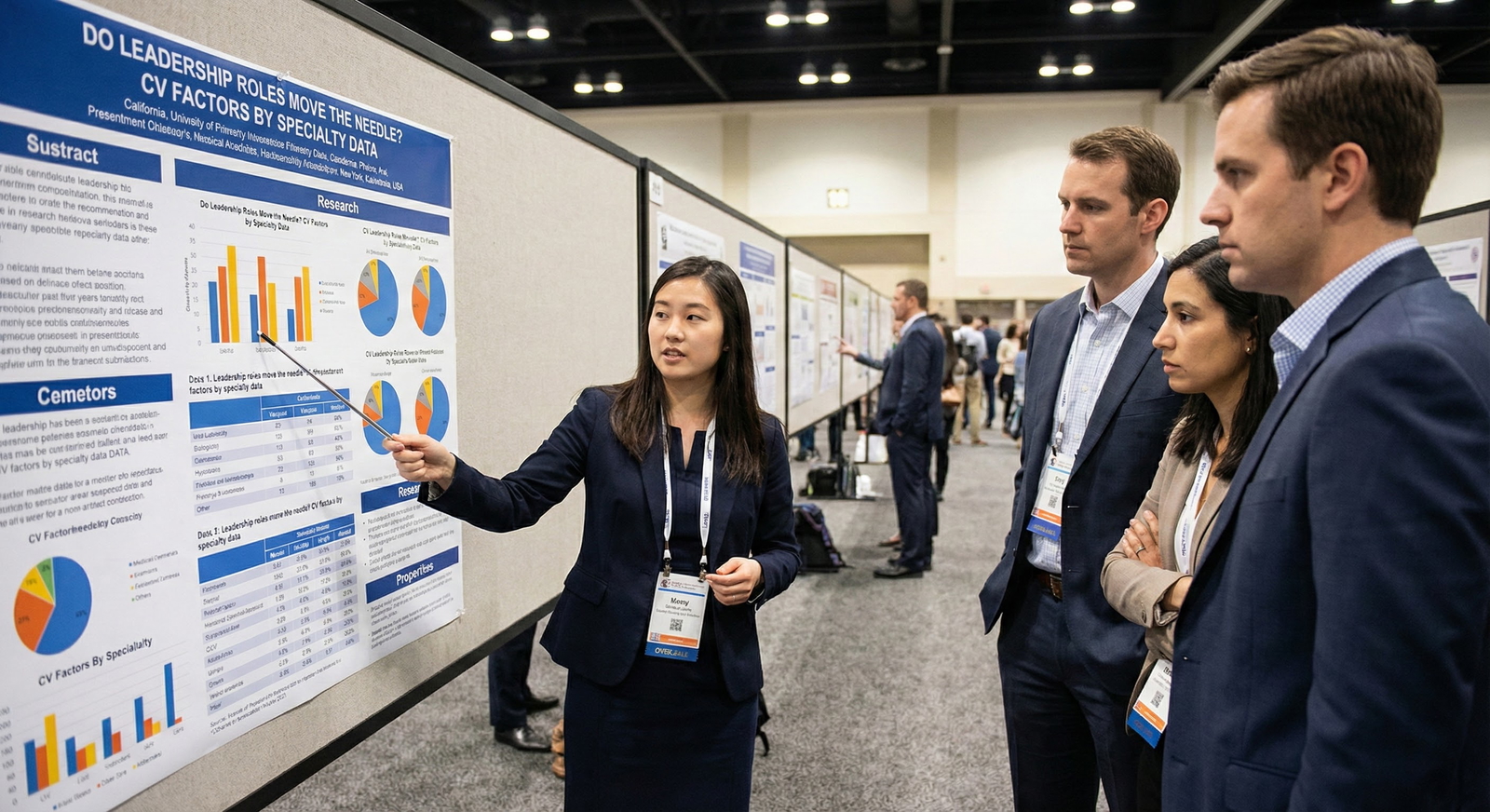
- National or regional conference presentations (CNS, AANS, NASS, SCCM, etc.)
- Case reports or tech reports related to spine, tumors, trauma, or vascular neurosurgery
Use standard citation format; be consistent (e.g., AMA). Clearly indicate “submitted,” “accepted,” or “in press.”
Example
Peer-Reviewed Publications
- Smith JA, Nguyen S, Patel R. Comparison of Outcomes After Endovascular vs. Open Repair of Ruptured Cerebral Aneurysms in a Community Setting. Journal of Neurosurgery. 2024;130(5):1234–1242.
Abstracts and Presentations
- Smith JA, Lee M, Johnson H. Early Neurologic Deterioration After Decompressive Craniectomy for TBI: A Single-Center Review. Poster presented at: Congress of Neurological Surgeons Annual Meeting; October 2024; Chicago, IL.
- Smith JA. Osteopathic Principles in Spine Surgery Recovery: A Case Series. Platform presentation at: American College of Osteopathic Surgeons Annual Conference; September 2023; Nashville, TN.
If your list is short, don’t hide it. Two or three focused, neurosurgery-relevant products are better than padded sections.
Leadership, Service, and Osteopathic Identity: Turning “DO” into an Advantage
Leadership: Show That You’re a Future Chief Resident
Neurosurgery programs seek residents who can eventually run a service, coordinate teams, and teach others.
High-yield leadership roles:
- Neurosurgery interest group president or officer
- Organizer of a neurosurgery skills workshop, suture clinic, or cadaver lab
- Coordinator for a quality improvement project in the ICU or OR
- Committee roles in AANS medical student chapters or neurosurgery societies
Example (Strong Leadership Entry)
President, Neurosurgery Interest Group
Rocky Mountain College of Osteopathic Medicine, 2022–2024
- Revitalized dormant interest group, growing active membership from 5 to 35 students
- Organized 6 neurosurgeon-led lectures, 2 hands-on suture/cranial fixation workshops, and 1 virtual panel on osteopathic pathways into neurosurgery residency
- Initiated a mentorship program pairing 20 preclinical students with neurosurgery residents at affiliated institutions
- Secured $1,200 in funding for educational events through grant applications and alumni outreach
Show numbers, scope, and impact. Avoid vague descriptors like “helped,” “assisted,” or “was part of.”
Service: Emphasize Depth and Continuity
Neurosurgery applicants are expected to be hard-working and patient-centered. Longitudinal service—especially in neurologically or surgically relevant contexts—supports this image.
Relevant service might include:
- OMM clinics serving chronic pain or spine patients
- Stroke education/community health fairs
- Free clinics, especially if you consistently worked in triage or urgent care
- Volunteering with brain injury support groups or rehab facilities
Example
Volunteer Osteopathic Manipulative Medicine Provider
Free Spine and Pain Clinic, Denver, CO, 2022–2024
- Provided supervised OMM for 3–5 patients per session with chronic low back and neck pain
- Collaborated with attending DOs and PT staff to design integrative care plans
- Helped develop a patient education handout on posture, ergonomics, and when to seek urgent neurosurgical evaluation
This simultaneously highlights your DO background and your relevance to spine and neurosurgery.
Showcasing Your Osteopathic Training Without Overdoing It
The phrase “DO graduate residency” sometimes triggers concerns in MD programs about familiarity with osteopathic principles. Address this by:
- Emphasizing your comfort with anatomy, physical exam, and hands-on patient care
- Showcasing environments where OMM and neurosurgery intersect (e.g., spine, chronic pain, rehab)
- Demonstrating that you also function seamlessly in MD-dominated environments (academic centers, research hospitals)
Balance is key: your CV should reflect pride in your osteopathic identity while clearly aligning with the expectations of a modern neurosurgery residency.
Technical Skills, Certifications, and Personal Interests
Technical and Surgical Skills
You are not expected to operate like a junior attending, but programs will be reassured to see:
- Comfort in the OR environment
- Exposure to basic neurosurgical instruments and techniques
- Procedural experience from surgery, anesthesia, or emergency medicine
Examples of Skills to List (honestly, never exaggerate):
- Basic suturing (simple interrupted, running, subcuticular, mattress)
- Assisting with craniotomy, laminectomy, spinal instrumentation (as student)
- Basic interpretation of CT/MRI brain and spine under supervision
- Familiarity with sterile technique, including prepping and draping
- EVD management exposure, ICP monitoring understanding (from ICU rotations)
You can also list:
- BLS, ACLS (current)
- ATLS course completed (especially valuable in trauma-heavy programs)
Professional Memberships
Include neurosurgery-relevant memberships:
- AANS Medical Student Chapter, member
- CNS Student or Resident-in-Training section (if available)
- American College of Osteopathic Surgeons (ACOS)
- State neurosurgical or osteopathic associations
This signals long-term engagement with the field and awareness of professional communities.
Personal Interests: Strategically Human
Program directors often scan this section quickly to understand what you’re like as a person. For neurosurgery, interests that imply resilience, focus, and teamwork can complement your narrative.
Examples:
- Long-distance running or endurance sports
- Classical piano, violin, or other instruments (discipline and persistence)
- High-level competitive team sports
- Technical hobbies (electronics, 3D printing, mechanical work)
Avoid clichés (“travel,” “reading,” “movies”) unless described with specificity and depth.
Example
- Marathon running (completed 3 marathons, PR 3:25, use structured training and data tracking)
- Amateur woodworking (designed and built custom standing desk and bookshelves)
- Chess (USCF-rated, local tournament competitor)
Common CV Mistakes That Hurt DO Applicants in Neurosurgery
Unfocused Narrative
- CV appears as a general “surgery or anything competitive” pitch rather than clearly neurosurgery-focused.
- Fix: Reorder sections, emphasize neurosurgery rotations and research, and ensure your top experiences are all neuro/surgical/ICU-oriented.
Underselling Osteopathic Training
- Only a shallow mention of OMM or DO identity, or none at all.
- Fix: Add 1–2 thoughtful entries showing how osteopathic principles inform your patient care, especially in spine/pain.
Overinflating Roles or Skills
- Claiming to “perform” procedures that you only observed or assisted minimally.
- Neurosurgery is small; program directors verify. Exaggeration is fatal if discovered.
Poor Formatting and Inconsistency
- Mixed date formats, inconsistent bullet styles, variable font sizes, spelling errors.
- In neurosurgery, sloppiness on your CV implies possible sloppiness in the OR.
Overcrowded, Text-Dense Entries
- 8–10 bullets per job or project with no prioritization.
- Fix: Use 3–5 strong bullets maximum, each starting with a powerful action verb and including concrete metrics.
Ignoring the “DO Graduate Residency” Context
- Applying as if the pathway and expectations were identical to MD applicants.
- Fix: Be explicit about your cross-training (e.g., away rotations at MD institutions, USMLE scores) and build relationships with neurosurgeons who know DO pathways.
Practical Steps and Timeline: Building Your Neurosurgery CV as a DO
MS1–MS2 (Preclinical)
- Join or start a neurosurgery interest group.
- Seek early neuroscience or neurosurgery research opportunities.
- Establish mentorship with at least one neurosurgeon (MD or DO).
- Begin building a master document to log activities, hours, and achievements.
MS3
- Prioritize neurosurgery, neurology, ICU, and trauma rotations.
- Collect written feedback and informal “mini-evaluations” you can later quote in letters or use to frame CV bullets.
- Present at least one poster (local/regional if national is not yet feasible).
MS4
- Schedule neurosurgery sub-internships/audition rotations (ideally at both DO-friendly and MD programs that have taken DOs).
- Update your CV with each major milestone: publications, presentations, new leadership roles.
- Have your CV reviewed by:
- A neurosurgery mentor
- A residency advisor familiar with the osteopathic residency match landscape
- A peer or senior resident for clarity and formatting
By the time you apply, your CV should reflect sustained, escalating commitment to neurosurgery.
FAQs: CV Building for DO Graduates in Neurosurgery
1. As a DO graduate, is it essential to have neurosurgery-specific research on my CV to match?
It’s not absolutely required, but neurosurgery-specific research significantly strengthens your application, especially for MD programs. If you lack neurosurgery research, aim for projects in neurology, critical care, trauma, or radiology that involve neuroimaging or neurologic outcomes. Clearly connect the skills you gained—data analysis, hypothesis generation, scientific writing—to neurosurgery in both your CV and interviews.
2. How many publications or presentations do I need for a competitive neurosurgery residency CV?
There is no fixed number, but many successful applicants have at least 2–3 neurosurgery or neuro-related scholarly products (posters, abstracts, or papers). Quality and relevance matter more than sheer quantity. One first-author paper plus a couple of posters can be more persuasive than ten superficial co-authorships where you can’t explain your role.
3. Should I list every volunteer and leadership activity, even if unrelated to neurosurgery?
No. Prioritize experiences that either:
- Support your neurosurgery narrative (neuro/ICU/surgery-related), or
- Demonstrate qualities neurosurgeons value: leadership, resilience, teamwork, initiative.
You can include a few non-medical or unrelated items for breadth, but the majority should align with your story as a future neurosurgeon.
4. How do I address concerns about being a DO applicant on my CV?
You don’t need to “defend” your DO background explicitly. Instead, let your CV indirectly address concerns by demonstrating:
- Strong exam performance (COMLEX ± USMLE)
- Success in MD-dominated environments (academic hospitals, away rotations)
- Neurosurgery-relevant research and scholarship
- Leadership and professionalism validated by neurosurgery faculty
A concise entry or two showcasing OMM in spine/pain clinics can also highlight a unique strength you bring to brain surgery residency programs.
By crafting a clear, neurosurgery-focused CV that thoughtfully integrates your osteopathic identity, you position yourself as a strong, distinctive candidate in a highly competitive field.