Understanding the Radiology Residency CV: What Program Directors Look For
Diagnostic radiology is one of the most competitive specialties in the residency match. A strong, well-structured CV is not just a formality; it’s a strategic document that can differentiate you from other highly qualified applicants. Your CV should tell a coherent story about who you are as a future radiologist: curious, analytical, team‑oriented, and committed to imaging and patient care.
Before diving into specific residency CV tips, it helps to understand how your CV is actually used:
- Screening tool: Faculty reviewers skim CVs quickly to identify interview offers among hundreds of applications.
- Conversation guide: Interviewers often use your CV as a roadmap for questions and discussion.
- Risk assessment: Red flags (gaps, low performance, professionalism issues) often appear first on the CV.
- Fit assessment: Programs look for alignment with radiology—interest in imaging, analytical thinking, and longitudinal commitment.
Core qualities radiology program directors commonly value:
- Academic excellence: Solid scores and class performance (but not always perfect).
- Evidence of analytical thinking: Research, quality improvement, data-driven projects.
- Technical curiosity: Comfort with technology, imaging, and sometimes informatics/AI.
- Teamwork & communication: Radiology is collaborative—your CV should show you work well with others.
- Consistency of interest: A pattern of radiology-related activities over time (electives, research, shadowing, leadership).
When you build your medical student CV, everything you include should serve at least one of these goals. The rest of this guide explains how to build, organize, and polish a CV that helps you stand out in the diagnostic radiology match.
Core Structure of a Strong Radiology Residency CV
Your CV should be clear, consistent, and easy to skim. Radiology faculty are used to scanning large volumes of imaging—your document should be just as navigable.
A typical structure:
- Contact Information
- Education
- Examinations & Certifications (optional section depending on context)
- Research & Publications
- Presentations & Posters
- Clinical Experience / Radiology-Specific Experience
- Leadership & Activities
- Honors & Awards
- Teaching & Mentorship
- Service & Volunteerism
- Professional Memberships
- Skills (including technical and language skills)
1. Contact Information
Keep this simple and professional:
- Full name (the name used in ERAS and official documents)
- Professional email address (e.g., firstname.lastname@domain.com)
- Phone number
- City and state (no full address needed in many contexts)
- Optional: LinkedIn profile or professional website (only if well-maintained and professional)
Avoid: personal photos, casual email addresses, or excessive social links.
2. Education
List in reverse chronological order:
- Medical school: name, city, state/country, anticipated graduation date
- Undergraduate or prior graduate degrees: institution, degree, major, graduation year, honors if significant (e.g., summa cum laude)
Example:
- MD Candidate, University of Midwest School of Medicine, Expected May 2026
- BS in Biomedical Engineering, University of State, May 2022, Magna Cum Laude
Include:
- Dual degrees (e.g., MD/PhD, MPH) and thesis titles if strongly relevant to radiology, imaging, or data science.
3. Examinations & Certifications (Optional but Useful)
Depending on how your institution structures ERAS documents, this may partly live in application fields, but it’s often helpful on a stand‑alone CV:
- USMLE Step 1, Step 2 CK (or COMLEX equivalents) – report as “Completed” or with score if appropriate in your context.
- Relevant certifications: BLS, ACLS, or informatics/imaging certifications (e.g., AI/ML courses, image analysis workshops).
- For international grads: English proficiency tests (IELTS, TOEFL) if noteworthy.
Keep this brief—your CV is not the primary place for test score details, but it’s acceptable to include high scores or distinctions.

Showcasing Research, Publications, and Presentations in Radiology
Radiology is an academically oriented specialty, and your research section can carry major weight in the diagnostic radiology match. Even if you’re not aiming for a heavily academic career, demonstrating scholarly curiosity signals that you will engage thoughtfully with imaging and evidence-based practice.
Research & Publications: How to List Them Properly
Divide this section into clear subsections:
- Peer‑Reviewed Publications
- Manuscripts Under Review / In Preparation (only if substantial and ideally with a timeline)
- Book Chapters
- Other Publications (blogs, lay press, educational materials)
Use a standard citation format (e.g., AMA or Vancouver) and be consistent. Bold your name within author lists to highlight your role:
Nguyen AL, Patel S, Johnson R, et al. Deep learning applications in chest CT for pulmonary nodule detection: A systematic review. AJR Am J Roentgenol. 2024;223(1):45‑57.
Key residency CV tips for this section:
- Prioritize radiology-related work: Imaging, informatics, AI, anatomy, oncology, physics, quality/safety in imaging.
- Don’t inflate: “Under review” is acceptable; “in preparation” should only be used if a full draft exists and all authors are engaged.
- Clarify your role: If you had a major role (first author, data analysis), be prepared to explain your contributions during interviews.
If you lack radiology-specific publications, it’s still valuable to list:
- Clinical research in other specialties (e.g., cardiology, oncology).
- Quality improvement projects with measurable outcomes.
- Data-driven or bioengineering projects.
Then, in future conversations (personal statement, interviews), connect how that work built skills applicable to radiology: data analysis, image interpretation, quantitative reasoning, or systems thinking.
Presentations, Posters, and Abstracts
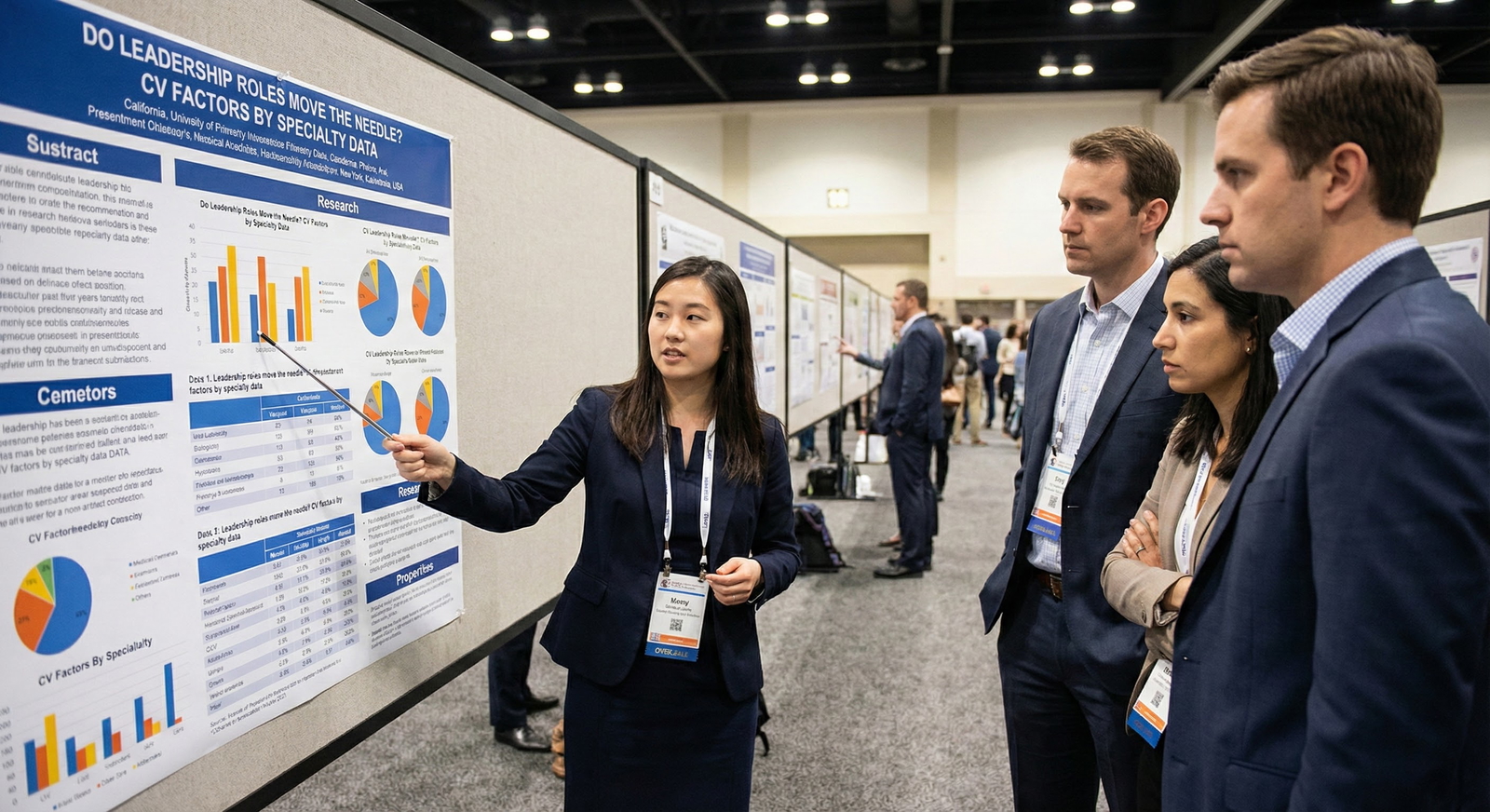
This category often impresses radiology program directors because it shows you can communicate findings—vital in a specialty where verbal and written communication with clinicians is central.
Organize into:
- National / International Conferences
- Regional / Institutional Presentations
Include:
- Authors (bold your name)
- Title of presentation
- Meeting/conference name
- Location and date
- Type: oral presentation, poster, invited talk
Example:
Smith JP, Lee T, Gupta R. Automated detection of intracranial hemorrhage on CT using convolutional neural networks. Oral presentation at: Radiological Society of North America (RSNA) Annual Meeting; Chicago, IL; November 2024.
If you have many items, consider ordering:
- By importance (national first, then regional, then local)
- Or by chronology within each category (most recent first)
How to Build Radiology-Relevant Research If You’re Starting Late
If you’re early in medical school or feel “behind,” you can still strengthen this portion of your medical student CV:
Join a radiology research group:
- Email faculty with clear, concise interest.
- Attach an updated CV and 3–4 sentence summary of your skills (e.g., statistics, coding, literature review experience).
Leverage case reports:
- Radiology is rich with unusual or educational cases.
- Work with radiology residents/fellows to identify cases for case reports or educational posters.
Get involved in clinical informatics or AI projects:
- Many radiology departments are running AI validation, workflow optimization, or reporting standardization projects.
- Even data cleaning and chart review experience is valuable.
Start a small QI project:
- Examples: reducing contrast waste, improving adherence to imaging guidelines, optimizing communication of critical results.
- These are publishable or presentable at radiology society meetings.
Over time, this strategy builds a portfolio that clearly aligns you with diagnostic radiology.
Radiology-Focused Experiences: Rotations, Electives, and Skills
Beyond raw “radiology residency” interest, programs want to see that you’ve actually spent time in imaging environments and understand what the work entails.
Clinical and Radiology-Specific Experience
Create subsections such as:
- Radiology Electives and Sub‑Internships
- Other Clinical Rotations (Selected)
- Shadowing and Observerships (especially important for IMGs)
For radiology rotations, list:
- Institution, department, dates
- Type: Diagnostic Radiology, Neuroradiology, Interventional Radiology, Emergency Radiology, etc.
- A concise bullet describing what you did, emphasizing active engagement:
Examples:
Diagnostic Radiology Elective, University Hospital, July 2025
- Interpreted plain radiographs and CT studies under supervision; presented imaging findings during daily readouts and multidisciplinary tumor boards.
Neuroradiology Rotation, Academic Medical Center, September 2025
- Participated in interpretation of MRI brain and spine studies; observed interventional spine procedures; prepared two educational case presentations for resident conferences.
Avoid generic bullets (“Observed imaging studies”) and instead highlight interactions, responsibility, or deliverables (talks, mini‑projects).
Translating Non-Radiology Clinical Experience to Radiology
Even non-imaging rotations can strengthen your radiology residency CV if you frame them correctly:
Instead of:
- “Completed core internal medicine rotation.”
Use:
- “Collaborated with radiologists to select appropriate imaging for complex inpatients, improving understanding of imaging indications and limitations.”
For surgery:
- “Assisted in pre‑operative planning using CT and MRI; correlated intraoperative findings with preoperative imaging.”
This demonstrates that you already connect clinical scenarios with imaging—exactly what radiologists must do daily.
Technical and Analytical Skills That Matter
Radiology programs appreciate applicants who are comfortable with:
- Data analysis tools: R, Python, SPSS, Stata
- Imaging software: OsiriX, Horos, 3D slicer, or similar (if you’ve truly used them)
- Programming: Python, MATLAB, or basic scripting relevant to image analysis or AI projects
- Machine learning / AI exposure: Coursework, online certifications, or applied projects
- Basic web or database skills: SQL, web-based educational tool development
Include a Skills section near the end of your CV and be honest—if you list it, be prepared to describe your experience concretely.
Example:
Technical Skills
- Data Analysis: R (intermediate), SPSS (advanced), Excel (advanced)
- Programming: Python (basic for data cleaning and visualization)
- Imaging Tools: OsiriX/Horos (basic use for research measurements and 3D reconstruction)
Leadership, Teaching, and Service: Signaling Who You Are as a Colleague
Radiology is often perceived as less patient‑facing, but in reality it’s highly collaborative, involving constant interaction with clinicians, technologists, and patients. Your leadership, teaching, and service sections should reassure programs that you are not only technically capable but also a strong colleague and communicator.
Leadership Roles That Matter for Radiology
Examples that strengthen your residency CV:
- Radiology interest group officer or founder
- Student representative to hospital imaging committees
- Leadership in technology, informatics, or engineering clubs
- Positions in multidisciplinary organizations (e.g., oncology interest group, surgery interest group) with clear imaging connections
- Class leadership positions (curriculum committees, student senate)
When listing leadership roles:
- Include title, organization, dates
- Under each, provide 1–2 concise bullets with measurable impact or initiatives
Example:
President, Radiology Interest Group, University of Midwest SOM
August 2024 – Present
- Organized a 6‑lecture radiology series with faculty, increasing student participation by 40% compared with prior year.
- Launched a peer‑mentorship program connecting 25 pre‑clinical students with radiology residents.
Focus on outcomes and initiatives, not just responsibilities.
Teaching and Mentorship
Radiologists frequently teach residents, fellows, medical students, and clinicians. Demonstrated teaching experience is a plus.
Include:
- Small group teaching (anatomy, imaging, problem‑based learning)
- Peer tutoring
- OSCE preparation workshops
- Radiology education initiatives (e.g., imaging case-of-the-week for classmates)
Example bullets:
- “Facilitated weekly small‑group sessions in anatomy with emphasis on radiologic imaging correlations for 12 first‑year medical students.”
- “Created a digital case bank of 30 chest radiograph cases for second‑year students, with annotated findings and explanation.”
Teaching experience that uses imaging specifically is especially attractive in a radiology residency CV.
Service and Volunteer Work
Programs value applicants who demonstrate empathy, reliability, and community engagement. This can include:
- Student‑run free clinics
- Imaging or screening programs (e.g., mammography drives, lung cancer screening outreach)
- Telehealth or rural health initiatives
- Community education (radiation safety, health literacy workshops)
When describing volunteer roles, focus on:
- Your responsibility level
- Consistency over time
- Any leadership or quality improvement you introduced
Even non‑radiology service can strengthen your application if it reflects professionalism, compassion, and commitment.
Design, Formatting, and Strategy: How to Build a High-Impact CV
Even if your content is strong, a poorly organized or cluttered CV can hurt you. Reviewers may only spend 1–2 minutes per CV during initial screening.
General Formatting Principles
- Length: For medical student CVs, 2–4 pages is typical; more is acceptable if you have extensive research, but avoid padding.
- Font: Clean, professional fonts (e.g., Calibri, Arial, Times New Roman, 11–12 pt).
- Consistency: Uniform use of bold, italics, dates, and bullet styles.
- White space: Adequate spacing between sections improves readability.
- File naming: Use a clear professional name:
LastName_FirstName_CV_2025.pdf.
Avoid:
- Excess colors, graphics, or tables.
- Long blocks of text without bullets.
- Redundant or overlapping entries.
Ordering Sections Strategically
Programs skim from top to bottom, but they focus on what they care most about. For diagnostic radiology, consider this sequence:
- Education
- Research & Publications
- Presentations & Posters
- Radiology and Clinical Experience
- Leadership & Activities
- Honors & Awards
- Teaching & Mentorship
- Service & Volunteerism
- Professional Memberships
- Skills
If you have especially strong research, move it near the top. If your research is modest but your leadership or service is outstanding, you may place those slightly higher. Tailor your order to highlight your biggest strengths relative to radiology.
Aligning Your CV With the Rest of Your Application
Your CV does not exist in isolation. It must align with:
- Personal statement: Themes and key activities should match and reinforce each other.
- Letters of recommendation: If a radiology mentor writes about your research, that project should be clearly listed and detailed on your CV.
- ERAS entries: Dates, titles, and authors must match exactly to avoid confusion or apparent inconsistencies.
Before submitting, cross‑check:
- All dates are consistent across documents.
- Titles of projects, publications, and roles match exactly.
- No duplicated experiences with different descriptions.
Common Pitfalls in Radiology Residency CVs
Avoid these frequent errors in how to build CV for residency:
- Overstuffed “interests” section: Keep hobbies brief and authentic; don’t use them as filler.
- Vague research descriptions: “Worked on a radiology project” is not helpful; be specific about your role and outcomes.
- Overuse of jargon or buzzwords: Use clear language; assume the reader may not be in your exact subspecialty.
- Unverifiable claims: Anything you list—skills, projects, roles—must be defensible in an interview.
- Neglecting radiology alignment: A CV full of unrelated activities with no imaging tie‑in gives the impression of last‑minute specialty choice.
Building Your CV Over Time: A Strategic Roadmap
For early medical students:
MS1–MS2:
- Join radiology interest groups and national organizations (e.g., RSNA, ACR student membership).
- Seek out radiology mentors and start small research or QI projects.
- Take on early leadership roles in interest groups.
- Begin tracking experiences in a “CV log” document.
MS3:
- Align core rotation experiences with imaging exposure.
- Solidify at least one or two substantial radiology research projects.
- Present posters at institutional or regional conferences; aim for at least one national if feasible.
- Update your CV every few months rather than scrambling in MS4.
MS4 (Application Year):
- Choose radiology electives at your home institution and, if possible, away rotations.
- Finalize manuscripts, abstracts, and presentations.
- Ask mentors to review your residency CV and tailor it for diagnostic radiology.
- Polish formatting, check for consistency, and export as a clean PDF.
For those later in training or switching from another specialty, emphasize longitudinal commitment from the point you decided on radiology and show how prior experiences (surgery, internal medicine, engineering) provide a strong foundation for imaging.
FAQs: CV Building in Diagnostic Radiology
1. How important is research for matching into diagnostic radiology?
Research is not an absolute requirement but is highly valued, particularly at academic programs. Radiology is data‑driven and rapidly evolving with AI and image analysis, so evidence of scholarly work signals that you can engage with new technologies and literature. Publications are ideal, but strong abstracts, posters, and ongoing projects also strengthen your application. If you have limited research, prioritize at least one substantial imaging‑related or data‑focused project and be ready to discuss it in detail.
2. Do I need radiology-specific activities on my CV to be competitive?
Yes, some radiology‑specific exposure is very helpful. Program directors want to see that you understand the specialty and have made an informed choice. This can include radiology electives, shadowing, radiology interest group leadership, imaging‑related research, or participation in radiology conferences. If your early CV is weak in radiology, you can still improve it quickly by seeking out elective rotations, a mentor in the department, and at least one project or presentation in imaging.
3. How should I list manuscripts that are not yet published?
Use a clearly labeled subsection such as “Manuscripts Under Review” or “Manuscripts In Preparation.” List full author names (with yours bolded), full title, and a brief status note (e.g., “Submitted to Radiology; under review” or “Draft complete; planned submission to AJNR January 2026”). Avoid padding this section with vague or speculative projects; only include work with a completed or nearly completed manuscript and active mentorship.
4. What are the biggest formatting mistakes that hurt a radiology residency CV?
Common issues include inconsistent dates or citation styles, overly long paragraphs instead of concise bullets, poor organization (no clear sections), and cluttered designs with unusual fonts or colors. Radiologists are accustomed to structured reports and organized images; your CV should reflect the same clarity. Keep it clean, standardized, and easy to skim, with the most radiology‑relevant content (research, presentations, imaging electives) clearly visible in the top half of the first page.
A well‑constructed CV for diagnostic radiology doesn’t just list activities—it builds a coherent narrative that you’re analytical, reliable, collegial, and genuinely invested in imaging. If you continually refine your medical student CV, seek feedback from radiology mentors, and align your experiences with the qualities programs value, your CV will become a powerful asset in the diagnostic radiology match.