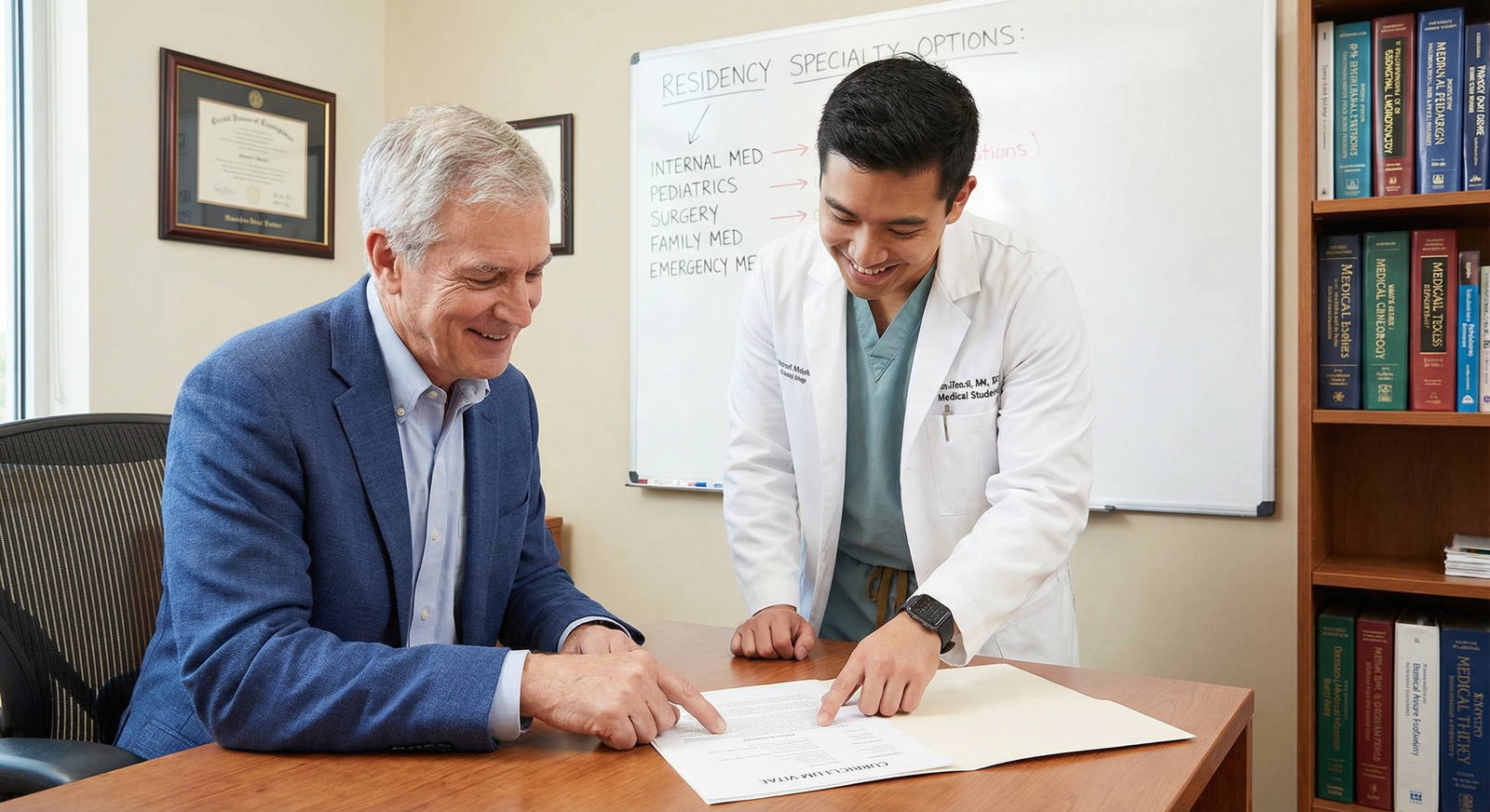
Understanding the Role of the CV in Your Internal Medicine Match
Your CV is the backbone of your residency application. For a Caribbean IMG targeting an internal medicine residency, it’s more than a list of activities—it’s your core narrative on paper.
Why the CV Matters So Much for Caribbean IMGs
As a Caribbean medical school graduate, program directors will often view your application through two lenses:
Standard screening filters
- USMLE scores, clinical grades, gaps, and red flags
- Alignment with internal medicine as a career choice
Context-specific questions for Caribbean IMGs
- Is this applicant well-prepared clinically despite being outside the U.S. system for basic sciences?
- Have they had substantial US clinical experience (USCE)?
- Does their trajectory show consistency, maturity, and reliability?
- Are they likely to adapt well to a busy internal medicine residency?
Your CV is where you begin to answer these questions—clearly, consistently, and strategically.
CV vs. ERAS Application vs. Resume
For residency applications, you will complete the ERAS application, which already asks for much of what a CV would contain. However, you still need a robust CV because:
- It is often requested for away rotations, research positions, electives, and observerships.
- Attendings and letter writers may ask for your “CV” to understand your profile.
- Some programs, especially community or smaller internal medicine residency programs, may explicitly request a separate CV.
- Planning and updating a CV early helps you see where you have strengths and where you need to fill gaps.
Think of your CV as the master document from which you draw everything you enter into ERAS.
Core Structure: What a Strong IM Residency CV Should Include
Your CV must be clean, consistent, and easy to scan. For internal medicine residency, clarity beats creativity.
Recommended CV Sections (in order)
- Header
- Education
- US Clinical Experience (USCE) & Other Clinical Experience
- Research & Scholarly Activity
- Publications, Abstracts, and Presentations
- Work Experience (Non-clinical)
- Leadership & Extracurricular Activities
- Honors & Awards
- Certifications & Licenses
- Skills (Optional, brief)
- Professional Interests (Optional, very brief)
Let’s break down each component with examples tailored to Caribbean medical students and graduates.
1. Header: Make It Professional and Complete
Include:
- Full name (consistent with USMLE and ERAS)
- Current location (city, state, country)
- Phone (with country code)
- Professional email (yourname@gmail.com type)
- LinkedIn URL (optional but increasingly useful)
- ECFMG ID (optional on CV, but handy for medical contexts)
Avoid:
- Photos or headshots (not standard in US residency CVs)
- Demographics like age, marital status, or religion
Example:
John A. Doe, MD (Expected 2026)
St. George’s University School of Medicine, Grenada
Currently in: Brooklyn, NY | +1 (XXX) XXX-XXXX | john.doe@email.com
ECFMG ID: XXXXXXXX | LinkedIn: linkedin.com/in/johndoemd
2. Education: Emphasize Medical Training and Clarity of Timeline
For a Caribbean medical school residency trajectory, your education section should make your path transparent—no question about gaps or overlaps.
Include (for each degree):
- Institution name, city, country
- Degree and expected or completed date
- Honors if relevant (e.g., cum laude, Dean’s List)
- Brief note on basic sciences vs. clinical years (optional, if helpful to clarify)
Example:
Doctor of Medicine (MD), Expected May 2026
St. George’s University School of Medicine (SGU), Grenada & Clinical Centers in the United States
- Basic Sciences: Grenada Campus (Aug 2022 – Dec 2023)
- Clinical Rotations: Multiple sites in NY/NJ (Jan 2024 – Apr 2026)
Bachelor of Science in Biology, May 2021
University of Miami, Miami, FL, USA
- Graduated magna cum laude
If you’re aiming to highlight your SGU residency match potential, showing a clear, timely progression through SGU (or Ross, AUA, etc.) helps reassure programs that you’re on track and organized.
3. Clinical Experience: The Heart of the IM Residency CV for Caribbean IMGs
For internal medicine, this section can make or break your file, especially as a Caribbean IMG.
Separate your experience into:
- US Clinical Experience (USCE) – core and elective rotations in the U.S.
- Other Clinical Experience – home-country experience, observerships, volunteer clinical roles
3.1 How to List USCE for Internal Medicine
For IM programs, highlight:
- Internal medicine core rotation
- IM sub-internships (Sub-I) or acting internships
- IM electives (cardiology, GI, pulmonary, nephrology, hospitalist, etc.)
- Any continuity clinic experience
For each entry, include:
- Hospital name, city, state
- Department / specialty
- Type: Core rotation, elective, sub-internship, observership
- Dates (month/year)
- Brief bullet points emphasizing responsibility and skills (NOT just tasks)
Example (Good):
Internal Medicine Core Clerkship, 8 weeks
Maimonides Medical Center, Brooklyn, NY, USA | Core Clinical Rotation
Jan 2025 – Mar 2025
- Managed 4–6 patients daily under supervision, including diabetes, CHF, COPD exacerbations, and sepsis
- Presented daily progress notes and developed assessment and plan on rounds
- Performed admission H&Ps and coordinated diagnostic workup with multidisciplinary teams
- Participated in daily morning reports and resident teaching conferences
This level of detail shows you can function in a typical internal medicine workflow.
3.2 Highlighting Experience for IM Match
To strengthen your IM match profile:
- Ensure at least one strong IM core and one IM-related elective in the U.S.
- If possible, add a Sub-I in Internal Medicine with clear responsibility for patient care.
- Use language that mirrors internal medicine: pre-rounding, sign-out, differential diagnosis, multidisciplinary care, transitions of care, medication reconciliation, evidence-based management.
3.3 Observerships and Home-Country Clinical Work
If you did observerships or hospital work in your home country:
- Put them in a separate subsection: “Other Clinical Experience”
- Be very honest about the level of responsibility (observer vs. hands-on)
- Connect the experience to internal medicine when relevant
Example:
Clinical Observer, Internal Medicine, 4 weeks
Kingston Public Hospital, Kingston, Jamaica | Observership
Aug 2024 – Sep 2024
- Observed inpatient management of common internal medicine conditions including pneumonia, uncontrolled diabetes, and hypertensive emergencies
- Attended teaching rounds and morning reports; participated in case-based discussions
- Gained perspective on managing complex patients in a resource-limited setting
This shows initiative, exposure, and maturity, even if not hands-on.

Research, Scholarly Work, and How to Be Competitive in IM
While internal medicine is relatively more flexible than some highly competitive specialties, research and academic output still strengthen your profile, especially as a Caribbean IMG.
4. Research & Scholarly Activity
If you have limited research, that’s common. What matters is:
- Clear documentation
- Relevance to internal medicine (if possible)
- Evidence of follow-through and academic curiosity
Include:
- Project title
- Role (e.g., Research Assistant, Sub-investigator, Data collector)
- Institution and department
- Dates
- 2–3 bullets on responsibilities and outcomes
Example:
Research Assistant, Heart Failure Readmissions Project
Department of Medicine, St. Michael’s Medical Center, Newark, NJ
Jun 2024 – Dec 2024
- Collected and analyzed data on 200+ patients with heart failure focusing on 30-day readmission rates
- Performed chart reviews and entered data into REDCap database
- Contributed to abstract submitted to the American College of Physicians regional meeting
5. Publications, Abstracts, and Presentations
Separate this section clearly and use a consistent citation style (e.g., AMA). Organize as:
- Peer-reviewed publications
- Abstracts and posters
- Oral presentations
You can indicate “Submitted” or “In preparation” cautiously, but do not exaggerate.
Example:
Poster Presentations
Doe JA, Singh R, et al. “Predictors of 30-Day Readmission in Heart Failure Patients at a Community Hospital.” Poster presented at: ACP New Jersey Chapter Meeting; March 2025; New Brunswick, NJ.
Even 1–2 posters or abstracts can significantly enhance your residency CV for internal medicine, especially when combined with meaningful clinical exposure.
If You Have Little or No Research
You can still be competitive for internal medicine, but consider:
- Joining ongoing quality improvement (QI) projects on your IM rotations.
- Asking attendings: “Are there any QI or chart review projects I could help with?”
- Turning interesting cases into case reports or case presentations at student or regional meetings.
This proactive approach signals academic engagement, something programs appreciate in IM residents.
Work, Leadership, and Extra-Curriculars: Crafting a Strong Narrative
Program directors are looking for a dependable team player who can handle the workload, communicate well, and stay resilient. Your work and leadership experiences tell that story.
6. Work Experience (Non-Clinical)
As a Caribbean IMG, you might have:
- Tutoring or teaching assistant roles
- Part-time jobs (retail, restaurant, customer service)
- Administrative work
Don’t hide these—present them strategically.
Focus on transferrable skills:
- Communication
- Time management
- Teamwork
- Problem-solving
- Working with diverse populations
Example:
Anatomy Tutor
St. George’s University School of Medicine, Grenada
Sep 2023 – Dec 2023
- Led weekly small-group review sessions for 10–15 first-year medical students
- Developed structured teaching materials and practice questions
- Improved passing rate among group participants from 72% to 89%
This clearly shows teaching ability—valuable in internal medicine residency where residents teach students and junior colleagues.
7. Leadership & Extracurricular Activities
Internal medicine values leadership that relates to:
- Patient advocacy
- Health education
- Community service
- Team coordination
Examples:
- Class representative
- Student council roles
- President or officer of an Internal Medicine Interest Group
- Organizer of health fairs or screening events
Example:
President, Internal Medicine Interest Group
St. George’s University School of Medicine
Jan 2024 – Dec 2024
- Organized monthly talks with internal medicine attendings and residents, attended by 40+ students per session
- Coordinated a mentorship program pairing 30 preclinical students with clinical-year mentors
- Led a community blood pressure and diabetes screening event serving 150+ local residents
This aligns perfectly with your goal of an internal medicine residency: leadership, continuity of care, population health awareness.
8. Honors & Awards
Include:
- Dean’s list
- Scholarships
- Exam-based awards (if any)
- Recognition for teaching or leadership
Example:
Dean’s List, Basic Sciences – St. George’s University School of Medicine (4 consecutive terms)
This reinforces academic consistency, a plus for SGU residency match outcomes and other Caribbean medical school residency applications.
Certifications, Skills, and Fine-Tuning Your CV for IM Programs
9. Certifications & Licenses
For internal medicine residency, standard items include:
- USMLE Step 1, Step 2 CK (with scores; some prefer to list in a dedicated “Examinations” section)
- ECFMG certification status (if applicable)
- BLS, ACLS (if current)
- Any national licenses in your home country (if applicable)
Example:
Certifications
- USMLE Step 1: Passed (Score: XXX, Month Year)
- USMLE Step 2 CK: Passed (Score: XXX, Month Year)
- Basic Life Support (BLS), American Heart Association, Expires June 2026
- Advanced Cardiovascular Life Support (ACLS), AHA, Expires June 2026
- ECFMG Certification (Expected 2025)
10. Skills (Use Sparingly and Honestly)
This section should be short and relevant:
- Languages (with proficiency level)
- Statistical software (SPSS, Stata, R, if used)
- EMR familiarity (Epic, Cerner, etc.—only if meaningful exposure)
- Basic procedural skills (if properly trained and used)
Example:
Skills
- Languages: English (native), Spanish (conversational)
- EMR: Experienced with Epic and Cerner during US clinical rotations
- Research Tools: REDCap, basic SPSS
Avoid generic skills like “hardworking” or “team player” here—these should emerge from your experiences, not labels.
11. Professional Interests (Optional but Helpful)
One or two lines that align with your intended specialty:
Professional Interests: General internal medicine, health disparities, quality improvement, and resident education.
This reaffirms your commitment to internal medicine without overselling.

Strategic Residency CV Tips for Caribbean IMGs
Understand What Internal Medicine PDs Look For
For internal medicine program directors evaluating a Caribbean IMG CV, key questions are:
Can this applicant handle the clinical workload?
→ Highlight solid IM rotations, Sub-I, responsibility, and patient load.Are they reliable and consistent academically?
→ Emphasize timely progression, exam passes, dean’s list, sustained involvement.Will they fit into our team culture?
→ Show teamwork, teaching, communication, and leadership examples.Do they have a genuine interest in internal medicine?
→ Reflect IM-focused electives, IM interest group leadership, IM-related research/QI, and a clear IM narrative.
How to Build CV for Residency as a Caribbean IMG: Action Plan
1. Audit your current CV (or create a master document)
List everything you’ve done since starting medical school: clinical, academic, volunteer, work. Then categorize.
2. Identify gaps relevant to internal medicine
Common gaps for Caribbean IMGs:
- Limited US clinical internal medicine experience
- Little or no research/QI
- No leadership or teaching experiences
- Unclear narrative connecting experiences to IM
3. Targeted steps to fill those gaps before application season
- USCE in IM: Prioritize IM core, IM electives, and if possible, a Sub-I in IM in the US.
- Research/QI: Ask IM attendings about ongoing projects; volunteer for data collection or chart reviews.
- Leadership/Teaching: Tutor juniors in IM-related subjects; lead review sessions; take roles in IM or student-run clinics.
- Service: Join health fairs, free clinics, or community screening events, especially focusing on chronic diseases (diabetes, hypertension, obesity).
4. Keep a running CV and update monthly
Document:
- Exact dates
- Supervisors’ names and positions
- Concrete tasks and outcomes
This habit makes ERAS entry and residency CV building easier and more accurate.
Tailor, Don’t Fabricate
- Do not exaggerate roles. US programs are highly experienced at reading IMG CVs.
- Focus on what you truly did and learned.
- Use bullet points that show impact or responsibility, not just presence.
Weak bullet:
“Attended clinic and followed patients.”
Stronger bullet:
“Conducted initial focused histories and physical examinations on 2–3 patients per clinic session under supervision; presented assessment and plan to attending.”
Formatting Essentials
- Length: For a residency CV, 2–4 pages is typical for a Caribbean IMG with clinical, research, and work experience.
- Font: Simple and readable (e.g., Times New Roman, Calibri, 11–12 pt).
- Consistency: Same format for dates, locations, and bullet points.
- Order: Reverse chronological within each section (most recent first).
Connecting CV to SGU Residency Match and Other Caribbean Schools
If you're from SGU, Ross, AUA, or similar Caribbean schools:
- Many of these institutions publish match lists; review where internal medicine graduates match.
- Notice patterns: programs value strong USCE, solid Step scores, clean timelines, and at least some scholarly or leadership activity.
- Structure your CV to make it immediately obvious that you meet those patterns.
For example, if many SGU residency matches in IM come from hospitals where SGU has core rotations, highlight those rotations clearly and thoroughly.
Frequently Asked Questions (FAQ)
1. How is a residency CV different from a job resume?
A residency CV is longer, more detailed, and academically oriented. It includes:
- Full education and training history
- Clinical rotations
- Research and scholarly work
- Leadership and teaching
- Certifications and exams
A job resume is usually 1 page and customized for an industry role. For residency, program directors expect a comprehensive academic CV, not a condensed business-style resume.
2. Should I include my USMLE scores on my CV?
You can, but it’s not mandatory, since programs see them through ERAS. Many Caribbean IMGs choose to include scores when they are strengths or clearly within the program’s typical range. If you’re unsure, you can simply list:
USMLE Step 1: Passed
USMLE Step 2 CK: Passed
and let ERAS convey the specific scores.
3. I have no publications. Will that hurt my internal medicine chances?
Lack of publications is not a deal-breaker for internal medicine, especially at many community and mid-tier university-affiliated programs. However:
- Having any scholarly activity (posters, QI projects, case reports) helps.
- If you’re still early in training, try to join at least one project before applying.
- For highly academic IM programs, research productivity becomes more important.
Your clinical performance and USCE are still primary factors, especially as a Caribbean IMG.
4. Can non-medical jobs (like retail or restaurant work) help my CV?
Yes, when framed correctly. Non-medical jobs can demonstrate:
- Work ethic and time management
- Customer service and communication skills
- Ability to work in teams and under pressure
Include them in a Work Experience section and use focused bullet points that highlight transferrable skills. Don’t let them overshadow your medical experiences, but don’t hide them either—especially if they explain how you financed your education or filled a gap year.
By approaching CV building as a strategic, ongoing process, you position yourself as a serious candidate for internal medicine residency, even as a Caribbean IMG. Every rotation, project, and role you take on can—and should—feed into a clear, cohesive CV that tells programs: “I’m prepared, I’m committed to internal medicine, and I will be a reliable, teachable resident in your program.”