Understanding the EM–IM Pathway and What Programs Look For
Emergency Medicine–Internal Medicine (EM–IM) combined residency is a competitive, five-year training pathway that prepares you to manage acutely ill patients in both the emergency department and inpatient settings. For a non-US citizen IMG or foreign national medical graduate, your CV must show that you:
- Can thrive in high-acuity, fast-paced environments (EM)
- Have strong clinical reasoning, continuity of care, and systems-based practice (IM)
- Understand and can navigate the US healthcare system
- Are a reliable, ethical, and team-oriented trainee
- Have genuine interest in combined training, not just either EM or IM alone
Unique Challenges for Non-US Citizen IMGs
As a non-US citizen IMG applying in emergency medicine internal medicine (EM IM combined), you often face:
- Limited US clinical experience opportunities (especially in EM)
- Visa considerations (J-1 vs H-1B), which some programs mention explicitly
- Less familiarity with US-style documentation and formatting for a medical student CV
- Need to “translate” your international accomplishments into US-relevant impact
A strong residency CV is one of your most powerful tools to close these gaps. It is more than a list of activities; it is a strategic narrative showing how your background fits exactly what EM–IM programs need.
Core Structure: How to Build a CV for EM–IM Residency
Use a standard, clean, US-style format. Your residency CV should usually follow this order:
- Contact Information
- Education
- USMLE/Board Exams
- Clinical Experience
- Research & Scholarly Activity
- Leadership & Teaching Experience
- Work & Volunteer Experience
- Honors & Awards
- Professional Memberships
- Skills (Languages, Technical, Certifications)
- Personal Interests (brief)
Think of these sections as “evidence blocks” that collectively demonstrate your fit for emergency medicine internal medicine.
1. Contact Information
Keep it professional and simple:
- Full name (matching all official documents)
- Email (professional, e.g., firstname.lastname@…)
- Mobile phone (with country and area code)
- Current address (US address if you have one; otherwise home country)
- Optional: LinkedIn profile if updated and professional
Avoid: Photos, date of birth, marital status, nationality, or passport number. These are not needed and can raise bias-related concerns.
2. Education
List your education in reverse chronological order:
- Medical school name, city, country
- Degree (e.g., MBBS, MD), graduation month/year
- Class rank or percentile if favorable (top 10%, top quartile, etc.)
- Thesis title (if applicable)
If you completed or are completing any additional degrees or diplomas (e.g., public health, critical care diplomas, online US-based courses relevant to EM or IM), include them as separate entries.
Example:
Doctor of Medicine (MD)
University of X Faculty of Medicine, City, Country
Graduated: June 2022 | Class Rank: Top 15%
As a foreign national medical graduate, explicitly listing country and context helps programs understand your training environment.
3. Examination Scores: USMLE and Other Licensure Exams
Most EM–IM programs care deeply about:
- USMLE Step 1 (Pass/Fail but attempts matter)
- USMLE Step 2 CK (numeric score very important)
- OET/IELTS/TOEFL (if applicable)
- ECFMG certification status
Include:
- Exam name
- Score (if numeric)
- Date taken
- Attempts (only if asked or if multiple attempts; ERAS will show it)
You may create a subsection titled “Licensure and Certification” for:
- USMLE Step 1 (Pass; MM/YYYY)
- USMLE Step 2 CK (XXX; MM/YYYY)
- OET Medicine (Grade XXX; MM/YYYY)
- ECFMG Certification (Expected MM/YYYY or Certified MM/YYYY)
Programs know that as a non-US citizen IMG, licensure logistics are more complex. A clear, organized exam section reassures them you’re progressing properly.
Showcasing Clinical Experience for EM–IM as a Non-US Citizen IMG
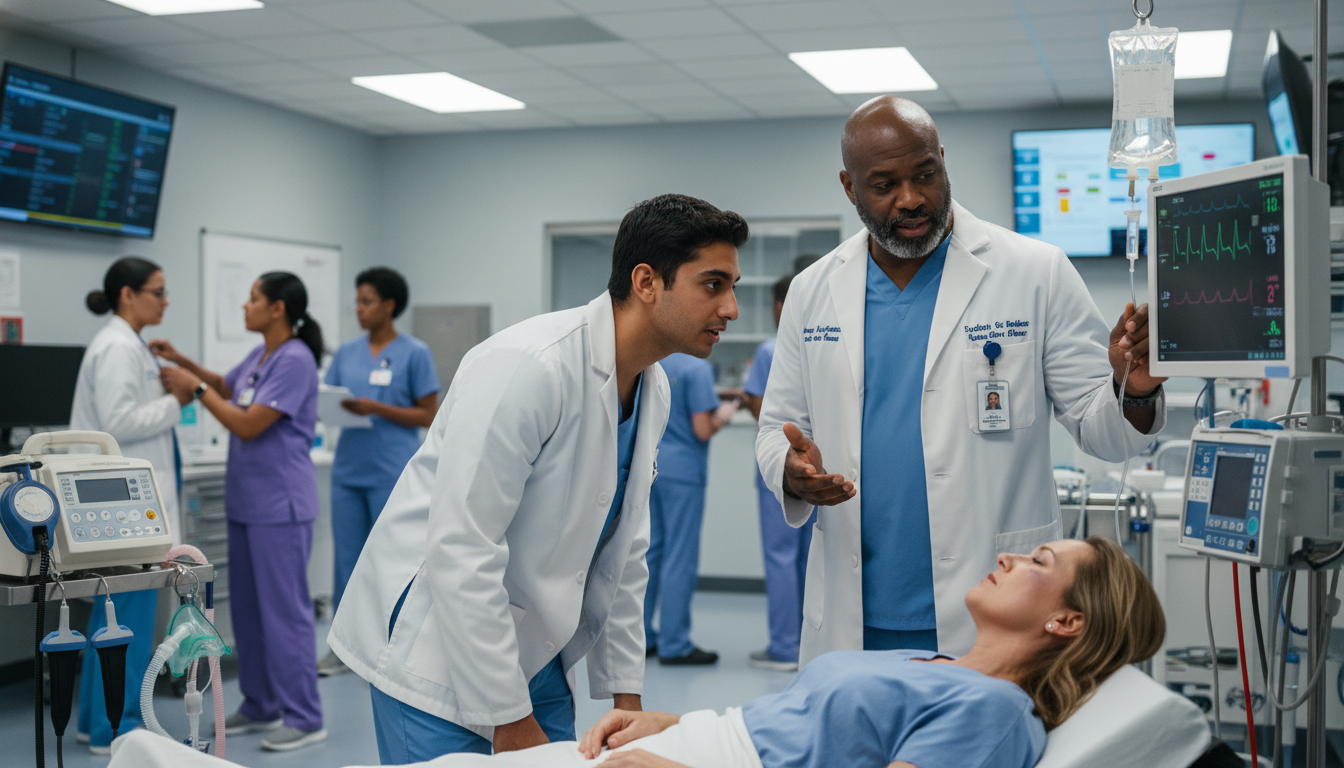
For combined emergency medicine internal medicine training, clinical experience is the heart of your CV. Program directors look for consistent, credible evidence that you understand both EM and IM practice, ideally in the US.
1. US Clinical Experience (USCE)
For a non-US citizen IMG, this is often the most heavily scrutinized section. Use a dedicated heading:
Clinical Experience (United States)
Include:
- Institution name, city, state
- Department and type (e.g., EM observership, IM sub-internship)
- Dates (month/year to month/year)
- Role (observer, extern, sub-intern, research fellow)
- 2–4 bullet points describing what you did (focus on responsibilities, skills, and settings)
Strong EM example:
Emergency Medicine Observership
University Hospital, Department of Emergency Medicine, City, State, USA
08/2024 – 09/2024
- Observed and assisted in evaluation of ~10–15 patients per shift in a Level 1 trauma center, focusing on chest pain, dyspnea, and trauma activations.
- Participated in daily ED case discussions and simulation sessions on airway management and ACLS scenarios.
- Gained familiarity with US triage systems, EMR documentation, and interdisciplinary communication with nursing and consultants.
Strong IM example:
Internal Medicine Sub-internship
Community Teaching Hospital, Department of Internal Medicine, City, State, USA
06/2024 – 07/2024
- Managed 4–6 inpatients daily under supervision, including admissions from ED, daily progress notes, and discharge summaries.
- Presented new admissions and follow-up cases at team rounds, focusing on diagnostic reasoning and evidence-based management.
- Collaborated with residents and pharmacists for medication reconciliation and care coordination.
Tips specific to non-US citizen IMGs
- Show progression: If you completed multiple rotations, highlight how responsibilities increased (e.g., from observership to sub-internship).
- Highlight EM–IM overlap: Admissions from ED to the ward, sepsis management, chest pain pathways, and transitions of care.
- If your visa status made hands-on roles difficult, emphasize active observation and participation in teaching, case discussions, and QI projects.
2. Home Country Clinical Experience
Programs know that as a foreign national medical graduate, your strongest hands-on experience may be in your home system. Include it under:
Clinical Experience (International) or Clinical Experience (Home Country)
Focus on acuity, autonomy, and scope:
- Internship or foundation years (rotations, responsibilities, supervision level)
- Work as a general physician, medical officer, or resident
- EM-like settings: urgent care, ED, casualty, ICU
- IM-related inpatient and outpatient practice
Example:
Internship – Internal Medicine Rotation
General Hospital, City, Country
01/2023 – 03/2023
- Independently evaluated 10–15 new admissions daily, including patients with sepsis, heart failure, COPD exacerbations, and diabetic emergencies.
- Performed common bedside procedures (arterial blood gas sampling, lumbar punctures under supervision).
- Coordinated with ED staff for admission decisions and transfer of critically ill patients to ICU.
This shows that you already function in roles similar to junior US residents, reinforcing your readiness for combined EM–IM.
3. EM–Specific and IM–Specific Emphasis on Your CV
To align with emergency medicine internal medicine expectations:
EM signals:
- Rotations in emergency departments, urgent care, trauma, critical care
- ACLS, ATLS, PALS, BLS certifications
- Experience with triage, resuscitation, procedural skills (even if only in simulation)
- Exposure to pre-hospital or disaster medicine
IM signals:
- Continuity clinics, inpatient ward rotations, step-down/ICU
- Chronic disease management, complex comorbidities
- QI projects related to readmissions, handoffs, sepsis bundles
For EM–IM, strive for balanced representation. If your CV heavily favors IM, add EM-related electives, ED shadowing, or EM research. If heavily EM-focused, add evidence that you appreciate long-term management and complex internal medicine.
Research, Scholarly Activity, and QI: Strengthening Your Academic Profile

Not all EM–IM residents are research-focused, but a solid scholarly section differentiates you as a foreign national medical graduate and signals comfort with evidence-based medicine.
1. Types of Work to Include
Organize under clear headings such as:
- Peer-Reviewed Publications
- Conference Presentations
- Posters and Abstracts
- Quality Improvement Projects
- Case Reports and Case Presentations
For each entry, include:
- Authors (Last name, initials; underline your name if allowed in your format)
- Title
- Journal or conference name
- Year, volume, pages (if published)
- Location and date (for presentations)
Example (abstract):
Ahmed S., Kumar R., et al. “Outcomes of Sepsis Management Pathways in a Tertiary Care Emergency Department in India.” Presented at American College of Emergency Physicians (ACEP) Scientific Assembly, Philadelphia, PA, USA, 2024.
If your work is in progress, label it “In Preparation” or “In Submission” but be honest—programs expect that some projects may still be evolving.
2. EM–IM-Relevant Research Topics
Strong topic areas for emergency medicine internal medicine include:
- Sepsis management and pathways
- Chest pain risk stratification and ACS protocols
- COPD, asthma, or heart failure exacerbations (ED to inpatient transitions)
- Seizure, stroke, and neurologic emergencies
- ED-initiated care for chronic conditions (diabetes, hypertension)
- Readmission reduction and care coordination
- ICU and high-acuity medical care
Even if your research is not directly in EM or IM, highlight transferable skills:
- Study design, data analysis, critical appraisal
- Team collaboration in multi-disciplinary projects
3. Quality Improvement and Systems Work
EM–IM programs highly value physicians who can improve systems of care. QI is a bridge between EM and IM, and an excellent way for a non-US citizen IMG to show:
- Familiarity with protocols and guidelines
- Understanding of patient safety, workflow, and documentation
Example QI entry:
Quality Improvement Project – Reducing Door-to-Antibiotic Time in Suspected Sepsis
Internal Medicine Department, General Hospital, Country
2022 – 2023
- Led a team of 4 interns to analyze delays in antibiotic administration for suspected sepsis patients admitted from ED to IM wards.
- Implemented standardized sepsis order sets and nurse-triggered alerts; monitored pre- and post-intervention times.
- Achieved a 25% reduction in median door-to-antibiotic time over 6 months.
This clearly connects EM (ED presentation) and IM (ward care), which is ideal for your EM–IM narrative.
Leadership, Teaching, and Non-Clinical Experience That Matter for EM–IM
Emergency medicine internal medicine physicians must communicate clearly, lead teams, and teach under pressure. Your residency CV should highlight these non-clinical competencies.
1. Leadership Roles
Include:
- Student government positions
- Class representative roles
- Club or society leadership (EM, IM, public health, research club)
- Organizing committees for conferences or workshops
Focus on impact, not titles alone.
Example:
President, Emergency Medicine Interest Group
Medical University, Country | 2020 – 2021
- Organized monthly EM case conferences and simulation sessions for 50+ students.
- Coordinated with local ED physicians to host workshops on airway management and trauma assessment.
- Increased group membership by 40% over one academic year.
This ties leadership directly to EM exposure, supporting your EM–IM interest.
2. Teaching Experience
EM–IM residents are expected to teach students, nurses, and junior trainees. On your medical student CV, include:
- Formal teaching roles (tutor, teaching assistant)
- Peer teaching sessions
- Teaching during internships (e.g., orienting new interns or students)
Example:
Clinical Skills Tutor, Physical Examination Course
Medical University, Country | 2019 – 2020
- Conducted small-group teaching sessions (8–10 students) on cardiovascular and respiratory examination techniques.
- Developed OSCE-style practice cases and provided feedback on communication and bedside manner.
Point out how this prepares you to teach in high-pressure EM and IM settings.
3. Work Experience (Clinical and Non-Clinical)
As a non-US citizen IMG, you may have:
- Worked as a medical officer in ED, ICU, or wards
- Held non-medical jobs (research assistant, scribe, translator, lab tech)
Include only positions that:
- Demonstrate reliability, communication, and teamwork
- Add value to your EM–IM story
For US-based jobs like ED scribe or medical assistant, emphasize your exposure to EMR, US documentation, and interdisciplinary practice.
Practical Residency CV Tips for Non-US Citizen IMGs Targeting EM–IM
This section brings together concrete, actionable residency CV tips to help you stand out as a non-US citizen IMG or foreign national medical graduate.
1. Use US-Standard Formatting
- 1–2 pages is typical for a medical student CV; IMGs often have 2–3 pages due to extra experience—this is acceptable if well organized.
- Use a clean, readable font (11–12 pt, e.g., Calibri, Arial, Times New Roman).
- Maintain consistent formatting for dates, headings, and bullet points.
- Avoid graphics, tables, or colors that may not render well in ERAS PDFs.
2. Customize Content to EM–IM
Even though you may also apply to categorical EM and IM, your CV should subtly emphasize combined competence:
- Balance EM and IM experiences in clinical rotations.
- Select 2–3 research or QI experiences that sit at the intersection of emergency and internal medicine.
- Highlight roles where you managed patients across the ED–inpatient continuum.
You don’t need separate CVs for each specialty, but for your personal statement and ERAS experiences descriptions, tailor the emphasis accordingly.
3. Articulate Your Non-US Background as a Strength
As a foreign national medical graduate, your diverse clinical exposure is an asset:
- Mention high-volume or resource-limited settings where you built strong clinical judgment.
- Emphasize adaptability to new systems and cultures.
- Highlight language skills and ability to communicate with diverse patient populations.
Use bullet points that show specific, measurable contributions rather than vague self-descriptions.
4. Avoid Common IMG CV Pitfalls
- Overcrowded CVs: Listing every small workshop or online certificate separately makes it hard to see what’s important. Group minor items (e.g., “Additional Online Courses”).
- Unverified titles: Avoid inflated job titles that may seem implausible for a student (e.g., “Chief Emergency Physician” during internship).
- Unclear acronyms: Spell out acronyms at least once, especially for non-US institutions.
- Spelling and grammar errors: These are particularly damaging for communication-heavy fields like EM–IM.
Have at least one mentor or peer familiar with US applications review your CV.
5. Align CV, Personal Statement, and Letters of Recommendation
Your residency CV does not stand alone. EM–IM program directors will compare it with:
- ERAS application entries
- Personal statement
- Letters of recommendation, especially EM and IM letters
Ensure:
- Dates and titles match across all documents.
- The story your CV tells (e.g., “I’m committed to EM–IM because…”) is consistent with your personal statement.
- Recommenders are aware of your combined EM–IM interest so their letters reinforce that narrative.
6. Visa and Eligibility Information
You do not need to list visa status in the CV itself; ERAS collects that separately. However, if you’ve held previous US visas (e.g., research J-1, student F-1), be ready to discuss it if asked.
As a non-US citizen IMG, focus your CV on merit and fit; let the formal application handle visa logistics.
Putting It All Together: Example EM–IM-Focused CV Profile
Here’s how a short, integrated narrative can emerge purely from your CV entries:
- Education: Top 15% graduate from a reputable international medical school; strong IM foundation.
- Exams: Competitive Step 2 CK score; ECFMG certified.
- Clinical Experience:
- US IM sub-internship with significant inpatient responsibility.
- US EM observership at a Level 1 trauma center; familiar with US ED workflow.
- Home country internship in ED and medical wards handling high-acuity emergencies.
- Research/QI: QI project on sepsis management from ED to ward; poster at national conference.
- Leadership: President of EM interest group; organized simulation and case-based learning.
- Teaching: Clinical skills tutor; led bedside teaching for junior students.
- Skills: Bilingual or trilingual; ACLS/BLS certified; competent in EMR use through scribe or observership roles.
From these elements alone, a program director can clearly see:
- You understand both EM and IM practice.
- You manage acutely ill patients and chronic disease.
- You can adapt to the US system.
- You are likely to succeed in a demanding EM–IM combined environment.
That is exactly what a strong residency CV should accomplish.
FAQ: CV Building for Non-US Citizen IMGs in EM–IM
1. How is a residency CV different from a regular job CV?
A residency CV is more academic and clinical than a typical job CV. It emphasizes:
- Education and training
- Clinical rotations and responsibilities
- Research and QI
- Teaching and leadership
For a non-US citizen IMG, it also functions as a translation tool to explain your international experience in terms US programs understand. It is not focused on salary, positions of employment, or generic “skills” sections as much as on clinical readiness and academic potential.
2. Do I need separate CVs for EM, IM, and EM–IM?
You can usually use one well-structured CV for all three, but:
- For EM–IM applications, ensure your experiences show balanced interest and exposure to both EM and IM.
- For ERAS, the “CV” is essentially created through your MyERAS entries; customization happens more in your personal statement and which experiences you choose to highlight in interviews.
However, if you are directly emailing programs or mentors (especially as a non-US citizen IMG seeking electives or observerships), you may lightly tailor your PDF CV to emphasize EM or IM more depending on the recipient.
3. How much US clinical experience is enough for EM–IM, especially as a foreign national medical graduate?
There is no strict number, but for a non-US citizen IMG, programs often like to see:
- At least one US Internal Medicine rotation (sub-I or strong elective)
- At least one US Emergency Medicine experience (observership, elective, or scribe work if available)
- Evidence of strong performance from letters of recommendation in both specialties
If you have limited USCE, make your home country ED and IM experiences as detailed and outcomes-focused as possible on your CV, and pursue US-based online electives, tele-rotations, or research collaborations to complement them.
4. Should I include non-medical jobs or volunteer work on my residency CV?
Yes, if they:
- Demonstrate relevant skills (communication, leadership, resilience)
- Are substantial in time commitment or responsibility
- Add to your narrative as someone who can thrive in EM–IM
For example, work as an interpreter, teacher, or community health volunteer can be valuable. Briefly connect these roles to competencies that matter in emergency medicine internal medicine (e.g., working with diverse populations, handling stressful situations, coordinating teams).
A carefully constructed CV is one of the most powerful tools you have as a non-US citizen IMG aiming for EM–IM. By structuring your experiences strategically and emphasizing your unique strengths as a foreign national medical graduate, you can show programs not only that you are ready for residency—but that you are specifically built for the demands and rewards of combined emergency medicine internal medicine training.