
Understanding the CV Needs of a DO Graduate Targeting EM-IM
Pursuing a combined Emergency Medicine–Internal Medicine (EM-IM) residency as a DO graduate places you in a unique position in the residency landscape. Your CV must simultaneously:
- Showcase your osteopathic training and identity
- Demonstrate readiness for both emergency medicine and internal medicine
- Overcome lingering misconceptions some programs may still hold about DO applicants
- Compete in a relatively small, highly selective pool of EM IM combined programs
Think of your CV as a strategic document, not just a list of activities. Every section should support three core messages:
- Clinical readiness across acute and longitudinal care
- Commitment to EM-IM as a deliberate career path, not a backup plan
- Osteopathic training as an asset, not a side note
This article will walk you through how to build a standout medical student CV tailored to EM-IM, with specific residency CV tips for DO graduates: what to include, how to frame experiences, and how to avoid common pitfalls in the osteopathic residency match era.
Core CV Structure for an EM-IM–Bound DO Graduate
A strong residency CV follows a predictable structure but is customized in content and emphasis. A suggested order:
- Contact & Identification
- Education
- Standardized Exams & Certifications
- Clinical Experience (Core & Elective Rotations)
- Research & Scholarly Activity
- Leadership, Teaching, and Service
- Professional Experience (Non-clinical)
- Honors, Awards, and Scholarships
- Professional Memberships
- Skills & Interests
Let’s walk through how to build CV for residency within each of these sections, with a focus on EM-IM and the DO graduate residency context.
1. Contact & Identification
This section is simple but critical:
- Full name (must match ERAS)
- Preferred credentials: Jane A. Smith, DO
- Email (professional, not casual)
- Phone number
- City/State (full address optional)
- Optional: LinkedIn or professional website if it is well developed and updated
Tips:
- Avoid nicknames; use your legal name everywhere to prevent confusion.
- Use a professional email (e.g., jane.smith.do@gmail.com, not drjaneROCKS@…).
2. Education
Here is where you emphasize your osteopathic identity in a polished, concise manner.
Format:
Doctor of Osteopathic Medicine (DO) – [School Name], City, State
Dates (Expected Graduation: May 2026)- Class Rank/Quartile (if favorable and allowed)
- GPA only if your school uses it and you are strong
- Track or Distinction (e.g., EM track, Primary Care Track, OMT honors)
Bachelor of Science in [Major] – [University], City, State
Dates- Major/Minor, Honors (cum laude, etc.)
EM-IM–Focused Angle:
If your DO school provided:
- Special EM or IM pathways
- Combined EM/critical care experiences
- Longitudinal primary care or inpatient IM experiences
Mention these briefly under your DO entry to show foundational alignment with both EM and IM.
Example bullet:
- EM track with longitudinal emergency department exposure and additional simulation-based resuscitation training
This begins signaling to EM IM combined programs that you were thinking along this path early.
3. Exams & Certifications: USMLE, COMLEX, ACLS, and More
For DO graduates, exam reporting is a central part of osteopathic residency match strategy.
Include:
- COMLEX-USA Level 1, Level 2-CE, (Level 3 if taken)
- USMLE Step 1, Step 2 CK (if taken)
- BLS, ACLS, PALS, ATLS (if obtained before application)
Format:
- COMLEX-USA Level 2-CE – 6/2025 – Score: ###
- USMLE Step 2 CK – 7/2025 – Score: ###
- ACLS Provider – American Heart Association – Expires 06/2027
Residency CV tips for DO applicants:
- If you took both COMLEX and USMLE, list both clearly; many EM and IM PDs are more comfortable benchmarking USMLE scores.
- If you did not take USMLE, do not apologize for it in the CV; simply present COMLEX clearly. You can address any questions briefly in your personal statement or in interviews if asked.
- For EM and emergency medicine internal medicine programs, having ACLS (and ideally PALS) before applying is a plus. ATLS is helpful if available but not mandatory as a student.

Showcasing Clinical Experience: The Heart of Your EM-IM CV
For EM IM combined programs, your clinical rotations are your strongest signal of readiness and fit. This is where many DO graduates under-present their strengths.
4. Clinical Rotations: More Than a List
Instead of a bare “Core Rotations” list, your residency CV should:
- Highlight EM and IM rotations, especially sub-internships and audition rotations
- Show progressive responsibility and complexity
- Include settings (academic, community, county, VA) to show breadth
Suggested structure:
Core Clinical Rotations
List in reverse chronological order, grouped by type.
Example:
Emergency Medicine Rotations
Sub-Internship, Emergency Medicine – [Hospital Name], City, State
Dates- Level 1 trauma center; high acuity adult and pediatric patients
- Performed focused histories and physicals; independently presented to attendings
- Participated in resuscitations, airway management, and ED flow coordination
Emergency Medicine Core Clerkship – [Institution], City, State
Dates- Community ED with high volume of geriatric and chronic disease patients
- Managed common ED presentations under supervision (chest pain, sepsis, DKA)
Internal Medicine Rotations
Sub-Internship, Internal Medicine – Inpatient – [Hospital], City, State
Dates- Managed 6–8 patients daily with attending oversight
- Led family discussions for goals of care and disposition planning
Internal Medicine – Outpatient – [Clinic], City, State
Dates- Longitudinal care of chronic disease (HF, COPD, diabetes); focus on medication optimization and follow-up
Osteopathic Angle:
Include 1–2 bullets where OMM/OMT was genuinely integrated into care, especially for musculoskeletal or pain complaints in either EM or IM settings. This subtly positions your DO training as a clinical advantage.
Example:
- Incorporated osteopathic manipulative treatment (OMT) for acute low back pain in ED patients when appropriate, focusing on non-opioid pain management strategies.
5. EM-IM–Specific Clinical Narrative
EM-IM programs want evidence that you understand and are committed to the dual nature of their training: acute stabilization + longitudinal management.
On your CV, you can show this through:
- Having both EM and IM sub-internships
- Critical care, step-down, or cardiac ICU experiences
- Rotations in hospitalist medicine or ED-based observation units
- Experiences in transitions of care, such as admission, discharge, and follow-up clinics
Under relevant rotations, emphasize:
- Cross-cutting skills (e.g., sepsis management in ED vs. inpatient)
- Continuity of care (e.g., seeing ED patients in follow-up IM clinic)
- Systems-level understanding (e.g., throughput, bed management, readmission prevention)
Example bullets:
- Participated in admit/transfer decisions in the ED, balancing hospital capacity with clinical needs.
- Followed patients from ED presentation through inpatient stay and subsequent IM clinic visit to understand transitions of care and system challenges.
Research, Scholarship, and Academic Productivity in EM-IM
Many DO graduates underestimate how much “counts” as research and scholarly work. EM-IM is a small, academic-leaning niche; demonstrating some academic engagement helps.
6. Research & Scholarly Activity
Divide into sections if you have multiple items:
- Peer-reviewed publications
- Abstracts and posters
- Oral presentations
- QI/QA projects
- Educational products (curricula, modules, simulation scenarios)
Format example:
Publications
- Smith JA, Patel R, Nguyen L. “Outcomes of sepsis protocols initiated in the emergency department and continued on internal medicine wards.” Journal of Emergency and Hospital Medicine. 2024;12(3):145–152.
Abstracts & Posters
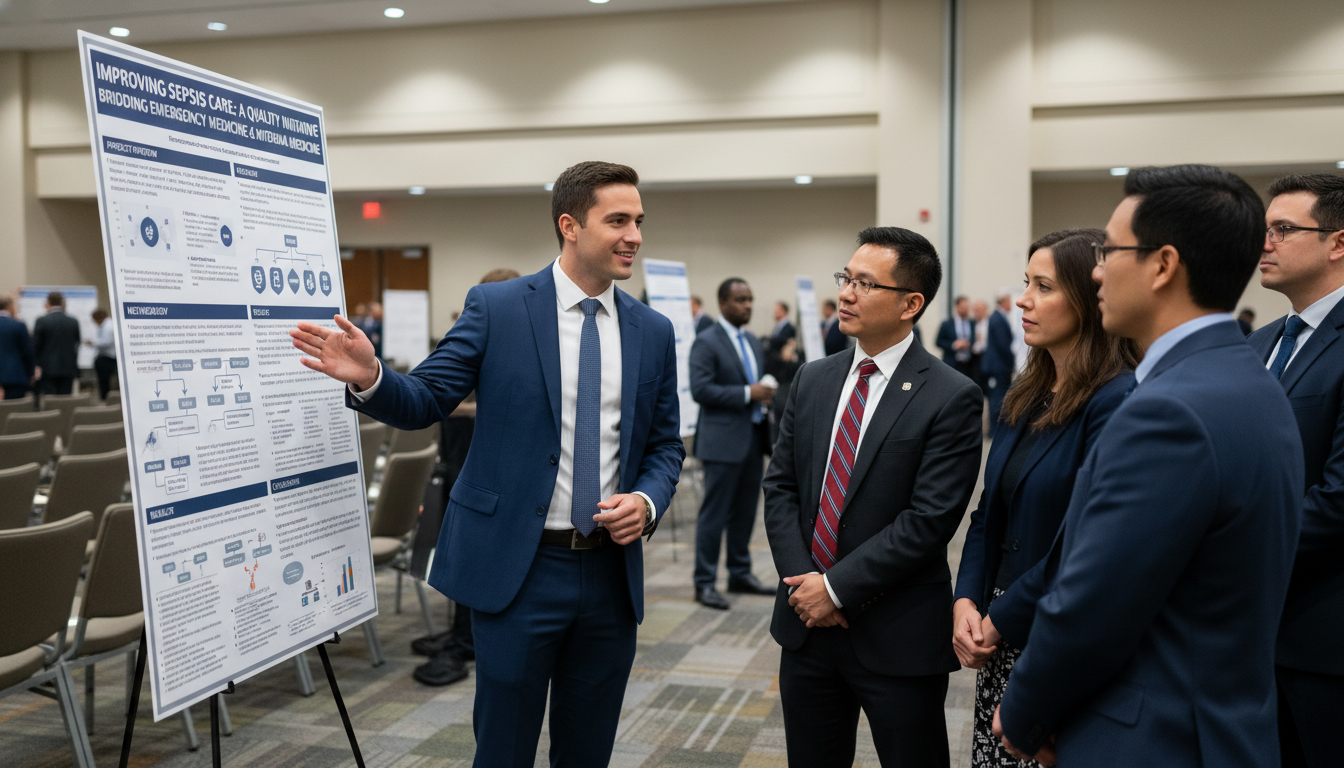
- Smith JA, et al. “Implementing a sepsis early-warning tool bridging ED and inpatient units.” Poster presented at: ACEP Scientific Assembly; October 2024; Philadelphia, PA.
QI Projects
- Sepsis Early-Goal–Directed Therapy Across ED and IM Floors – [Hospital], 2023–2024
- Led chart review of 100 cases; identified delays in antibiotic timing at transition points.
- Implemented standardized handoff checklist between ED and IM admitting team; decreased average time to antibiotics by 15 minutes.
Even if you don’t have formal publications, QI projects, case reports, and conference posters are valuable, especially when they touch both EM and IM or systems of care.
Osteopathic residency match angle:
Programs understand that some DO schools have fewer built-in research pipelines than large MD institutions. What matters most is:
- Initiative
- Relevance to your specialty
- Evidence that you can think critically about data, patient outcomes, or education
How to Build CV for Residency If You Have Limited Research
If you worry your research section is thin:
Leverage any case presentations from EM or IM rotations; turn them into structured entries.
Ask mentors whether ongoing ED, hospitalist, or ICU projects need help with chart review, literature review, or data entry.
Document in-progress projects with honest labeling:
- In Preparation – Manuscript drafting phase
- Submitted – Under review
- In Progress – Data collection/analysis
Just avoid inflating your role or misrepresenting status. Integrity matters more than padding volume.
Leadership, Teaching, and Service: Signaling EM-IM Fit
EM-IM programs train future clinical leaders who can function in both acute care and longitudinal care environments. Your non-research activities can communicate this very effectively.
7. Leadership Roles
Highlight any positions that reflect:
- Responsibility
- Team coordination
- Advocacy or systems thinking
Examples suitable for a DO graduate heading into EM-IM:
- EM interest group president or officer
- IM or hospitalist interest group leadership
- Student government, curriculum committees
- GME committees with resident/attending interaction
- Coordinator for free clinics, especially walk-in or urgent care models
Format:
- President, Emergency Medicine Interest Group – [COM name]
Dates- Organized monthly EM case conferences and procedure workshops (airway, ultrasound).
- Coordinated joint event with Internal Medicine Interest Group on sepsis and ED-to-floor transitions.
This reinforces your genuine interest in both specialties, not just EM.
8. Teaching Experience
EM-IM physicians routinely teach students, residents, and interprofessional teams. Show that you already enjoy and excel in teaching:
- Peer tutoring or TBL facilitation
- Anatomy or OMM TA
- Step/COMLEX prep small groups
- Workshop leader for procedures or simulation
Example:
- Peer Tutor, Clinical Skills & OMM – [COM]
Dates- Led weekly small-group sessions on physical exam and osteopathic structural exam for OMS-I students.
- Integrated emergency presentations (e.g., shortness of breath, chest pain) with longitudinal IM follow-up discussions.
Teaching roles also signal that you can communicate clearly and work with learners at different levels, which is central in ED and inpatient settings.
9. Service and Community Engagement
Combined EM-IM training is well-suited to caring for underserved and complex populations. Community service showing sustained commitment is valuable:
- Free clinics, mobile health units
- Homeless health outreach, addiction services
- Health education in schools or community centers
- Disaster response or EMS ride-alongs (where allowed)
Describe your role, approximate hours (if substantial), and what populations you served. Emphasize aspects that align with EM-IM, such as:
- High medical complexity
- Barriers to access and follow-up
- Need for both acute and chronic care frameworks
Practical Residency CV Tips for DO Graduates Targeting EM-IM
10. Tailoring Content for EM IM Combined Programs vs Pure EM or IM
Your CV should be flexible enough to support:
- EM-IM combined applications
- Categorical EM and/or categorical IM programs (if you’re applying broadly)
You do not need multiple CVs, but you should:
- Use EM-IM–specific bullet points for combined programs in ERAS experiences
- Emphasize both acute and longitudinal care in descriptions
- Avoid signaling that EM-IM is “just a stepping stone” to a single specialty
Examples of EM-IM–friendly wording:
- “Managed acute decompensation of chronic disease in ED and inpatient settings.”
- “Participated in continuity clinics for patients initially seen in the ED.”
- “Interested in career combining acute care, ward medicine, and systems leadership.”
11. Presenting Osteopathic Identity Strategically
In the modern, unified match, a DO graduate residency candidate is evaluated alongside MD peers. Your osteopathic background should read as a strength:
- List OMT experiences where they added clear clinical value (e.g., rib dysfunction in COPD exacerbations, musculoskeletal pain, headaches).
- Mention osteopathic honor societies (e.g., Sigma Sigma Phi) or osteopathic research.
- If you completed OMM consult service rotations, include them just like any other rotation.
Avoid over-saturating the CV with OMT references in EM-IM contexts where they weren’t truly used, but do make it clear that you bring a whole-person, structural-and-functional mindset to patient care.
12. Formatting and Style: Making Your CV Easy to Read
Program directors scan dozens of CVs at a time. To ensure your medical student CV is easy to navigate:
- Use consistent formatting for headings, dates, and bullet points.
- Keep bullet points results- and responsibility-oriented, not just descriptive.
- Avoid dense paragraphs; lean on clean bullet lists.
- Use reverse chronological order for everything.
- Spell out acronyms on first use (EM, IM, QI, etc.) unless they are universally known.
A clean, logical format doesn’t just look good; it signals attention to detail and professionalism—qualities that matter in both emergency medicine and internal medicine environments.
13. Common Pitfalls in EM-IM CVs (and How to Fix Them)
Pitfall 1: Listing everything without prioritization
Fix: Emphasize roles and experiences most relevant to EM, IM, and systems-based practice. It’s okay to summarize older or less relevant experiences.
Pitfall 2: Inflated titles or unclear roles
Fix: Use titles that match official positions; clarify your responsibilities with honest bullets.
Pitfall 3: No sense of progression
Fix: Show increasing responsibility and complexity: preclinical involvement → clerkship performance → sub-I roles → QI leadership.
Pitfall 4: Vague bullets
Fix: Replace “Helped with sepsis project” with “Abstracted data on 60 sepsis admissions to compare time-to-antibiotics before and after protocol change.”
Pitfall 5: Typos and inconsistent formatting
Fix: Proofread carefully; ask mentors or peers to review. Typos suggest carelessness—unappealing in a specialty where details literally save lives.
Putting It All Together: Strategy for a Strong EM-IM CV as a DO
As you prepare for the osteopathic residency match (or more accurately now, the single NRMP match with DO applicants), think of your CV as your professional story in outline form:
- Your education grounds you as a DO graduate with a holistic care framework.
- Your exam performance shows objective readiness.
- Your clinical experiences demonstrate comfort in both emergency and internal medicine settings.
- Your research and QI show curiosity and systems thinking.
- Your leadership, teaching, and service forecast your future contributions to the EM-IM community.
Before you submit, ask yourself:
“If a busy PD only had 3 minutes to glance at this CV, would they clearly see why I belong in EM-IM and what unique value I bring as a DO graduate?”
If the answer isn’t a resounding yes, refine:
- Reorder sections to highlight your strongest EM-IM content
- Sharpen bullets to show impact and responsibility
- Remove clutter that distracts from your core story
Finally, align your CV with your personal statement, letters of recommendation, and ERAS experiences. Consistency and clarity across documents greatly strengthen your application.
Frequently Asked Questions (FAQ)
1. How should a DO graduate list both COMLEX and USMLE scores on a residency CV?
List each exam separately and clearly:
- COMLEX-USA Level 1 – Date – Score: ###
- COMLEX-USA Level 2-CE – Date – Score: ###
- USMLE Step 1 – Date – Score: ###
- USMLE Step 2 CK – Date – Score: ###
Do not hide COMLEX scores; EM-IM and emergency medicine internal medicine programs understand DO-specific exams. If you have USMLE scores, list them too, as many PDs use them for easier comparison.
2. What if I don’t have research specific to EM or IM—will that hurt my EM-IM application?
Not necessarily. Programs understand that not all schools offer robust EM or IM research pipelines. Focus on:
- Any QI, case reports, or educational projects you’ve done
- Demonstrating depth in clinical rotations, particularly sub-Is
- Showing systems awareness (e.g., sepsis protocols, ICU throughput, readmission reduction)
If you can, join a small EM or IM project even in your fourth year and list it as “In Progress” with a clear description. EM-IM programs value initiative and curiosity more than a specific number of publications.
3. How can I best highlight my osteopathic training on a residency CV without overdoing it?
Use your DO background as an enhancer, not the main headline:
- Include your DO degree and any osteopathic honors (Sigma Sigma Phi, OMM fellowships).
- Mention OMT where you actually used it clinically, especially for pain, respiratory mechanics, or functional complaints.
- Show how osteopathic principles (whole-person care, structure-function relationships) inform your approach to both acute care and chronic disease.
Avoid peppering every bullet point with “OMM” or “osteopathic”; instead, place a few well-chosen examples that convey real clinical value.
4. Should I create different versions of my CV for EM-IM, EM-only, and IM-only programs?
You don’t need entirely different documents, but you can:
- Maintain a single, strong core CV
- Adjust emphasis in ERAS experience descriptions and personal statements, not the formal CV file itself
- In your CV, craft bullets that naturally speak to both acute and longitudinal care so it works seamlessly for EM-IM, EM, and IM
For example, describing your sepsis experience through the lens of ED stabilization and inpatient management appeals to all three pathways.
By thoughtfully crafting your CV with these strategies, you’ll present yourself as a capable, reflective, and well-prepared DO graduate ready to thrive in the demanding but rewarding world of Emergency Medicine–Internal Medicine training.