
A strong medical CV is one of the most powerful tools you have during residency applications. While USMLE scores, MSPE, and letters of recommendation carry significant weight, your CV is the comprehensive snapshot of who you are as a developing physician: your Medical Education, Clinical Experience, research, leadership, and the story of your Career Development so far.
This guide walks you through how to transform a merely “good” CV into a strategically crafted, residency-ready document that showcases your strengths, aligns with your target specialty, and helps you stand out in a competitive match cycle.
Understanding the Strategic Role of Your CV in Residency Applications
Your medical CV is more than a list of experiences; it is a curated narrative of your growth as a future resident. Program directors and selection committees often skim your CV quickly at first, then return to it later during ranking discussions. A great CV makes that first skim memorable and the second read reassuring.
What Program Directors Look for in a Medical CV
Residency programs use your CV to:
- Confirm your trajectory: Does your Medical Education and experience logically lead toward this specialty?
- Assess your readiness: Have you developed sufficient Clinical Experience and academic maturity?
- Differentiate you from peers: What sets you apart from hundreds of similar applicants?
- Identify alignment: Do your activities reflect the values and clinical focus of their program?
Key Objectives of a Residency-Ready CV
Your CV should:
Highlight relevant experiences
- Emphasize Clinical Experience, research, and leadership that align with your chosen specialty.
- Prioritize recency and relevance over sheer quantity.
Showcase concrete achievements
- Move beyond job descriptions to outcomes: What did you improve, initiate, or accomplish?
- Include metrics when possible (e.g., “improved clinic workflow by reducing average patient wait time by 15%”).
Demonstrate growth and professionalism
- Show increasing responsibility over time.
- Reflect professionalism, reliability, and commitment to patient-centered care.
Support your personal statement and interviews
- Your CV should “back up” the themes and claims in your personal statement.
- Experiences listed on your CV should provide rich stories to draw from in interviews.
Structuring a High-Impact Medical CV for Residency
Clear organization is critical. Many reviewers will spend less than a minute on the first pass of your CV. A clean, consistent structure helps them quickly find what matters most.
Below is a recommended structure commonly used for residency applications and Academic Medicine.
1. Contact Information and Professional Identity
This section should be clean and easy to find at the top of the first page.
Include:
- Full name (as used in ERAS or official school records)
- Professional credentials (e.g., “Jane Doe, MS4” during medical school; add MD/DO after graduation)
- Phone number (professional voicemail message)
- Professional email address (ideally school or first.last format)
- City, State (full mailing address optional)
- LinkedIn profile URL (if complete and professional)
- Personal academic or portfolio website (if you maintain one and it adds value)
Tip:
Avoid unprofessional emails (e.g., nicknames or jokes). Your contact line sets the tone for the entire document.
2. Professional Summary or Objective Statement (Optional but Powerful)
A brief, focused statement can immediately orient the reader to who you are as an applicant. Keep it to 2–3 sentences and tailor it to your specialty and Career Development goals.
Example – Internal Medicine:
Fourth-year medical student with strong interest in health systems improvement and chronic disease management. Seeking an Internal Medicine residency position where I can integrate evidence-based practice, quality improvement, and patient-centered communication to care for diverse adult populations.
Example – General Surgery:
Aspiring academic surgeon with experience in surgical outcomes research and dedication to technical excellence and multidisciplinary teamwork. Seeking a General Surgery residency to further develop operative skills and contribute to quality improvement initiatives.
Use this space to:
- Name your intended specialty
- Highlight 1–2 defining strengths (e.g., research, community engagement, leadership)
- Indicate career direction (e.g., academic medicine, primary care, subspecialty interest if appropriate)
Core Sections of a Strong Residency CV
Most residency CVs include the following major sections. Order them based on what is most relevant and impressive for your profile and specialty.

3. Education: Your Medical and Academic Foundation
List your training in reverse chronological order.
Include for each degree:
- Degree and major (MD, DO, MBBS, BS in Biology, etc.)
- Institution name and location
- Graduation date (or expected graduation date)
- Honors (e.g., AOA, Gold Humanism, summa cum laude)
- Notable distinctions or scholarships
Example:
Doctor of Medicine (MD)
University of Michigan Medical School, Ann Arbor, MI
Expected May 2025
- Gold Humanism Honor Society
- Distinction in Clinical Excellence
Bachelor of Science in Neuroscience
University of California, Los Angeles, CA
Graduated June 2021
- Magna Cum Laude, Dean’s List (all eligible terms)
Optional additions (if truly relevant):
- Selected advanced coursework (e.g., “Advanced Cardiology Elective” for an aspiring cardiologist)
- Dual degrees (MPH, MBA, MS) – especially helpful for academic or leadership-focused paths
4. Clinical Experience: The Heart of Your Medical CV
This is often the most important section for residency applications. It should clearly demonstrate your hands-on patient care and Clinical Experience.
What to Include
- Clinical roles beyond required clerkships (though some CVs briefly summarize core rotations)
- Sub-internships/acting internships
- Away/audition rotations
- Externships or observerships (for IMGs)
- Longitudinal clinics or continuity experiences
- Significant student-run free clinic roles
- For each entry:
- Role/Title (e.g., Sub-Intern, Clinical Extern, Student Clinic Director)
- Institution and location
- Dates (month/year – month/year)
- 2–4 bullet points focusing on responsibilities and impact
Example:
Sub-Intern, Internal Medicine
Massachusetts General Hospital, Boston, MA
July 2024 – August 2024
- Managed a census of 4–6 patients daily under supervision, including pre-rounding, order entry, and daily progress notes.
- Led family meetings to discuss care plans and discharge planning for complex patients.
- Collaborated with interprofessional teams to optimize transitions of care and reduce readmission risk.
Tips for Describing Clinical Experience
- Use action verbs: “Managed,” “coordinated,” “performed,” “led,” “initiated.”
- Emphasize level of autonomy (within appropriate supervision frameworks).
- Highlight specialty-relevant skills:
- Emergency Medicine: triage, rapid assessment, resuscitation team participation.
- Pediatrics: family-centered communication, growth and development assessments.
- Psychiatry: diagnostic interviewing, safety assessments, interdisciplinary collaboration.
- Mention patient population and setting: urban underserved, rural, tertiary care, community hospital, VA, etc.
5. Research Experience: Academic Depth and Critical Thinking
Research is especially important for competitive specialties (Dermatology, Orthopedics, Radiation Oncology, Radiology, ENT, Neurosurgery, etc.) and for applicants considering academic medicine.
For each project, include:
- Title or brief descriptive name
- Role (e.g., Research Assistant, Student Investigator, Co-investigator)
- Institution and department
- Principal investigator’s name and credentials
- Dates of involvement
- 2–4 bullet points describing:
- Study focus
- Your specific responsibilities
- Skills used (e.g., statistical software, chart review, literature search)
- Outcomes (abstracts, posters, manuscripts, QI implementation)
Example:
Research Assistant, Cardiology Outcomes Research
Cleveland Clinic, Department of Cardiovascular Medicine, Cleveland, OH
PI: Sarah Johnson, MD, MS
June 2023 – Present
- Conducted retrospective chart review of 600+ patients undergoing TAVR to evaluate predictors of 30-day readmissions.
- Performed data cleaning and statistical analysis using R, contributing to multivariable regression models.
- Co-authored abstract accepted for poster presentation at the American College of Cardiology Scientific Session 2024.
Pro tip:
If you have many projects, group them under subsections (e.g., “Clinical Research,” “Basic Science Research,” “Quality Improvement Projects”) to improve readability.
6. Publications, Abstracts, and Presentations
This section reinforces your scholarly productivity and communication skills—key components of long-term Career Development in medicine.
Organize it clearly, usually in this order:
- Peer-reviewed journal articles
- Book chapters
- Abstracts
- Oral presentations
- Poster presentations
Use standard citation formats (e.g., AMA), and bold or underline your name in the author list so it stands out.
Example:
Peer-Reviewed Publications
- Doe J, Patel R, Nguyen T. Implementation of a Telehealth Program for Heart Failure Patients in a Community Hospital. J Gen Intern Med. 2024;39(3):455–462.
Abstracts and Presentations
- Doe J, Smith A. Utilization of Point-of-Care Ultrasound in the Evaluation of Dyspnea in the ED. Poster presented at: Society for Academic Emergency Medicine Annual Meeting; May 2023; Austin, TX.
If a manuscript is submitted or in preparation, label it clearly:
- “Accepted”
- “In Press”
- “Submitted”
- “In Preparation” (use sparingly and only if truly near submission)
7. Volunteer Experience and Community Engagement
Programs value humanism, service orientation, and commitment to communities—these are essential elements of modern Medical Education and practice.
Include:
- Role/title
- Organization and location
- Dates
- 2–4 bullets describing activities and impact
Example:
Student Volunteer, Free Community Health Clinic
Hope Community Health Center, Detroit, MI
September 2021 – Present
- Conduct weekly blood pressure and diabetes screenings for uninsured and underinsured adults.
- Provide patient education on lifestyle modification and medication adherence, using interpreter services as needed.
- Collaborate with a multidisciplinary team to connect patients with social services and follow-up care.
Highlight:
- Longitudinal commitment
- Leadership within service organizations
- Work with populations relevant to your specialty (e.g., pediatrics, geriatrics, addiction medicine, refugee health)
8. Leadership, Teaching, and Professional Development
Leadership and teaching demonstrate maturity, initiative, and potential as a resident who will help train others.
Possible entries:
- Student organization officer roles (e.g., President, Treasurer)
- Peer tutor or teaching assistant roles
- OSCE or clinical skills tutor
- Curriculum development projects
- Committee memberships (curriculum, wellness, diversity, etc.)
Example:
Co-President, Internal Medicine Interest Group
University of Texas Southwestern Medical School, Dallas, TX
March 2022 – April 2023
- Organized monthly case-based conferences featuring Internal Medicine faculty and residents.
- Coordinated mentorship pairings for 60+ preclinical students with Internal Medicine residents.
- Launched a journal club series to promote critical appraisal skills.
Pro tip:
Frame leadership roles with outcomes—what changed or improved because you were involved?
9. Certifications, Licensure, and Skills
This section communicates practical readiness for Clinical Experience during residency.
Include:
- BLS, ACLS, PALS, ATLS (with expiration dates)
- State training licenses (if applicable)
- USMLE/COMLEX steps passed (some programs prefer this in ERAS only; follow your dean’s guidance)
- Language skills (specify level: native, fluent, conversational, basic)
- Technical or software skills (e.g., Epic, Cerner, REDCap, R, SPSS, Python for data analysis)
- Relevant procedural skills (e.g., ultrasound experience), especially for certain specialties
Example:
Certifications:
- Basic Life Support (BLS), American Heart Association, Expires 06/2026
- Advanced Cardiac Life Support (ACLS), American Heart Association, Expires 06/2026
Skills:
- Languages: Spanish (conversational medical proficiency), Vietnamese (basic)
- Software: Epic, Cerner, REDCap, SPSS, Microsoft Office, Zoom
10. Professional Affiliations and Memberships
Demonstrate engagement with professional communities relevant to your specialty and career aspirations.
Examples:
- American Medical Association (AMA)
- American College of Physicians (ACP)
- American Academy of Family Physicians (AAFP)
- Specialty-specific interest groups or societies
Format:
- Organization name
- Membership type (student member, associate member)
- Dates of membership
- Leadership roles (if any)
Advanced Tips to Elevate Your Residency CV from Good to Great
Beyond basic structure, these refinements can significantly improve how competitive your CV appears.
1. Tailor Your CV to Each Specialty and Program Type
You may submit one master CV, but you can maintain specialty-focused versions for networking, email outreach, and in-person events.
For academic programs:
- Move research and publications higher in the CV.
- Provide more detail on scholarly work and teaching.
For community-focused or primary care programs:
- Highlight continuity clinics, community engagement, and longitudinal patient care.
- Emphasize communication skills and population health experiences.
For procedure-heavy specialties (e.g., Surgery, EM):
- Emphasize procedural exposure, simulation training, and hands-on skills.
Research each program’s mission statement and pillars (e.g., underserved care, research, innovation) and subtly reflect alignment through which experiences you emphasize and how you describe them.
2. Keep It Focused and Concise—But Not Impoverished
While traditional advice suggests “1–2 pages,” Medical CVs, especially for residency, can extend beyond two pages if you have substantial research, publications, or multiple advanced degrees. The key is relevance and organization:
- For applicants with fewer experiences: aim for 1–2 well-curated pages.
- For research-heavy or dual-degree applicants: 3–4 pages can be appropriate.
Remove:
- High school achievements (almost always unnecessary)
- Minor, short-term activities without clear impact
- Redundant or overlapping entries
3. Write Impactful Bullet Points
Transform generic bullets into specific, outcome-oriented statements.
Weak:
- “Helped with patient education.”
Stronger:
- “Counseled 10–15 patients per week on diabetes self-management, using teach-back methods to confirm understanding.”
Weak:
- “Participated in QI project.”
Stronger:
- “Collaborated on QI initiative to reduce inappropriate antibiotic prescribing for URIs, contributing to a 20% decrease over six months.”
Aim for:
- Action verb + task + context + result (when possible)
4. Maintain Professional, Consistent Formatting
Your CV should look clean, modern, and easy to scan.
- Use a simple, professional font (e.g., Calibri, Arial, Times New Roman, 11–12 pt).
- Be consistent with:
- Date format (e.g., “June 2022 – August 2022” everywhere)
- Bullet style
- Use of bold/italics
- Use white space generously to avoid crowding.
- Save and share as PDF to preserve formatting.
5. Eliminate Errors and Ambiguities
Residency selection committees expect precision.
- Spell-check and grammar-check thoroughly.
- Verify all institution names, dates, and titles.
- Make sure there are no unexplained gaps in your timeline; if there are, be prepared to explain them positively (e.g., research year, family responsibilities, health issues).
6. Seek Targeted Feedback and Iterate
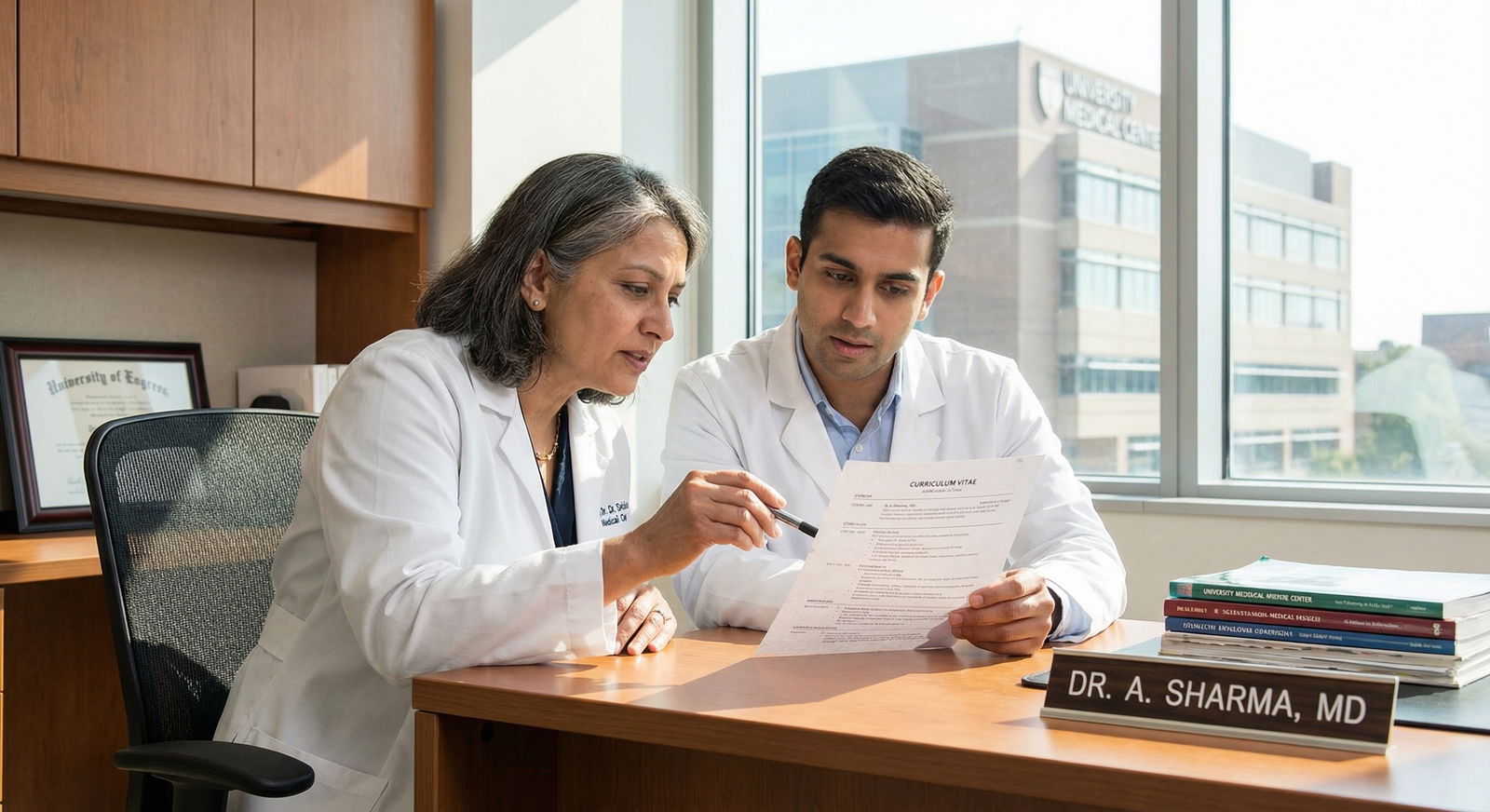
Your perception of your CV may differ from how experienced educators view it.
- Ask for feedback from:
- Specialty advisors
- Residents in your target field
- Faculty mentors
- Career development or Medical Education offices
- Specific questions to ask:
- “What are my three strongest elements from this CV?”
- “What sections feel underdeveloped for this specialty?”
- “Does this CV tell a coherent story about my career interests?”
Update your CV regularly (every 3–6 months) throughout medical school so it’s always nearly residency-ready.
Frequently Asked Questions About Residency CVs
How long should my CV be for residency applications?
For most students:
- 1–2 pages is appropriate if you have a typical level of activity and are not research-heavy.
- 3–4 pages is reasonable if you have:
- Substantial research with multiple publications/abstracts
- Additional degrees (e.g., MPH, MBA, PhD)
- Extensive leadership or work history
Content should be:
- Directly relevant to your medical training, Career Development, and Clinical Experience
- Well organized, without redundancy
Programs care more about clarity and relevance than strict page limits.
Is an objective or professional summary required on a medical CV?
No, it is not required—but it can be helpful if:
- You are applying to a specific specialty and want to clearly state your interest.
- You have a focused career goal (e.g., academic medicine, rural primary care).
- You want to emphasize a unifying theme (e.g., health disparities, global health, medical education).
Keep it:
- 2–3 sentences
- Specialty-specific but not program-specific (unless using for networking directly with a program)
- Free of clichés (e.g., “hardworking team player” without examples)
Should I include my GPA, class rank, or exam scores on my CV?
This depends on your context and school policies:
GPA/Class rank:
- Include if officially reported by your institution and clearly strong (e.g., top 10%, AOA).
- If not reported or not particularly strong, omit and let your MSPE speak to your performance.
USMLE/COMLEX scores:
- Many applicants keep these in ERAS only, not on the CV.
- Follow your school’s Career Development or advising recommendations and your comfort level.
What if I feel I have “less” clinical or research experience than my peers?
You can still create a compelling CV by:
- Highlighting depth over breadth:
- Longitudinal commitments (e.g., 2 years at the same free clinic)
- Leadership in a smaller number of activities
- Emphasizing skills and growth:
- Communication, teamwork, cultural humility, problem-solving
- Showcasing related strengths:
- Strong teaching experience
- Community engagement
- Quality improvement or systems-based projects
- Using your fourth year strategically:
- Sub-internships, electives, or short research blocks that align with your target specialty
Programs appreciate authentic, thoughtful Career Development paths, not just long lists of activities.
Can I include personal interests and hobbies on my residency CV?
Yes—with intentionality.
- A brief “Interests” section at the end of your CV can:
- Humanize you as an applicant
- Provide natural conversation starters in interviews
- Be specific and authentic:
- “Marathon running (completed 3 marathons, interested in sports medicine)”
- “Classical piano (12 years of training, occasional performances)”
- “Cooking regional Vietnamese cuisine and hosting community dinners”
Avoid:
- Controversial topics (e.g., highly polarizing political activities) unless they are central to your professional identity and you are prepared to discuss them thoughtfully.
- Overly generic interests (e.g., “reading, traveling”) without any specific angle.
Transforming your CV from good to great is an iterative, intentional process that mirrors your growth throughout Medical Education. By structuring your CV clearly, emphasizing relevant Clinical Experience, integrating research and leadership, and aligning your activities with your chosen specialty, you create a document that not only lists your accomplishments but also tells a compelling story of your emerging professional identity.
Continue updating your CV as you progress, seek feedback from mentors, and ensure it supports your broader residency application strategy. Your CV is often the first—and lasting—impression a program has of you as a future colleague. Make it count.