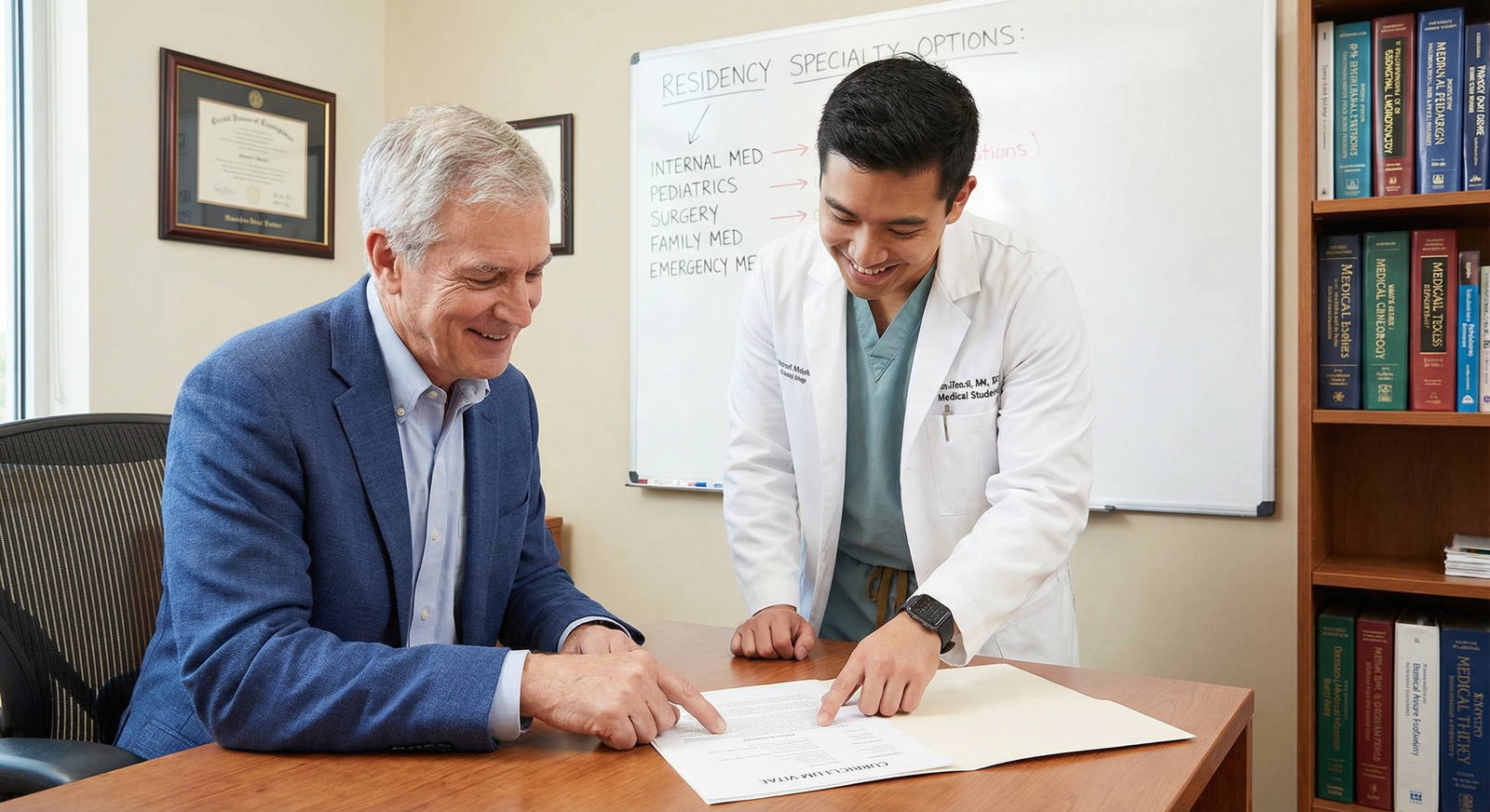
Crafting a strong medical student CV for residency is one of the most high‑yield steps you can take before the Match. It’s your professional story on a single document—a snapshot that residency programs will scan in seconds to decide whether you’re worth a closer look. Done well, it reinforces your ERAS application and personal statement; done poorly, it can quietly weaken an otherwise solid profile.
This guide walks you through how to build a CV for residency, from structure and content to style, strategy, and common mistakes. Whether you’re an MS1 mapping out your path or an MS4 polishing your application, you’ll find practical, actionable residency CV tips you can use immediately.
Why Your Medical Student CV Matters More Than You Think
Many students assume the CV is just a formality because programs primarily review ERAS. In reality, your medical student CV is used in ways you may not see:
- Screening and shortlisting: Some programs ask for a CV in addition to ERAS, especially for away rotations, research positions, or prelim/TY years.
- Faculty reference tool: Interviewers often print your CV as an easy reference in interviews or when writing letters.
- Scholarships, honors, and jobs: Schools and hospitals frequently request an updated CV for awards, leadership positions, or part‑time clinical work.
- Post‑residency opportunities: Fellowships, early research roles, and quality improvement initiatives may ask for your CV, not your ERAS PDF.
A clear, well‑organized CV does three things:
- Clarifies your narrative – Shows a logical progression of interests and achievements.
- Signals professionalism – Clean formatting and error‑free writing reflect attention to detail (critical in medicine).
- Supports your brand – Highlights strengths aligned with your target specialty (e.g., leadership for EM, research for radiation oncology, service for FM/IM, etc.).
Core Principles of an Excellent Residency CV
Before we get into structure and sections, it helps to understand a few overarching principles.
1. Prioritize Relevance and Impact
Residency programs don’t have time to wade through every part‑time job and club you ever joined. They care most about:
- Clinical experiences
- Research and scholarly activity
- Leadership, teaching, and service
- Honors, awards, and distinctions
Ask of every entry: “Does this help a PD understand why I’d be a strong resident in this specialty?” If not, reconsider including it or compress it.
2. Consistency Is Non‑negotiable
Inconsistencies in dates, titles, or roles between your CV and ERAS can raise quiet red flags. Maintain:
- The same job and position titles
- The same start and end dates
- The same institution names and locations
- The same publications and authorship order
Keep a master document of all entries so you can copy‑paste into ERAS and your CV to avoid discrepancies.
3. Clarity Beats Creativity
This is not the place for unusual fonts, colors, or “creative” layouts. Residency readers appreciate:
- Standard fonts (Times New Roman, Garamond, Calibri, Arial)
- Font size 10–12 for text, 12–14 for section headings
- Simple formatting (bold, italics, and spacing used sparingly)
- Logical, easy‑to‑scan sections
Your content—not your design—should stand out.
4. Strategic Customization
You should maintain one master CV, but it’s smart to create slightly tailored versions:
- A “research‑heavy” CV for research positions or academic residencies
- A “leadership‑and‑teaching” emphasized CV for education‑oriented programs
- A “service‑focused” version for primary care or community‑centered residencies
The core stays the same, but the ordering and emphasis shift to match your goal.
Essential Sections of a Strong Medical Student CV
Below is a recommended structure for how to build a CV for residency. You can adjust section order slightly, but avoid leaving out key parts that programs expect.

1. Header and Contact Information
Keep this compact and professional.
Include:
- Full name (larger font, bold)
- Professional email address (ideally school or Gmail; avoid casual names)
- Mobile phone number
- City, state (full home mailing address optional)
- Optional: LinkedIn URL, professional website, or ORCID if well‑maintained
Example:
Alexandra M. Lee, MS4
Email: alexandra.lee@medschool.edu • Phone: (555) 123‑4567
Boston, MA • LinkedIn: linkedin.com/in/alexandramlee
Avoid photos, graphics, or personal details (age, marital status, etc.)—they’re unnecessary and can raise bias issues.
2. Education
List all post‑secondary education in reverse chronological order.
Include for each entry:
- Institution name, city, state
- Degree and expected or completion date
- Honors (e.g., AOA, Gold Humanism, cum laude)—can be here or in Honors/Awards section
- Optional: Thesis title or concentration
Example:
Harvard Medical School, Boston, MA
Doctor of Medicine (M.D.), Expected May 2026
Pathways Curriculum; Candidate for AOA Honor Medical SocietyUniversity of California, Berkeley, CA
Bachelor of Science in Molecular and Cell Biology, May 2020
Graduated magna cum laude
Do not include high school. If you have additional graduate degrees (MPH, MS, PhD), prioritize them above undergrad.
3. Clinical Experience (and Away Rotations)
This is central to any medical student CV aimed at residency.
You can title this section:
- “Clinical Experience”
- “Clinical and Sub‑Internship Experience”
- “Core and Elective Rotations” (if early in clerkships)
Include:
- Role/title (e.g., Sub‑Intern, Acting Intern, Clinical Elective Student)
- Specialty and site
- Institution, city, state
- Dates (month/year – month/year)
- 1–3 bullet points highlighting responsibilities or accomplishments (not just tasks)
Example:
Sub‑Intern, Internal Medicine – Inpatient
Massachusetts General Hospital, Boston, MA | Aug 2025 – Sep 2025
- Carried a patient load of 6–8 under resident supervision, writing daily notes and presenting on rounds.
- Managed admission H&Ps, discharge summaries, and clinical communication with consultants and families.
- Led daily brief teaching for medical students on common inpatient issues (e.g., electrolyte disturbances, DKA).
For early‑stage students with limited formal clinical experiences, you can include substantial:
- Longitudinal clinic experiences
- Student‑run free clinic roles
- Shadowing (only if extensive and structured)
But by MS3/MS4, shadowing usually moves off or to the very bottom unless particularly relevant.
4. Research Experience and Scholarly Activity
For many specialties (IM, neuro, rad‑onc, derm, ortho, ENT, etc.), this section is critically important. Even for less research‑heavy fields, it shows scholarly engagement and discipline.
Break into two parts if you have enough content:
- Research Experience
- Publications & Presentations
Research Experience
Include:
- Role (e.g., Research Assistant, Student Investigator)
- Project or lab title
- PI name and department
- Institution, city, state
- Dates
- 2–4 concise bullets focusing on your contributions and skills learned
Example:
Student Researcher, Cardiology Outcomes Research Group
Brigham and Women’s Hospital, Boston, MA | Jun 2023 – Present
Mentor: Deepa Patel, MD, MPH
- Designed and implemented retrospective chart review evaluating 30‑day readmission rates following heart failure discharge.
- Extracted and managed data for 520 patients using REDCap; performed descriptive and multivariable analysis in Stata.
- Co‑authored manuscript submitted to Journal of Hospital Medicine (under review).
Publications and Presentations
Use a consistent citation style (APA, Vancouver, or journal style) and group them:
- Peer‑reviewed publications
- Manuscripts under review / in preparation (clearly labeled)
- Abstracts and poster presentations
- Oral presentations / invited talks
Example (peer‑reviewed publication):
Lee AM, Johnson T, Patel D. Thirty‑day readmission after heart failure discharge: impact of structured follow‑up calls. J Hosp Med. 2025;10(3):145‑152.
Example (poster presentation):
Lee AM, Patel D. Structured follow‑up calls reduce 30‑day readmissions after heart failure discharge. Poster presented at: Society of Hospital Medicine Annual Meeting; April 2025; San Diego, CA.
Be honest about status—never label something “in press” or “accepted” unless you have official confirmation.
5. Teaching, Leadership, and Service
Residency programs highly value evidence that you can lead, teach, and serve—core to being a resident.
You can keep all of these in one combined section or split into:
- Teaching Experience
- Leadership Experience
- Volunteer & Community Service
Teaching Experience
Include:
- Role (e.g., Peer Tutor, Anatomy TA, USMLE Step 1 Course Facilitator)
- Audience (MS1s, pre‑meds, community health workers)
- Responsibilities and outcomes (curriculum development, sessions led, feedback scores if available)
Example:
Peer Tutor, Physiology and Pathophysiology
Harvard Medical School, Boston, MA | Sep 2023 – May 2024
- Led weekly small‑group review sessions for 8 first‑year students focusing on cardiovascular and renal physiology.
- Created practice questions and case‑based discussions; average student exam performance improved by 7%.
Leadership Experience
Include both formal titles and substantial informal roles:
- Class officer positions
- Student organization leadership (e.g., SNMA, AMSA, specialty interest groups)
- Project or initiative leads (e.g., QI projects, curriculum committees)
Focus on scope, responsibility, and impact, not just titles.
Volunteer and Community Service
Programs appreciate longitudinal commitment, especially service that aligns with your specialty interest.
- Highlight sustained involvement rather than one‑off events.
- Emphasize roles with responsibility (coordinator, clinic manager).
6. Honors, Awards, and Distinctions
This is where you consolidate academic and professional recognition.
Common entries:
- AOA (Alpha Omega Alpha) or equivalent
- Gold Humanism Honor Society
- Clerkship honors
- Medical school scholarships and grants
- Undergraduate honors (magna/summa cum laude, Phi Beta Kappa)
- Notable competitive awards (research prizes, poster awards)
Format consistently:
Alpha Omega Alpha Honor Medical Society, Junior inductee, 2025
Clerkship Honors, Internal Medicine, Pediatrics, Neurology, 2024
Gold Humanism Honor Society, Inducted 2025
Avoid listing minor or purely participation‑type “awards.”
7. Professional Memberships and Activities
Include national organizations, especially if relevant to your specialty:
- AMA, ACP, AAP, AAFP, ACS, ACEP, etc.
- Specialty‑specific student or trainee sections
- Any active committee roles or leadership positions
Example:
American College of Physicians (ACP), Medical Student Member, 2023 – Present
- Member, Medical Student Health & Well‑Being Committee (2024 – Present)
8. Skills, Certifications, and Additional Information
This short section can be valuable if kept relevant.
Potential items:
- Languages (with level: native, fluent, proficient, conversational)
- Technical skills (Stata, SPSS, R, REDCap, Qualtrics, NVivo)
- Clinical skills certifications (BLS, ACLS, PALS, ATLS)
- Select non‑clinical skills relevant to medicine (e.g., curriculum design, quality improvement methodologies like PDSA)
Example:
Languages: Spanish (conversational medical), Mandarin (basic)
Certifications: BLS (expires 06/2026), ACLS (expires 06/2026)
Technical: REDCap, Stata, SPSS, Excel (advanced), PowerPoint
Be honest—overstating language ability or technical skill often backfires quickly.
Formatting, Length, and Style: How to Make Your CV Readable

Strong content can be undermined by poor presentation. Use these residency CV tips to make your document easy to read and professional.
Optimal Length
- For most U.S. medical students: 2–4 pages is typical.
- International medical graduates or those with extensive prior careers may legitimately run longer (4–6 pages), but only if content is relevant and well‑organized.
- Avoid the temptation to “pad” your CV. Density of meaningful activity matters more than sheer length.
Layout and Formatting Best Practices
- Margins: 0.75–1.0 inch on all sides.
- Font: 10–12 pt for text, 12–14 pt for headings; one main font throughout.
- Headings: Clear, all caps or bold (e.g., EDUCATION, RESEARCH EXPERIENCE).
- Dates: Align dates to the right or left consistently; use month/year format (e.g., Aug 2024 – May 2025).
- Bullets: Use concise bullet points rather than long paragraphs.
- White space: Leave enough space between sections; crowded text looks overwhelming.
Tip: Save and send your CV as a PDF to preserve formatting across devices and systems.
Writing Strong Bullet Points
Avoid vague, generic bullets like “Participated in research” or “Responsible for patient care.” Instead, use a simple framework:
Action verb + what you did + how/why + (result/impact if possible)
Weak:
- “Helped with patient care on the wards.”
Stronger:
- “Managed daily care for 4–6 hospitalized patients under resident supervision, including admissions, progress notes, and discharge planning.”
Weak:
- “Worked on data.”
Stronger:
- “Cleaned and analyzed a dataset of 400 stroke patients to identify predictors of 90‑day functional outcomes using logistic regression.”
Aim for specificity and impact without exaggeration.
Style and Tone
- Write in the past tense for completed activities; present tense for ongoing roles.
- Avoid first person (“I,” “my”); CVs are written in an impersonal tone.
- Use standard professional English; avoid slang or overly casual wording.
Strategic Tips: How to Build CV for Residency Over Time
Your CV is not a one‑time project—it should evolve throughout medical school. Here’s how to approach it strategically during each phase.
MS1–MS2: Laying the Foundation
- Start your master CV early and update it quarterly.
- Track every activity with:
- Start/end dates
- Supervisor/mentor name and contact
- Your responsibilities
- Any outputs (posters, talks, protocols)
- Explore broadly: clinical exposure, interest groups, early research.
Focus on depth over breadth—it’s better to commit to a few things for 1–2 years than scatter across dozens of short‑term roles.
MS3: Building Clinical and Specialty‑Aligned Experiences
- Log all core clerkships and honors as they occur.
- Seek opportunities for:
- Case reports
- QI projects on your teams
- Teaching junior students or pre‑meds
- Begin to identify a specialty narrative: what are you drawn to, and how can your CV start reflecting that trajectory?
MS4: Refinement and Targeted Positioning
- Remove or compress outdated, less relevant entries (e.g., some early college activities) if your CV feels long or cluttered.
- Reorder sections so the most relevant to your specialty rise to the top.
- For research‑heavy fields: put Research above Teaching/Service.
- For primary care or EM: highlight Clinical Experience, Service, and Leadership early.
- Ensure alignment with:
- ERAS entries
- Personal statement themes
- Letters of recommendation
Key idea: When a PD glances at your CV, your intended specialty and primary strengths should be immediately apparent.
Common Mistakes to Avoid on a Residency CV
Even strong students make preventable errors that subtly undermine their application.
Typos and grammatical errors
- These suggest lack of attention to detail—fatal in medicine.
- Ask at least two people (ideally including a faculty mentor) to review.
Inflated roles or ambiguous titles
- Don’t call yourself “Principal Investigator” on a project led by a faculty member.
- Use accurate titles: “Student Researcher,” “Sub‑Investigator,” “Team Lead.”
Over‑crowding with minor activities
- Ten different 2‑hour health fairs do not each need a separate bullet.
- Combine into one line: “Volunteer, community health fairs (screening BP, counseling) – ~25 hours over 2023–2024.”
Inconsistent formatting
- Different bullet styles, font sizes, and date formats look unprofessional.
- Standardize everything in one dedicated editing session.
Personal or sensitive information
- Avoid listing age, marital status, photos, or unrelated hobbies (e.g., political affiliations) unless clearly relevant and strategic.
Unclear time gaps
- If you took a leave of absence or gap year, don’t hide it—briefly note it in Education or under a short “Additional Information” bullet, ready to discuss during interviews.
Putting It All Together: A Sample Section‑by‑Section Snapshot
Below is a high‑level outline of a polished residency‑focused medical student CV:
- Header & Contact
- Education
- Clinical Experience (Sub‑Is, Electives, Significant Longitudinal Clinics)
- Research Experience
- Publications & Presentations
- Teaching Experience
- Leadership Experience
- Volunteer & Community Service
- Honors & Awards
- Professional Memberships
- Skills & Certifications
As you advance, you may rearrange sections to emphasize your strengths and target specialties. That’s normal and encouraged—as long as the final product remains honest, clear, and easy to navigate.
FAQs About Medical Student CVs for Residency
1. How is my CV different from my ERAS application?
ERAS uses structured fields and character limits; your CV is a free‑form, cohesive document. ERAS is what programs must use; your CV is what:
- Faculty often print for quick reference
- You submit for research, scholarships, or away rotations
- You bring to interviews, if requested
They should contain the same core information, but your CV can better highlight structure and emphasize certain areas through ordering and formatting.
2. Should my CV be one page like a traditional job resume?
No. A one‑page limit may work for general industry, but not for academic medicine. For most applicants, 2–4 pages is appropriate, depending on your level of experience. The key is not length per se, but whether each line adds meaningful value to your residency candidacy.
3. Do I need to tailor my CV to each residency program?
You don’t need wildly different documents for every program, but slight tailoring can help:
- Emphasize research for academic, university‑based programs.
- Highlight community service and continuity clinics for community or primary care‑oriented residencies.
- Move the most relevant sections (e.g., global health, QI) closer to the top for specific program strengths.
In practice, most students maintain 2–3 versions aligned with their primary application strategies.
4. What if I don’t have much research or leadership—will my CV look weak?
Not necessarily. Programs look for growth, commitment, and alignment with their mission, not just raw volume of activities. If research is limited, emphasize:
- Strong clinical evaluations and honors
- Caring, long‑term community service
- Teaching roles (peer tutoring, mentoring)
- Quality improvement or systems‑based projects
Work with mentors early to identify one or two high‑yield experiences you can deepen over time, and update your CV as those mature into more substantial roles or outputs.
Building a strong, strategic CV for residency is less about last‑minute polishing and more about deliberately curating your experiences over time. Start early, update regularly, and use your CV as a living roadmap of your professional growth. Done well, it becomes more than a document for the Match—it becomes a tool to guide your development throughout your medical career.