Understanding the Clinical Informatics Landscape as an IMG
Clinical informatics is a rapidly growing field at the intersection of medicine, data, and technology. For an international medical graduate (IMG), this specialty offers a powerful pathway to integrate clinical training with health IT, analytics, and systems improvement. However, because it is relatively new and highly competitive, your CV must do more than list degrees and jobs—it must communicate that you understand the U.S. healthcare system, can work with digital tools, and can bridge the gap between clinicians and IT professionals.
Before you even start drafting your residency or fellowship CV, clarify:
- Your target:
- Are you applying to a clinical informatics fellowship after completing a primary specialty?
- Or seeking a residency in a field that values informatics (IM, FM, EM, Pathology, Pediatrics) with the long-term goal of CI fellowship?
- The context of your training:
- IMG status
- Prior degrees (e.g., MBBS, MD, BSc, MPH, MSc in Health Informatics, etc.)
- Work experience (clinical, health IT, research, quality improvement)
This article is an IMG residency guide tailored to clinical informatics. It will walk you step-by-step through how to build a CV for residency or fellowship in a way that speaks the language of U.S. program directors and highlights your health IT training, informatics potential, and readiness for team-based digital healthcare.
Core Principles of a Strong IMG Clinical Informatics CV
Before diving into sections and formatting, anchor your strategy in a few core principles.
1. Clarity Over Complexity
Many IMGs have rich, diverse experiences—multiple hospitals, countries, and roles. A confusing, densely packed CV makes it harder for program directors to see your value.
- Use clear headings and consistent formatting.
- Keep descriptions concise, outcome-focused, and in U.S. terminology.
- Avoid abbreviations unfamiliar to U.S. readers (spell out hospital names, exam types, and degrees at least once).
2. Clinical First, Informatics as a Differentiator
Even in clinical informatics, directors want to see:
- Solid clinical training
- Patient-care experience
- Familiarity with the realities of frontline practice
Your informatics experience should build on, not replace, your clinical foundation. Organize your CV to show that you are first a competent clinician, then an informatics innovator.
3. Demonstrate Systems Thinking and Impact
Clinical informatics is about improving systems, not just using software. On your CV:
- Emphasize projects that changed processes, reduced errors, streamlined documentation, or improved data use.
- Quantify impact where possible: reduced turnaround time, increased completion rate, fewer errors.
4. Make Your Path Understandable
Residency and fellowship directors need to quickly understand:
- Where you trained
- Why you chose informatics
- What you did between graduation and application
Gaps or non-traditional paths are common for IMGs. Your CV must organize your story so reviewers don’t need to guess.
Structuring Your CV: Sections and Order That Work for IMGs
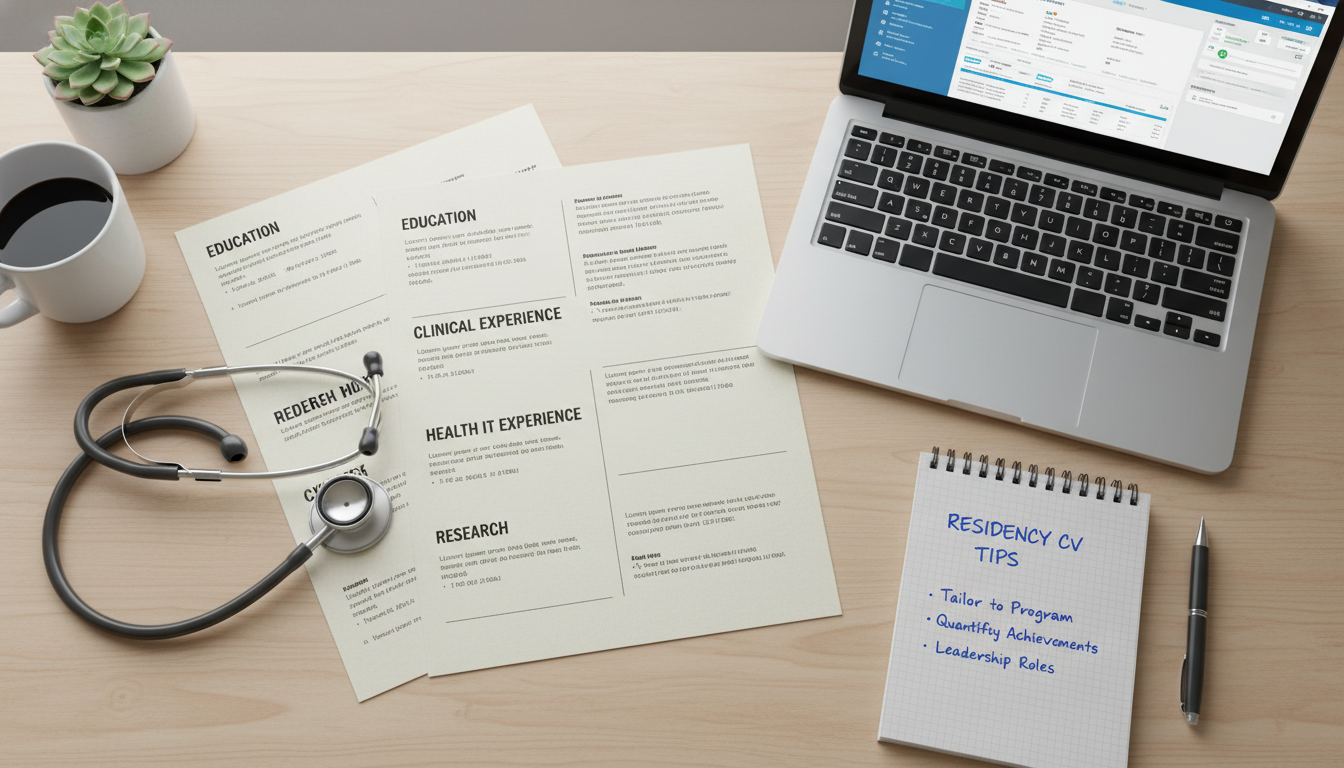
Below is a recommended structure for an IMG residency guide–style CV, customized for those aiming at clinical informatics. Adapt the order slightly depending on your strengths, but maintain a coherent flow.
- Contact Information
- Education
- Medical Licensure and Certifications (if any)
- Clinical Experience
- Health IT / Clinical Informatics Experience
- Research and Scholarly Activities
- Teaching and Leadership Experience
- Quality Improvement and Patient Safety Projects
- Skills (Technical, Language, Other)
- Awards and Honors
- Professional Memberships
- Volunteer Experience
1. Contact Information
Keep this brief and professional, at the top of the first page:
- Full name (as used on official documents)
- Phone
- Professional email (e.g., firstname.lastname@…)
- City, state (U.S. location if currently in the U.S.)
- LinkedIn profile (optional but recommended if updated and professional)
Avoid including:
- Photo
- Age, marital status, nationality, or immigration status
(these are not expected and may create bias)
2. Education
List in reverse chronological order:
- Degree (e.g., MD, MBBS, BSc, MPH, MSc in Health Informatics)
- Institution, city, country
- Dates (month/year – month/year)
- Brief notes if needed to translate the context:
- “5-year medical program equivalent to U.S. MD”
- “Graduated in top 10% of class”
If you have formal health IT training—such as a master’s in clinical informatics, biomedical informatics, or public health with informatics concentration—place it prominently and describe relevant coursework:
- Clinical decision support systems
- Database management and SQL
- EHR implementation
- Health data analytics, machine learning
- Interoperability and standards (HL7, FHIR)
This is especially valuable when applying for a clinical informatics fellowship or for residency programs with strong informatics tracks.
Showcasing Clinical Experience as an IMG
For an international medical graduate, clinical credibility is the base on which your informatics narrative rests. This section must be polished and tailored to U.S. expectations.
3. Clinical Experience
Organize into subheadings where helpful:
- Internship / House Job
- Residency-equivalent Training (if done abroad)
- U.S. Clinical Experience (USCE)
- Other Clinical Roles (e.g., medical officer, GP, hospitalist)
For each role, include:
- Position title (translated to U.S.-equivalent terms where appropriate)
- Institution name, city, country
- Dates
- Specialty (Internal Medicine, Surgery, etc.)
- Brief, focused bullet points
Use bullet points to highlight:
- Scope of responsibilities
- “Managed 15–20 inpatients per day under supervision”
- “Performed and documented complete histories and physicals”
- Systems and workflows
- “Used hospital EHR for order entry and documentation”
- “Participated in multidisciplinary rounds including nursing, pharmacy, social work”
- Quality and safety responsibilities
- “Assisted with sepsis protocol implementation”
- “Participated in mortality and morbidity (M&M) reviews”
Emphasizing U.S. Clinical Experience (USCE)
USCE is particularly valuable for residency in any specialty and shows you can function in the U.S. healthcare environment. If you have:
- Observerships
- Externships
- Sub-internships
- Research with clinical shadowing
List them clearly as separate entries, making the setting and your role obvious.
Example:
Clinical Extern, Internal Medicine
ABC Medical Center, New York, NY, USA | 05/2024 – 08/2024
- Conducted supervised patient interviews and physical exams; presented cases during team rounds
- Entered notes in the EHR under supervision, learning U.S. documentation standards and billing codes
- Assisted with a small QI project to improve medication reconciliation accuracy at admission
Highlight any exposure to:
- EHR use
- Clinical decision support tools
- Order sets and protocols
- Multidisciplinary teamwork
These are all stepping stones to clinical informatics.
Making Informatics Your Differentiator
This is where your CV should stand out from a typical applicant. Whether you are targeting residency or a dedicated clinical informatics fellowship, you want a distinct section that organizes and highlights your health IT and informatics achievements.
4. Health IT / Clinical Informatics Experience
Create a dedicated header (e.g., “Clinical Informatics & Health IT Experience”) even if you have only a few relevant entries. This signals your direction and interest immediately.
Include:
- Job titles (e.g., Clinical Informatics Intern, Health IT Associate, Data Analyst, EHR Superuser)
- Fellowship or certificate programs
- Major projects, even if done as a student or volunteer
For each, include:
- Role
- Institution / organization
- Dates
- Concise bullet points focusing on tools, methods, and impact
Examples of Strong Bullet Points
- “Collaborated with IT and nursing to design and pilot a new EHR order set for sepsis management, reducing order entry time by 30% in a 3-month pilot.”
- “Developed a dashboard in Tableau to monitor ED wait times and left-without-being-seen rate; contributed to a 12% reduction over 6 months.”
- “Assisted in mapping ICD-10 codes to problem lists for a population health registry of diabetic patients.”
Use numbers whenever possible: percent changes, number of patients, size of dataset, duration of project.
5. Clinical Informatics Fellowship-Related Content
If you are applying specifically to a clinical informatics fellowship, program directors expect to see:
- A primary clinical specialty (e.g., IM, Pediatrics, FM, EM, Anesthesiology, Pathology) established or in progress
- Documented participation in:
- EHR optimization
- Quality improvement projects with IT components
- Data analysis related to patient care
- Workflow redesign
Your CV should connect your clinical experiences to informatics projects:
“As an internal medicine resident, I noticed frequent duplicate orders and worked with the informatics team to adjust order sets, reducing duplicates by 18%.”
These cross-linkages are powerful; they tell a coherent story that you don’t just like technology, you use it to solve real clinical problems.
Leveraging Research, Projects, and Technical Skills
6. Research and Scholarly Activities
For a CV targeting clinical informatics, this section can greatly strengthen your profile, especially if you lack extensive formal health IT training.
Include:
- Peer-reviewed articles
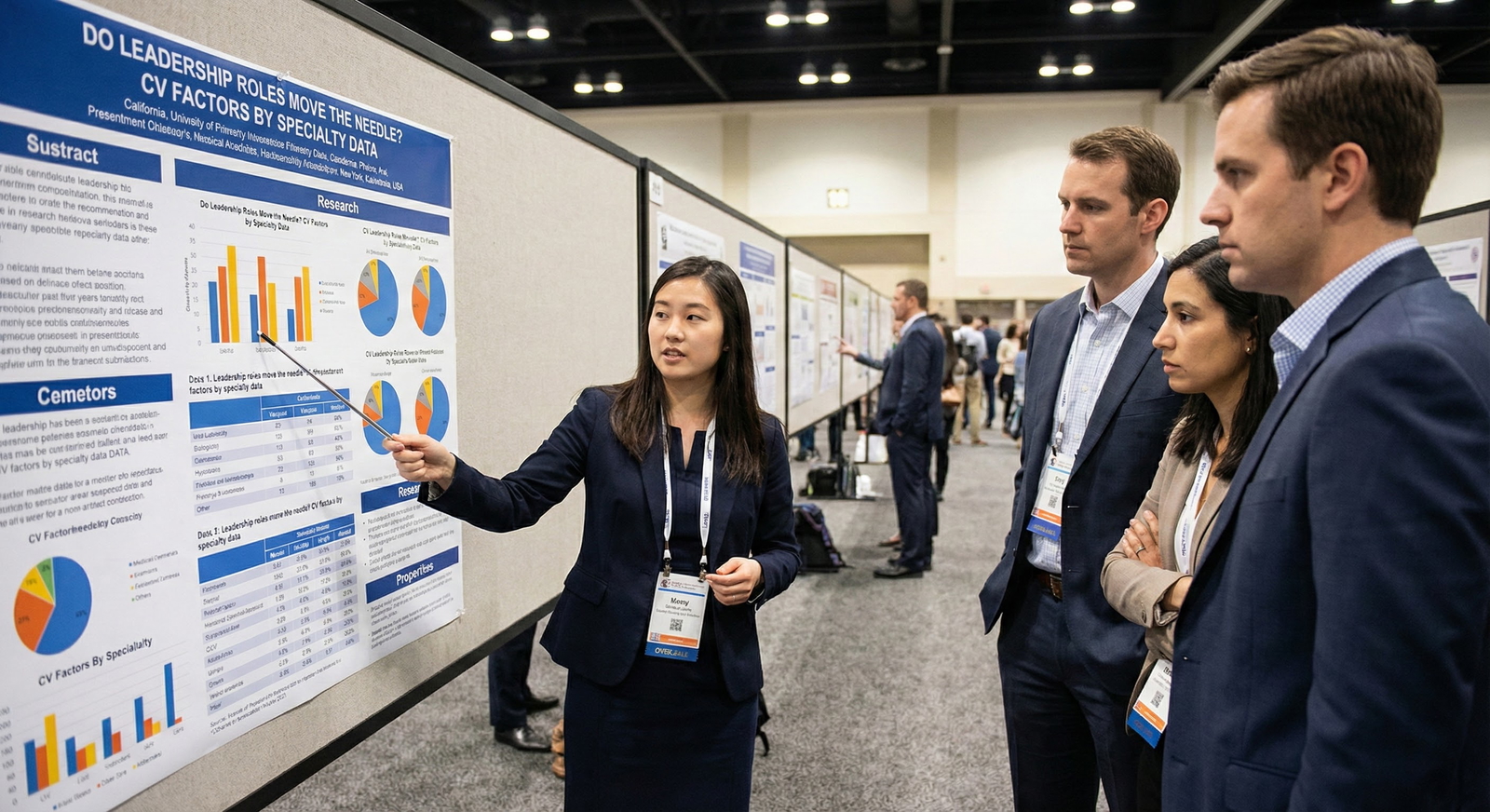
- Conference abstracts/posters
- Oral presentations
- Book chapters or invited talks
- Significant non-published projects (label as “Working manuscript” or “Project” clearly)
Format publications in a consistent citation style (e.g., AMA or Vancouver). Emphasize topics such as:
- EHR implementation or optimization
- Data analytics, predictive modeling, machine learning in healthcare
- Telemedicine or digital health
- Clinical decision support tools
- Workflow or process improvement
Example entry:
Smith J, Kumar R, Chen L. Implementation of an EHR-based sepsis alert and its effect on time-to-antibiotics in a community hospital. J Hosp Med. 2023;18(2):110–117.
For posters or presentations:
- Title
- Authors (underline your name or bold it)
- Conference name, location, date
- Poster vs. oral presentation
If your research is not yet published but highly relevant, you may list under “Research Projects”:
“Design and evaluation of a rule-based clinical decision support system for antibiotic stewardship in a tertiary hospital in India. Role: data extraction, rules specification, pilot evaluation.”
7. Quality Improvement and Patient Safety Projects
Because QI sits at the intersection of care and systems, this section is particularly relevant to clinical informatics.
Include:
- Title or short descriptive name of the project
- Institution and dates
- Your role
- Tools used (EHR data, dashboards, process maps, PDSA cycles)
- Outcomes with any measurable impact
Example:
Improving Medication Reconciliation Completeness on Admission
XYZ Hospital, Karachi, Pakistan | 01/2022 – 06/2022
- Collected baseline data from EHR and paper charts showing 62% completeness
- Helped design a standardized medication history template in the EHR
- After 3 PDSA cycles, increased completeness to 87%; results presented at hospital quality council
This is precisely the type of concrete example that makes your CV compelling to both residency and clinical informatics fellowship programs.
8. Technical and Data Skills
Since this is an IMG residency guide tailored to informatics, the skills section is critical. Avoid listing every technology you’ve ever seen; instead, highlight tools and skills you can actually use, and group them by category.
Example Skills Section:
Technical Skills
- Programming: Python (pandas, NumPy), R (tidyverse), basic SQL
- Data Tools: Excel (advanced), Tableau, Power BI
- EHR Systems: Epic (basic documentation and order entry), Cerner (familiar), local in-house EHR
- Standards / Concepts: ICD-10, SNOMED CT (basic knowledge), HL7 and FHIR (introductory familiarity)
Language Skills
- English (fluent), Spanish (intermediate), Hindi (native)
For residency CV tips in this area:
- Only include programming languages if you can demonstrate at least practical, project-level competence.
- For each skill, be prepared to discuss real examples where you used it (e.g., a small Python script to clean a dataset).
Tailoring Your CV for Residency vs. Clinical Informatics Fellowship
9. How to Build CV for Residency (with Informatics Interests)
When your immediate target is residency (e.g., in Internal Medicine, Family Medicine, Pediatrics, EM), but you have a long-term goal of a clinical informatics fellowship:
- Lead with clinical and educational strength:
- Medical school, exam scores (on ERAS application), clinical experiences.
- Embed informatics throughout:
- Mention informatics-oriented projects in clinical and research sections.
- Add an “Interests: Clinical Informatics, Quality Improvement, Health IT Innovation” line near the end.
- Don’t overshadow your clinical readiness:
- Avoid making your CV look like you are more IT than clinician; emphasize that you want to be a clinician who uses informatics to improve care.
Actionable example:
- Under Internal Medicine observership:
“Assisted with implementation of a best practice alert for CKD patients; participated in provider feedback sessions, contributing to alert tuning.”
10. Optimizing a CV for a Clinical Informatics Fellowship Application
If you’re applying after or during a primary residency:
- Explicitly identify your clinical specialty and PGY level.
- Move “Clinical Informatics & Health IT Experience” higher in the CV, just after Clinical Experience or even directly after Education, depending on its strength.
- Emphasize:
- EHR-related committees (e.g., order set committee, documentation improvement team)
- Analytics projects
- Cross-functional work with IT, nursing, administration
- Teaching others how to use technology
A clinical informatics fellowship director will scan your CV for:
- Continuous involvement in informatics during residency
- Clear evidence that you can function as a bridge between clinicians and IT
- Proof of curiosity about data, systems, usability, and workflow
Make their job easy.
Common IMG Pitfalls and How to Avoid Them
11. Overcrowded CV with Unfiltered Information
Many IMGs list every job, rotation, or short experience. This dilutes the power of your key achievements.
- Aim for 2–4 bullet points per significant role.
- Combine very short or similar experiences if they add little distinct value.
- Focus on what supports your current goal (residency or fellowship in informatics).
12. Non-U.S. Terminology and Unclear Roles
Translate roles into terms that U.S. program directors understand:
- “House Officer” → “Intern (rotating internship)”
- “Senior House Officer” → “Resident equivalent” (only if appropriate and accurate)
- “Medical Officer” → “General Practitioner / Staff Physician” as context-appropriate
Include brief clarifications instead of assuming familiarity with your local system.
13. Long Unexplained Gaps
If you had periods focused on exam preparation, family responsibilities, or non-clinical work (e.g., IT job), don’t leave them blank. Instead, create:
- “Non-clinical Experience”
- “Professional Development Period”
- “Health IT Experience”
and clearly indicate what you were doing, especially if it strengthens your clinical informatics profile (such as programming courses or data analyst roles).
14. Generic, Non-Impactful Bullet Points
Avoid bullets like:
- “Worked in a busy hospital.”
- “Used computers to document patient care.”
- “Attended rounds and clinics.”
Instead, specify:
- “Documented >150 inpatient encounters using Epic EHR; became informal resource for peers learning note templates.”
- “Analyzed 300+ ED visits for chest pain to identify delays in troponin testing; findings informed new order set in EHR.”
Final Polishing: Formatting, Length, and Consistency
Length
- For residency: 2–3 pages is typical and acceptable.
- For clinical informatics fellowship, with more experience, 3–4 pages may be reasonable.
Avoid extremely long CVs (7–10 pages) unless you have extensive published research; even then, consider a separate publications list.
Formatting
- Use a clean, professional font (e.g., 10–12 pt).
- Consistent use of:
- Bold for institutions or role titles
- Italics for journal names
- Uniform date format (MM/YYYY – MM/YYYY)
- Adequate white space; avoid dense blocks of text.
Alignment with Application Systems
Remember that your ERAS application (for residency) or specialty-specific application may ask for similar information in different fields. Your CV should:
- Mirror the same dates, titles, and descriptions you use in ERAS or in a fellowship application portal.
- Serve as a cohesive narrative that aligns with your personal statement, letters of recommendation, and interview answers.
FAQ: CV Building for IMGs in Clinical Informatics
1. How is a medical student CV different from a residency CV for an IMG interested in informatics?
A medical student CV is more exploratory and may emphasize coursework, early research, and brief experiences. A residency CV must be more focused and outcome-oriented, highlighting clinical readiness and substantial projects. For IMGs aiming at clinical informatics, a medical student CV might show early interest (e.g., informatics electives, basic research), while a residency CV must show clear, applied experiences with health IT, EHRs, or data analysis, even if modest.
2. Should I list basic computer skills like Microsoft Word or PowerPoint on my CV?
In most cases, no. These are assumed. Instead, highlight skills that matter for health IT training and informatics: SQL, Python, R, Tableau, experience with EHR systems, familiarity with HL7/FHIR, or applied data analytics. Only list tools you can meaningfully discuss and have used in real projects.
3. I have no formal health informatics degree. Can I still build a strong clinical informatics profile as an IMG?
Yes. Many successful clinical informatics fellows and informatics-focused residents do not have formal informatics degrees. Focus on:
- Leading or participating in EHR optimization or QI projects
- Learning practical analytics skills (e.g., Excel, SQL, Python/R) through courses and projects
- Engaging in research involving clinical data or digital tools
Document these clearly on your CV with specific roles, tools, and measurable impact.
4. How can I show ongoing commitment to clinical informatics on my CV?
Demonstrate continuity over years:
- Multiple projects or roles that involve EHRs, analytics, or workflow changes
- Membership in organizations like AMIA or digital health interest groups
- Progressive complexity in your work—from simple data extraction to designing decision support, for example
- Consistent mention of clinical informatics in your interests, personal statement, and during interviews, backed by concrete experiences listed in your CV.
By intentionally organizing your clinical, informatics, research, and technical experiences, you can transform a standard IMG CV into a compelling story of a future clinical informatics leader. Whether your next step is residency or a clinical informatics fellowship, use your CV not just as a record, but as strategic evidence that you are ready to connect medicine, data, and technology to improve patient care.