Understanding the CV Needs of an IMG Applying to Preliminary Surgery
As an international medical graduate (IMG) aiming for a preliminary surgery year, your curriculum vitae (CV) is more than a summary of your history—it is a strategic tool to communicate “I can succeed in a US surgical training environment.” This IMG residency guide will walk you through how to build a CV for residency that speaks specifically to prelim surgery programs.
A preliminary surgery residency spot is different from a categorical position:
- Preliminary (prelim) surgery year: 1-year position, often used by:
- Future applicants to categorical general surgery
- Applicants aiming for other specialties (e.g., radiology, anesthesia, urology) that require a surgical intern year
- IMGs trying to gain US clinical experience and a foothold in the US system
Program directors reviewing applicants for a prelim surgery year often look for:
- Evidence of work ethic and resilience in demanding environments
- Hands-on clinical experience, particularly in acute care or surgical settings
- Ability to function in a team and follow protocols
- Adaptability to US healthcare, especially for IMGs
- Professionalism and communication, including written documentation skills
Your CV must therefore highlight:
- Clinical readiness for a fast-paced surgical environment
- Progress toward integration into US medicine (USMLE, USCE, etc.)
- Clear, logical presentation and impeccable professionalism
The rest of this article will break down each section of the medical student CV / early career CV and show you step-by-step residency CV tips tailored specifically to IMGs pursuing preliminary surgery.
Core Principles of a Strong Preliminary Surgery CV for IMGs
Before diving into sections, understand the principles that distinguish a strong IMG residency guide–style CV from a generic one.
1. Clarity and Structure Over “Flashiness”
Program directors often read hundreds of CVs. They prefer:
- Clean, consistent fonts (e.g., Arial, Calibri, Times New Roman 10–12 pt)
- Clear headings and bullet points
- Reverse chronological organization (most recent experience first)
Avoid:
- Fancy colors or graphics
- Long paragraphs
- Unusual fonts or inconsistent formatting
2. US-Style Content and Conventions
As an IMG, you may come from a system where CVs include personal details not used in the US. For a US residency CV:
Do NOT include:
- Photo (unless explicitly requested by a program—ERAS handles photos separately)
- Age, date of birth, marital status
- Religion, nationality, number of children
- National ID numbers
Do include:
- US contact information and a professional email address
- USMLE status and scores (if acceptable to disclose depending on application system rules)
- Visa status (briefly, in a suitable section—often in “Personal Information” or “Additional Information”)
3. Prioritize Relevance to Surgery
You may have diverse experiences. For a prelim surgery residency application, prioritize:
- Surgical or acute care rotations
- Emergency, ICU, trauma-related experiences
- Operating room exposure, procedural experience (as appropriate for a student/graduate)
- Relevant research (surgical outcomes, critical care, etc.)
Less relevant experiences can still be listed, but place them lower and keep them concise.

Section-by-Section Guide: How to Build CV for Residency in Preliminary Surgery
This section gives a detailed breakdown of each component, with practical residency CV tips and examples tailored to international medical graduates.
Contact Information and Header
Place at the top in a clear, simple format.
Include:
- Full name (as it appears on official documents)
- Current address (US address if available; if abroad, indicate city and country)
- Phone number (with country code if non-US)
- Professional email: e.g., firstname.lastname.md@gmail.com
- LinkedIn profile (optional but recommended if well-maintained)
Example:
Ahmed Karim, MD
Los Angeles, CA 90024 | +1 (555) 123-4567
ahmed.karim.md@gmail.com | LinkedIn: linkedin.com/in/ahmedkarimmd
Avoid adding titles like “Dr.” in the name field; “MD” or equivalent can follow your name.
Professional Summary (Optional but Valuable for IMGs)
A 2–3 line professional summary can be extremely helpful for IMGs who may have a complex background. This is not mandatory but recommended when your path is not straightforward.
Good for:
- Highlighting that you are an IMG actively transitioning into US clinical practice
- Emphasizing surgical interest and relevant strengths
Example Professional Summary for Prelim Surgery IMG:
International medical graduate with strong clinical foundation in general surgery and trauma care, US clinical experience in acute care surgery, and a record of reliability in high-acuity settings. Seeking a preliminary surgery position to further develop operative and perioperative skills while contributing to high-quality patient care.
Keep this concise and targeted to preliminary surgery.
Education Section
For an IMG residency guide, education is a cornerstone. List:
- Medical school
- Prior degrees (bachelor’s, masters, if applicable)
- Graduation date or expected graduation date
Use reverse chronological order (most recent first).
Example Format:
Doctor of Medicine (MD equivalent)
University of XYZ Faculty of Medicine, City, Country
2015 – 2021
- Graduated with Honors (Top 10% of class)
- Thesis: “Short-Term Outcomes After Emergency Laparotomy in Resource-Limited Settings”
If your medical school grading or structure is unfamiliar to US readers, briefly clarify:
- Convert percentages into approximate class rank when possible (e.g., “Top 15%”).
- If your program is 6-year combined undergrad-med, state that clearly.
Tip for IMGs: If you had surgery-related honors, scholarships, or distinctions, list them as sub-bullets under education or in a separate “Honors & Awards” section.
USMLE and Licensure Information
For residency applications, it’s best to create a dedicated “Examinations & Certifications” or “Licensure & Exams” section.
Include:
- USMLE Step 1: pass status and date (and score if appropriate in your context)
- USMLE Step 2 CK: score and date
- USMLE Step 3 (if taken)
- ECFMG certification status (very important for IMGs)
Example:
Licensure & Examinations
- USMLE Step 1 – Pass, January 2022
- USMLE Step 2 CK – 245, October 2022
- USMLE Step 3 – Scheduled for March 2025
- ECFMG Certified, November 2023
For preliminary surgery programs, strong Step 2 CK performance and ECFMG certification are especially important. Make this section easy to find.
Clinical Experience: Core of the Prelim Surgery CV
For an international medical graduate applying to a preliminary surgery residency, this is arguably the most critical section.
Divide clinical experience into:
- US Clinical Experience (USCE) – Observerships, externships, sub-internships, clerkships, hands-on roles
- International Clinical Experience – Your core medical school rotations, internships, and post-graduate year(s) abroad
1. US Clinical Experience (Highly Valuable for IMGs)
Label this clearly: “US Clinical Experience” or “US Clinical Rotations”.
For each entry, include:
- Role (e.g., Visiting Medical Student, Clinical Extern, Surgical Sub-Intern)
- Institution, City, State
- Department and dates
- Bullet points emphasizing responsibilities and skills transferable to a surgical intern role
Example:
Visiting Medical Student, General Surgery Sub-Internship
ABC University Hospital, Department of Surgery, Boston, MA
August – September 2023
- Actively participated in pre-operative and post-operative care of 15–20 inpatients daily under supervision
- Assisted in the OR with retracting, suturing skin, and procedural preparation for laparoscopic cholecystectomy and hernia repairs
- Wrote daily progress notes and presented patients during morning rounds
- Collaborated with residents and nurses to coordinate discharge planning and follow-up
Emphasize:
- Team-based care
- Communication
- Documentation
- Understanding of US hospital workflows
These demonstrate readiness for a prelim surgery year.
2. International Clinical Experience
For your home-country rotations and internships, especially surgery and trauma:
Example:
Intern, General Surgery and Trauma Rotation
XYZ Teaching Hospital, City, Country
July – December 2021
- Managed pre- and post-operative care for patients undergoing emergency and elective procedures (e.g., appendectomy, bowel obstruction, wound debridement)
- Performed focused physical exams, wrote admission notes, and assisted in minor procedures under supervision
- Participated in daily ward rounds and emergency call duties (8–10 calls/month)
Avoid listing every single rotation if space is tight; instead, highlight those most relevant to surgery, ICU, emergency medicine, and procedural care.
Research Experience (Including Quality Improvement)
Not all prelim surgery applicants must have strong research backgrounds, but research can distinguish an IMG. Especially valued:
- Surgical outcomes research
- Trauma or critical care projects
- Quality improvement in perioperative care
Create a section titled “Research Experience” or “Research & Quality Improvement”.
For each project:
- Role (Research Assistant, Co-Investigator, etc.)
- Institution and department
- Dates
- Brief project description
- Skills and contributions (data collection, statistical analysis, manuscript writing, etc.)
Example:
Research Assistant, Acute Care Surgery Outcomes
ABC University Hospital, Division of Trauma & Acute Care Surgery, Boston, MA
January – August 2023
- Collected and managed data on postoperative complications after emergent laparotomies (n=250)
- Assisted with statistical analysis using SPSS and preparation of abstracts for national conferences
- Co-authored one manuscript currently under peer review
If you lack traditional research, emphasize quality improvement (QI):
Quality Improvement Intern
XYZ Hospital, General Surgery Department
March – June 2022
- Conducted chart review to identify delays in preoperative antibiotic administration
- Helped develop standardized order sets, contributing to a 15% improvement in antibiotic timing within six months
This still shows analytical thinking and contributions to system improvement—valuable for a prelim surgery residency.
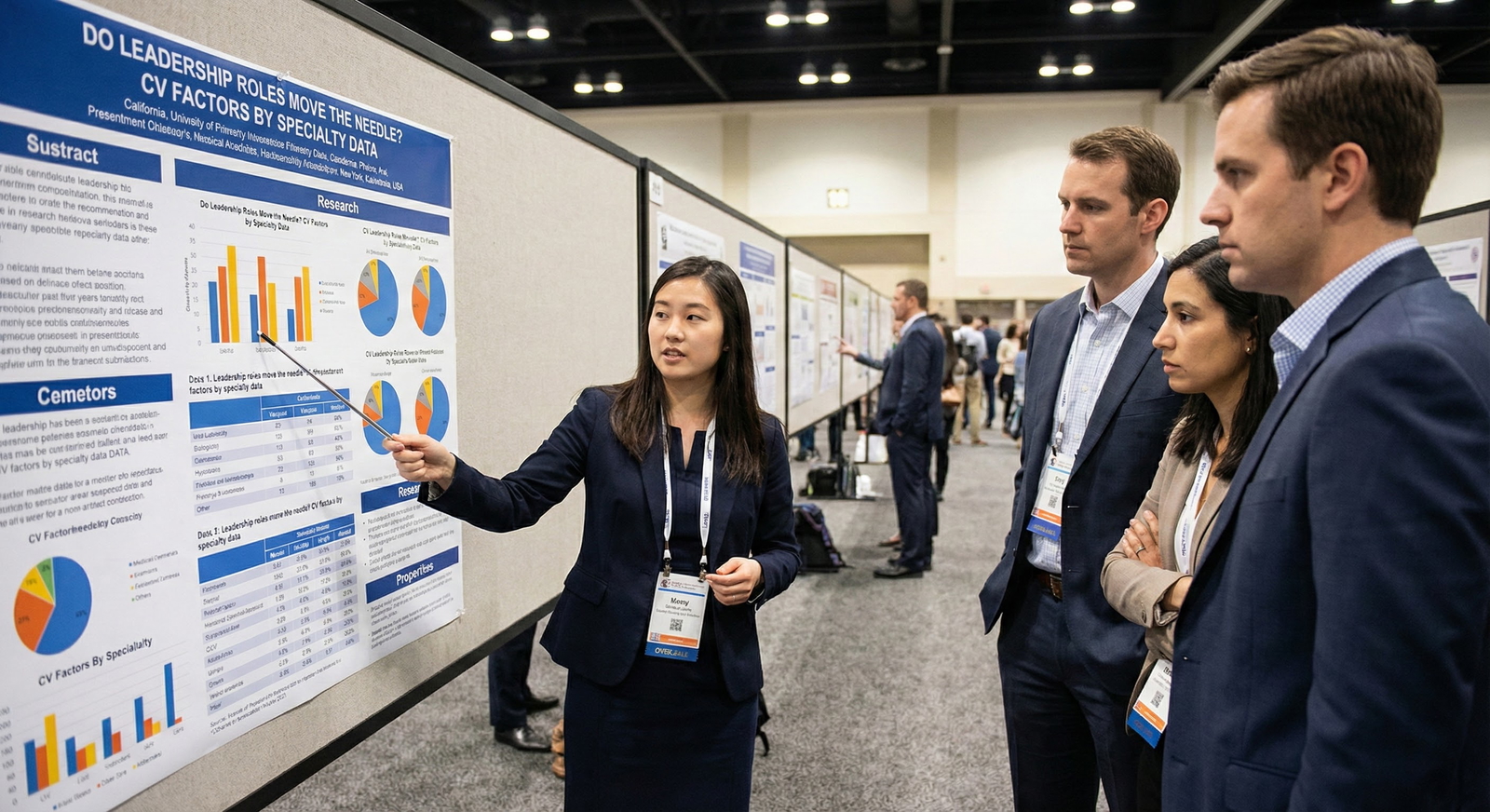
Publications, Presentations, and Posters
Keep this a separate section if you have any scholarly output. This is a core piece of a competitive medical student CV.
Organize subheadings:
- Peer-Reviewed Publications
- Abstracts & Posters
- Oral Presentations
Use standard citation style (e.g., AMA). Indicate if an item is:
- Published
- In press
- Accepted for presentation
- Submitted (only if meaningful; do not list every unreviewed draft)
Example:
Peer-Reviewed Publications
- Karim A, Patel R, et al. Early predictors of postoperative sepsis following emergency laparotomy. Journal of Surgical Outcomes. 2023;12(3):145–152.
Poster Presentations
- Karim A, et al. “Preoperative Delays in Emergency Abdominal Surgery in a Resource-Limited Setting.” Presented at: American College of Surgeons Clinical Congress; October 2023; San Francisco, CA.
For a prelim surgery application, even one or two surgical-related abstracts can support your commitment to the field.

Leadership, Teaching, and Volunteer Activities: Showing You’re More Than Just Clinical
Prelim surgery interns must work effectively within a team, supervise students, and contribute to hospital systems. Your CV should give evidence that you can do this.
Leadership Roles
Create a section titled “Leadership & Activities” or “Leadership Experience.”
Examples relevant to an IMG and prelim surgery:
- Class representative or student society officer
- Organizer of surgical interest group activities
- Coordinator of clinical skills workshops or journal clubs
Example:
President, Surgical Society
University of XYZ Faculty of Medicine
2019 – 2020
- Organized monthly surgical skills workshops (suturing, knot-tying) for 50–70 students
- Coordinated lectures with visiting surgeons on trauma and emergency surgery
- Led a student team to organize an annual surgery career day with 200+ attendees
Such activities suggest initiative and interest in teaching and teamwork.
Teaching Experience
Even as a student or recent graduate, you may have:
- Tutored junior students
- Led anatomy or clinical skills sessions
- Given presentations to peers
Include a “Teaching Experience” subsection if you have multiple roles, or fold these bullets under leadership.
Example:
Clinical Skills Tutor
XYZ Faculty of Medicine
2018 – 2019
- Taught physical examination techniques and basic surgical knot-tying to pre-clinical students in small groups
- Received positive anonymous feedback (average rating 4.7/5)
Preliminary surgery programs appreciate residents who can help educate younger learners.
Volunteer and Community Service
Volunteering demonstrates compassion, cultural competence, and commitment beyond self-interest—important qualities in any residency.
Prioritize:
- Healthcare-related service (free clinics, health fairs, surgical camps)
- Activities that show comfort working with diverse or underserved populations
Example:
Volunteer Physician Assistant (Unlicensed Role / Medical Graduate)
Free Community Health Clinic, City, Country
January – June 2022
- Assisted attending physicians with triage, basic wound care, and patient education for low-income families
- Provided counseling on postoperative wound care for minor surgical procedures
Be transparent about your role. Avoid over-stating responsibilities.
Technical Skills, Languages, and Additional Strengths
This part of your medical student CV can support your readiness for a busy, high-acuity prelim surgery year.
Clinical and Technical Skills
List skills that are appropriate to your training level and within your scope.
Examples:
- Phlebotomy, IV insertion (if genuinely performed independently in your training)
- Basic suturing, wound care, abscess incision and drainage (under supervision)
- Foley catheter placement, nasogastric tube placement (under supervision)
Phrase carefully:
- “Performed under supervision” for procedures as a student/graduate
- Avoid implying independent practice beyond your credentials
Example:
Clinical Skills
- Basic surgical skills: instrument handling, simple interrupted and mattress sutures (under supervision)
- Inpatient care: writing daily progress notes, order entry under supervision, perioperative counseling
- Familiarity with EMR systems: Epic (observer-level), Cerner
Languages
As an IMG, your multilingual ability is an asset, especially in diverse US communities.
Example:
Languages
- English – Fluent (IELTS 8.0 / TOEFL 110, if applicable)
- Arabic – Native
- Spanish – Conversational
Listing standardized test scores for language is helpful if English is not your first language and you have strong scores.
Certifications and Courses
Add relevant items:
- BLS, ACLS, ATLS (if completed or scheduled)
- Surgical skills workshops (e.g., ATLS, basic laparoscopy workshops)
Example:
Certifications & Courses
- Basic Life Support (BLS), American Heart Association, valid through 2026
- Advanced Cardiac Life Support (ACLS), valid through 2026
- Trauma Course for Medical Students, XYZ Surgical Association, 2022
These support your suitability for an acute surgical environment.
Formatting, Common Mistakes, and Strategic Tips for IMGs
Beyond content, presentation can make or break your CV. Here’s how to polish it for maximum impact in the residency match and applications phase.
Formatting Essentials
- Length: For most IMG residency applications, 2–3 pages is appropriate. Avoid more than 4 pages unless you have extensive publications.
- Consistency:
- Same date format throughout (e.g., “Jan 2022 – Mar 2023”)
- Same bullet style
- Same font and size
Use clear H2-style headings (Education, Clinical Experience, Research, etc.), and allow enough white space to keep it readable.
Tailoring Specifically for Preliminary Surgery
To align your CV with prelim surgery expectations:
- Place surgical and acute care experiences first within their sections
- Highlight call responsibilities, night shifts, or high-acuity work
- Emphasize comfort in fast-paced, procedure-heavy environments
- Connect research or QI projects back to surgery or perioperative care when possible
Example bullet transformation:
- Weak: “Completed internal medicine rotation with exposure to many cases.”
- Strong: “Managed 10–15 inpatients daily on a high-acuity internal medicine service, coordinating care for sepsis, GI bleeding, and preoperative optimization for surgical candidates.”
The strong version connects medicine to perioperative and acute care relevance.
Common IMG Mistakes to Avoid
Overloading with non-relevant details
- Long lists of unrelated conferences or minor activities dilute impact.
- Focus on quality and relevance to surgery and residency work.
Inflating roles
- Program directors are familiar with typical responsibilities of students and IMGs in various systems.
- Be honest; overstatement can hurt credibility.
Using non-US CV norms
- Remove personal photos, marital status, and unrelated personal info.
- Adapt to US expectations for a professional medical CV.
Poor English / grammatical errors
- As an international medical graduate, language quality is scrutinized.
- Have your CV reviewed by a native/fluent English speaker (ideally someone familiar with US residency).
Inconsistent dates or gaps not explained
- If there’s a gap in training, briefly account for it in bullet points or in your personal statement (e.g., research year, immigration process, exam preparation).
Using Your CV Alongside ERAS
In the US, many programs rely heavily on the ERAS application format. However:
- A well-structured CV is still important for:
- Emailing faculty when requesting observerships, research roles, or letters of recommendation
- Networking at conferences
- Supplementary materials some programs may request
Ensure the information on your CV matches what you submit in ERAS (dates, titles, responsibilities).
FAQs: CV Building for IMG Preliminary Surgery Applicants
1. How is a prelim surgery residency CV different from a categorical surgery CV?
The structure is similar, but emphasis differs slightly:
- Prelim surgery programs may prioritize:
- Clinical reliability and readiness for hard work
- Ability to support surgical services (ward, OR, night float)
- Flexibility and teamwork, since prelim positions sometimes support multiple services
- Your CV should demonstrate that, even if you ultimately plan a different specialty, you are fully committed to performing well in a surgical intern role.
2. Should I mention that I’m ultimately interested in another specialty (e.g., radiology, anesthesia) on my CV?
Your CV itself typically does not need to declare your ultimate specialty goal. It should read as fully supportive of surgical training. You can address broader career goals tactfully in your personal statement if needed, focusing on how a preliminary surgery year fits into your development and how you will be a dedicated, high-performing surgical intern regardless of future plans.
3. How can I make my CV competitive if I have limited surgical research?
You can still build a strong residency CV by:
- Highlighting any clinical work in high-acuity or operative settings
- Emphasizing quality improvement projects (e.g., perioperative care, infection control) even if not formal research
- Attending and presenting at local or regional conferences, even with case reports
- Demonstrating strong US clinical experience and excellent evaluations
Research is helpful but not mandatory for many preliminary surgery programs, especially if other aspects are strong.
4. Is it acceptable to include non-medical jobs or experiences on my prelim surgery CV?
Yes, if they:
- Demonstrate work ethic, leadership, or resilience
- Show skills transferable to medicine (teamwork, customer service, management)
Place them in a section such as “Additional Experience”, and keep bullets concise. For example, working night shifts, managing a team, or handling high-pressure situations can support your narrative as someone ready for challenging surgical intern duties.
By applying these structured residency CV tips and tailoring your content to the expectations of preliminary surgery programs, you can transform your background as an international medical graduate into a compelling, US-style residency document. Focus on clarity, honesty, and relevance to surgical training—and ensure every section of your CV answers the key question for the reader: “Can this applicant safely and reliably function as a surgical intern in my program?”