Understanding the Role of Your CV in the Family Medicine Match
Your CV is the backbone of your residency application. For an international medical graduate (IMG) targeting family medicine residency in the U.S. or Canada, it does more than list your experiences—it tells reviewers very quickly:
- Who you are as a clinician and learner
- How you’ve prepared for family medicine specifically
- Whether you understand U.S./Canadian clinical systems
- If you’ll integrate well into a team and community-focused specialty
Program directors often skim a medical student CV or early-career CV in 30–90 seconds on first pass. Your goal is to make those seconds count: clean formatting, strategic structure, and content that screams “strong, reliable future family physician.”
This IMG residency guide will walk you step-by-step through:
- What to include (and what to leave out)
- How to structure and format your CV
- How to build missing pieces if your CV feels weak
- Tailored residency CV tips for family medicine and IMGs
Core Principles of a Strong IMG Family Medicine CV
Before diving into sections and wording, anchor your CV in these principles.
1. Clarity and Readability Over Fancy Design
Residency programs are busy. A successful CV is:
- Simple and professional – no graphics, colors, or columns that break on upload
- Consistent – same font, spacing, and date format throughout
- Scannable – clear headings, bullet points, and logical order
Aim for:
- Font: 10–12 pt (e.g., Times New Roman, Calibri, Arial)
- Margins: 0.75–1 inch
- Length: Typically 2–4 pages for IMGs (more clinical years and experiences than U.S. grads)
2. Alignment With Family Medicine Values
Family medicine programs look for:
- Breadth of clinical exposure
- Longitudinal patient care experiences
- Community engagement and advocacy
- Teamwork, communication, and cultural competence
- Interest in primary care, prevention, and continuity
Your CV should deliberately highlight:
- Primary care clinics, outpatient experiences, and continuity clinics
- Community health projects, screenings, rural/underserved rotations
- Holistic and biopsychosocial approaches in your experiences
3. Tailored for IMGs
As an international medical graduate, program directors want reassurance about:
- Clinical readiness in the U.S./Canada
- Language and communication skills
- Adaptability to new systems and culture
Show this through:
- U.S./Canadian clinical experience (USCE/CSCE)
- Strong Step/board performance (where applicable)
- Clear, jargon-free English and professional tone
- Evidence of teamwork in diverse environments
Essential Sections of an IMG Family Medicine CV
Below is a practical structure for how to build a CV for residency in family medicine. You can adjust the order slightly, but generally follow this hierarchy.
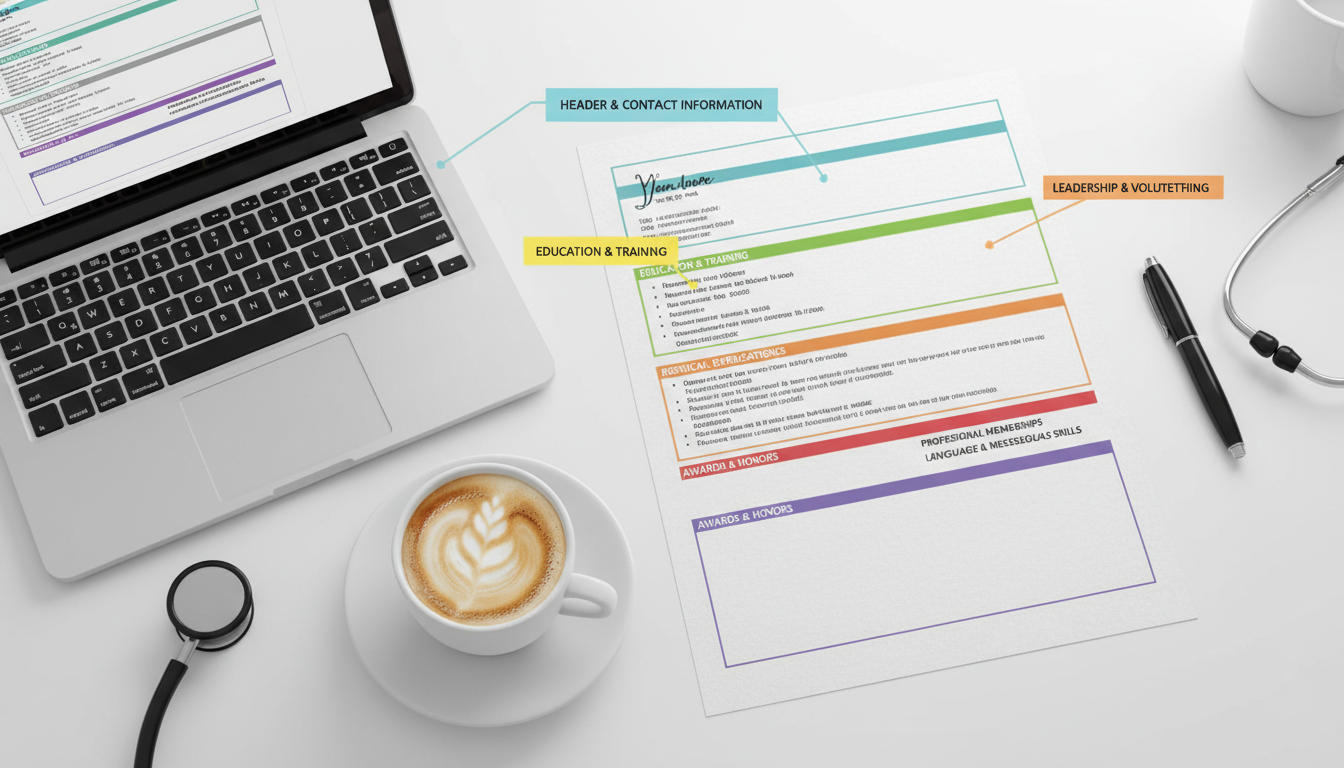
1. Header: Your Professional Identity
Include:
- Full name (bold, slightly larger font)
- Degrees (e.g., MD, MBBS, MBChB)
- Professional email (avoid nicknames)
- Phone number with country code
- City and state/province of current residence
- Optional: LinkedIn profile (only if current and professional)
Do NOT include:
- Photo (unless explicitly required by country/program)
- Marital status, religion, age, or other personal demographics
Example:
Aisha Rahman, MD
Email: aisha.rahman.md@gmail.com | Phone: +1 (555) 123-4567
Toronto, ON, Canada | LinkedIn: linkedin.com/in/aisharahmanmd
2. Education
List in reverse chronological order:
Medical School
- Institution name, city, country
- Degree (e.g., MBBS)
- Dates (month/year – month/year or expected graduation)
- Honors (e.g., “Graduated with Distinction,” “Top 10% of class” if applicable)
Postgraduate or Additional Degrees
- MPH, MSc, PhD, or relevant certificates
Undergraduate Education
- Degree, university, major (if relevant to healthcare, research, or communication)
Example Entry:
Bachelor of Medicine, Bachelor of Surgery (MBBS)
Aga Khan University, Karachi, Pakistan
09/2015 – 06/2021
- Graduated with Honors (Top 15% of class)
If your graduation is older and you’ve had a gap, address the gap elsewhere (see below) but keep the education straightforward.
3. Licensure, Exams, and Certifications
This section is crucial in any IMG residency guide.
Include, as applicable:
- USMLE Step 1, Step 2 CK, Step 3 (scores and dates, if you choose to list them)
- COMLEX scores (for DO applicants)
- LMCC, MCCQE (for Canadian applications)
- ECFMG Certification (and date)
- ACLS, BLS, PALS certifications with expiration dates
- Any local medical license/registration
Example:
Examinations & Certifications
- ECFMG Certified, 08/2024
- USMLE Step 1: Passed, 06/2022
- USMLE Step 2 CK: 245, 02/2023
- BLS & ACLS (AHA), Valid through 12/2026
If your scores are weaker, you may omit them from the CV and let ERAS/other systems report them, focusing on strengths in your experiences.
4. Clinical Experience (Core of Your Family Medicine CV)
This is the most important section for family medicine residency and often the deciding factor in your FM match prospects.
Split into subsections if you have enough content:
- U.S./Canadian Clinical Experience (USCE/CSCE)
- International Clinical Experience
- Family Medicine–Focused Experience (if extensive)
What to Include
For each entry:
- Role (e.g., Visiting Medical Student, Clinical Observer, Extern)
- Specialty and setting (e.g., Family Medicine – Outpatient Clinic)
- Institution, city, country
- Dates (month/year – month/year)
- Brief bullet points (2–5) showing what you did and what you learned or achieved
Example: Strong Family Medicine USCE Entry
Clinical Extern, Family Medicine – Outpatient & Community Clinic
Lakeview Family Medicine Residency Clinic, Chicago, IL, USA
09/2023 – 12/2023
- Participated in outpatient visits under supervision, including chronic disease management (diabetes, hypertension, COPD) and acute complaints.
- Performed focused histories and physical exams, presented cases to attending physicians, and contributed to assessment and plan.
- Educated patients on lifestyle modification, medication adherence, and preventive screenings.
- Worked with an interdisciplinary team (nurse practitioner, social worker, pharmacist) to coordinate care for high-risk patients.
Tips for IMGs
- Emphasize continuity of care, prevention, and holistic care
- Highlight communication skills (e.g., counseling, motivational interviewing, working with interpreters)
- Show experience across the lifespan (pediatrics, adult, geriatrics, women’s health)
- If you lack U.S./Canadian clinical experience, put your strongest outpatient rotations first and actively work on obtaining observerships/externships
5. Research Experience
You do not need to be a prolific researcher to be competitive in family medicine, but having some scholarly activity strengthens your application and shows curiosity and discipline.
What to Highlight
- Projects related to: primary care, quality improvement (QI), public health, chronic disease management, health disparities, mental health, or rural/underserved populations
- Your specific role (data collection, analysis, manuscript writing, patient recruitment)
- Any outcomes: abstracts, posters, presentations, publications
Example Entry:
Research Assistant – Hypertension Management in Urban Primary Care Clinics
Department of Family Medicine, University of Toronto, Toronto, ON, Canada
01/2022 – 10/2023
- Collected and analyzed data from 250+ patients on blood pressure control and adherence to follow-up.
- Assisted in designing an intervention involving nurse-led counseling and SMS reminders.
- Co-authored an abstract presented at the North American Primary Care Research Group (NAPCRG) conference.
6. Publications, Presentations, and Posters
Create separate subsections if you have multiple items; otherwise, group them.
- Use a consistent citation style (e.g., AMA or Vancouver)
- Bold your name in multi-author works
- Include status: “Published,” “In Press,” or “Submitted” (only if genuinely submitted)
Example:
Publications
Rahman A, Ali S, Khan M. Barriers to Medication Adherence in Patients with Type 2 Diabetes in a Community Health Center. J Prim Care Community Health. 2023;14:123–130.Presentations
Ali S, Rahman A. Implementing a Group Visit Model for Diabetes Education in a Low-Income Clinic. Oral Presentation, American Academy of Family Physicians (AAFP) National Conference, 2023.
7. Teaching and Leadership Experience
Family medicine programs value applicants who can:
- Educate patients, peers, and medical students
- Lead or collaborate in teams
- Organize community or clinical initiatives
Include:
- Teaching assistant roles
- Peer teaching or tutoring
- Leadership in student organizations
- Chief intern roles, committee memberships
Example Entry:
Student Coordinator – Community Health Education Program
Aga Khan University, Karachi, Pakistan
01/2020 – 12/2020
- Led a team of 12 medical students delivering monthly health education sessions on nutrition, vaccination, and maternal health in underserved neighborhoods.
- Developed culturally appropriate educational materials and evaluated participant feedback.
Make each bullet clearly linkable to skills relevant to family medicine: education, communication, cultural competency, or systems-based practice.
8. Volunteer and Community Service
This section is particularly powerful in a family medicine residency CV because it showcases:
- Commitment to underserved populations
- Preventive and community-oriented mindset
- Cultural awareness
Include:
- Health fairs, screening camps, free clinics
- Work with refugee, immigrant, or rural communities
- Long-term involvement with NGOs or community organizations
Example:
Volunteer Clinician – Free Community Health Clinic
Toronto Refugee Health Network, Toronto, ON, Canada
03/2022 – Present
- Assisted with intake, vitals, and basic health counseling for newly arrived refugees.
- Collaborated with physicians to provide continuity care for chronic illness and mental health concerns.
9. Awards, Honors, and Scholarships
This section demonstrates excellence and reliability.
Include:
- Medical school honors (e.g., distinction in Family Medicine)
- Research awards or conference prizes
- Scholarships or merit-based funding
Organize in reverse chronological order, with brief context where unclear.
Example:
Awards & Honors
- Best Student in Family Medicine Rotation, Aga Khan University, 2020
- Merit Scholarship for Academic Excellence (Top 5% of class), 2018–2020
10. Professional Memberships and Societies
List relevant organizations, especially those related to family medicine or primary care.
Examples:
- American Academy of Family Physicians (AAFP) – International Member
- College of Family Physicians of Canada (CFPC) – Student Member
- Local medical associations or specialty interest groups
Showing active membership reinforces your commitment to the specialty.
11. Skills and Additional Qualifications
This section helps you stand out and can be very important for an IMG.
Consider including:
- Languages – Mention proficiency levels: native, fluent, conversational, basic
- Clinical skills – Point-of-care ultrasound, office procedures (e.g., Pap smears, joint injections)
- Technical skills – EMR systems (Epic, Cerner), data analysis software (SPSS, R)
- Other skills – Medical writing, curriculum development
Example:
Languages: English (Fluent), Urdu (Native), Arabic (Conversational)
Technical Skills: Epic EMR, REDCap, SPSS
12. Interests (Optional but Useful)
A brief “Interests” section can humanize you and sometimes provides an interview talking point, especially in a people-centered specialty like family medicine.
Choose:
- Genuine interests (community sports, cooking, running, music, language learning)
- Activities that reflect wellness, teamwork, or commitment
Keep it to 1–2 lines.
Strategic CV Building: Filling Gaps and Strengthening Weak Areas
If your CV currently feels thin or unbalanced, this section offers practical how to build CV for residency strategies specifically for IMGs.

1. Limited U.S./Canadian Clinical Experience
If you lack USCE/CSCE:
- Target observerships and externships in family medicine clinics, FQHCs, and community health centers
- Consider short-term rotations (4–8 weeks) across different settings (rural, urban, underserved)
- Use networking: alumni from your school, LinkedIn, physician organizations, or community connections
While you search, maximize your home-country experience:
- Emphasize outpatient, continuity, and primary care aspects
- Highlight roles involving patient education and chronic disease follow-up
2. Older Graduation Year or Clinical Gap
Programs will look closely at what you’ve done since graduation.
To strengthen this:
- Engage in consistent clinical involvement: paid or volunteer roles in healthcare (clinic assistant, research coordinator, telehealth support where allowed)
- Take on structured research or QI projects with clear outputs
- Maintain certifications and exam activity (e.g., Step 3, relevant continuing education)
On your CV, present your most recent work clearly, showing ongoing engagement with medicine and patient care.
3. Limited Research
If you have little research experience:
- Join a small, focused project with a local academic clinician or department
- Participate in QI projects in clinics—these are very relevant to family medicine and often feasible within a few months
- Aim for posters or local presentations; they still demonstrate initiative and scholarly activity
Don’t wait for big publications only; smaller but completed projects look better than big ambitions with no output.
4. Weak Leadership or Teaching Experience
Strengthen these areas by:
- Volunteering to mentor junior students or IMGs preparing for exams
- Leading case discussions or journal clubs (and listing them under Teaching Experience)
- Coordinating health education sessions in clinics, schools, or community centers
Use your CV bullet points to show concrete actions and outcomes: “organized,” “developed,” “led,” “coordinated,” “implemented.”
Writing Strong Bullets and Avoiding Common IMG CV Mistakes
Your experiences must be easy to understand for reviewers who do not know your home system.
Using Action-Oriented, Outcome-Focused Bullets
Follow a simple structure:
Action verb + What you did + Why/Outcome (if possible)
Weak bullet:
- “Worked in outpatient clinic seeing patients.”
Stronger bullet:
- “Conducted supervised outpatient visits for adults with diabetes and hypertension, focusing on medication adherence and lifestyle counseling.”
Even stronger:
- “Conducted supervised outpatient visits for adults with diabetes and hypertension, improving follow-up adherence by emphasizing personalized lifestyle counseling and simplified medication schedules.”
Avoiding Jargon and Unclear Roles
Avoid local titles and abbreviations that are unfamiliar.
Instead of:
- “House Officer” or “SHO,” specify “Intern,” “Junior Resident,” or “General Practice Resident” with context.
Clarify your level of autonomy:
- “Under direct supervision, performed…”
- “As part of a team, assisted with…”
Common Mistakes IMGs Should Avoid
Overloading with personal information
- No photos, marital status, religion, or citizenship (unless explicitly required by country).
Mixing CV and personal statement
- The CV is not the place to explain motivation; keep that for your personal statement.
Inconsistent formatting
- Random fonts, bullet styles, and date formats make the CV look unprofessional.
Unverified or exaggerated experiences
- Programs may verify your experiences. Keep everything truthful and accurate.
Listing every minor workshop or short course as a separate big entry
- Group smaller courses under “Additional Training” with brief mention.
Tailoring Your CV Specifically for Family Medicine
Here is how to make your CV clearly “family medicine–oriented” for the FM match:
- Emphasize outpatient and primary care in Clinical Experience.
- Highlight rotations or experiences in:
- Pediatrics, women’s health, geriatrics, mental health
- Rural or underserved urban communities
- Bring forward community projects, preventive care initiatives, and public health work.
- Add professional memberships like AAFP or CFPC to show commitment.
- Include teaching, leadership, and community service that align with a holistic, patient-centered philosophy.
Whenever you choose which experience to put first (e.g., USCE vs. hospital rotations), ask:
“Does this entry help them see me as a future family physician?”
If not, move it lower or reframe the bullets to emphasize continuity, communication, and community aspects.
Practical Steps to Build and Maintain Your Residency CV
To keep your medical student CV or early IMG CV ready for applications:
Start Early
- Begin documenting experiences from clinical years onward.
- Collect supervisor names and contact info as you go.
Use a Master CV Document
- Maintain one long version with everything you’ve done.
- Create shorter, tailored versions for specific applications.
Review Every 3–6 Months
- Add new experiences immediately.
- Remove outdated certificates and refine bullet points.
Get Feedback
- Have mentors, advisors, or current residents review your CV.
- Ask specifically: “What parts feel weak or unclear as an IMG applying to family medicine?”
Align With Application Systems
- ERAS, CaRMS, and other systems have their own layouts.
- Use your CV as a reference to fill in these forms efficiently and consistently.
FAQs: CV Building for IMGs Applying to Family Medicine
1. How long should my CV be as an IMG applying to family medicine?
For most international medical graduates, 2–4 pages is reasonable. You often have more clinical and educational experiences than a U.S. graduate, which is acceptable. The key is relevance and clarity—do not pad your CV with unrelated or repeated content. If an experience doesn’t add value to your story as a future family physician, consider removing or shortening it.
2. Should I list my USMLE scores directly on my CV?
You may list them, but it’s not mandatory. Application systems like ERAS already capture this information. If your scores are solid or a strength of your application, listing them can be beneficial. If your scores are weaker, you can omit them from the CV and rely on the official reporting, while using your CV to emphasize your clinical skills, USCE, community work, and family medicine alignment.
3. I don’t have U.S. clinical experience. Can I still build a strong CV for family medicine?
Yes, but your CV must clearly showcase:
- Strong outpatient and primary care experience in your home country
- Community work, preventive care, and longitudinal patient relationships
- Good exam performance and ongoing medical engagement
At the same time, actively work on obtaining observerships, externships, or telehealth exposure in North America. Even short rotations, when described well, can significantly strengthen your CV and reassure programs about your adaptability to their healthcare system.
4. Do I need research to match into family medicine?
Research is helpful but not mandatory for family medicine. Many successful applicants have limited research but strong clinical, community, and leadership experiences. If you do engage in research, prioritize topics relevant to primary care, health systems, and community health. Even small QI projects or local presentations can enhance your CV and show that you think critically about patient care and system improvement.
By applying these structured residency CV tips, you’ll turn your experiences into a clear, compelling narrative of why you are ready to be a compassionate, capable, and community-focused family physician. As an international medical graduate, your diverse background is a strength; your CV is where you present it in a way that resonates with family medicine program directors and selection committees.